Perspective - (2025) Volume 15, Issue 3
Received: 01-Sep-2025, Manuscript No. jttr-25-175421;
Editor assigned: 03-Sep-2025, Pre QC No. P-175421;
Reviewed: 17-Sep-2025, QC No. Q-175421;
Revised: 22-Sep-2025, Manuscript No. R-175421;
Published:
29-Sep-2025
, DOI: 10.37421/2161-0991.2025.15.311
Citation: Leclerc, Antoine. ”Regenerative Medicine: Converging Innovations for Repair.” J Transplant Technol Res 15 (2025):311.
Copyright: © 2025 Leclerc A. This is an open-access article distributed under the terms of the Creative Commons Attribution License, which permits unrestricted use, distribution and reproduction in any medium, provided the original author and source are credited.
Regenerative medicine is a dynamic field dedicated to repairing or replacing damaged tissues and organs, integrating a wide range of scientific and technological innovations to address significant medical challenges. Mesenchymal stem cell-derived exosomes are promising cell-free therapeutics for tissue regeneration. These nanoscale vesicles carry rich cargo that facilitates intercellular communication and modulates processes crucial for tissue repair. Exosomes can promote angiogenesis, reduce inflammation, and stimulate resident stem cell proliferation, offering a versatile tool for degenerative diseases without direct cell transplantation complexities[1].
Biomaterials are foundational, with rapid advancements like 3D printing and bioactive scaffolds. These materials provide essential structural support and biochemical cues, guiding cell behavior and tissue formation. Sophisticated fabrication techniques with intelligent material design enable intricate scaffolds mimicking native tissues, leading to more effective and personalized regenerative therapies[2].
Gene therapy holds substantial promise by precisely controlling cellular functions and tissue repair. This involves modifying genetic material to correct defects or enhance therapeutic capabilities, like promoting growth factor production or modulating immune responses. Though delivery efficiency and safety remain challenges, advancements are bringing gene therapy closer to clinical application[3].
Stem cell-based therapies revolutionize ocular regenerative medicine, offering hope for blindness. Researchers explore various stem cell types, including Induced Pluripotent Stem Cells (iPSCs) and mesenchymal stem cells, to repair damaged corneal, retinal, and optic nerve tissues. These therapies aim to replace lost cells, support existing ones, and modulate the microenvironment to restore vision, with clinical trials showing significant progress[4].
Artificial Intelligence (AI) transforms regenerative medicine by accelerating discovery and analyzing complex data. AI algorithms identify therapeutic targets, optimize cell differentiation protocols, and predict material biocompatibility. This computational power streamlines research, reduces costs, and enables personalized treatment development, promising new insights and expedited translation from lab to clinic[5].
Immunomodulation is critical in regenerative medicine, as the immune system both hinders and promotes tissue repair. Strategies manipulate immune responses to create a permissive environment, reduce inflammation, prevent fibrosis, and support transplanted cells. Challenges include precise control and preventing side effects, but ongoing research offers pathways to enhance regenerative outcomes[6].
3D bioprinting transforms regenerative medicine by enabling intricate, functional tissues tailored to individual needs. This technology precisely places cells, biomaterials, and bioactive molecules in three-dimensional structures, mimicking native tissue complexity. Customizing geometries and cellular compositions overcomes traditional tissue engineering limitations, leading to more effective, personalized implants for various therapeutic applications[7].
Exosomes are emerging as a promising cell-free therapeutic for cartilage regeneration, particularly for osteoarthritis. These nanovesicles carry bioactive molecules that modulate inflammation, promote chondrocyte proliferation, and stimulate extracellular matrix synthesis. Their ability to deliver therapeutic cargo to target sites, with lower immunogenicity and easier storage, makes them compelling for innovative treatments of degenerative joint diseases[8].
The clinical translation of Induced Pluripotent Stem Cell (iPSC)-derived cells is a significant frontier. iPSCs offer an autologous source for regenerating damaged tissues without embryonic stem cell concerns. Despite hurdles like tumorigenicity and immune rejection, successful clinical trials in ocular and cardiac repair demonstrate immense potential to treat incurable conditions and restore vital functions[9].
Tissue engineering and regenerative medicine converge to repair or replace damaged tissues and organs, offering powerful alternatives to traditional treatments. Current trends integrate advanced biomaterials, sophisticated cell therapies, and bioactive signaling molecules to create functional tissue constructs. Future prospects include personalized medicine, organ-on-a-chip, and off-the-shelf regenerative products, addressing donor organ shortages and providing durable solutions[10].
Regenerative medicine aims to restore damaged tissues and organs, presenting alternatives to conventional treatments. Cell-free strategies, particularly mesenchymal stem cell-derived exosomes, are pivotal [1]. These nanoscale vesicles, laden with proteins, lipids, and nucleic acids, mediate intercellular communication and modulate processes vital for tissue repair. Exosomes promote angiogenesis, reduce inflammation, and stimulate resident stem cell proliferation, offering a versatile tool for degenerative diseases without direct cell transplantation complexities [1]. Beyond general tissue repair, exosomes are specifically explored for cartilage regeneration and osteoarthritis treatment by modulating inflammation and promoting chondrocyte activity, offering benefits of easier storage and lower immunogenicity compared to live cells [8].
Biomaterials form the bedrock of regenerative medicine, rapidly evolving with innovations like 3D printing and bioactive scaffolds [2]. These materials provide essential structural support and biochemical cues, actively guiding cell behavior and promoting tissue formation. Integrating sophisticated fabrication with intelligent material design enables intricate scaffolds that closely mimic native tissue architecture, leading to more effective and personalized regenerative therapies [2]. Notably, 3D bioprinting transforms the field by creating functional tissues and organs tailored to individual patient needs. This technology precisely places cells, biomaterials, and bioactive molecules in three-dimensional structures, overcoming traditional tissue engineering limitations and enabling personalized implants for applications such as cartilage repair and vascularized organ patches [7].
Stem cell-based therapies are revolutionizing regenerative medicine, offering significant hope for conditions like blindness. Researchers investigate diverse stem cell types, including Induced Pluripotent Stem Cells (iPSCs) and mesenchymal stem cells, to repair damaged corneal, retinal, and optic nerve tissues [4]. These therapies aim to replace lost cells, support existing ones, and modulate the microenvironment to restore vision. Significant progress, marked by ongoing clinical trials, highlights their potential to restore eyesight and prevent further vision loss [4]. The clinical translation of iPSC-derived cells is a major frontier, progressing from research to patient care. iPSCs provide an autologous source for tissue regeneration, sidestepping ethical concerns of embryonic stem cells. Despite challenges like tumorigenicity and immune rejection, successful trials in ocular and cardiac repair demonstrate their immense potential to treat previously incurable conditions [9].
Gene therapy holds substantial promise for regenerative medicine through its capacity for precise control over cellular functions and tissue repair [3]. This involves modifying genetic material within cells to correct underlying defects or enhance therapeutic capabilities, such as promoting growth factor production or modulating immune responses. While challenges in delivery efficiency and long-term safety persist, continuous advancements are moving gene therapy closer to clinical application for a range of regenerative strategies, from tissue engineering to addressing genetic disorders affecting organ function [3]. Immunomodulation is another critical aspect, acknowledging the immune system's dual role in both hindering and facilitating tissue repair [6]. Strategies here focus on manipulating immune responses to foster a permissive environment for regeneration, reducing inflammation, preventing fibrosis, and supporting transplanted cells. Research into approaches like tolerogenic scaffolds is enhancing regenerative outcomes [6].
Artificial Intelligence (AI) is rapidly transforming regenerative medicine by accelerating discovery and integrating complex data sets [5]. AI algorithms analyze vast biological information, identifying novel therapeutic targets, optimizing cell differentiation protocols, and predicting material biocompatibility. This computational power streamlines research, lowers experimental costs, and enables personalized approaches to treatment development. The synergy between AI and regenerative medicine promises to unlock new insights and expedite therapy translation from lab to clinic [5]. Ultimately, tissue engineering and regenerative medicine represent converging disciplines focused on repairing or replacing damaged tissues and organs. Future prospects include personalized medicine, organ-on-a-chip technologies for drug screening, and the development of off-the-shelf regenerative products, all vital for addressing the global shortage of donor organs and providing durable solutions for chronic diseases and injuries [10].
Regenerative medicine is undergoing rapid transformation, combining various advanced strategies to repair and replace damaged tissues and organs. One key area involves mesenchymal stem cell-derived exosomes, which act as a cell-free therapeutic approach. These nanoscale vesicles carry vital cargo that supports intercellular communication, reduces inflammation, promotes angiogenesis, and stimulates resident stem cell proliferation, offering a less complex alternative to cell transplantation. Biomaterials are fundamental, with innovations like 3D printing and bioactive scaffolds providing essential structural support and biochemical signals. These materials guide cell behavior and tissue formation, allowing for intricate structures that mimic native tissues for personalized therapies. Gene therapy holds significant promise, enabling precise control over cellular functions. By modifying genetic material, it can correct defects or boost therapeutic capabilities, such as enhancing growth factor production, moving closer to clinical applications for various disorders. Stem cell-based therapies, including those utilizing Induced Pluripotent Stem Cells (iPSCs) and mesenchymal stem cells, are making strides, particularly in ocular regenerative medicine to repair damaged corneal, retinal, and optic nerve tissues. The clinical translation of iPSC-derived cells, offering an autologous source without ethical concerns, is a major frontier, with successful trials in cardiac and ocular repair. Artificial Intelligence (AI) is bridging data and discovery in the field. AI algorithms analyze extensive biological data, identify therapeutic targets, optimize cell differentiation, and predict material biocompatibility, significantly streamlining research and enabling personalized treatment development. Immunomodulation is also crucial, focusing on strategies to manipulate immune responses to create a pro-regenerative environment, reduce inflammation, and prevent fibrosis, despite challenges in precise control. Complementing these efforts, 3D bioprinting allows for the creation of intricate, functional tissues tailored to patient needs, precisely placing cells and biomaterials to overcome limitations in traditional tissue engineering. Exosomes are specifically being explored for cartilage regeneration, particularly in osteoarthritis treatment, by modulating inflammation and promoting chondrocyte activity. Overall, the convergence of tissue engineering and regenerative medicine integrates advanced biomaterials, cell therapies, and signaling molecules, pointing towards personalized medicine, organ-on-a-chip technologies, and off-the-shelf regenerative products to address organ shortages and chronic diseases.
None
None
Yu M, Shuo L, Haolin C. "Mesenchymal Stem Cell-Derived Exosomes as a Cell-Free Therapy for Tissue Regeneration".Stem Cells Int 2023 (2023):5493032.
Indexed at, Google Scholar, Crossref
Feng C, Qiaojun H, Ting H. "Advances in Biomaterials for Regenerative Medicine: From 3D Printing to Bioactive Scaffolds".Int J Mol Sci 23 (2022):8527.
Indexed at, Google Scholar, Crossref
James RS, Karen LJ, Patricia MW. "Gene Therapy in Regenerative Medicine: Current Status and Future Perspectives".Mol Ther 29 (2021):1-15.
Indexed at, Google Scholar, Crossref
Qing Y, Yun J, Min W. "Stem Cell-Based Therapies in Ocular Regenerative Medicine".Stem Cell Rev 19 (2023):1111-1126.
Indexed at, Google Scholar, Crossref
Yang W, Xin L, Hang Z. "Artificial Intelligence in Regenerative Medicine: Bridging the Gap between Data and Discovery".Adv Sci 10 (2023):e2301980.
Indexed at, Google Scholar, Crossref
Lei C, Shu Y, Jin Z. "Immunomodulation in Regenerative Medicine: Strategies and Challenges".Trends Mol Med 28 (2022):843-855.
Indexed at, Google Scholar, Crossref
L. M, T. B, J. AB. "3D Bioprinting for Personalized Regenerative Medicine".Nat Rev Mater 7 (2022):760-779.
Indexed at, Google Scholar, Crossref
Xue F, Tianye Z, Xinjian Q. "Exosomes in Cartilage Regeneration: A Promising Strategy for Osteoarthritis Treatment".Front Bioeng Biotechnol 9 (2021):730623.
Indexed at, Google Scholar, Crossref
Masayo M, Hitoshi K, Shuhei S. "Clinical Translation of iPSC-Derived Cells for Regenerative Medicine".Cell Stem Cell 27 (2020):706-715.
Indexed at, Google Scholar, Crossref
Cathy DO, Krystian L, Liesl JS. "Tissue Engineering and Regenerative Medicine: Current Trends and Future Prospects".Adv Healthc Mater 8 (2019):e1801452.
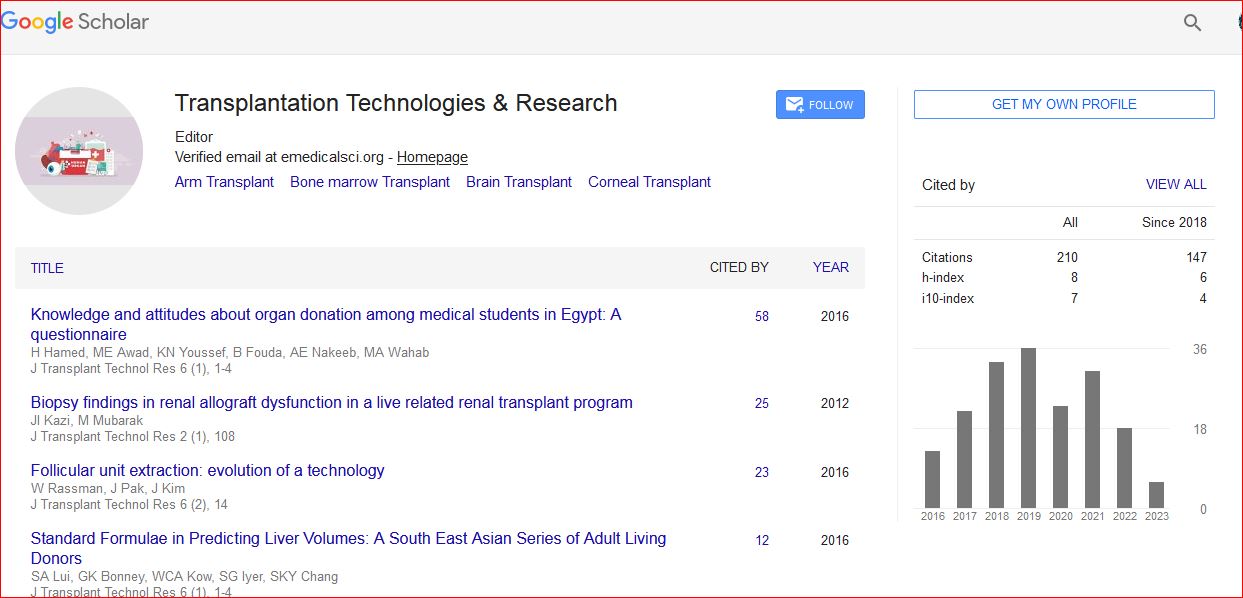
Transplantation Technologies & Research received 223 citations as per Google Scholar report