Opinion - (2025) Volume 9, Issue 6
Received: 01-Dec-2025, Manuscript No. jid-26-188367;
Editor assigned: 03-Dec-2025, Pre QC No. P-188367;
Reviewed: 17-Dec-2025, QC No. Q-188367;
Revised: 22-Dec-2025, Manuscript No. R-188367;
Published:
29-Dec-2025
, DOI: 10.37421/2684-4559.2025.9.359
Citation: Al-Mutairi, Ahmed. "Predicting And Preventing Hospital Bloodstream Infections." Clin Infect Dis 13 (2025):359.
Copyright: © 2025 Al-Mutairi A. This is an open-access article distributed under the terms of the Creative Commons Attribution License, which permits unrestricted use, distribution and reproduction in any medium, provided the original author and source are credited.
Developing accurate risk stratification models for hospital-acquired bloodstream infections (HA-BSIs) is crucial for optimizing patient care and resource allocation. These models aim to identify patients at higher risk of developing HA-BSIs, allowing for targeted preventive interventions and earlier detection. Key components of these models often include patient demographics, underlying comorbidities, severity of illness scores, device utilization (e.g., central venous catheters), and prior antibiotic exposure. Machine learning approaches are increasingly being explored to enhance the predictive power of these models, potentially incorporating real-time electronic health record data for more dynamic risk assessment [1].
This study validates a predictive model for central line-associated bloodstream infections (CLABSIs) in an intensive care unit setting. It highlights the importance of specific variables such as duration of catheterization, type of catheter, and patient's APACHE II score in predicting CLABSI risk. The findings underscore the utility of such models in guiding infection control practices and reducing healthcare-associated infections [2].
This research explores the application of machine learning algorithms, specifically random forests and logistic regression, to predict bloodstream infections in hospitalized patients. The authors demonstrate that machine learning models can achieve higher accuracy than traditional risk scores by integrating a broader range of clinical factors and identifying complex interactions [3].
This systematic review examines various risk factors associated with hospital-acquired infections, with a focus on bloodstream infections. It identifies patient-related factors (e.g., immunocompromise, diabetes) and healthcare-related factors (e.g., indwelling devices, duration of hospitalization) that significantly increase the risk of BSIs. The review emphasizes the need for comprehensive risk assessment tools [4].
The authors propose a novel risk score for predicting the development of sepsis in patients with suspected bloodstream infections. This score integrates clinical signs, laboratory markers, and patient history to stratify patients into low, intermediate, and high-risk categories, facilitating timely intervention and management [5].
This paper focuses on the impact of antimicrobial stewardship programs on the incidence of hospital-acquired bloodstream infections. While not a direct risk stratification model, it highlights how interventions informed by risk assessment and surveillance can significantly reduce BSI rates. The study suggests that understanding patient-specific risks is foundational to effective stewardship [6].
The authors investigate the use of administrative data and electronic health records to develop and implement a real-time risk prediction tool for healthcare-associated infections, including bloodstream infections. This approach allows for dynamic risk assessment, enabling clinicians to adjust preventive strategies based on evolving patient conditions [7].
This study focuses on the risk factors contributing to catheter-related bloodstream infections (CRBSIs) in cancer patients. It identifies specific patient vulnerabilities and treatment-related factors that increase susceptibility, suggesting the need for tailored risk assessment and management strategies in this immunocompromised population [8].
The authors explore the utility of routine laboratory parameters in developing a simple risk score for predicting bloodstream infections in hospitalized patients. They identify specific hematological markers that are significantly associated with increased risk, offering a potentially low-cost and easily implementable tool for initial risk assessment [9].
This study retrospectively analyzes factors associated with bloodstream infections in patients admitted to a general medical ward. It identifies patient comorbidities, length of stay, and use of certain medications as significant risk factors, emphasizing the need for ward-specific risk assessment and preventive strategies [10].
Developing accurate risk stratification models for hospital-acquired bloodstream infections (HA-BSIs) is crucial for optimizing patient care and resource allocation. These models aim to identify patients at higher risk of developing HA-BSIs, allowing for targeted preventive interventions and earlier detection. Key components of these models often include patient demographics, underlying comorbidities, severity of illness scores, device utilization (e.g., central venous catheters), and prior antibiotic exposure. Machine learning approaches are increasingly being explored to enhance the predictive power of these models, potentially incorporating real-time electronic health record data for more dynamic risk assessment [1].
This study validates a predictive model for central line-associated bloodstream infections (CLABSIs) in an intensive care unit setting. It highlights the importance of specific variables such as duration of catheterization, type of catheter, and patient's APACHE II score in predicting CLABSI risk. The findings underscore the utility of such models in guiding infection control practices and reducing healthcare-associated infections [2].
This research explores the application of machine learning algorithms, specifically random forests and logistic regression, to predict bloodstream infections in hospitalized patients. The authors demonstrate that machine learning models can achieve higher accuracy than traditional risk scores by integrating a broader range of clinical factors and identifying complex interactions [3].
This systematic review examines various risk factors associated with hospital-acquired infections, with a focus on bloodstream infections. It identifies patient-related factors (e.g., immunocompromise, diabetes) and healthcare-related factors (e.g., indwelling devices, duration of hospitalization) that significantly increase the risk of BSIs. The review emphasizes the need for comprehensive risk assessment tools [4].
The authors propose a novel risk score for predicting the development of sepsis in patients with suspected bloodstream infections. This score integrates clinical signs, laboratory markers, and patient history to stratify patients into low, intermediate, and high-risk categories, facilitating timely intervention and management [5].
This paper focuses on the impact of antimicrobial stewardship programs on the incidence of hospital-acquired bloodstream infections. While not a direct risk stratification model, it highlights how interventions informed by risk assessment and surveillance can significantly reduce BSI rates. The study suggests that understanding patient-specific risks is foundational to effective stewardship [6].
The authors investigate the use of administrative data and electronic health records to develop and implement a real-time risk prediction tool for healthcare-associated infections, including bloodstream infections. This approach allows for dynamic risk assessment, enabling clinicians to adjust preventive strategies based on evolving patient conditions [7].
This study focuses on the risk factors contributing to catheter-related bloodstream infections (CRBSIs) in cancer patients. It identifies specific patient vulnerabilities and treatment-related factors that increase susceptibility, suggesting the need for tailored risk assessment and management strategies in this immunocompromised population [8].
The authors explore the utility of routine laboratory parameters in developing a simple risk score for predicting bloodstream infections in hospitalized patients. They identify specific hematological markers that are significantly associated with increased risk, offering a potentially low-cost and easily implementable tool for initial risk assessment [9].
This study retrospectively analyzes factors associated with bloodstream infections in patients admitted to a general medical ward. It identifies patient comorbidities, length of stay, and use of certain medications as significant risk factors, emphasizing the need for ward-specific risk assessment and preventive strategies [10].
The collective research emphasizes the critical need for robust risk stratification models to predict and prevent hospital-acquired bloodstream infections (HA-BSIs) and related conditions like sepsis and central line-associated bloodstream infections (CLABSIs). These models incorporate a wide array of factors including patient demographics, comorbidities, severity of illness, device utilization, and prior antibiotic exposure. Advanced methodologies such as machine learning are being leveraged to enhance predictive accuracy by integrating broader clinical data and identifying complex interactions. Furthermore, the development of novel risk scores using clinical signs, laboratory markers, and patient history, along with the utilization of real-time electronic health records, are highlighted as key strategies. The impact of antimicrobial stewardship programs is also discussed in the context of reducing BSI rates, underscoring the importance of understanding patient-specific risks. Specific patient populations, such as those in intensive care units or undergoing cancer treatment, require tailored risk assessment and management due to increased vulnerability. The research also points to the utility of routine laboratory parameters and administrative data in developing effective risk prediction tools, ultimately aiming to optimize patient care and resource allocation.
None
None
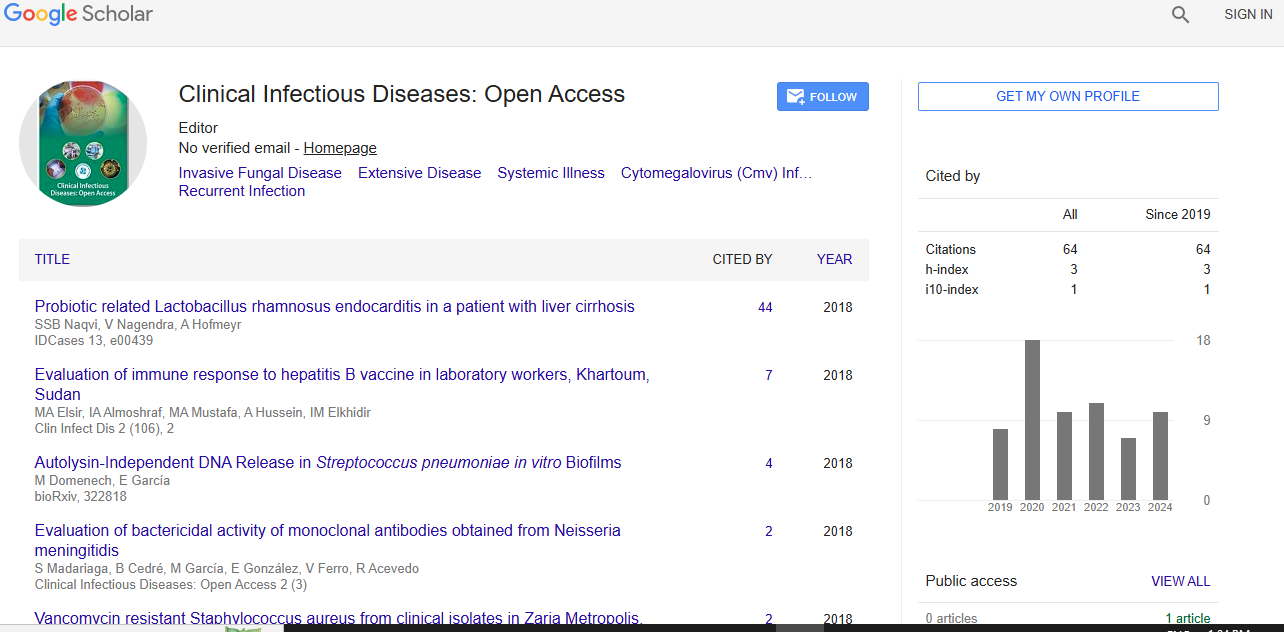
Clinical Infectious Diseases: Open Access received 1149 citations as per Google Scholar report