Brief Report - (2025) Volume 11, Issue 5
Received: 01-Sep-2025, Manuscript No. aso-26-184659;
Editor assigned: 03-Sep-2025, Pre QC No. P-184659;
Reviewed: 17-Sep-2025, QC No. Q-184659;
Revised: 22-Sep-2025, Manuscript No. R-184659;
Published:
29-Sep-2025
, DOI: 10.37421/2471-2671.2025.11.186
Citation: Rahman, Aisha. ”Precision Surgical Oncology: Tailored
to Tumor Biology.” Arch Surg Oncol 11 (2025):186.
Copyright: © 2025 Rahman A. This is an open-access article distributed under the terms of the Creative Commons Attribution License, which permits unrestricted use,
distribution and reproduction in any medium, provided the original author and source are credited.
Precision surgical oncology represents a paradigm shift in cancer treatment, moving towards highly individualized approaches that are guided by the unique biological characteristics of each tumor. This patient-centric strategy is designed to optimize the complete removal of cancerous tissue while simultaneously preserving as much healthy tissue as possible, ultimately leading to enhanced oncological outcomes and a better quality of life for patients. The foundation of this evolving field is built upon significant advancements in several key areas, including sophisticated molecular profiling techniques, cutting-edge imaging technologies, and the widespread adoption of minimally invasive surgical methods [1].
Molecular profiling of tumors stands as a cornerstone of precision surgical oncology. By meticulously identifying specific genetic mutations, aberrant gene expression patterns, and characteristic protein biomarkers within a tumor, clinicians can gain invaluable insights into its behavior. This detailed understanding empowers surgeons to predict the tumor's trajectory and to strategically select the most effective therapeutic interventions. These decisions can encompass the precise extent of surgical resection required and the potential necessity for additional adjuvant therapies to combat any residual disease [2].
Advanced imaging techniques play a vital role in the precise delineation and accurate staging of tumors. Modalities such as advanced magnetic resonance imaging (MRI) sequences, positron emission tomography-computed tomography (PET-CT) scans, and intraoperative ultrasound provide surgeons with unprecedented visualization capabilities. These technologies allow for a more accurate mapping of tumor margins, the detection of even microscopic metastatic disease, and the meticulous planning of the optimal surgical approach, all of which contribute to achieving a higher rate of complete tumor resection [3].
Minimally invasive surgical techniques, including laparoscopic surgery and robotic-assisted procedures, are increasingly becoming integrated into the practice of precision surgical oncology. These sophisticated approaches offer a multitude of benefits to patients, such as smaller incisions, reduced blood loss during surgery, shorter hospital stays and recovery periods, and often improved cosmetic results. Crucially, these less invasive methods do not compromise the oncological principles necessary for effective tumor resection [4].
The concept of the tumor microenvironment is emerging as a critical factor in the planning and execution of precision surgery. A comprehensive understanding of the diverse cellular and molecular components that surround and interact with the tumor can significantly inform surgical strategies. This knowledge can guide decisions regarding the optimal margin of resection necessary to achieve clear margins and can also highlight opportunities for neoadjuvant or adjuvant therapies aimed at modulating the microenvironment to enhance treatment efficacy [5].
Genomic instability and the presence of specific driver mutations within a tumor are key determinants that influence its responsiveness to surgical intervention and subsequent treatments. Precision surgical oncology capitalizes on this understanding to personalize the surgical resection margins and the selection of adjuvant therapies. The ultimate goal is to effectively prevent the recurrence of the tumor and the spread of metastasis, thereby improving long-term patient survival [6].
Neoadjuvant and adjuvant therapies are integral components of the precision surgical oncology armamentarium. The strategic tailoring of these treatments, administered either before (neoadjuvant) or after (adjuvant) surgery, based on a detailed analysis of the tumor's biology, can significantly improve the resectability of tumors, effectively eradicate microscopic metastatic disease, and ultimately enhance overall survival rates. This represents a truly multimodal approach to comprehensive cancer care [7].
The development and refinement of liquid biopsies represent a significant advancement in the field of precision surgical oncology. These innovative diagnostic tools, capable of detecting circulating tumor DNA (ctDNA) and other cancer-derived molecules in bodily fluids, offer valuable insights. Liquid biopsies can assist in the early detection of cancer, monitor the patient's response to treatment, and identify the presence of minimal residual disease, thereby complementing established surgical and imaging methods [8].
Patient stratification, based on a thorough understanding of tumor biology, is fundamental to the successful implementation of precision surgical oncology. This process involves categorizing patients into distinct groups according to their specific molecular tumor profiles. Such stratification is crucial for accurately predicting prognosis and for tailoring both surgical interventions and adjuvant treatments to achieve the most optimal patient outcomes [9].
The integration of artificial intelligence (AI) and machine learning (ML) into surgical oncology holds immense promise for the future. These powerful technologies possess the capability to analyze vast and complex datasets, predict surgical outcomes with greater accuracy, optimize intricate treatment planning, and identify novel biomarkers that may have previously gone unnoticed. These advancements are poised to further propel the principles of precision surgical oncology forward [10].
Precision surgical oncology is fundamentally redefining cancer treatment by moving towards a highly personalized approach where surgical strategies are meticulously tailored to the specific biological makeup of an individual tumor. This patient-centered methodology is designed to maximize the extent of tumor removal while simultaneously minimizing damage to surrounding healthy tissues, thereby leading to significant improvements in oncological outcomes and overall patient quality of life. The successful implementation of this approach is heavily reliant on crucial enabling factors such as sophisticated molecular profiling, advanced imaging technologies, and the application of minimally invasive surgical techniques [1].
Molecular profiling of tumors is an indispensable element in the practice of precision surgical oncology. This process involves the detailed identification of specific genetic mutations, unique gene expression patterns, and characteristic protein biomarkers present within the tumor. This granular information allows surgical oncologists to accurately predict tumor behavior and to make informed decisions regarding the most effective therapeutic strategy, including the precise extent of surgical resection and the potential need for adjuvant therapies [2].
Advanced imaging technologies are critical for the precise delineation of tumors and for accurate staging. Techniques such as advanced MRI sequences, PET-CT scans, and intraoperative ultrasound provide surgeons with unparalleled visualization capabilities. These tools enable a more accurate assessment of tumor margins, facilitate the detection of micrometastatic disease, and guide the planning of the optimal surgical approach, ultimately enhancing the completeness of tumor resection [3].
Minimally invasive surgical techniques, including laparoscopy and robotic-assisted surgery, are increasingly being incorporated into the framework of precision surgical oncology. These approaches offer numerous advantages to patients, such as smaller incisions, reduced blood loss, shorter recovery times, and potentially improved cosmetic outcomes, all while ensuring oncologically sound tumor removal [4].
The concept of the tumor microenvironment is gaining significant attention within precision surgical oncology. Understanding the complex interplay of cellular and molecular components surrounding a tumor can profoundly influence surgical strategies. This knowledge can inform decisions about the necessary margin of resection for achieving clear margins and can also guide the selection of neoadjuvant or adjuvant therapies aimed at favorably altering the microenvironment [5].
Genomic instability and the presence of specific driver mutations within a tumor play a crucial role in determining its response to surgical intervention and subsequent treatments. Precision surgical oncology leverages this understanding to personalize surgical resection margins and the choice of adjuvant therapies. The objective is to effectively prevent recurrence and metastasis, thereby optimizing long-term patient outcomes [6].
Neoadjuvant and adjuvant therapies are essential components of precision surgical oncology. Tailoring these treatments based on the tumor's unique biology, either before or after surgery, can enhance resectability, eradicate microscopic metastatic disease, and improve overall survival. This highlights the importance of a multimodal approach to cancer management [7].
The advent of liquid biopsies, which allow for the detection of circulating tumor DNA (ctDNA) and other cancer-derived molecules in bodily fluids, marks a significant advancement for precision surgical oncology. Liquid biopsies can be instrumental in early cancer detection, monitoring treatment response, and identifying minimal residual disease, thereby complementing traditional surgical and imaging methods [8].
Patient stratification based on tumor biology is a fundamental requirement for precision surgical oncology. This involves categorizing patients into specific groups according to their molecular tumor profiles, which is essential for predicting prognosis and for tailoring surgical and adjuvant treatments to achieve the best possible outcomes [9].
The integration of artificial intelligence (AI) and machine learning (ML) in surgical oncology holds substantial promise for the future. These technologies can analyze complex datasets, predict surgical outcomes, optimize treatment planning, and identify novel biomarkers, thereby further advancing the principles of precision surgical oncology [10].
Precision surgical oncology tailors cancer treatment to individual tumor biology, maximizing tumor removal while minimizing harm to healthy tissues. Key enablers include molecular profiling, advanced imaging, and minimally invasive techniques. Molecular profiling identifies genetic mutations and biomarkers to guide surgical decisions and therapy selection. Advanced imaging aids in precise tumor delineation and staging. Minimally invasive surgery offers benefits like faster recovery. The tumor microenvironment and genomic alterations also inform surgical strategies. Neoadjuvant and adjuvant therapies are crucial for improving outcomes. Liquid biopsies aid in early detection and monitoring. Patient stratification based on tumor biology is essential for personalized treatment. Artificial intelligence and machine learning show promise in optimizing surgical oncology.
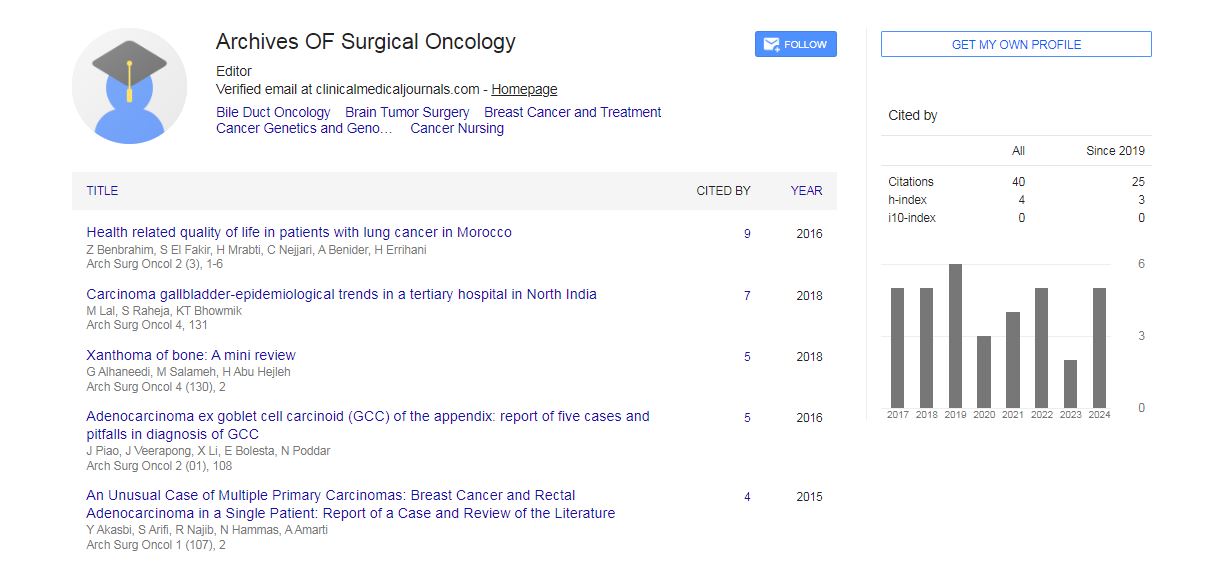
Archives of Surgical Oncology received 37 citations as per Google Scholar report