Brief Report - (2025) Volume 16, Issue 2
Received: 01-Mar-2025, Manuscript No. jnmrt-25-172728;
Editor assigned: 03-Mar-2025, Pre QC No. P-172728;
Reviewed: 17-Mar-2025, QC No. Q-172728;
Revised: 24-Mar-2025, Manuscript No. R-172728;
Published:
31-Mar-2025
, DOI: 10.37421/2155-9619.2025.16.637
Citation: Ramirez, Lucas E.. ”Precision Cancer Management: Technologies for Better Outcomes.” J Nucl Med Radiat Ther 16 (2025):637.
Copyright: © 2025 Ramirez E. Lucas This is an open-access article distributed under the terms of the Creative Commons Attribution License, which permits unrestricted use, distribution and reproduction in any medium, provided the original author and source are credited.
Monitoring cancer treatment response and detecting disease progression are critical components of effective oncology. Recent scientific endeavors have significantly advanced these capabilities, moving beyond traditional methods to embrace innovative technologies that offer greater precision, reduced invasiveness, and dynamic insights into tumor biology. The utility of circulating tumor DNA (ctDNA) as a non-invasive biomarker is rapidly gaining recognition, enabling the monitoring of cancer treatment, the detection of minimal residual disease, and the prediction of recurrence by leveraging its clinical utility and technical advancements for personalized cancer management [1] . For example, standardized evaluation criteria remain foundational, with guidelines like RECIST 1.1 providing the benchmark for assessing treatment response in solid tumors. These criteria, however, face ongoing challenges and require refinement to adapt to the complexities introduced by novel therapies such as immunotherapy [2] . Complementing these guidelines, molecular imaging techniques, when combined with liquid biopsy approaches like ctDNA analysis, offer comprehensive insights into tumor biology. These methods are crucial for effectively monitoring therapeutic efficacy and detecting emerging drug resistance, highlighting their synergistic roles in guiding adaptive therapeutic strategies and ultimately improving patient outcomes [3] . The integration of liquid biopsies, particularly ctDNA, into precision oncology represents a major step forward. These non-invasive tools facilitate real-time monitoring of tumor evolution and treatment efficacy, thereby enabling timely clinical decisions and highly personalized therapeutic adjustments [4] . The field also continuously seeks to identify and validate new biomarkers, especially for monitoring patient responses to cancer immunotherapy. Various predictive and prognostic markers, including immune-related factors and genetic signatures, hold significant potential to guide treatment selection and enhance the overall efficacy of immunotherapeutic approaches [5] . Moreover, the application of Artificial Intelligence (AI) in cancer imaging is revolutionizing diagnosis, prognosis, and treatment monitoring. AI enhances the interpretation of complex medical images, promising improved accuracy and efficiency in assessing tumor response and informing therapeutic decisions [6] . Expanding on non-invasive strategies, a range of minimally invasive techniques, encompassing both liquid biopsies and advanced imaging modalities, offer less burdensome and more frequent assessment opportunities compared to conventional biopsies. These approaches are vital for dynamically tracking disease progression and gauging treatment effectiveness [7] . Radiomics further exemplifies the advancements in imaging, focusing on extracting quantitative features from medical images. This provides valuable insights into tumor characteristics and aids in predicting patient outcomes, thus enhancing the precision of treatment monitoring in oncology [8] . At a deeper, more granular level, single-cell sequencing and other single-cell technologies are proving invaluable for dissecting the tumor microenvironment and monitoring therapeutic response. These advanced techniques provide unprecedented resolution, revealing cellular heterogeneity and dynamic changes during treatment, which in turn informs more precise interventions [9] . Looking to the future, nanotechnology is emerging with burgeoning applications across cancer care, including enhanced diagnosis, targeted treatment delivery, and disease monitoring. Nanoscale tools and materials offer superior sensitivity and specificity for detecting tumor markers and tracking therapeutic responses, thereby opening new avenues for personalized medicine [10] . Collectively, these technological advancements underscore a paradigm shift in cancer monitoring, moving towards more individualized, dynamic, and minimally invasive approaches.
The landscape of cancer treatment monitoring is being fundamentally transformed by a suite of advanced technologies aimed at improving precision and reducing invasiveness. Central to these innovations are liquid biopsies, particularly those focusing on circulating tumor DNA (ctDNA). These methods offer a non-invasive pathway to monitor cancer treatment, identify minimal residual disease, and predict potential recurrence. They provide real-time insights into a tumor's biological changes and evolution, which is essential for tailoring treatment plans and detecting mechanisms of drug resistance early on [1, 3, 4]. These advancements allow for dynamic tracking of disease progression and treatment effectiveness, often with less burden on patients than traditional tissue biopsies [7].
Complementing these molecular insights are significant developments in medical imaging. While standard criteria such as RECIST 1.1 remain crucial for evaluating treatment response in solid tumors, their application is continually evolving to address the complexities introduced by new therapeutic modalities, especially immunotherapy [2].
Beyond these established guidelines, novel imaging techniques are pushing the boundaries of what is detectable. Radiomics, for instance, extracts quantitative features from medical images to provide deeper insights into tumor characteristics, enhancing the prediction of patient outcomes and improving the precision of treatment monitoring [8]. Artificial Intelligence (AI) is also playing a transformative role in cancer imaging, where it enhances the interpretation of images for diagnosis, prognosis, and treatment response assessment, leading to potentially greater accuracy and efficiency in clinical decision-making [6]. Molecular imaging further enriches this field by offering comprehensive views that complement liquid biopsy data, providing a more holistic understanding of tumor biology and response to therapy [3].
The search for more effective biomarkers is another critical area of focus, particularly for monitoring responses to cancer immunotherapy. Researchers are exploring various predictive and prognostic markers, including immune-related factors and specific genetic signatures. These emerging biomarkers hold the promise to guide treatment selection, ensuring that patients receive the most effective immunotherapeutic approaches for their specific condition [5]. Understanding the intricate tumor microenvironment is also vital for developing targeted therapies and monitoring their impact. Here, single-cell sequencing and other single-cell technologies offer unparalleled resolution. These advanced techniques can reveal cellular heterogeneity and dynamic changes occurring within the tumor during treatment, providing crucial information that informs more precise interventions and adaptive therapeutic strategies [9].
Looking ahead, nanotechnology is poised to revolutionize several facets of cancer care. Its applications span enhanced diagnosis, more targeted treatment delivery, and highly sensitive disease monitoring. Nanoscale tools and materials can offer superior sensitivity and specificity for detecting subtle tumor markers and tracking therapeutic responses, thereby opening significant new avenues for personalized medicine. This integration of diverse high-tech approaches, from molecular analysis to advanced imaging and nano-scale tools, highlights a comprehensive strategy towards refining cancer management. These innovations collectively empower clinicians with better tools to monitor disease, adapt therapies, and ultimately improve patient outcomes in a highly personalized manner [10].
The evolving landscape of cancer management increasingly relies on sophisticated methods for monitoring treatment effectiveness, detecting minimal residual disease, and predicting recurrence. This collection of research highlights several key innovations driving this progress. Circulating tumor DNA (ctDNA) analysis and broader liquid biopsy techniques are pivotal, offering non-invasive, real-time insights into tumor biology and evolution, crucial for personalized cancer management and tracking resistance mechanisms. Alongside these, advancements in imaging play a significant role. Standard guidelines like RECIST 1.1 are continually refined to accommodate new therapies, while radiomics and Artificial Intelligence (AI) enhance the interpretation of medical images, improving diagnostic accuracy and treatment response assessment. Molecular imaging further complements liquid biopsies by providing comprehensive views of tumor behavior. Beyond these, the field explores novel biomarkers for immunotherapy, single-cell technologies to unravel the tumor microenvironment, and the burgeoning applications of nanotechnology for enhanced detection and monitoring. Collectively, these minimally invasive and high-resolution approaches promise to guide adaptive therapeutic strategies, leading to improved patient outcomes by enabling dynamic tracking of disease progression and treatment efficacy. The integration of these diverse technologies underscores a future where cancer care is increasingly precise, responsive, and tailored to individual patient needs.
None
None
Indexed at, Google Scholar, Crossref
Indexed at, Google Scholar, Crossref
Indexed at, Google Scholar, Crossref
Indexed at, Google Scholar, Crossref
Indexed at, Google Scholar, Crossref
Indexed at, Google Scholar, Crossref
Indexed at, Google Scholar, Crossref
Indexed at, Google Scholar, Crossref
Indexed at, Google Scholar, Crossref
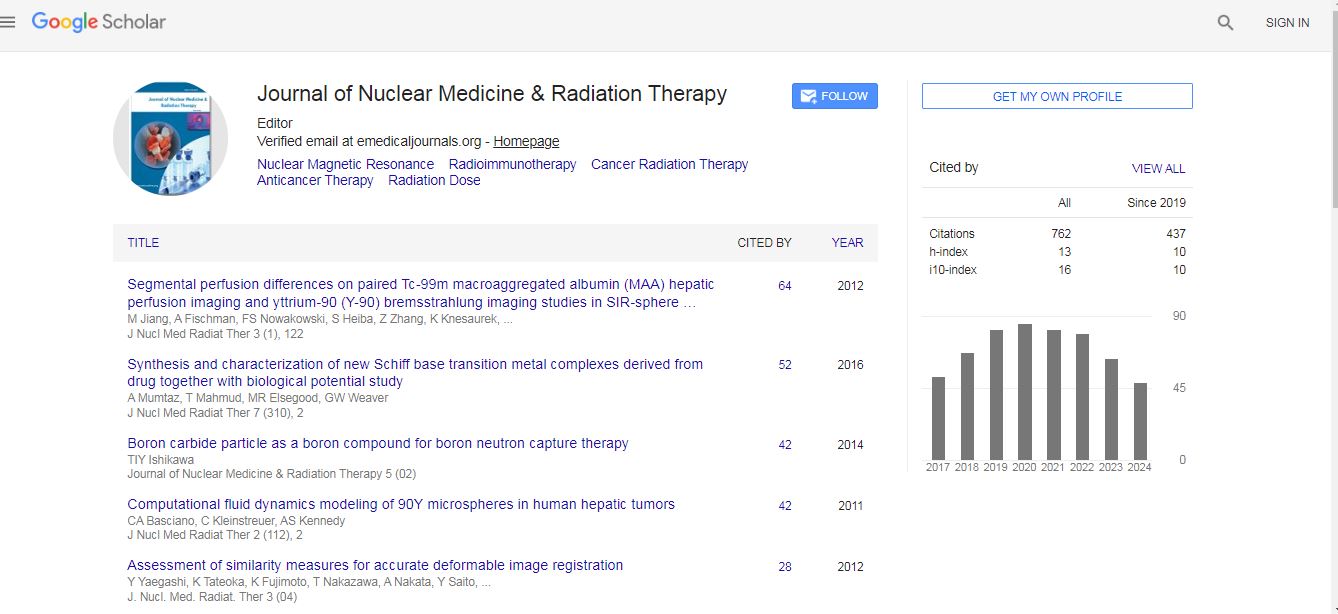
Nuclear Medicine & Radiation Therapy received 706 citations as per Google Scholar report