Opinion - (2025) Volume 9, Issue 4
Received: 02-Nov-2025, Manuscript No. jmbp-25-175112;
Editor assigned: 04-Nov-2025, Pre QC No. P-175112;
Reviewed: 18-Nov-2025, QC No. Q-175112;
Revised: 24-Nov-2025, Manuscript No. R-175112;
Published:
29-Nov-2025
, DOI: 10.37421/2684-4931.2025.9.275
Citation: O’Sullivan, Kevin. ”Plasmids: Resistance, Evolution and Biotechnology.” J Microbiol Patho 09 (2025):275.
Copyright: © 2025 O’Sullivan K. This is an open-access article distributed under the terms of the Creative Commons Attribution License, which permits unrestricted use, distribution and reproduction in any medium, provided the original author and source are credited.
Bacterial plasmids are crucial drivers in the global spread of antibiotic resistance. Plasmids can transfer resistance genes between bacteria, making them a significant challenge for public health. Understanding their mechanisms, from replication to horizontal gene transfer, is essential for developing new strategies against drug-resistant infections [1].
This article delves into the core aspects of plasmid biology, examining how these extrachromosomal elements replicate and transfer genetic material between bacteria. What this really means is that plasmids are crucial for bacterial adaptation, especially in challenging environments, by enabling the rapid spread of advantageous traits like antibiotic resistance or virulence factors [2].
This research explores the intricate relationship between CRISPR-Cas systems and plasmids, seeing them as a double-edged sword. While CRISPR-Cas can defend bacteria against incoming foreign DNA, including plasmids, plasmids also serve as vehicles for the dissemination of CRISPR-Cas components or can evolve to evade these defense mechanisms, presenting a fascinating arms race in microbial genetics [3].
This paper reviews the diverse systems used to classify bacterial plasmids, explaining their applications in understanding plasmid epidemiology and evolution. The classification helps us trace the spread of important traits, such as antibiotic resistance, and offers a framework for studying how these elements impact microbial communities [4].
This review examines the dynamic interplay between plasmids and their bacterial hosts, specifically focusing on the host's defense systems and the mechanisms bacteria employ to combat incoming plasmids. Here's the thing, this constant evolutionary arms race determines plasmid persistence and spread, which has major implications for understanding the dissemination of critical genetic information, like antibiotic resistance genes [5].
This paper investigates the intricate dynamics of plasmid transfer and stability, underscoring their critical role in bacterial evolution and the alarming spread of antibiotic resistance. It's clear that understanding how plasmids move between bacteria and how they maintain themselves in new hosts is vital for predicting and mitigating the emergence of superbugs [6].
This research explores the potential of plasmid DNA as a versatile platform for developing next-generation vaccines. Using plasmids allows for stable, safe, and easily producible vaccines that can deliver antigens directly to host cells, offering a promising alternative to traditional vaccine approaches, particularly for emerging infectious diseases and cancer immunotherapies [7].
This paper investigates the fundamental mechanisms governing plasmid segregation and stability, drawing insights from naturally occurring plasmids. Understanding how plasmids reliably partition into daughter cells is crucial, because it sheds light on their persistence within bacterial populations and the successful dissemination of plasmid-encoded traits, like antimicrobial resistance [8].
This paper explores how plasmids evolve and their crucial roles in microbial adaptation. It reveals that plasmids are not just passive carriers of genes; they actively participate in shaping bacterial evolution, allowing bacteria to quickly respond to environmental pressures, including the presence of antibiotics or heavy metals, by acquiring new genetic traits [9].
This article highlights the incredible versatility of plasmids as fundamental tools in both biotechnology and synthetic biology. From gene cloning and protein expression to gene therapy vectors and vaccine development, plasmids serve as indispensable workhorses, enabling scientists to manipulate genetic material with precision and achieve complex biological engineering feats [10].
Plasmids are remarkable extrachromosomal DNA elements that play pivotal roles in the microbial world, significantly influencing bacterial evolution, adaptation, and public health. A primary concern is their function as crucial drivers in the global dissemination of antibiotic resistance [1]. These genetic elements possess the unique ability to transfer resistance genes between bacteria through horizontal gene transfer, making them a formidable challenge in the fight against drug-resistant infections. Consequently, comprehending their mechanisms, including replication and transfer, is paramount for developing effective countermeasures [1].
What this really means is that plasmids are fundamental for bacterial survival and adaptation, especially when bacteria encounter harsh or changing environments [2]. They facilitate the rapid acquisition and spread of beneficial traits, such as antibiotic resistance or factors that enhance virulence, allowing bacteria to thrive where they might otherwise perish. The core aspects of plasmid biologyâ??how they replicate independently and how they transfer genetic materialâ??are key to understanding their wide-ranging influence [2]. This constant movement of genetic information allows for dynamic shifts in bacterial populations.
The interplay between plasmids and bacterial defense systems, particularly CRISPR-Cas, represents a sophisticated evolutionary arms race [3]. CRISPR-Cas systems are known to defend bacteria by targeting and neutralizing foreign DNA, including invading plasmids. However, plasmids are not static targets; they can evolve mechanisms to evade these defenses or even act as vehicles themselves for the dissemination of CRISPR-Cas components [3]. This dynamic interaction highlights the intricate genetic battles occurring at the microbial level, constantly shaping the genetic landscape of bacterial communities. Furthermore, the robust classification systems for bacterial plasmids are invaluable for epidemiological tracking and evolutionary studies [4]. These systems allow researchers to monitor the spread of critical traits, like resistance genes, and gain insights into how plasmids impact microbial populations on a broader scale [4].
Host-plasmid interactions are another critical area of study, focusing on the bacterial host's defense mechanisms and the strategies bacteria employ to counteract incoming plasmids [5]. This ongoing evolutionary struggle directly impacts plasmid persistence and their ability to spread within bacterial populations. The success or failure of these interactions has profound implications for how vital genetic information, such as antibiotic resistance genes, is propagated across different bacterial species [5]. The dynamics of plasmid transfer and stability are also central to bacterial evolution and the alarming rise of antibiotic resistance [6]. Understanding the precise mechanisms by which plasmids move between bacteria and stably integrate into new hosts is essential for anticipating and mitigating the emergence of superbugs, which pose a significant threat to global health [6].
Beyond these ecological and public health implications, plasmids demonstrate incredible utility in various biotechnological applications. For example, plasmid DNA serves as a versatile platform for the development of next-generation vaccines [7]. These plasmid-based vaccines offer advantages in terms of stability, safety, and ease of production, providing a promising alternative to conventional vaccine methods, particularly for addressing emerging infectious diseases and advancing cancer immunotherapies [7]. Moreover, insights into the fundamental mechanisms of plasmid segregation and stability, gleaned from natural plasmids, are crucial for ensuring their reliable partitioning into daughter cells [8]. This reliable partitioning is essential for the successful and sustained dissemination of plasmid-encoded traits, including antimicrobial resistance, within bacterial populations [8]. Plasmids are indeed active participants in shaping bacterial evolution, not merely passive genetic carriers [9]. They enable bacteria to rapidly adapt to environmental pressures, from antibiotics to heavy metals, by acquiring new genetic traits efficiently [9]. Finally, their role extends profoundly into biotechnology and synthetic biology, where they act as indispensable tools [10]. From gene cloning and protein expression to gene therapy vectors, plasmids facilitate precise genetic manipulation and the realization of complex biological engineering goals [10]. This broad utility underscores their importance as both a biological phenomenon and a powerful scientific instrument.
Bacterial plasmids are fundamental drivers in the global spread of antibiotic resistance, posing a significant challenge to public health [1]. These extrachromosomal elements are crucial for bacterial adaptation, enabling the rapid spread of advantageous traits like antibiotic resistance and virulence factors [2]. Plasmids demonstrate intricate relationships with bacterial defense systems, such as CRISPR-Cas, where they can be targeted or evolve to evade these mechanisms, highlighting a fascinating arms race in microbial genetics [3]. Classification systems for plasmids are essential for understanding their epidemiology and evolution, helping trace the spread of important traits like antibiotic resistance across microbial communities [4]. The dynamic interplay between plasmids and their bacterial hosts, including bacterial defense systems, critically determines plasmid persistence and spread, which has major implications for the dissemination of genetic information [5]. Understanding the dynamics of plasmid transfer and stability is vital for predicting and mitigating the emergence of superbugs, as these processes are critical for bacterial evolution and the alarming spread of antibiotic resistance [6]. Plasmids are not just passive carriers; they actively shape bacterial evolution, allowing quick responses to environmental pressures such as antibiotics [9]. Furthermore, the fundamental mechanisms governing plasmid segregation and stability, derived from naturally occurring plasmids, shed light on their persistence within bacterial populations and the successful dissemination of antimicrobial resistance traits [8]. Beyond their roles in resistance and adaptation, plasmids serve as versatile platforms for developing next-generation vaccines, offering stable, safe, and easily producible alternatives [7]. In biotechnology and synthetic biology, plasmids are indispensable tools for gene cloning, protein expression, gene therapy, and vaccine development, enabling precise genetic manipulation and complex biological engineering feats [10].
None
None
Priya V, Pradeep K, Monica K. "Bacterial plasmids as a major driver of antibiotic resistance".F1000Res 12 (2023):782.
Indexed at, Google Scholar, Crossref
Ravindra K, Seema S, Manu M. "Insights into plasmid biology: From replication to horizontal gene transfer and its implications in bacterial adaptation".J Basic Microbiol 62 (2022):1144-1160.
Indexed at, Google Scholar, Crossref
Yang W, Yuxin Z, Kaishan Z. "CRISPR-Cas systems in plasmid biology: A double-edged sword".Environ Microbiol 23 (2021):11-23.
Indexed at, Google Scholar, Crossref
Minoru S, Satomi K, Yuri S. "Plasmid classification systems and their applications".Curr Issues Mol Biol 33 (2019):29-45.
Indexed at, Google Scholar, Crossref
Alejandro S, Adrian R, Fernando DLC. "Plasmid-host interactions: The roles of bacterial defense systems and anti-plasmid mechanisms".FEMS Microbiol Rev 47 (2023):fuad053.
Indexed at, Google Scholar, Crossref
Tanisha G, Sheetal Y, Monika S. "Dynamics of plasmid transfer and stability: Importance in bacterial evolution and spread of antibiotic resistance".Curr Res Microb Sci 5 (2024):100236.
Indexed at, Google Scholar, Crossref
Purushottam S, Jaimin KP, Manish A. "Plasmid DNA as a Platform for Next-Generation Vaccine Development".Vaccines (Basel) 10 (2022):1690.
Indexed at, Google Scholar, Crossref
Kristina B, Mette S, Jens SM. "Mechanisms of plasmid segregation and stability: Lessons from natural plasmids".Front Microbiol 11 (2020):1269.
Indexed at, Google Scholar, Crossref
Shikha S, Archana K, Ajay S. "Evolution of plasmids and their roles in microbial adaptation".Environ Sci Pollut Res 30 (2023):40707-40722.
Indexed at, Google Scholar, Crossref
Ritu G, Debashish S, Ranjeet S. "Plasmids as versatile tools in biotechnology and synthetic biology".Front Bioeng Biotechnol 12 (2024):1353702.
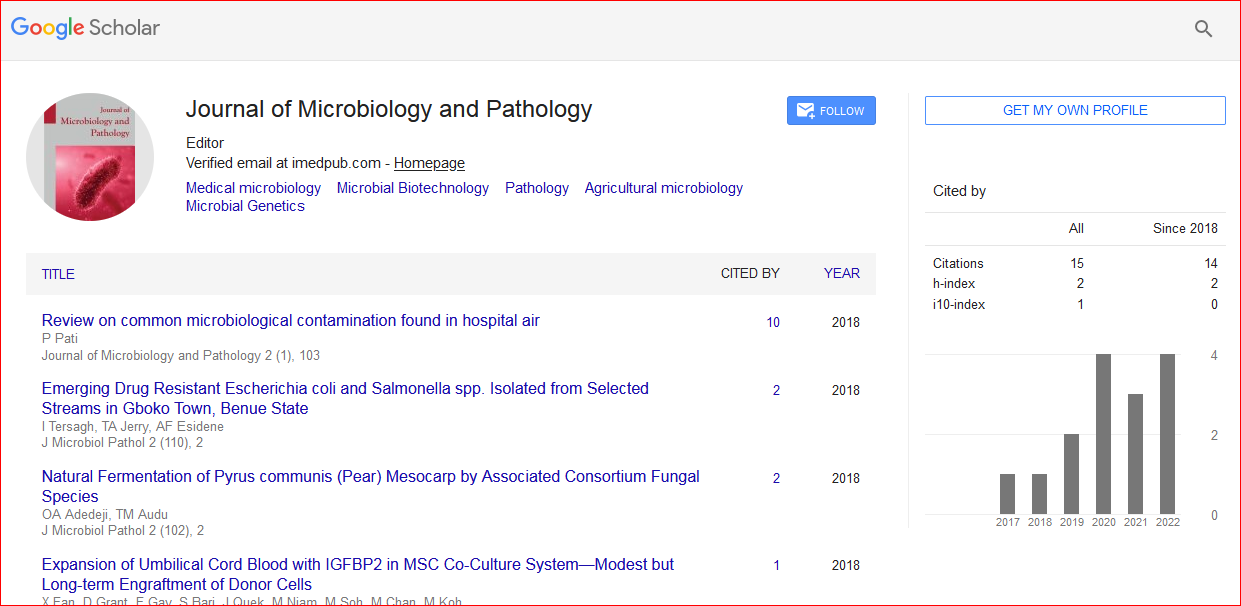
Journal of Microbiology and Pathology received 18 citations as per Google Scholar report