Perspective - (2025) Volume 15, Issue 5
Received: 01-Sep-2025, Manuscript No. jnt-26-178967;
Editor assigned: 03-Sep-2025, Pre QC No. P-178967;
Reviewed: 17-Sep-2025, QC No. Q-178967;
Revised: 22-Sep-2025, Manuscript No. R-178967;
Published:
29-Sep-2025
, DOI: 10.37421/2161-0959.2025.15.587
Citation: Brandner, Lukas. ”Personalized Nutrition: Transforming Kidney Disease Management.” J Nephrol Ther 15 (2025):587.
Copyright: © 2025 Brandner L. This is an open-access article distributed under the terms of the Creative Commons Attribution License, which permits unrestricted use, distribution and reproduction in any medium, provided the original author and source are credited.
Precision nutrition in nephrology care represents a paradigm shift from generalized dietary advice to highly individualized interventions designed to optimize health outcomes for patients with kidney disease. This advanced approach acknowledges the complex interplay of factors that influence kidney function and overall well-being, moving beyond conventional guidelines to address the unique needs of each patient [1].
Central to precision nutrition is the concept of individualized protein intake. Research is increasingly focused on determining optimal protein quantities based on specific parameters such as the stage of chronic kidney disease (CKD), whether a patient is on dialysis, and their personal physiological response, aiming to balance nutritional requirements with the reduction of uremic toxins and disease progression [2].
Micronutrient management within the context of CKD also demands a precise approach due to the altered absorption, metabolism, and excretion patterns characteristic of kidney disease. This involves meticulous monitoring and targeted supplementation of essential vitamins and minerals, such as vitamin D, iron, and zinc, often tailored to an individual's biochemical profile and disease severity to prevent both deficiencies and toxicities [3].
The gut microbiome's significant influence on CKD progression and the formation of uremic toxins is another area where precision nutrition strategies are being applied. Interventions like prebiotics and probiotics, alongside specific dietary modifications, aim to modulate microbial communities and their metabolic byproducts, thereby positively impacting kidney health [4].
For patients experiencing acute kidney injury (AKI), nutritional support is a critical component of care that is increasingly being approached with precision. Early and individualized interventions focus on carefully managing fluid and electrolyte balance, ensuring adequate energy and protein delivery, and mitigating catabolic states to promote recovery and minimize complications [5].
The application of nutrigenomics and metabolomics holds immense promise for advancing precision nutrition in nephrology. By analyzing an individual's genetic makeup and metabolic profile, clinicians can gain deeper insights into specific nutrient requirements and predict responses to various dietary interventions, enabling the development of truly personalized nutritional plans [6].
In patients undergoing hemodialysis, precision in dietary management is vital for optimizing fluid, electrolyte, and nutrient balance. This translates to personalized strategies for managing phosphorus and potassium levels, ensuring appropriate protein intake, and providing sufficient energy to combat malnutrition and inflammation, thereby enhancing uremic symptom control and overall well-being [7].
Personalized sodium and fluid restriction plays a critical role in managing hypertension and fluid overload commonly seen in nephrology patients. Precision in this area involves a thorough assessment of an individual's sodium balance and their specific response to fluid management strategies, guiding tailored recommendations to prevent cardiovascular complications and preserve kidney function [8].
The overarching philosophy of precision nutrition in nephrology is to move away from generic dietary plans. By integrating a wide array of patient-specific data, including genetic information, lifestyle factors, and relevant disease biomarkers, nutritionists and nephrologists can collaboratively develop more effective and targeted dietary strategies for managing kidney disease [9].
Finally, the development and utilization of advanced biomarkers and diagnostic tools are fundamental to the successful implementation of precision nutrition in nephrology. These sophisticated tools enable the identification of individual nutrient deficiencies, metabolic abnormalities, and specific predispositions to dietary responses, ultimately facilitating more accurate and impactful nutritional interventions [10].
Precision nutrition in nephrology care fundamentally involves tailoring dietary recommendations to the unique needs of each patient, taking into account multifaceted factors such as the specific stage of kidney disease, co-existing comorbidities, genetic predispositions, and current treatment regimens. The primary aim of this individualized approach is to optimize clinical outcomes, slow the progression of kidney disease, and significantly improve the patient's quality of life by precisely managing nutrient intake. It represents a significant departure from generalized dietary guidelines, emphasizing personalized interventions that highlight the critical role of specific micronutrients, macronutrients, and their complex interactions in maintaining kidney health [1].
The role of individualized protein intake within the broader scope of precision nutrition for chronic kidney disease (CKD) is a subject of intense investigation. Current research endeavors are exploring the optimal amounts of protein based on an individual's CKD stage, their dialysis status, and their unique physiological response, moving towards the development of personalized protein prescriptions. This strategy seeks to strike a balance between meeting essential nutritional needs and effectively reducing the accumulation of uremic toxins, thereby contributing to slower disease progression [2].
Micronutrient management in CKD requires a high degree of precision due to the inherent alterations in nutrient absorption, metabolism, and excretion that occur in individuals with compromised kidney function. This necessitates careful and continuous monitoring, along with targeted supplementation of specific vitamins and minerals, such as vitamin D, iron, and zinc. These interventions are often customized to the patient's specific biochemical profile and the current state of their disease, with the dual objective of preventing both deficiencies and potential toxicities [3].
The gut microbiome has emerged as a significant factor in the progression of CKD and the generation of uremic toxins. Precision nutrition strategies are being developed to target this microbial ecosystem through the use of prebiotics, probiotics, and specialized dietary interventions. The goal is to modulate the composition and metabolic activity of gut microbial communities, ultimately influencing kidney health in a positive manner [4].
Nutritional interventions for patients experiencing acute kidney injury (AKI) are undergoing a rapid evolution, with precision approaches taking center stage. These strategies emphasize early and individualized nutritional support to effectively manage fluid and electrolyte balance, ensure adequate provision of energy and protein, and mitigate the effects of catabolism. Such tailored interventions are crucial for improving recovery rates and reducing the incidence of complications [5].
The integration of nutrigenomics and metabolomics offers a powerful pathway towards achieving highly personalized nutrition in nephrology practice. By meticulously analyzing an individual's genetic makeup and their metabolic profile, clinicians are empowered to identify specific nutrient requirements and accurately predict how patients will respond to different dietary interventions, thereby paving the way for truly precise nutritional care [6].
Precision in dietary management for patients undergoing hemodialysis is paramount for optimizing the balance of fluids, electrolytes, and essential nutrients. This focus aims to improve the control of uremic symptoms and enhance overall well-being. Key aspects include personalized management of phosphorus and potassium intake, ensuring adequate protein consumption, and providing sufficient energy to combat the common challenges of malnutrition and inflammation in this patient population [7].
Personalized approaches to sodium and fluid restriction are indispensable in the management of hypertension and fluid overload, conditions frequently encountered in nephrology patients. Precision in this context involves a careful assessment of an individual's sodium balance and their specific response to various fluid management strategies. This detailed understanding guides the development of tailored recommendations designed to prevent cardiovascular complications and optimize kidney function [8].
The emerging field of precision nutrition in nephrology underscores a significant departure from traditional, one-size-fits-all dietary plans. By synthesizing patient-specific data, encompassing genetics, lifestyle habits, and relevant disease biomarkers, nutritionists and nephrologists can collaborate to develop more effective and precisely targeted dietary strategies for the comprehensive management of kidney disease [9].
Furthermore, the advancement and application of sophisticated biomarkers and diagnostic tools are fundamentally important for the successful implementation of precision nutrition within the field of nephrology. These advanced tools provide the capability to identify individual nutrient deficiencies, detect metabolic disturbances, and ascertain predispositions to specific dietary responses, thereby enabling the delivery of more accurate and efficacious nutritional interventions [10].
Precision nutrition in nephrology is a patient-centered approach that tailors dietary recommendations to individual needs, considering factors like kidney disease stage, comorbidities, genetics, and treatment. This personalized strategy aims to optimize outcomes, slow disease progression, and improve quality of life. Key areas of focus include individualized protein intake, precise micronutrient management, and interventions targeting the gut microbiome. Advanced tools like nutrigenomics, metabolomics, and biomarkers are crucial for identifying specific needs and predicting responses to dietary changes. This shift from generalized guidelines to tailored interventions is transforming kidney disease management, with specific applications for acute kidney injury, hemodialysis patients, and the management of hypertension and fluid overload.
None
None
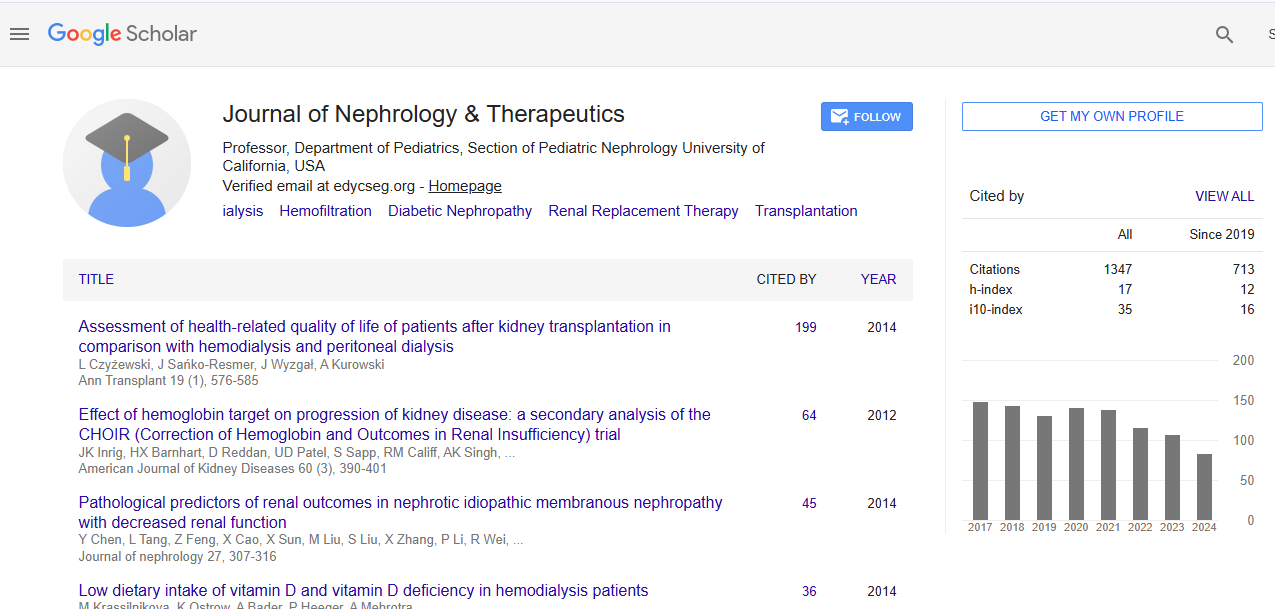
Journal of Nephrology & Therapeutics received 784 citations as per Google Scholar report