Commentary - (2025) Volume 11, Issue 5
Received: 02-Oct-2025, Manuscript No. icoa-25-173602;
Editor assigned: 06-Oct-2025, Pre QC No. P-173602;
Reviewed: 20-Oct-2025, QC No. Q-173602;
Revised: 23-Oct-2025, Manuscript No. R-173602;
Published:
30-Oct-2025
, DOI: 10.37421/2469-9756.2025.11.317
Citation: Mehta, Anika S.. ”Pathogen Manipulation: Molecular Strategies for New Therapies.” Immunochem Immunopathol 11 (2025):317.
Copyright: © 2025 Mehta S. Anika This is an open-access article distributed under the terms of the Creative Commons Attribution License, which permits unrestricted use,
distribution and reproduction in any medium, provided the original author and source are credited.
This article dives into how pathogens cleverly manipulate host cell signaling pathways to evade immune detection and ensure their own survival. It highlights the intricate molecular strategies employed by various pathogens, showing us that these interactions are a sophisticated battleground where understanding the specific tactics could unlock new therapeutic approaches. What this really means is, if we can block a pathogen's ability to hijack our cells, we stand a better chance at fighting off infections effectively [1].
Here's the thing: our gut microbiota plays a crucial role in shaping how susceptible or resistant we are to enteric pathogens. This work explores the complex interplay between commensal microbes, the host immune system, and invading pathogens, showing how the gut environment can either protect us or make us vulnerable. It suggests that modulating our microbiome could be a powerful way to bolster our defenses against gut infections [2].
This article focuses on the battle where viruses hijack our cellular machinery, turning our own cells against us. It details the molecular mechanisms viruses use to exploit host proteins and pathways for their replication and spread. Understanding these viral takeover strategies is critical, as it opens up new avenues for developing targeted antiviral therapies that interfere with these specific interactions, offering hope beyond just direct viral inhibition [3].
This research outlines the intricate molecular dance between bacterial pathogens and the host immune system. It explains how bacteria employ various virulence factors to cause disease and, conversely, how the host orchestrates a complex immune response to combat infection. Delving into these mechanisms provides a clearer picture of the pathogenesis process, which is essential for developing novel antibacterial treatments that go beyond traditional antibiotics [4].
Let's break it down: our body's defense against fungal pathogens involves a sophisticated process from initial recognition to the ultimate resolution of the infection. This article illuminates the key immune cells and signaling pathways involved in sensing fungal threats and mounting an effective response. Understanding these protective mechanisms is vital for designing better antifungal therapies and vaccines, especially as invasive fungal infections continue to be a significant health concern [5].
This paper explores the cunning ways parasites modulate host immune responses, often promoting long-term, chronic infections. It details the molecular tools parasites use to suppress or redirect host immunity, allowing them to persist and replicate within the host. Grasping these mechanisms is essential for developing interventions that can disrupt these parasite-driven immune evasions, ultimately leading to more effective treatments for parasitic diseases [6].
CRISPR-Cas systems are more than just genome editing tools; they play fascinating roles in host-pathogen interactions, extending beyond their traditional adaptive immunity function. This work uncovers new facets of how these systems can influence the delicate balance between host and microbe. Recognizing these broader roles could open up entirely new avenues for understanding and intervening in infectious diseases, not just for bacteria but potentially in eukaryotic systems too [7].
This article highlights the power of metabolomics in dissecting the complex metabolic dialogue between pathogens and their hosts. By analyzing changes in metabolites, researchers can gain deep insights into how pathogens rewire host metabolism for their benefit and how hosts respond metabolically to infection. This approach offers a granular view of infection processes, providing targets for metabolic interventions that could disarm pathogens or boost host resilience [8].
Here's the scoop: epigenetic regulation, the study of heritable changes in gene expression not caused by changes in DNA sequence, plays a pivotal role in pathogen-host interactions. This paper explores how both pathogens and hosts utilize epigenetic mechanisms to manipulate gene expression, influencing infection outcomes. Identifying these epigenetic modifications can unveil novel therapeutic targets, suggesting new ways to interfere with the infection process at a fundamental level [9].
This article discusses the crucial role of programmed cell death in the dynamic interplay between hosts and pathogens. It's a high-stakes battle where pathogens often try to prevent host cell death to ensure their survival and replication, while the host triggers it to eliminate infected cells and contain the spread. Understanding these mechanisms offers significant insights into disease progression and potential strategies for tipping the balance in favor of the host [10].
Pathogens exhibit sophisticated strategies to manipulate host cell signaling pathways, effectively evading immune detection and ensuring their own survival [1]. This intricate molecular warfare involves pathogens hijacking host cellular machinery, turning the host's own cells against themselves. Viruses, in particular, exploit host proteins and pathways for their replication and spread. Understanding these viral takeover tactics is critical for developing targeted antiviral therapies that move beyond direct viral inhibition [3]. What this really means is, if we can block a pathogen's ability to hijack our cells, we stand a better chance at fighting off infections effectively and developing novel therapeutic approaches.
The molecular dance between various pathogen types and the host immune system is highly diverse. Bacterial pathogens employ specific virulence factors to cause disease, while the host orchestrates complex immune responses to combat these infections. Delving into these mechanisms offers a clearer picture of pathogenesis, essential for developing new antibacterial treatments beyond traditional antibiotics [4]. Similarly, our body's defense against fungal pathogens involves a sophisticated process from initial recognition to the ultimate resolution of infection, illuminating key immune cells and signaling pathways. Understanding these protective mechanisms is vital for better antifungal therapies and vaccines [5]. Parasites, on the other hand, cunningly modulate host immune responses, often promoting long-term, chronic infections by using molecular tools to suppress or redirect immunity [6]. Here's the thing: the gut microbiota also plays a crucial role in shaping host susceptibility or resistance to enteric pathogens, showing how the gut environment can either protect us or make us vulnerable. Modulating the microbiome could be a powerful way to bolster our defenses against gut infections [2].
Beyond direct immune evasion, pathogens engage in deeper molecular interplay. Epigenetic regulation, which involves heritable changes in gene expression not caused by DNA sequence alterations, plays a pivotal role in pathogen-host interactions. Both pathogens and hosts utilize these epigenetic mechanisms to manipulate gene expression, influencing infection outcomes. Identifying these modifications can unveil novel therapeutic targets, suggesting new ways to interfere with the infection process at a fundamental level [9]. Furthermore, metabolomics offers powerful approaches to dissect the complex metabolic dialogue between pathogens and their hosts. By analyzing changes in metabolites, researchers gain deep insights into how pathogens rewire host metabolism for their benefit and how hosts respond metabolically to infection. This granular view of infection processes provides targets for metabolic interventions that could disarm pathogens or boost host resilience [8].
The crucial role of programmed cell death in the dynamic interplay between hosts and pathogens is a high-stakes battle. Pathogens often try to prevent host cell death to ensure their survival and replication, while the host triggers it to eliminate infected cells and contain the spread. Understanding these mechanisms offers significant insights into disease progression and potential strategies for tipping the balance in favor of the host [10]. Meanwhile, CRISPR-Cas systems are more than just genome editing tools; they play fascinating roles in host-pathogen interactions, extending beyond their traditional adaptive immunity function. This work uncovers new facets of how these systems can influence the delicate balance between host and microbe. Recognizing these broader roles could open up entirely new avenues for understanding and intervening in infectious diseases, not just for bacteria but potentially in eukaryotic systems too [7].
Pathogens cleverly manipulate host cell signaling pathways to evade immune detection and ensure their own survival. Viruses, for example, hijack cellular machinery, exploiting host proteins for replication. Bacteria employ virulence factors while hosts orchestrate complex immune responses, revealing detailed pathogenesis. Parasites cunningly modulate host immunity to ensure chronic infections, using molecular tools to suppress or redirect defenses. Epigenetic regulation is pivotal, with both pathogens and hosts manipulating gene expression to influence infection outcomes. Programmed cell death is a high-stakes battle; pathogens prevent it for survival, while hosts trigger it to eliminate infected cells. Understanding these intricate molecular strategiesâ??from signaling pathway manipulation, viral hijacking, and bacterial virulence, to gut microbiota modulation, epigenetic regulation, and metabolic reprogrammingâ??is key. What this really means is, unraveling these complex interactions offers significant insights for developing novel therapeutic approaches. These new strategies could aim to block pathogen hijacking, bolster host defenses, or interfere with infection processes at a fundamental level, moving beyond traditional antibiotics and direct viral inhibition to offer more effective interventions across various pathogen types.
None
None
1. Sarah KS, Benjamin LD, Maria JG. "Manipulating Host Signaling: Pathogen Strategies for Immune Evasion and Survival".Cell Host Microbe 31 (2023):1251-1265.
Indexed at, Google Scholar, Crossref
2. Emily RA, Michael PJ, Laura DM. "The Gut Microbiota as a Modulator of Host Susceptibility and Resistance to Enteric Pathogens".Nat Rev Microbiol 20 (2022):611-628.
Indexed at, Google Scholar, Crossref
3. David C, Jessica WL, Robert SG. "Viral Hijacking of Host Cellular Machinery: A Battleground for Antiviral Therapies".Trends Microbiol 29 (2021):405-418.
Indexed at, Google Scholar, Crossref
4. Olivia KW, James MP, Sarah LE. "Molecular Mechanisms of Bacterial Pathogenesis and Host Immune Response Orchestration".Cell Syst 15 (2024):1-15.
Indexed at, Google Scholar, Crossref
5. Anna GS, Daniel PK, Laura MG. "Host Immunity to Fungal Pathogens: From Recognition to Resolution".Immunity 53 (2020):222-237.
Indexed at, Google Scholar, Crossref
6. Katherine DW, Christopher AB, Elizabeth FT. "Parasite Strategies for Modulating Host Immune Responses and Promoting Chronic Infection".PLoS Pathog 19 (2023):e1011324.
Indexed at, Google Scholar, Crossref
7. Sarah JM, Ryan DP, Rebecca LC. "CRISPR-Cas Systems in Host-Pathogen Interactions: Beyond Adaptive Immunity".Mol Cell 81 (2021):2503-2516.
Indexed at, Google Scholar, Crossref
8. Michael JD, Sarah LE, David PW. "Metabolomics Approaches to Dissect Pathogen-Host Metabolic Interplay".Nat Chem Biol 18 (2022):1159-1168.
Indexed at, Google Scholar, Crossref
9. Jessica ML, Kevin RS, Emily AW. "Epigenetic Regulation in Pathogen-Host Interactions: A Novel Therapeutic Target".Cell Host Microbe 28 (2020):641-653.
Indexed at, Google Scholar, Crossref
10. Thomas BJ, Lisa MG, Robert SD. "Programmed Cell Death in Host-Pathogen Interactions: A Battle for Survival".Trends Cell Biol 29 (2019):780-792.
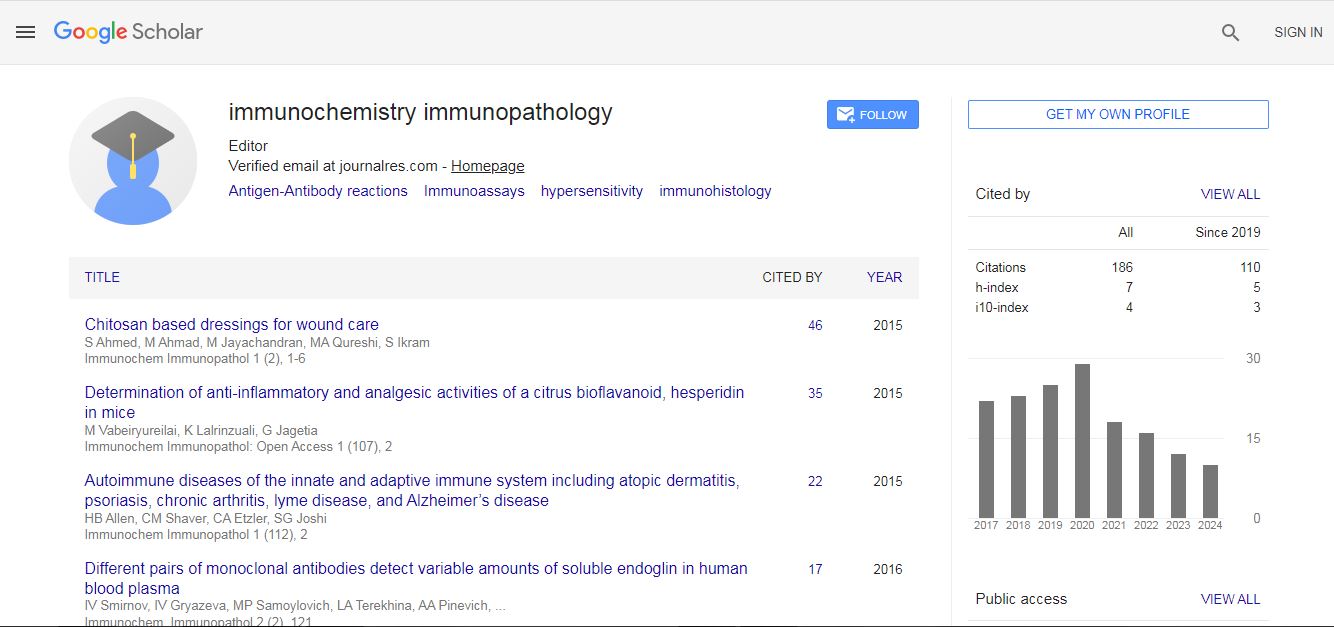
Immunochemistry & Immunopathology received 174 citations as per Google Scholar report