Brief Report - (2025) Volume 15, Issue 2
Received: 02-Jun-2025, Manuscript No. jttr-25-175364;
Editor assigned: 04-Jun-2025, Pre QC No. P-175364;
Reviewed: 18-Jun-2025, QC No. Q-175364;
Revised: 23-Jun-2025, Manuscript No. R-175364;
Published:
30-Jun-2025
, DOI: 10.37421/2161-0991.2025.15.295
Citation: Stanton, Amelia R.. ”Organ Transplantation: Challenges, Ethics, Innovation.” J Transplant Technol Res 15 (2025):295.
Copyright: © 2025 Stanton R. Amelia This is an open-access article distributed under the terms of the Creative Commons Attribution License, which permits unrestricted use, distribution and reproduction in any medium, provided the original author and source are credited.
Organ transplantation, a medical marvel, continuously evolves, offering a lifeline to individuals facing end-stage organ failure. This complex field navigates a multitude of challenges, from ethical quandaries to immunological hurdles and psychological impacts. The pursuit of better outcomes also drives innovation in bioengineering and advanced preservation techniques. The foundation of ethical and legal practice is critical. The complex ethical and legal landscape surrounding organ transplantation focuses on issues like organ allocation, donor consent, and preventing organ trafficking. This highlights a persistent need for frameworks that balance medical necessity with human rights and societal values, ensuring fairness and equity [1].
Immunological considerations remain at the forefront of transplant success. Ongoing immunological hurdles in solid organ transplantation concern allograft rejection and chronic graft failure. Progress has been made with advancements in immunosuppressive therapies, biomarker discovery, and cellular engineering, designed to improve long-term transplant outcomes and enhance patient well-being [2].
Unforeseen global events can profoundly impact established protocols. This is evident in the unique ethical dilemmas in organ allocation during public health crises. Addressing these requires careful exploration of strategies for fair distribution of scarce organs while managing competing demands for healthcare resources, ensuring equitable access for all patients [3].
Considering the long-term prognosis is paramount. Reviews consistently delve into factors influencing long-term success rates and complications. This research covers chronic graft dysfunction, cardiovascular risks, and post-transplant malignancies, emphasizing strategies for improving both patient and graft survival over extended periods [4].
Beyond the physical, the emotional toll is substantial. The significant psychological impact of organ transplantation covers pre-transplant mental health assessments, ensuring adherence to treatment, and aiding in coping with the emotional burden of a life-altering procedure. This work underscores the critical importance of integrated psychosocial support systems [5].
Innovation continuously pushes boundaries. Breakthroughs in xenotransplantation, particularly the pioneering use of genetically modified pig organs for human recipients, represent a fascinating frontier. This research discusses efforts to overcome immunological barriers and address safety concerns, highlighting the potential of xenotransplantation to alleviate critical organ shortages [6].
Advancements in bioengineering and regenerative medicine are also shaping the future. Cutting-edge approaches are aimed at enhancing organ transplantation, covering strategies like organ decellularization, 3D bioprinting, and advanced stem cell therapies. These efforts are geared towards creating functional organs and reducing reliance on traditional donor organs [7].
Managing immune responses is key to preventing rejection. Innovative immunomodulatory therapies are designed to prevent or mitigate organ transplant rejection. These include targeted immunosuppression, cell-based therapies, and approaches to induce donor-specific tolerance, with the goal of improving graft survival and reducing side effects of conventional treatments [8].
Organ preservation technology has seen considerable improvements. An updated review discusses the advancements and benefits of machine perfusion technology in preserving donor organs. This technique significantly improves organ viability, allows for better assessment, and effectively expands the donor pool, leading to improved post-transplant outcomes [9].
A particularly sensitive area involves pediatric patients. This article explores the specific challenges associated with organ transplantation in pediatric patients, addressing issues like donor organ scarcity, complex surgical techniques, long-term growth and development considerations, and the psychological impact on young recipients and their families [10].
In essence, the field of organ transplantation is a dynamic interplay of medical innovation, ethical consideration, and patient-centered care. Addressing these multifaceted aspects is crucial for advancing transplant medicine and improving lives worldwide.
The ethical and legal considerations in organ transplantation form a cornerstone of its practice, demanding careful navigation of complex issues [1]. These include equitable allocation, informed donor consent, and preventing organ trafficking. Robust frameworks must balance medical necessity with human rights and societal values. These dilemmas are further compounded during public health crises, where ethical considerations in organ allocation become paramount [3]. Such situations necessitate developing precise strategies for fair distribution of scarce organs, managing competing demands for healthcare resources, and ensuring equitable access. Moreover, pediatric organ transplantation presents its own distinct set of challenges [10]. This area addresses donor organ scarcity for children, complex surgical techniques, long-term growth and development considerations, and the significant psychological impact on young recipients and their families, requiring a highly specialized and empathetic approach.
Immunological challenges and advancements in solid organ transplantation remain central to improving patient outcomes [2]. Primary hurdles involve allograft rejection and chronic graft failure. However, the field has seen significant progress through advancements in immunosuppressive therapies, innovative biomarker discovery, and cellular engineering, all designed to improve long-term transplant outcomes. Understanding the long-term outcomes is crucial for refining treatment protocols [4]. Reviews consistently delve into factors influencing success rates and complications like chronic graft dysfunction, cardiovascular risks, and post-transplant malignancies. This research actively emphasizes proactive strategies for improving both patient and graft survival. To effectively prevent or mitigate organ transplant rejection, novel immunomodulatory strategies are continuously being explored [8]. These include highly targeted immunosuppression, cell-based therapies, and approaches to induce donor-specific tolerance, aiming to enhance graft survival while reducing the severe side effects associated with conventional anti-rejection treatments.
The psychological aspects in solid organ transplantation are profound and require dedicated attention, influencing patients at every stage of their journey [5]. This critical area of study meticulously examines the significant psychological impact, encompassing thorough pre-transplant mental health assessments, ensuring rigorous adherence to complex post-transplant treatment regimens, and providing essential support for coping with the immense emotional burden of a life-altering medical procedure. This research strongly underscores the undeniable importance of providing integrated psychosocial support. Such comprehensive support systems contribute significantly not only to immediate recovery but also to overall long-term patient well-being and successful adjustment, fostering resilience throughout the entire transplant process.
Transformative technological advancements are rapidly reshaping the landscape of organ transplantation, offering solutions to persistent challenges. Advances in xenotransplantation, particularly through the groundbreaking use of genetically modified pig organs for human recipients, represent a promising avenue for addressing critical organ shortages [6]. Efforts in this domain focus intensely on overcoming inherent immunological barriers and rigorously addressing all associated safety concerns. Complementing these developments, bioengineering and regenerative medicine strategies for organ transplantation are actively exploring cutting-edge approaches [7]. These include sophisticated techniques like organ decellularization, advanced 3D bioprinting, and various stem cell therapies, all specifically geared towards creating functional organs and thereby reducing profound reliance on traditional human donor organs. Furthermore, the updated review on machine perfusion technology for organ preservation highlights its considerable benefits [9]. This technique demonstrably improves organ viability, allows for a much better assessment of organ quality, and significantly expands the donor pool, ultimately leading to improved post-transplant outcomes for recipients.
Organ transplantation is a complex field facing diverse challenges and driven by continuous innovation. Ethical and legal frameworks are crucial for guiding organ allocation, donor consent, and preventing trafficking, especially during crises like pandemics. Immunological hurdles, such as allograft rejection and chronic graft failure, are addressed through advancements in immunosuppressive therapies and cellular engineering, aiming to improve long-term patient and graft survival. Research also focuses on mitigating complications like cardiovascular risks and post-transplant malignancies. The psychological impact on patients, from pre-transplant assessment to post-transplant adherence and coping, highlights the need for integrated psychosocial support. Breakthroughs in xenotransplantation using genetically modified pig organs offer hope for alleviating organ shortages by overcoming immunological barriers. Bioengineering and regenerative medicine, including organ decellularization, 3D bioprinting, and stem cell therapies, are actively working to create functional organs and reduce reliance on traditional donors. Innovative immunomodulatory strategies aim to prevent rejection and reduce treatment side effects. Improved organ preservation techniques, like machine perfusion, enhance viability and expand the donor pool, leading to better outcomes. Finally, pediatric transplantation presents unique challenges concerning organ scarcity, surgical complexities, developmental considerations, and significant psychological support needs for young recipients and their families. This broad spectrum of research underscores ongoing efforts to advance transplant medicine across medical, ethical, and technological fronts.
None
None
Parisa E, Arezo Z, Zahra R. "Ethical and legal considerations in organ transplantation: A systematic review".J Med Ethics Hist Med 16 (2023):38.
Indexed at, Google Scholar, Crossref
Stefano T, Mattia T, Luca B. "Immunological challenges and advancements in solid organ transplantation".Front Cardiovasc Med 10 (2023):1297594.
Indexed at, Google Scholar, Crossref
Amelia R, Marco C, Silvia DS. "Ethical considerations in organ allocation during pandemics".Minerva Anestesiol 86 (2020):1109-1111.
Indexed at, Google Scholar, Crossref
Marco D, Isabella L, Manuela A. "Long-term outcomes of solid organ transplantation: current challenges and future perspectives".Exp Rev Gastroenterol Hepatol 15 (2021):395-407.
Indexed at, Google Scholar, Crossref
Verena R, Roland S, Barbara J. "Psychological aspects in solid organ transplantation: a narrative review".J Clin Med 11 (2022):5493.
Indexed at, Google Scholar, Crossref
Martina V, Bruna P, Raffaele D. "Advances in xenotransplantation: current status and future perspectives".Transfusion 62 (2022):S29-S38.
Indexed at, Google Scholar, Crossref
Giuseppe O, Seyed HM, Anthony CF. "Bioengineering and regenerative medicine strategies for organ transplantation".Curr Opin Organ Transplant 25 (2020):549-556.
Indexed at, Google Scholar, Crossref
Jost G, Emilio DP, W HWT. "Novel immunomodulatory strategies to prevent organ transplant rejection".J Clin Med 12 (2023):3450.
Indexed at, Google Scholar, Crossref
Markus S, Kamran M, Nora S. "Machine perfusion for organ preservation in transplantation: an updated review".Transplant Rev (Orlando) 35 (2021):100595.
Indexed at, Google Scholar, Crossref
Aditya D, Sunny K, Hong C. "Unique challenges in pediatric organ transplantation".Curr Opin Pediatr 36 (2024):115-121.
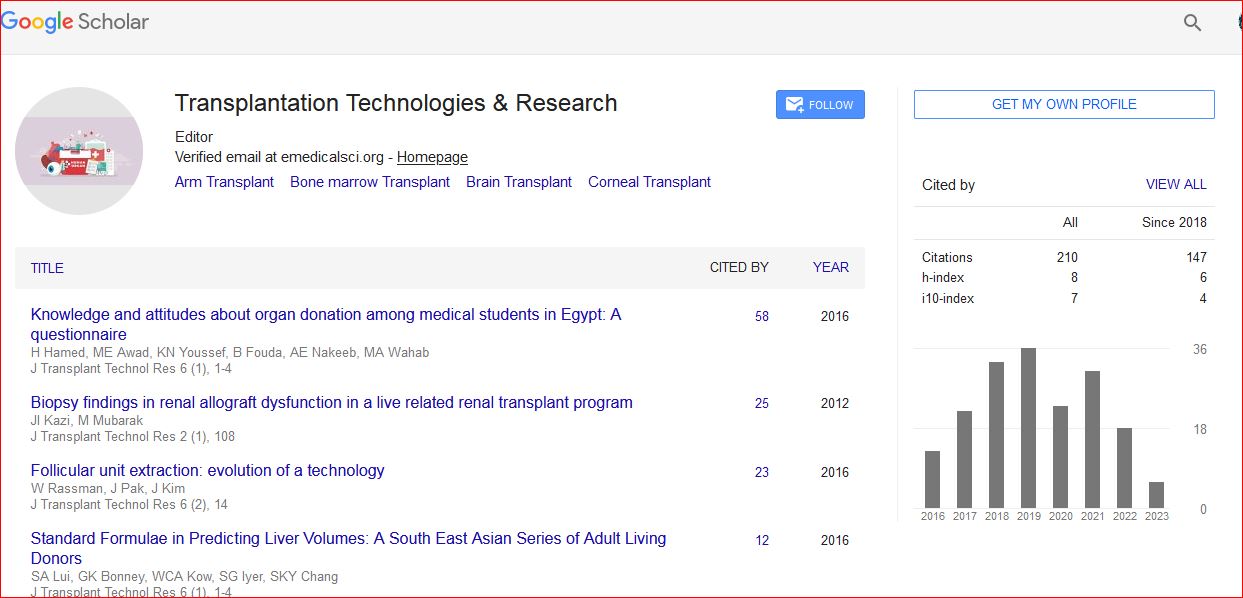
Transplantation Technologies & Research received 223 citations as per Google Scholar report