Perspective - (2025) Volume 15, Issue 4
Received: 01-Dec-2025, Manuscript No. jttr-25-175457;
Editor assigned: 03-Dec-2025, Pre QC No. P-175457;
Reviewed: 17-Dec-2025, QC No. Q-175457;
Revised: 22-Dec-2025, Manuscript No. R-175457;
Published:
29-Dec-2025
, DOI: 10.37421/2161-0991.2025.15.321
Citation: Turner, Olivia A.. ”Organ Transplant Ethics: Justice, Consent, Emerging Challenges.” J Transplant Technol Res 15 (2025):321.
Copyright: © 2025 Turner A. Olivia This is an open-access article distributed under the terms of the Creative Commons Attribution License, which permits unrestricted use, distribution and reproduction in any medium, provided the original author and source are credited.
The complex field of organ transplantation is consistently challenged by a myriad of ethical dilemmas, ranging from fundamental questions of patient eligibility to the integration of advanced technologies. At its core, the just and equitable allocation of scarce organs remains a central concern, particularly evident when considering individuals with substance use disorders. Here, clinicians and ethicists must meticulously balance principles of justice, utility, and beneficence, while simultaneously navigating entrenched societal biases and the challenging potential for relapse [1].
This requires thoughtful policy development to ensure fairness without unduly penalizing those striving for recovery. Another significant ethical domain centers on the living donor. Living kidney donation, while vital, carries inherent risks and demands robust safeguards to protect the donor's interests. This includes securing genuinely informed consent, upholding donor autonomy free from undue pressure, mitigating any potential for coercion, and providing comprehensive support for their psychological well-being throughout the process and beyond [2].
The broader issues of consent, authorization, and presumed consent in organ donation underscore the persistent tension between respecting individual autonomy and the urgent, life-saving need for transplantable organs. These legal and ethical frameworks require continuous re-evaluation to reflect evolving societal values and medical capabilities [3].
The very act of organ procurement from deceased individuals also involves distinct ethical layers. For donors after controlled circulatory death (cDCD), strict guidelines are paramount for the accurate determination of death and unwavering adherence to the â??dead donor ruleâ??. It is essential to ensure profound respect for the donorâ??s body and wishes during this process, especially as cDCD pathways become more common to meet increasing organ demand [4].
Similarly, in cases of deceased organ donation following brain death, ethical discussions revolve around the precision of diagnostic criteria, the deeply sensitive communication required with grieving donor families, and maintaining the absolute integrity of the entire donation process. This ensures that the profound gift of donation honors the deceased and their familyâ??s wishes with utmost dignity [9].
Beyond individual donor and recipient considerations, organ transplantation faces global ethical challenges that demand international collaboration. Pervasive issues such as organ trafficking, which tragically exploits vulnerable populations, and transplant tourism, where patients seek organs by circumventing national ethical guidelines, highlight a critical need for robust international ethical governance. Such governance is essential to ensure fair practices and prevent further exploitation [5].
These global disparities are mirrored in significant health inequities within solid organ transplantation. Socioeconomic status, racial background, and geographic location often profoundly impact access to transplant care and subsequent patient outcomes, fundamentally undermining the principle of distributive justice in organ allocation and necessitating systemic interventions [8].
Moreover, the frontier of transplantation medicine brings its own set of ethical quandaries. Xenotransplantation, involving the use of animal organs, raises complex questions regarding animal welfare, demanding humane treatment and careful consideration of the moral status of animals used as organ sources. There is also the critical potential for zoonotic disease transmission, and the necessity of obtaining truly informed consent from recipients for such novel and risky procedures. Society must also contend with the moral status of using animals as sources for human organs [6].
In parallel, the rapid integration of Artificial Intelligence (AI) and machine learning into organ transplantation introduces new ethical imperatives. This includes proactively addressing potential algorithmic bias, ensuring stringent data privacy, preserving patient autonomy in technologically-assisted decision-making, and diligently working towards the equitable distribution of this technologyâ??s substantial benefits across all patient demographics [10].
Finally, specific populations introduce specialized ethical considerations. Pediatric organ transplantation, for instance, involves navigating the complexities of proxy consent provided by parents, balancing their authority with the evolving autonomy of the child. Determining the 'best interest' for child recipients requires multidisciplinary ethical deliberation, alongside managing unique allocation challenges for a young and growing patient population, and addressing the significant long-term psychosocial impact on young patients and their families. These situations require careful, empathetic, and multidisciplinary ethical deliberation [7].
Cumulatively, this body of work highlights the dynamic and multifaceted ethical landscape of organ transplantation, emphasizing the continuous need for thoughtful analysis, adaptive policy, and a commitment to upholding core bioethical principles amidst ongoing medical advancements.
Organ transplantation operates within a highly complex ethical framework, where various stakeholders and medical advancements continually introduce new dilemmas. A fundamental area of focus is the fair distribution of organs. For instance, allocating organs to individuals with substance use disorders demands a careful balance of justice and utility, while actively addressing societal biases and the persistent concern of relapse [1]. Beyond this, the voluntary nature of living donation, particularly for kidneys, is paramount. Ethical guidelines must meticulously safeguard informed consent, ensure donor autonomy, and actively prevent any form of coercion, while also prioritizing the psychological well-being of the donor [2]. The very act of consent in organ donationâ??whether explicit authorization or presumed consentâ??highlights profound ethical and legal complexities in upholding individual autonomy against the pressing societal need for organs [3]. These foundational elements are critical for maintaining trust in the transplant system.
The process of organ procurement itself is rife with ethical considerations, particularly concerning deceased donors. When retrieving organs from donors after controlled circulatory death, adherence to the 'dead donor rule' and the precise determination of death are crucial. Respect for the deceased donor is paramount, a principle that must guide all aspects of procurement, especially as the demand for transplantable organs continues to escalate and these donation pathways become more common [4]. Similarly, deceased organ donation following brain death entails its own specific challenges, including the precise diagnostic criteria for brain death itself. Sensitive and clear communication with donor families is essential, as is maintaining the utmost integrity throughout the donation process to honor the wishes of both the deceased and their family. These practices reinforce the sanctity of the donation process and the profound gift it represents [9].
Looking beyond individual cases, global organ transplantation faces pervasive ethical challenges that transcend national borders. Issues like organ trafficking, which tragically exploits vulnerable populations, and transplant tourism, where patients seek organs by circumventing local regulations and often contribute to exploitative practices, are deeply concerning. Ensuring equitable access to transplantation for all eligible patients globally is a persistent struggle, necessitating robust international ethical governance to protect those most at risk and ensure fair distribution [5]. These global disparities are further reflected in significant domestic health inequities within solid organ transplantation, where socioeconomic status, racial background, and geographic location often profoundly influence access to care and patient outcomes. Such disparities fundamentally challenge the principle of distributive justice in organ allocation, highlighting systemic issues that require urgent attention and policy reform [8].
Moreover, the field is constantly evolving with new medical frontiers, each presenting its own ethical quandaries that push the boundaries of current frameworks. Xenotransplantation, the use of animal organs in humans, raises profound questions about animal welfare, demanding humane treatment and careful consideration of the moral status of animals used as organ sources. There is also the critical potential for zoonotic disease transmission, and the necessity of ensuring truly informed consent from recipients for what remains a highly experimental and uncertain procedure [6]. Similarly, the rapid integration of Artificial Intelligence (AI) and machine learning into transplantation brings with it complex ethical dimensions. We must proactively address algorithmic bias in allocation decisions, protect patient data privacy in shared systems, maintain patient autonomy in technologically-assisted decision-making processes, and work diligently to ensure that the benefits of this advanced technology are distributed equitably across all populations, avoiding new forms of disparity [10].
Finally, specific patient populations introduce unique ethical demands and vulnerabilities. Pediatric organ transplantation, for instance, involves complex dynamics around proxy consent provided by parents, balancing their authority with the evolving autonomy of the child. Determining the 'best interest' of a child recipient requires multidisciplinary ethical deliberation, alongside navigating the unique allocation complexities for a young and growing patient population, and addressing the significant long-term psychosocial impact on young patients and their families who navigate a lifetime of medical care [7]. Addressing these multifaceted ethical considerationsâ??from individual consent to global governance and technological integrationâ??is vital for maintaining public trust, ensuring equity, and guiding organ transplantation as a truly life-saving and ethically sound medical practice.
The ethical landscape of organ transplantation is notably complex, covering a wide range of issues from patient selection to advanced medical technologies. This body of work highlights critical challenges in organ allocation for individuals with substance use disorders, urging a balance between justice, utility, and addressing societal biases. Living kidney donation emphasizes the need for informed consent, donor autonomy, and psychological support. The foundational ethics of consent, authorization, and presumed consent are crucial, as is the respect for donors in deceased organ procurement, including cases of controlled circulatory death. Global concerns like organ trafficking, transplant tourism, and ensuring equitable access for vulnerable populations demand international governance. Emerging areas such as xenotransplantation raise questions about animal welfare and zoonotic risk, while the integration of Artificial Intelligence brings forth dilemmas regarding algorithmic bias, data privacy, and equitable technology distribution. Furthermore, specific challenges in pediatric transplantation involve proxy consent and long-term psychosocial impacts. Underlying these diverse issues are significant health inequities that impact access and outcomes, fundamentally challenging distributive justice. Collectively, these topics underscore the ongoing imperative for robust ethical frameworks to ensure fairness, respect, and efficacy in this vital medical field.
None
None
Elizabeth AH, Emily JG, Kimberly EL. "Ethical considerations in organ allocation for patients with substance use disorders".Curr Opin Organ Transplant 28 (2023):111-116.
Indexed at, Google Scholar, Crossref
Shailesh K, Ritika G, Thirunavukkarasu S. "Ethical challenges in living kidney donation".Transpl Int 37 (2024):11-16.
Indexed at, Google Scholar, Crossref
Pedro MM, Paulo M, Manuel AM. "Consent, authorization, and presumed consent in organ donation: Ethical and legal perspectives.".Transplant Rev (Orlando) 35 (2021):100588.
Indexed at, Google Scholar, Crossref
Stephen G, David S, Jonathan L. "Ethical aspects of organ procurement from donors with controlled circulatory death.".J Med Ethics 46 (2020):36-40.
Indexed at, Google Scholar, Crossref
Yosuke S, Ellen A, Elias dP. "Ethical challenges in global organ transplantation: A scoping review.".Transpl Int 36 (2023):11488.
Indexed at, Google Scholar, Crossref
David KC, Richard NP3, Wouter VdW. "Ethical issues in xenotransplantation.".Transpl Int 35 (2022):10609.
Indexed at, Google Scholar, Crossref
Silvia F, Abhijit K, Francesca F. "Ethical considerations in pediatric organ transplantation.".Pediatr Nephrol 36 (2021):3-10.
Indexed at, Google Scholar, Crossref
David G, Peter PR, Peter A. "Ethical implications of health inequities in solid organ transplantation".Transplantation 107 (2023):825-832.
Indexed at, Google Scholar, Crossref
James RR, Jared G, David AM. "Ethical considerations in deceased organ donation: A review of current practices.".Clin Transpl 34 (2020):e14041.
Indexed at, Google Scholar, Crossref
Lena L, Matthias S, Karoline S. "Ethical aspects of organ transplantation in the era of artificial intelligence and machine learning".Z Evid Fortbild Qual Gesundhwes 181 (2023):117-122.
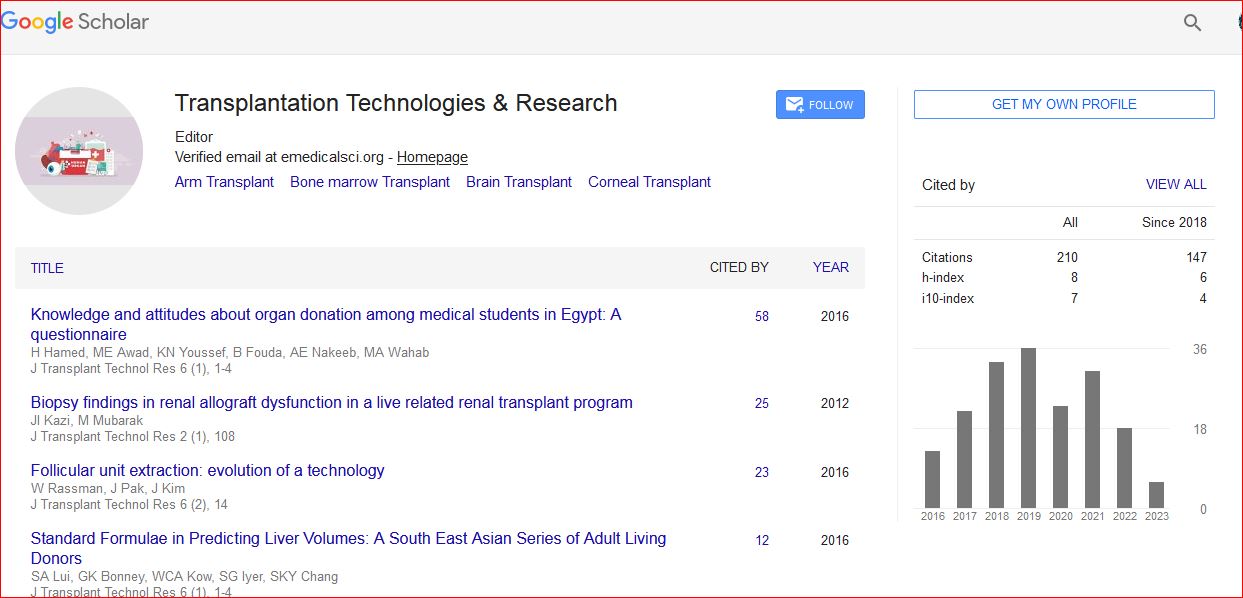
Transplantation Technologies & Research received 223 citations as per Google Scholar report