Short Communication - (2025) Volume 11, Issue 4
Received: 01-Jul-2025, Manuscript No. ohcr-25-174308;
Editor assigned: 03-Jul-2025, Pre QC No. P-174308;
Reviewed: 17-Jul-2025, QC No. Q-174308;
Revised: 22-Jul-2025, Manuscript No. R-174308;
Published:
29-Jul-2025
, DOI: 10.37421/2471-8726.2025.11.209
Citation: Santos, Miguel. ”Oral Manifestations: Windows to Systemic Diseases.” Oral Health Case Rep 11 (2025):209.
Copyright: © 2025 Santos M. This is an open-access article distributed under the terms of the Creative Commons Attribution License, which permits unrestricted use, distribution and reproduction in any medium, provided the original author and source are credited.
This systematic review highlights common oral manifestations in patients with inflammatory bowel disease (IBD), including aphthous ulcers, cheilitis, pyostomatitis vegetans, and periodontal disease. It underscores the importance of oral health screening in IBD management and suggests that these manifestations often correlate with disease activity. This makes oral health screening not just important, but vital in IBD management, as these manifestations can serve as clear diagnostic or prognostic indicators of disease activity and progression [1].
This review consolidates current understanding of oral symptoms linked to systemic lupus erythematosus (SLE), noting that lesions like discoid lupus erythematosus (DLE) plaques, non-specific erythema, ulcers, and lichenoid reactions are common. These oral manifestations are often among the first signs to appear, even preceding more generalized systemic symptoms, or they may closely correlate with periods of disease flares, necessitating vigilant monitoring [2].
This comprehensive review examines how diabetes mellitus significantly impacts oral health, leading to conditions like periodontal disease, xerostomia, oral candidiasis, and delayed wound healing. Understanding these connections is vital for dentists and physicians to collaboratively manage patient health, recognizing that poor glycemic control worsens oral issues and vice versa. This bidirectional relationship means that diligent management of blood sugar levels is as important as targeted oral hygiene to prevent or mitigate these severe oral complications, emphasizing the critical role of interprofessional collaboration [3].
A systematic review revealed that chronic kidney disease (CKD) often presents with distinct oral manifestations, including xerostomia, halitosis, taste alterations, oral mucosal lesions, and an increased risk of periodontal disease. These oral problems can significantly affect the quality of life for CKD patients and require integrated dental care as part of their overall medical management. Integrating comprehensive dental care into the broader medical management of CKD patients is paramount to improving their overall well-being and mitigating the significant impact these oral issues have on their quality of life [4].
This systematic review outlines the oral manifestations associated with rheumatoid arthritis (RA), highlighting conditions such as temporomandibular joint dysfunction, periodontal disease, xerostomia, and Sjögren's-like symptoms. Oral health screening and interdisciplinary care are essential for RA patients, as these manifestations impact their quality of life and may reflect systemic disease activity. These specific oral manifestations significantly impact a patient's quality of life and often provide valuable insights into the broader systemic disease activity, highlighting the necessity for coordinated, interdisciplinary care [5].
This review goes beyond the well-known xerostomia to explore the comprehensive range of oral manifestations in Sjögren's syndrome, including dental caries, candidiasis, salivary gland enlargement, and dysphagia. A thorough understanding of these diverse oral issues is paramount for effective patient management, aiming to improve oral health and overall well-being for those with Sjögren's. This broader understanding facilitates more effective patient management strategies, ultimately enhancing oral health and improving the overall well-being and comfort for individuals living with Sjögren's syndrome [6].
This systematic review explores the spectrum of oral manifestations in psoriasis patients, including fissured tongue, geographic tongue, cheilitis, and oral candidiasis. These findings suggest that oral cavity involvement in psoriasis is more common than often recognized, emphasizing the need for oral examinations in dermatological practice to improve diagnosis and patient care. Recognizing these diverse oral presentations is crucial, as they underscore the need for regular oral examinations within dermatological practice, which can lead to earlier diagnosis and significantly improved patient care for psoriasis sufferers [7].
This review details the diverse oral manifestations of HIV infection in the era of highly active antiretroviral therapy (HAART), noting a shift from opportunistic infections to conditions like dry mouth, Human Papillomavirus (HPV)-associated lesions, and periodontal disease. While HAART has altered the prevalence of certain oral lesions, continuous oral health monitoring remains critical for improving quality of life and detecting potential systemic complications in HIV-positive individuals. Therefore, consistent and thorough oral health monitoring remains indispensable for enhancing the quality of life and enabling early detection of potential systemic complications among individuals living with HIV [8].
This systematic review summarizes oral manifestations linked to celiac disease, including enamel defects, recurrent aphthous stomatitis, dry mouth, and glossitis. Oral signs can be early indicators of celiac disease, especially in children, making oral health professionals key in the diagnostic process and overall patient management. These findings position oral health professionals as key contributors in the diagnostic process and comprehensive management strategies for celiac disease, particularly in pediatric populations where oral signs might be the first clue [9].
This review provides an overview of how thyroid disorders, both hypo- and hyperthyroidism, affect oral health, causing issues like macroglossia, delayed tooth eruption, periodontal disease, and burning mouth syndrome. Recognizing these oral changes can signal underlying thyroid dysfunction, underscoring the importance of a comprehensive medical history and interdisciplinary approach in patient care. This nuanced understanding of how thyroid function affects oral health emphasizes the critical role of a detailed medical history and an integrated, interdisciplinary approach in providing holistic patient care [10].
Oral manifestations frequently serve as critical indicators of various underlying systemic diseases, particularly in autoimmune and inflammatory conditions. Inflammatory bowel disease (IBD) presents with distinct oral manifestations like aphthous ulcers, cheilitis, pyostomatitis vegetans, and periodontal disease. These often correlate with the disease activity, underscoring the importance of oral health screening in IBD management, and making these signs potential diagnostic or prognostic indicators [1]. Similarly, systemic lupus erythematosus (SLE) is characterized by lesions such as discoid lupus erythematosus (DLE) plaques, non-specific erythema, ulcers, and lichenoid reactions. These oral signs are crucial for early diagnosis and monitoring disease activity, frequently preceding systemic symptoms or correlating with disease flares [2]. Rheumatoid arthritis (RA) also presents with specific oral manifestations, including temporomandibular joint dysfunction, periodontal disease, xerostomia, and Sjögren's-like symptoms. Oral health screening and interdisciplinary care are essential for RA patients, as these manifestations significantly impact their quality of life and may reflect broader systemic disease activity [5].
Metabolic and endocrine disorders like diabetes mellitus profoundly affect oral health, leading to periodontal disease, xerostomia, oral candidiasis, and delayed wound healing. Understanding these connections is vital for collaborative patient management between dentists and physicians, acknowledging that poor glycemic control exacerbates oral issues and vice versa [3]. Thyroid disorders, encompassing both hypo- and hyperthyroidism, can cause issues like macroglossia, delayed tooth eruption, periodontal disease, and burning mouth syndrome. Recognizing these oral changes can signal underlying thyroid dysfunction, highlighting the need for a comprehensive medical history and an interdisciplinary approach in patient care [10]. Furthermore, celiac disease is linked to oral manifestations such as enamel defects, recurrent aphthous stomatitis, dry mouth, and glossitis. Oral signs can be early indicators of celiac disease, particularly in children, making oral health professionals key contributors in the diagnostic process and overall patient management [9].
Chronic and infectious systemic conditions also exhibit notable oral presentations. Chronic kidney disease (CKD) often manifests with xerostomia, halitosis, taste alterations, oral mucosal lesions, and an increased risk of periodontal disease. These oral problems significantly impact the quality of life for CKD patients and necessitate integrated dental care as part of their overall medical management [4]. In the context of Human Immunodeficiency Virus (HIV) infection, particularly in the era of highly active antiretroviral therapy (HAART), there has been a shift from opportunistic infections to conditions like dry mouth, Human Papillomavirus (HPV)-associated lesions, and periodontal disease. Continuous oral health monitoring remains critical for improving quality of life and detecting potential systemic complications in HIV-positive individuals [8].
Other systemic conditions like Sjögren's syndrome and psoriasis also have specific oral implications. Sjögren's syndrome extends beyond the well-known xerostomia to a comprehensive range of oral manifestations, including dental caries, candidiasis, salivary gland enlargement, and dysphagia. A thorough understanding of these diverse oral issues is paramount for effective patient management, aiming to improve oral health and overall well-being for those with Sjögren's [6]. Psoriasis patients frequently exhibit oral manifestations such as fissured tongue, geographic tongue, cheilitis, and oral candidiasis. These findings suggest that oral cavity involvement in psoriasis is more common than often recognized, emphasizing the need for oral examinations in dermatological practice to improve diagnosis and patient care [7].
Oral manifestations frequently serve as critical indicators of various underlying systemic diseases. For example, inflammatory bowel disease (IBD) presents with aphthous ulcers and periodontal disease, which often correlate with disease activity, making them potential diagnostic markers [1]. Systemic lupus erythematosus (SLE) is associated with lesions like DLE plaques and ulcers, vital for early diagnosis and monitoring disease flares [2]. Similarly, diabetes mellitus profoundly impacts oral health, causing periodontal disease, xerostomia, and candidiasis, with poor glycemic control worsening these issues [3]. Chronic kidney disease (CKD) manifests orally as xerostomia, halitosis, and taste alterations, significantly affecting patient quality of life and necessitating integrated dental care [4]. Rheumatoid arthritis (RA) can lead to temporomandibular joint dysfunction and periodontal disease, reflecting systemic activity and demanding interdisciplinary management [5]. Sjögren's syndrome goes beyond xerostomia to include dental caries and candidiasis, requiring comprehensive understanding for effective patient care [6]. Psoriasis patients often show fissured or geographic tongues and cheilitis, suggesting more common oral cavity involvement than typically recognized and highlighting the need for dermatological oral examinations [7]. HIV infection, even with HAART, still presents with dry mouth and HPV-associated lesions, underscoring the importance of ongoing oral health monitoring [8]. Celiac disease, particularly in children, may be indicated by enamel defects, recurrent aphthous stomatitis, and glossitis, positioning oral health professionals at the forefront of diagnosis [9]. Finally, thyroid disorders can manifest as macroglossia, delayed tooth eruption, and burning mouth syndrome, signaling underlying dysfunction and requiring a collaborative medical approach [10]. These connections emphasize the crucial role of oral health screening in diagnosing and managing systemic conditions.
None
None
1. Antonio T, Elena C, Leonardo RL. "Oral Manifestations in Patients with Inflammatory Bowel Disease: A Systematic Review".Inflamm Bowel Dis 29 (2023):1493-1502.
Indexed at, Google Scholar, Crossref
2. Yuxin L, Weifang T, Jing Z. "Oral manifestations of systemic lupus erythematosus: a narrative review".J Autoimmun 127 (2022):102781.
Indexed at, Google Scholar, Crossref
3. Leticia LM, Maira CD, Paula AS. "Oral Manifestations of Diabetes Mellitus: A Comprehensive Review".J Diabetes Complications 35 (2021):108003.
Indexed at, Google Scholar, Crossref
4. Sana M, Syed HH, Maryam HM. "Oral manifestations in patients with chronic kidney disease: a systematic review".J Oral Pathol Med 49 (2020):883-890.
Indexed at, Google Scholar, Crossref
5. Rebeca M, Alicia FL, Luis JP. "Oral manifestations of rheumatoid arthritis: A systematic review".Autoimmun Rev 22 (2023):103282.
Indexed at, Google Scholar, Crossref
6. Ting-Ting Y, Jing-Jing C, Jing L. "Beyond xerostomia: Comprehensive oral manifestations of Sjögren's syndrome".Clin Oral Investig 28 (2024):33.
Indexed at, Google Scholar, Crossref
7. Anastasios K, Nikolaos M, Aikaterini B. "Oral manifestations of psoriasis: A comprehensive review".Dermatol Ther 35 (2022):e15555.
Indexed at, Google Scholar, Crossref
8. Dania T, Anamaria LT, Luis FH. "Oral manifestations of HIV infection in the era of highly active antiretroviral therapy: a systematic review".J Oral Maxillofac Surg 78 (2020):1203.e1-1203.e12.
Indexed at, Google Scholar, Crossref
9. Mansi SG, Sheen BJ, Kedar NK. "Oral manifestations of celiac disease: a systematic review".J Clin Periodontol 48 (2021):1364-1372.
Indexed at, Google Scholar, Crossref
10. Fahimeh G, Maryam M, Nastaran E. "Oral manifestations of thyroid disorders: A review".J Clin Exp Dent 15 (2023):e83-e89.
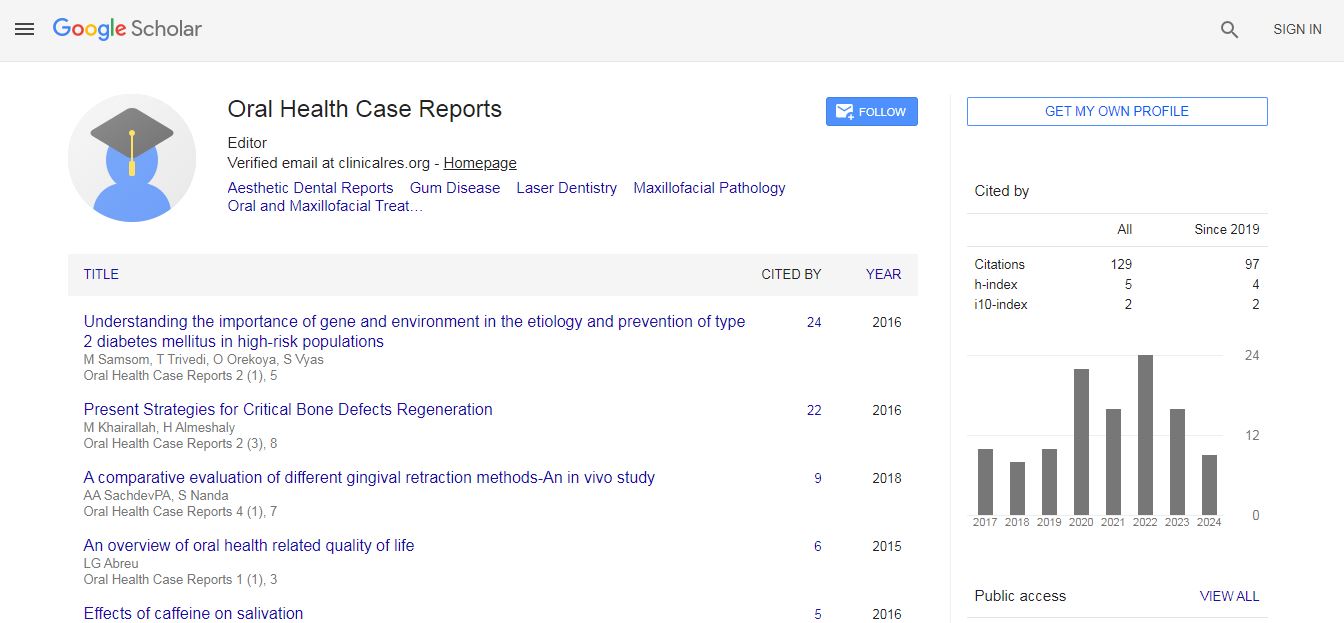
Oral Health Case Reports received 120 citations as per Google Scholar report