Short Communication - (2025) Volume 11, Issue 4
Received: 01-Jul-2025, Manuscript No. ohcr-25-174305;
Editor assigned: 03-Jul-2025, Pre QC No. P-174305;
Reviewed: 17-Jul-2025, QC No. Q-174305;
Revised: 22-Jul-2025, Manuscript No. R-174305;
Published:
29-Jul-2025
, DOI: 10.37421/2471-8726.2025.11.208
Citation: Ibrahim, Sara. ”Oral Health: Systemic Connections and Management Challenges.” Oral Health Case Rep 11 (2025):208.
Copyright: © 2025 Ibrahim S. This is an open-access article distributed under the terms of the Creative Commons Attribution License, which permits unrestricted use, distribution and reproduction in any medium, provided the original author and source are credited.
The complex community of microorganisms in our mouths, known as the oral microbiome, plays a crucial role in maintaining oral health and is deeply involved in the development and progression of various diseases throughout the body [1].
Imbalances in this microbial community can lead to common oral infections like periodontitis and caries, and also contribute to systemic conditions such as cardiovascular disease, diabetes, and certain neurodegenerative disorders, emphasizing a holistic view in disease prevention and management [1].
Research highlights a significant bidirectional relationship between periodontitis and diabetes mellitus [2].
Diabetes increases the risk and severity of periodontitis, while effective periodontitis treatment can positively impact glycemic control in diabetic patients [2].
This connection underscores the critical need for integrated care for individuals with both conditions, making oral health management an essential component of comprehensive diabetes care [2].
Regarding caries management, silver diamine fluoride (SDF) has proven effective in arresting dental caries, particularly in primary teeth [3].
This non-invasive, efficient, and cost-effective treatment option is a valuable alternative to traditional restorative procedures, significantly improving access to care, especially for children and individuals with special needs [3].
Ongoing challenges exist in diagnosing and treating oral candidiasis, an opportunistic fungal infection, exacerbated by increasing antifungal resistance, particularly among common Candida species [4].
Efforts are focusing on novel diagnostic tools, emerging therapeutic strategies, and a deeper understanding of Candida virulence factors and host immune responses to develop more effective treatments for susceptible immunocompromised patients [4].
Many patients with HIV/AIDS frequently exhibit distinct oral manifestations, including candidiasis, hairy leukoplakia, Kaposi's sarcoma, and periodontal diseases [5].
These manifestations are important diagnostically, often reflecting the patient's immune status and disease progression, thereby underscoring the ongoing importance of regular oral examinations for early detection and improved quality of life [5].
A growing concern in dentistry is antibiotic resistance in oral and maxillofacial infections, where common oral pathogens increasingly resist commonly prescribed antibiotics, compromising treatment efficacy for conditions like odontogenic and implant-related infections [6].
The critical need for prudent antibiotic prescribing, surveillance of resistance patterns, and new antimicrobial strategies is paramount to combat this global health threat in dentistry [6].
Oral Human Papillomavirus (HPV) infection is a significant risk factor for oropharyngeal cancer, and studies synthesize data on various HPV genotypes found in the oral cavity [7].
Understanding the epidemiology of oral HPV, including associated demographic and behavioral factors, is crucial for developing targeted public health interventions, such as vaccination strategies and early detection programs, to reduce the burden of HPV-related oral cancers [7].
The oral cavity is significantly affected by SARS-CoV-2 infection, as evidenced by diverse oral manifestations reported in COVID-19 patients [8].
Common findings include taste alterations, dry mouth, fungal infections, and various oral lesions like ulcers and vesicular eruptions, making oral health assessment vital for both diagnosis and managing discomfort, contributing to a better understanding of the virus's systemic impact [8].
Peri-implantitis, an inflammatory condition affecting tissues surrounding dental implants, often leads to bone loss and implant failure, with bacterial biofilms frequently implicated in its etiology [9].
Effective management of this condition requires thorough discussion of diagnostic criteria and treatment options, from non-surgical debridement to surgical interventions, alongside robust preventive strategies and early detection for long-term implant success [9].
Finally, oral biofilms are intricate entities that contribute to both health and disease processes [10].
Dysbiotic shifts within these microbial communities can trigger localized oral infections and contribute to systemic inflammatory conditions by influencing immune responses [10].
Advancements in understanding host-microbe interactions and signals for modulating biofilm composition point towards new therapeutic avenues for preventing and managing chronic oral and systemic diseases linked to oral biofilms [10].
The human oral cavity hosts a complex community of microorganisms, known as the oral microbiome, which is not only crucial for maintaining localized oral health but also plays a significant role in the development and progression of various systemic diseases [C001]. Imbalances, or dysbiosis, within this microbial community can trigger common oral infections such as periodontitis and dental caries, and contribute to widespread systemic conditions like cardiovascular disease, diabetes, and even certain neurodegenerative disorders [C001, C010]. Understanding the intricate role of oral biofilms in both health and disease processes is paramount, as dysbiotic shifts influence host immune responses and drive chronic inflammatory conditions both locally and systemically [C010]. This interconnectedness necessitates a holistic view in disease prevention and management, recognizing oral health as an integral component of overall well-being [C001].
Common oral infections and conditions present varied challenges and treatment approaches. Dental caries, a prevalent issue, can be effectively managed with non-invasive options such as silver diamine fluoride (SDF), which has been shown to arrest caries, particularly in primary teeth [C003]. SDF offers a valuable, cost-effective alternative to traditional restorative procedures, improving access to care for vulnerable populations like children and individuals with special needs [C003]. Another significant oral infection is peri-implantitis, an inflammatory condition affecting dental implants, often leading to bone loss and implant failure [C009]. Its etiology frequently involves bacterial biofilms, necessitating comprehensive diagnostic criteria and a range of treatment options from non-surgical debridement to surgical interventions [C009]. Effective long-term success of dental implants relies heavily on robust preventive strategies and early detection of this condition [C009].
The mouth often serves as a window into an individual's systemic health, with various diseases exhibiting distinct oral manifestations. For instance, a clear bidirectional relationship exists between periodontitis and diabetes mellitus; diabetes increases the risk and severity of periodontitis, while treating periodontitis positively impacts glycemic control in diabetic patients [C002]. This highlights the importance of integrated care, where managing oral health becomes an essential part of comprehensive diabetes management and vice versa [C002].
Beyond these bidirectional links, other systemic conditions profoundly impact oral health. Patients living with HIV/AIDS frequently present with distinct oral lesions such as candidiasis, hairy leukoplakia, Kaposi's sarcoma, and periodontal diseases [C005]. These manifestations hold diagnostic significance, reflecting the immune status and disease progression of these patients, thus emphasizing the importance of regular oral examinations for early detection and improved quality of life [C005]. Even novel pathogens, like SARS-CoV-2, cause diverse oral manifestations in COVID-19 patients, including taste alterations, dry mouth, fungal infections, and various oral lesions, underscoring the systemic impact of the virus on the oral cavity [C008]. This necessitates oral health assessment as a vital part of diagnosis and discomfort management in COVID-19 patients [C008].
Oral candidiasis, an opportunistic fungal infection, poses ongoing diagnostic and therapeutic challenges due to increasing prevalence of antifungal resistance, especially among common Candida species [C004]. The development of novel diagnostic tools and emerging therapeutic strategies is crucial to combat this resistance and improve treatment outcomes, particularly for immunocompromised patients who are most susceptible [C004]. Moreover, antibiotic resistance in oral and maxillofacial infections is a growing global health threat, with common oral pathogens demonstrating resistance to commonly prescribed antibiotics [C006]. This impacts the efficacy of treatments for conditions like odontogenic infections and implant-related infections, underscoring the critical need for prudent antibiotic prescribing practices, surveillance of resistance patterns, and the development of new antimicrobial strategies [C006]. Beyond bacterial and fungal infections, oral Human Papillomavirus (HPV) infection is a significant risk factor for oropharyngeal cancer [C007]. Synthesizing data on various HPV genotypes and associated demographic and behavioral factors is vital for targeted public health interventions, including vaccination strategies and early detection programs, to mitigate the burden of HPV-related oral cancers [C007].
The oral cavity serves as a critical nexus for both localized and systemic health, underscoring the profound impact of oral conditions on overall well-being. The oral microbiome, a complex community of microorganisms, is fundamental to oral health, yet its imbalances can drive common infections like periodontitis and caries, extending their influence to systemic conditions such as cardiovascular disease, diabetes, and even neurodegenerative disorders. This intricate connection is evident in the bidirectional relationship between periodontitis and diabetes, where managing one significantly affects the other, highlighting the need for integrated care approaches. Challenges in oral health management are multifaceted, ranging from the effective treatment of dental caries with non-invasive solutions like silver diamine fluoride, to confronting the rising tide of antibiotic resistance in oral and maxillofacial infections. Opportunistic infections such as oral candidiasis present difficulties in diagnosis and treatment due to increasing antifungal resistance, particularly in immunocompromised individuals. Furthermore, systemic conditions like HIV/AIDS and COVID-19 manifest significantly in the oral cavity, with specific lesions and symptoms serving as diagnostic indicators and impacting patient discomfort. The risk of oropharyngeal cancer is linked to oral Human Papillomavirus (HPV) infection, emphasizing the importance of public health interventions. Even dental implants are susceptible to inflammatory conditions like peri-implantitis, often linked to bacterial biofilms. Ultimately, a deeper understanding of oral biofilms and host-microbe interactions promises new therapeutic strategies for preventing and managing a broad spectrum of diseases, reinforcing the need for continuous research and holistic patient care.
None
None
1. Richard JL, Hyunjoo K, Robert JG. "The Oral Microbiome and Its Role in Oral and Systemic Diseases".Microbiol Spectr 11 (2023):e0030022.
Indexed at, Google Scholar, Crossref
2. Apinya L, Tharin T, Panida C. "The Bidirectional Relationship Between Periodontitis and Diabetes Mellitus: A Systematic Review and Meta-Analysis".J Clin Periodontol 50 (2023):1155-1166.
Indexed at, Google Scholar, Crossref
3. Sha SG, Duangporn D, MacLehose CMW. "Caries arrest with silver diamine fluoride: a systematic review and meta-analysis of clinical trials".J Dent 111 (2021):103738.
Indexed at, Google Scholar, Crossref
4. Rauni R, Elina P, Tiina M. "Oral Candidiasis: Emerging Challenges in Diagnostics and Treatment".J Fungi (Basel) 7 (2021):875.
Indexed at, Google Scholar, Crossref
5. Julián C, MarÃa DO, MarÃa B. "Oral Manifestations in HIV/AIDS Patients: A Systematic Review".J Clin Med 11 (2022):6926.
Indexed at, Google Scholar, Crossref
6. Dion P, Gabriella V, Carlo P. "Antibiotic Resistance in Oral and Maxillofacial Infections: A Systematic Review of Current Literature".Antibiotics (Basel) 12 (2023):664.
Indexed at, Google Scholar, Crossref
7. Peter O, Marcus H, Jerome F. "Prevalence and Incidence of Oral Human Papillomavirus Infection: A Systematic Review".J Oral Maxillofac Surg 80 (2022):553-564.
Indexed at, Google Scholar, Crossref
8. TarcÃsio B, AramÃzis RS, Eduardo NSG. "Oral manifestations in COVID-19 patients: a systematic review".Oral Dis 28 (2022):1257-1267.
Indexed at, Google Scholar, Crossref
9. Rainer S, Martina J, Karl-Otto H. "Peri-implantitis: aetiology, diagnosis and treatment options".J Cranio Maxillofac Surg 49 (2021):12-20.
Indexed at, Google Scholar, Crossref
10. George H, Triantafyllos C, John DL. "Current Understanding of Oral Biofilms in Health and Disease: Recent Insights".J Dent Res 99 (2020):1136-1144.
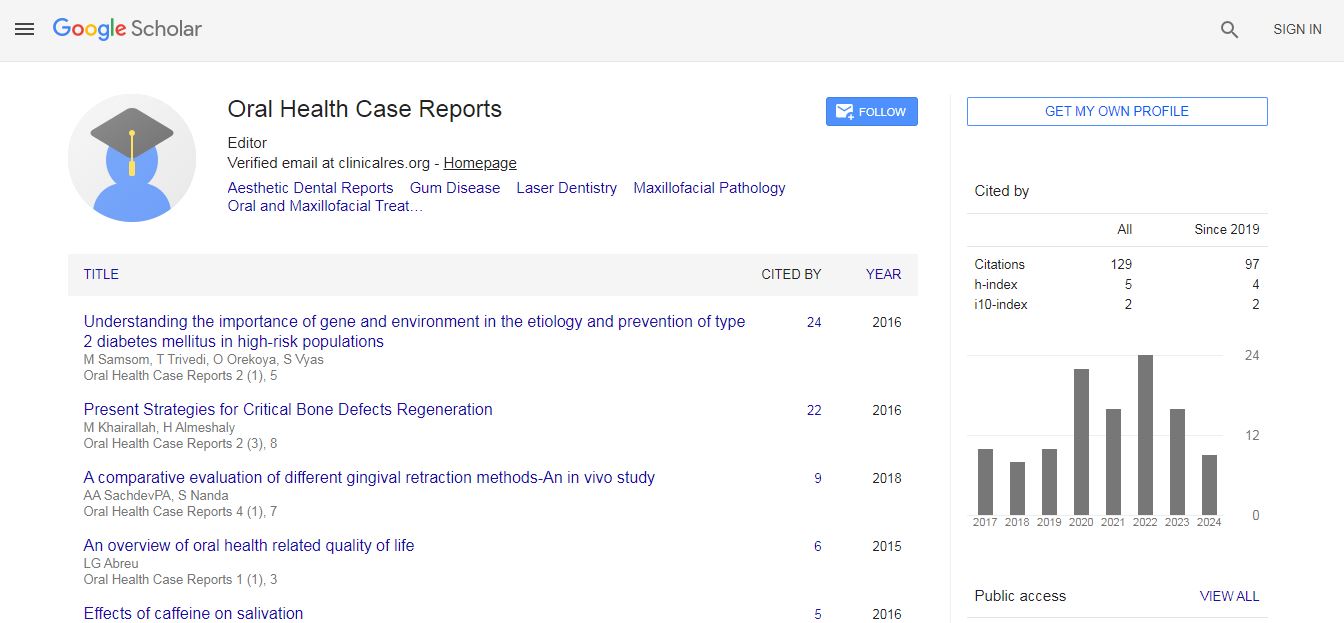
Oral Health Case Reports received 120 citations as per Google Scholar report