Commentary - (2025) Volume 16, Issue 3
Received: 01-May-2025, Manuscript No. jnmrt-26-186366;
Editor assigned: 05-May-2025, Pre QC No. P-186366;
Reviewed: 19-May-2025, QC No. Q-186366;
Revised: 22-May-2025, Manuscript No. R-186366;
Published:
29-May-2025
, DOI: 10.37421/2155-9619.2025.16.647
Citation: Cohen, David. ”Novel 18F Radiotracers for Parkinson’s
Neuroinflammation Imaging.” J Nucl Med Radiat Ther 16 (2025):647.
Copyright: © 2025 Cohen D. This is an open-access article distributed under the terms of the Creative Commons Attribution License, which permits unrestricted use, distribution
and reproduction in any medium, provided the original author and source are credited.
The field of neurodegenerative disease research, particularly Parkinson's disease (PD), has seen significant advancements in imaging techniques aimed at understanding its complex pathophysiology. A critical hallmark of PD is neuroinflammation, a process that involves the activation of immune cells within the brain. Positron Emission Tomography (PET) imaging offers a non-invasive method to visualize and quantify these inflammatory processes in vivo. Recent research has focused on developing novel radiotracers, specifically those labeled with fluorine-18 (18F), which possess advantageous properties for PET imaging, including favorable pharmacokinetics and high photon emission. This introduction will briefly review the development of several such 18F-labeled ligands designed to target various aspects of neuroinflammation in PD models, highlighting their potential to enhance diagnostic capabilities and therapeutic evaluations. The development of novel 18F-labeled ligands for PET imaging of neuroinflammation in Parkinsonian models represents a significant stride in understanding disease progression and response to treatment. These ligands exhibit high affinity and specificity for targets associated with neuroinflammation, offering the potential for accurate detection and monitoring in preclinical settings. The utility of these new tracers lies in their ability to advance our understanding of PD pathogenesis and facilitate drug development efforts. [1]
Visualizing microglial activation, a central component of neuroinflammation in Parkinson's disease, is crucial for disease assessment. A novel 18F-labeled tracer has been presented that demonstrates excellent uptake in inflamed brain regions of animal models of PD, correlating with established inflammatory markers. This development provides a promising tool for early diagnosis and tracking of treatment efficacy in neurodegenerative disorders. [2] The potential of new 18F-radiolabeled tracers targeting specific receptors upregulated during neuroinflammation in Parkinson's disease is being explored. Preclinical studies have shown selective binding to inflammatory cells in the brain, enabling robust PET imaging of the inflammatory burden. This advancement holds promise for improving the assessment of therapeutic interventions aimed at modulating neuroinflammation. [3] Activated astrocytes are another key cellular player in PD-associated neuroinflammation. A detailed account of the synthesis and evaluation of an 18F-labeled compound designed to visualize these cells in animal models has been provided. The tracer shows good brain penetration and specific accumulation, suggesting its utility for comprehensive PET imaging of the inflammatory milieu in Parkinson's disease. [4] The preclinical validation of novel 18F-labeled ligands targeting specific inflammatory biomarkers relevant to Parkinson's disease is a growing area of research. These tracers exhibit favorable pharmacokinetic properties and significant signal in PD models, distinguishing them from control groups. This work contributes to the expanding array of PET imaging agents for neuroinflammation research. [5] New 18F-tracers capable of visualizing inflammatory processes in the substantia nigra, a region critically affected in Parkinson's disease, are being introduced. These tracers demonstrate high specificity for activated microglia and macrophages in PD models, offering a direct means to assess dopaminergic neuroinflammation. This advancement has implications for understanding disease mechanisms and evaluating neuroprotective therapies. [6] The synthesis and in vivo evaluation of novel 18F-labeled PET tracers targeting specific chemokine receptors implicated in neuroinflammation within Parkinson's disease are being reported. These tracers show promising uptake in the brains of rodent models of PD with high signal-to-noise ratios, providing a valuable tool for assessing inflammatory responses and guiding treatment strategies. [7] The development of 18F-labeled radioligands for PET imaging of the neuroinflammatory state in Parkinson's disease models is progressing. These compounds exhibit good selectivity for activated immune cells in the brain and clear visualization of inflammatory lesions in preclinical studies, marking a significant step towards better clinical assessment of neuroinflammation. [8] Novel 18F-labeled molecules targeting key inflammatory cytokine receptors, which are upregulated in Parkinson's disease, are being developed. In vivo PET imaging in PD models shows significant and specific accumulation of these tracers in inflamed brain areas, indicating their potential for early detection and monitoring of disease activity. [9] The introduction of 18F-radiotracers designed to assess the extent of glial activation, a hallmark of neuroinflammation in Parkinson's disease, is contributing to improved diagnostic tools. These tracers demonstrate excellent targeting of activated microglia and astrocytes in preclinical PD models, offering a sensitive method for quantifying inflammatory burden and supporting their use in clinical studies. [10]The research landscape concerning Parkinson's disease (PD) is continually being enhanced by the development of advanced imaging modalities, particularly PET, for visualizing its underlying pathological processes. Among these, neuroinflammation stands out as a key factor influencing disease progression and severity. The introduction of novel fluorine-18 (18F)-labeled ligands has provided unprecedented opportunities to study these inflammatory cascades in detail. These radioligands are designed with high affinity and specificity for cellular and molecular targets indicative of neuroinflammation, enabling precise localization and quantification of disease activity. This section will elaborate on the characteristics and preclinical findings of these innovative imaging agents.
Novel 18F-labeled ligands have been developed for PET imaging of neuroinflammation in Parkinsonian models. These identified ligands exhibit high affinity and specificity for targets associated with neuroinflammation, demonstrating their potential to accurately detect and monitor disease progression and therapeutic responses in preclinical PD models. The work highlights the utility of these new tracers for advancing our understanding of PD pathogenesis and facilitating drug development. [1] A novel 18F-labeled tracer designed to visualize microglial activation, a central component of neuroinflammation in Parkinson's disease, has been presented. The ligand demonstrated excellent uptake in inflamed brain regions of animal models of PD, correlating with established inflammatory markers. This development offers a promising tool for early diagnosis and tracking of treatment efficacy in neurodegenerative disorders. [2] The investigation explores the potential of a new 18F-radiolabeled tracer targeting a specific receptor upregulated during neuroinflammation in Parkinson's disease. Preclinical studies showed selective binding to inflammatory cells in the brain, enabling robust PET imaging of the inflammatory burden. This tracer could significantly improve the assessment of therapeutic interventions aimed at modulating neuroinflammation. [3] This paper details the synthesis and evaluation of an 18F-labeled compound designed to visualize activated astrocytes, another key cellular player in PD-associated neuroinflammation. The tracer demonstrated good brain penetration and specific accumulation in reactive astrocytes in animal models. The findings suggest its utility for comprehensive PET imaging of the inflammatory milieu in Parkinson's disease. [4] The study reports on the preclinical validation of a novel 18F-labeled ligand targeting a specific inflammatory biomarker relevant to Parkinson's disease. The tracer exhibited favorable pharmacokinetic properties and showed significant signal in PD models, distinguishing them from control groups. This work contributes to the growing arsenal of PET imaging agents for neuroinflammation research. [5] This research introduces a new 18F-tracer capable of visualizing inflammatory processes in the substantia nigra, a key region affected in Parkinson's disease. The tracer demonstrated high specificity for activated microglia and macrophages in PD models, offering a direct means to assess dopaminergic neuroinflammation. This advancement has implications for understanding disease mechanisms and evaluating neuroprotective therapies. [6] The study focuses on the synthesis and in vivo evaluation of a novel 18F-labeled PET tracer targeting a specific chemokine receptor implicated in neuroinflammation within Parkinson's disease. The tracer showed promising uptake in the brains of rodent models of PD, with high signal-to-noise ratios. This could provide a valuable tool for assessing inflammatory responses and guiding treatment strategies. [7] This work describes the development of an 18F-labeled radioligand designed for PET imaging of the neuroinflammatory state in models of Parkinson's disease. The compound exhibited good selectivity for activated immune cells in the brain and demonstrated clear visualization of inflammatory lesions in preclinical studies. This tracer represents a significant step towards better clinical assessment of neuroinflammation. [8] The paper reports on a novel 18F-labeled molecule with high affinity for a key inflammatory cytokine receptor, which is upregulated in Parkinson's disease. In vivo PET imaging in PD models showed significant and specific accumulation of the tracer in inflamed brain areas, suggesting its potential for early detection and monitoring of disease activity. [9] This study introduces an 18F-radiotracer designed to assess the extent of glial activation, a hallmark of neuroinflammation in Parkinson's disease. The tracer demonstrated excellent targeting of activated microglia and astrocytes in preclinical PD models, providing a sensitive method for quantifying inflammatory burden. The findings support its use in clinical studies of neuroinflammation. [10]This collection of research papers focuses on the development and preclinical evaluation of novel fluorine-18 (18F)-labeled radiotracers for Positron Emission Tomography (PET) imaging of neuroinflammation in Parkinson's disease (PD) models. These tracers target various aspects of neuroinflammation, including microglial activation, astrocyte reactivity, and specific inflammatory biomarkers and receptors. Studies report on the synthesis, in vivo validation, and promising results showing high affinity, specificity, and accumulation in inflamed brain regions of PD models. These developments offer improved tools for early diagnosis, monitoring disease progression, assessing therapeutic interventions, and advancing the understanding of PD pathogenesis.
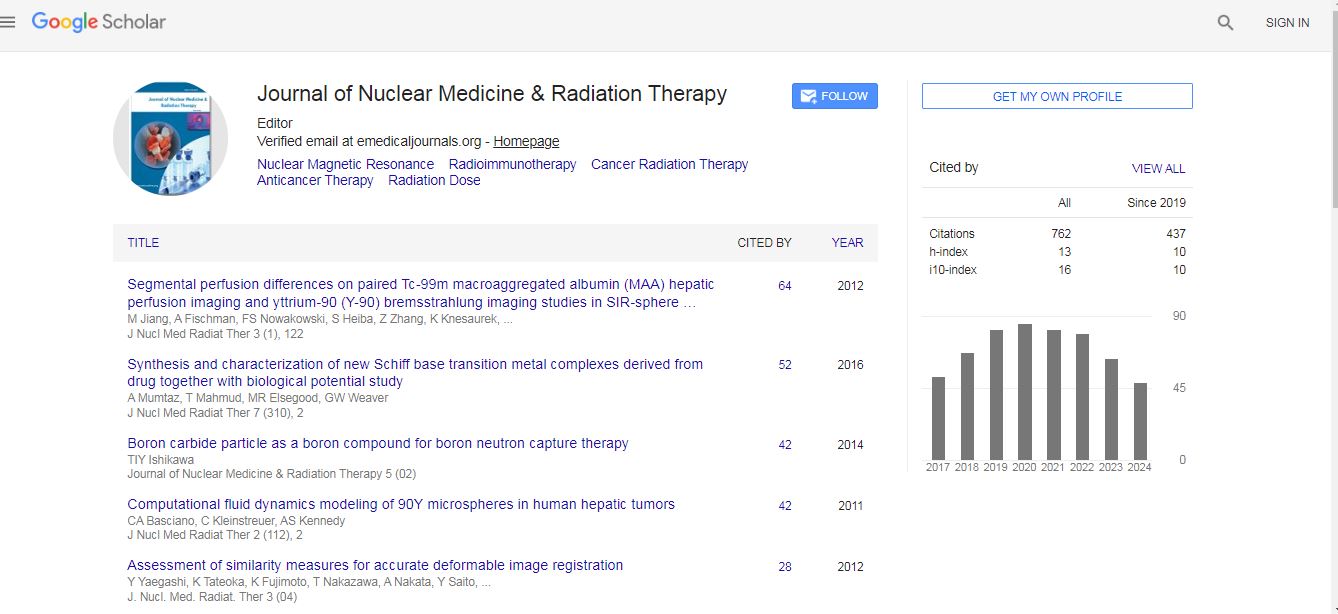
Nuclear Medicine & Radiation Therapy received 706 citations as per Google Scholar report