Perspective - (2025) Volume 11, Issue 2
Received: 31-Mar-2025, Manuscript No. aso-25-166074;
Editor assigned: 02-Apr-2025, Pre QC No. P-166074;
Reviewed: 16-Apr-2025, QC No. Q-166074;
Revised: 24-Apr-2025, Manuscript No. R-166074;
Published:
30-Apr-2025
, DOI: 10.37421/2471-2671.2025.10.160
Citation: Reterz, Sarah. “MYC Oncogene in Cancer Progression and Therapy Resistance.” Arch Surg Oncol 10 (2025): 160.
Copyright: © 2025 Reterz S. This is an open-access article distributed under the terms of the Creative Commons Attribution License, which permits unrestricted use, distribution and reproduction in any medium, provided the original author and source are credited.
MYC functions primarily as a transcription factor by forming heterodimers with its partner protein MAX, which then bind to specific DNA sequences known as E-boxes to regulate the transcription of target genes. These targets span a broad range of biological pathways, including those governing cell cycle progression, ribosome biogenesis, metabolism, DNA replication, and repair. By coordinating these processes, MYC controls cellular growth and division. In cancer, sustained MYC activation disrupts normal regulatory checkpoints, leading to unchecked proliferation. Moreover, MYC influences the tumor microenvironment by regulating angiogenesis, immune evasion, and interactions with stromal cells, thereby facilitating tumor expansion and progression. The oncogenic potential of MYC is further amplified by its ability to induce genomic instability and epigenetic alterations, which generate additional mutations and epigenetic states that drive tumor heterogeneity and evolution [2,3].
The role of MYC in cancer progression is well documented across a variety of tumor types. In hematological malignancies such as Burkitt lymphoma, chromosomal translocations lead to MYC overexpression, which is essential for tumor development and maintenance. Similarly, in solid tumors including breast cancer, lung cancer, colorectal cancer, and neuroblastoma, MYC amplification or overexpression correlates with aggressive disease, poor prognosis, and increased metastatic capacity. MYC-driven cancers often display hallmark features such as high proliferative indices, resistance to apoptosis, altered metabolism favoring aerobic glycolysis, and increased capacity for invasion and dissemination. These features underscore the multifaceted role of MYC as a master regulator of oncogenic processes that shape tumor biology [4].
In addition to driving tumor growth, MYC contributes significantly to therapy resistance, a major challenge in cancer treatment. Resistance can be intrinsic, present before therapy initiation, or acquired during treatment, often leading to disease relapse and poor clinical outcomes. MYC promotes resistance through multiple mechanisms. It upregulates the expression of genes involved in DNA damage repair and cell survival pathways, enabling cancer cells to withstand cytotoxic insults from chemotherapy and radiation. MYC also modulates cellular metabolism to support energy production and biosynthesis under stress conditions imposed by treatment. Furthermore, MYC-driven alterations in the tumor microenvironment, including suppression of immune responses and promotion of angiogenesis, create a protective niche that shields cancer cells from therapeutic effects. These resistance mechanisms complicate treatment and highlight the need for strategies that effectively target MYC or its downstream pathways [5].
Google Scholar Cross Ref Indexed at
Google Scholar Cross Ref Indexed at
Google Scholar Cross Ref Indexed at
Google Scholar Cross Ref Indexed at
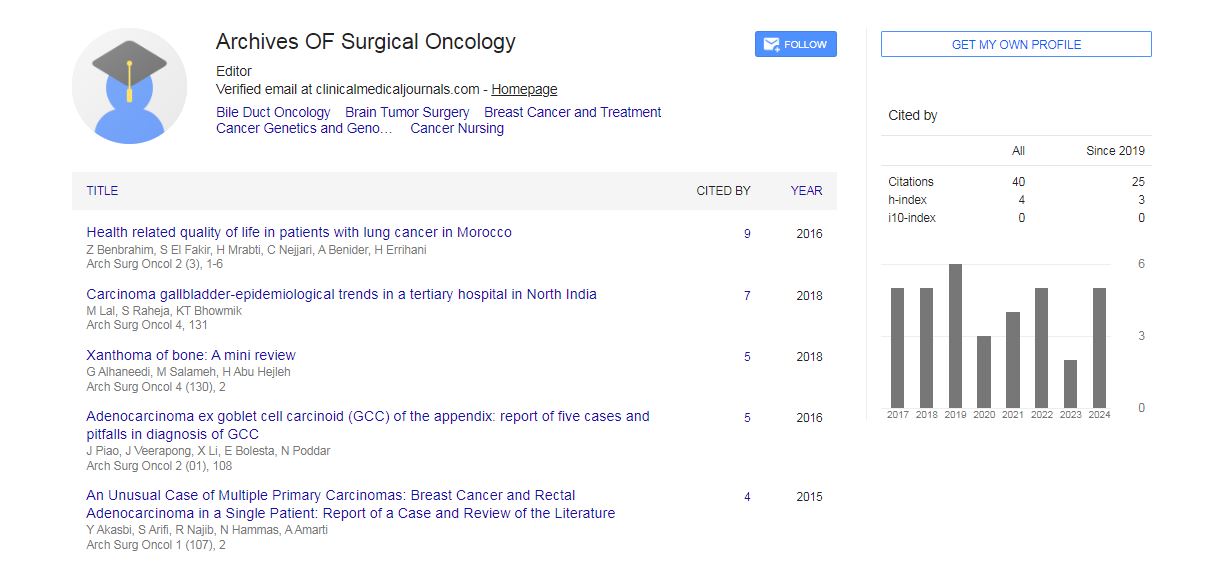
Archives of Surgical Oncology received 37 citations as per Google Scholar report