Perspective - (2025) Volume 11, Issue 3
Received: 01-May-2025, Manuscript No. aso-26-184619;
Editor assigned: 05-May-2025, Pre QC No. P-184619;
Reviewed: 19-May-2025, QC No. Q-184619;
Revised: 22-Sep-2025, Manuscript No. R-184619;
Published:
29-May-2025
, DOI: 10.37421/2471-2671.2025.11.174
Citation: Scott, Benjamin. ”Multidisciplinary Surgical Oncology:
Personalized, Precise, and Predictive.” Arch Surg Oncol 11 (2025):174.
Copyright: © 2025 Scott B. This is an open-access article distributed under the terms of the Creative Commons Attribution License, which permits unrestricted use, distribution
and reproduction in any medium, provided the original author and source are credited.
Surgical oncology is undergoing a significant transformation, driven by the increasing adoption of multidisciplinary approaches that integrate expertise from a wide array of medical specialties to enhance patient care strategies. This paradigm shift is rooted in a more profound understanding that managing complex oncological conditions, particularly challenging tumors, necessitates a comprehensive and holistic approach. This involves the collaborative efforts of surgeons, medical oncologists, radiation oncologists, pathologists, radiologists, and a dedicated team of supportive care professionals working in concert.
Current advancements in the field are strongly emphasizing the development of personalized treatment plans, which are informed by detailed genomic profiling of tumors, sophisticated advanced imaging techniques for precise diagnosis and staging, and the ongoing refinement of minimally invasive surgical procedures to reduce patient morbidity. Looking ahead, the future trajectory of surgical oncology is clearly directed towards further optimizing these integrated models. This will be achieved through the incorporation of groundbreaking advancements in artificial intelligence for more accurate diagnosis and sophisticated treatment planning, the development and application of novel immunotherapies to harness the body's own defenses against cancer, and the continuous evolution of more precise surgical navigation systems and advanced robotic platforms to improve surgical outcomes. The integration of genomic data into surgical oncology decision-making is revolutionizing the concept of personalized treatment for cancer patients. The advent of next-generation sequencing technologies enables a highly precise characterization of individual tumors, thereby guiding the selection of targeted therapies and immunotherapies that can be effectively combined with surgical interventions. This detailed molecular profiling proves invaluable in predicting a patient's likely response to various treatments and in identifying potential mechanisms of resistance that may emerge over time, allowing for the proactive implementation of management strategies within the framework of a multidisciplinary team. Advanced imaging modalities have become indispensable tools in the field of surgical oncology, playing a crucial role in accurate tumor staging, meticulous surgical planning, and the reliable assessment of treatment response. Technologies such as positron emission tomography-computed tomography (PET-CT), magnetic resonance imaging (MRI) with diffusion-weighted imaging capabilities, and artificial intelligence-enhanced computed tomography (CT) scans provide highly detailed anatomical and functional information about the tumor and surrounding tissues. This detailed visualization facilitates safer, more precise surgical resections, often minimizing the need for extensive and potentially invasive biopsies, thereby improving diagnostic accuracy and guiding surgical approach. Minimally invasive surgical techniques, including laparoscopic and robotic-assisted surgery, are progressively becoming the established standard of care for a wide range of oncological resections across various cancer types. These advanced surgical approaches offer substantial benefits to patients, such as significantly reduced intraoperative blood loss, shorter overall hospital stays, and a considerably faster recovery period post-surgery, leading to improved patient satisfaction and earlier return to daily activities. The increasing complexity and sophistication of robotic surgery, however, necessitate specialized and rigorous training for surgical teams and seamless integration into established multidisciplinary team workflows to ensure that the highest standards of patient care and optimal clinical outcomes are consistently achieved. The integration of artificial intelligence (AI) into the practice of surgical oncology holds immense promise for substantially enhancing diagnostic accuracy, enabling more personalized and effective treatment planning, and ultimately improving surgical outcomes for patients. AI algorithms possess the remarkable ability to analyze vast and complex datasets, encompassing medical imaging, pathology reports, and clinical information, in order to identify subtle patterns and predict treatment responses with a high degree of accuracy, thereby providing invaluable assistance to multidisciplinary teams in making more informed and data-driven clinical decisions. Immunotherapy has emerged as a rapidly advancing and pivotal pillar in the comprehensive treatment of cancer, and its strategic integration with surgical oncology represents a particularly significant and dynamic area of ongoing research and clinical investigation. The application of neoadjuvant (pre-operative) and adjuvant (post-operative) immunotherapy can effectively prime the patient's immune system to mount a more robust and effective response against cancer cells, potentially leading to improved rates of complete surgical resection and a reduced likelihood of cancer recurrence. Multidisciplinary teams are absolutely essential for the careful selection of appropriate patient candidates for immunotherapy and for the vigilant management of any potential immune-related adverse events or toxicities that may arise during treatment. Pathological assessment remains a fundamental and indispensable component of surgical oncology, providing critical diagnostic information that is vital for accurate diagnosis, precise staging of the disease, and informed selection of the most appropriate treatment strategies for each individual patient. Recent innovations in the fields of digital pathology and molecular pathology are significantly enhancing the precision, speed, and depth of these essential analyses, thereby strongly supporting collaborative multidisciplinary decision-making processes and accelerating the development of truly personalized therapeutic approaches. The optimal management of patients with complex oncological cases frequently demands a close and highly coordinated collaboration between surgical oncologists, who are responsible for tumor removal, and reconstructive surgeons, who are tasked with restoring form and function. Comprehensive perioperative planning, which crucially includes detailed strategies for defect reconstruction following tumor resection, is absolutely vital for effectively restoring lost function and significantly improving the overall quality of life for patients who have undergone extensive and challenging surgical procedures. Patient-reported outcomes (PROs) are increasingly recognized and valued as absolutely essential components of high-quality surgical oncology care, reflecting a growing appreciation for the patient's perspective on their treatment journey. The systematic integration of PRO measures into routine clinical practice allows for a more comprehensive and holistic assessment of the impact of various treatments on patients' overall well-being and quality of life, providing crucial insights that can guide necessary adjustments to care plans within the collaborative framework of a multidisciplinary team. The future evolution of surgical oncology is intrinsically linked to the continued refinement and enhancement of existing multidisciplinary models, driven by the synergistic integration of rapidly advancing technological capabilities and a progressively deeper understanding of tumor biology at the molecular level. This forward-looking vision includes the broader adoption of AI-driven decision support systems, the further development and application of advanced robotic surgical capabilities, and the widespread implementation of highly personalized treatment strategies that are meticulously guided by comprehensive genomic and molecular profiling data, all orchestrated by cohesive and highly collaborative expert teams.Surgical oncology is increasingly embracing multidisciplinary approaches, integrating expertise from various specialties to optimize patient care. This shift reflects a deeper understanding that cancer treatment, especially for complex tumors, requires a holistic strategy involving surgeons, medical oncologists, radiation oncologists, pathologists, radiologists, and supportive care professionals. Current concepts emphasize personalized treatment plans based on genomic profiling, advanced imaging techniques, and minimally invasive surgical procedures. Future directions are geared towards further refining these integrated models with advancements in artificial intelligence for diagnosis and treatment planning, novel immunotherapies, and the development of more precise surgical navigation and robotic systems [1].
The integration of genomic data into surgical oncology decision-making is revolutionizing personalized treatment. Next-generation sequencing allows for precise tumor characterization, guiding the selection of targeted therapies and immunotherapies alongside surgical intervention. This molecular profiling aids in predicting treatment response and identifying potential resistance mechanisms, enabling proactive management strategies within a multidisciplinary team [2].
Advanced imaging modalities, including PET-CT, MRI with diffusion-weighted imaging, and AI-enhanced CT, are crucial for accurate staging, surgical planning, and response assessment in surgical oncology. These technologies provide detailed anatomical and functional information, facilitating safer and more precise surgical resections and reducing the need for extensive biopsies [3].
Minimally invasive surgical techniques, such as laparoscopy and robotic surgery, are becoming standard in many oncologic resections. These approaches offer benefits like reduced blood loss, shorter hospital stays, and faster recovery times. The increasing complexity of robotic surgery necessitates specialized training and integration into multidisciplinary team workflows to ensure optimal patient outcomes [4].
The integration of artificial intelligence (AI) in surgical oncology promises to enhance diagnostic accuracy, personalize treatment planning, and improve surgical outcomes. AI algorithms can analyze large datasets, including imaging and pathology, to identify subtle patterns and predict treatment responses, assisting multidisciplinary teams in making more informed decisions [5].
Immunotherapy is a rapidly evolving pillar of cancer treatment, and its integration with surgical oncology is a key area of research. Neoadjuvant and adjuvant immunotherapy can prime the immune system to better fight cancer, potentially improving resection rates and reducing recurrence. Multidisciplinary teams are essential to select appropriate patients and manage potential immune-related toxicities [6].
Pathological assessment is foundational to surgical oncology, providing critical information for diagnosis, staging, and treatment selection. Innovations in digital pathology and molecular pathology are enhancing the precision and speed of these analyses, supporting multidisciplinary decision-making and the development of personalized therapies [7].
The optimal management of complex oncological cases often requires close collaboration between surgical oncologists and reconstructive surgeons. Perioperative planning, including strategies for defect reconstruction after tumor resection, is vital for restoring function and improving the quality of life for patients undergoing extensive surgery [8].
Patient-reported outcomes (PROs) are increasingly recognized as essential components of surgical oncology care. Integrating PRO measures into clinical practice allows for a comprehensive assessment of treatment impact on patients' quality of life, guiding adjustments to care plans within a multidisciplinary framework [9].
The future of surgical oncology lies in the continued refinement of multidisciplinary models, leveraging technological advancements and a deeper understanding of tumor biology. This includes greater adoption of AI-driven decision support, advanced robotic capabilities, and personalized treatment strategies guided by comprehensive genomic and molecular profiling, all orchestrated by cohesive, collaborative teams [10].
Surgical oncology is increasingly adopting multidisciplinary approaches, integrating various specialties for optimized patient care. This involves a holistic strategy for complex tumors, combining surgeons, oncologists, radiologists, and pathologists. Personalized treatment plans are driven by genomic profiling, advanced imaging, and minimally invasive procedures. Future directions include AI for diagnosis and planning, novel immunotherapies, and enhanced surgical navigation and robotics. Genomic data revolutionizes personalized treatment by enabling precise tumor characterization and guiding targeted therapies. Advanced imaging plays a crucial role in staging and surgical planning. Minimally invasive techniques like robotic surgery offer significant patient benefits. AI integration promises to improve diagnostic accuracy and treatment planning. Immunotherapy is becoming a key pillar, with neoadjuvant and adjuvant applications showing promise. Pathological assessment remains fundamental, with digital and molecular pathology enhancing precision. Reconstructive surgery is vital for complex cases to restore function and quality of life. Patient-reported outcomes are essential for assessing treatment impact. The future emphasizes refined multidisciplinary models, AI, advanced robotics, and personalized strategies.
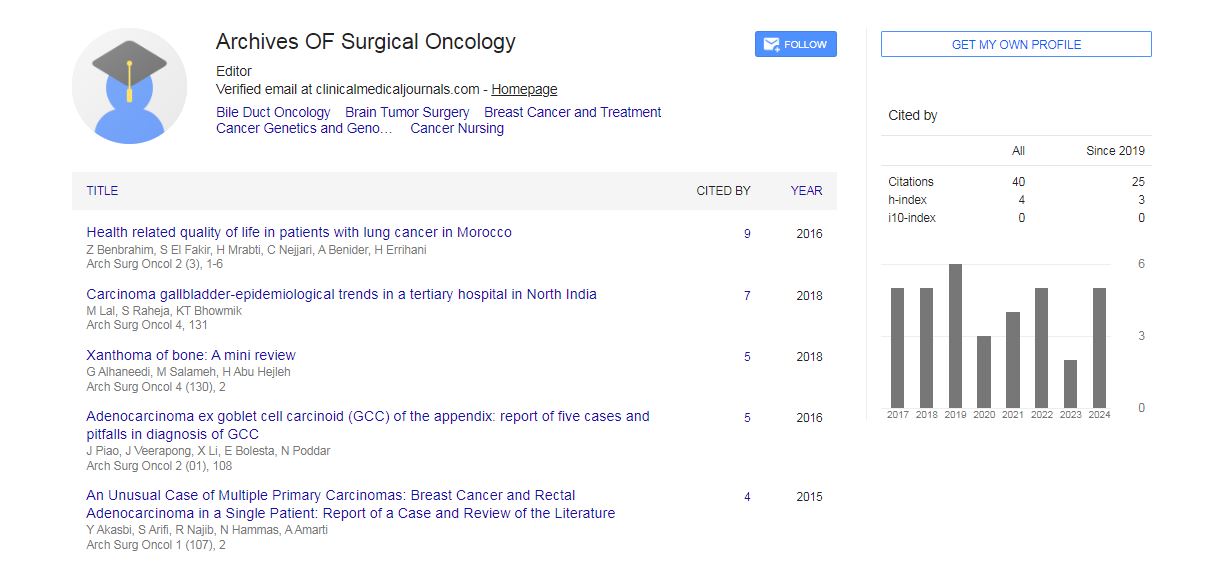
Archives of Surgical Oncology received 37 citations as per Google Scholar report