Brief Report - (2025) Volume 14, Issue 6
Received: 01-Dec-2025, Manuscript No. jme-26-185234;
Editor assigned: 03-Dec-2025, Pre QC No. P-185234;
Reviewed: 17-Dec-2025, QC No. Q-185234;
Revised: 22-Dec-2025, Manuscript No. R-185234;
Published:
29-Dec-2025
, DOI: 10.37421/2169-0022.2025.14.750
Citation: Romano, Lucia. ”Microstructural Defects: Impact on
Material Properties and Performance.” J Material Sci Eng 14 (2025):750.
Copyright: © 2025 Romano L. This is an open-access article distributed under the terms of the Creative Commons Attribution License, which permits unrestricted use,
distribution and reproduction in any medium, provided the original author and source are credited.
Defects and microstructural features are foundational to comprehending the intrinsic properties of materials, influencing a wide array of their behaviors. Research has consistently demonstrated that the presence and nature of these imperfections, ranging from point defects to extended interfaces, significantly dictate a material's performance in various applications. This scientific exploration aims to systematically review and synthesize existing knowledge on how these microstructural elements interact with and modify fundamental material characteristics.
At the atomic level, point defects such as vacancies and interstitials play a pivotal role in material science. Vacancies, which are vacant lattice sites, and interstitials, atoms residing in positions not normally occupied by them, are crucial for atomic diffusion and can alter electronic and mechanical properties. Their controlled introduction and manipulation are key strategies in material design, particularly for semiconductors and alloys where transport phenomena are critical. Line defects, prominently dislocations, are fundamental to the plastic deformation of crystalline materials. The movement and interaction of dislocations are directly responsible for a metal's ability to deform without fracturing. Understanding dislocation dynamics, their density, and their arrangement provides critical insights into strengthening mechanisms and the overall mechanical response of metallic systems under stress. Interfaces within a material, such as grain boundaries, act as barriers to dislocation motion and sites for atomic segregation. The character and structure of these boundaries significantly influence properties like diffusion rates, creep resistance, and susceptibility to fracture. Controlling grain boundary architecture is thus essential for optimizing materials for high-temperature or long-term service. Precipitates, finely dispersed second-phase particles within a matrix, are widely employed as a primary strengthening mechanism in many alloys. The effectiveness of precipitation hardening is intricately linked to the size, distribution, morphology, and crystallographic coherency of these precipitates with the surrounding matrix, directly impacting yield strength and toughness. Beyond simple point defects, more complex planar defects like stacking faults can significantly influence deformation mechanisms. In face-centered cubic metals, the energy associated with stacking faults dictates the ease with which dislocations can dissociate, affecting dislocation mobility and overall plastic behavior under load. The dynamic nature of vacancies also extends to their role in phase transformations. Vacancy concentrations can accelerate or retard solid-state reactions, acting as catalysts or inhibitors for processes like precipitation or ordering. This influence is particularly relevant during heat treatment, where controlling diffusion kinetics is paramount for achieving desired microstructures. Twin boundaries, representing a specific type of grain boundary where there is a mirror symmetry across the boundary plane, can also be engineered to enhance mechanical properties. Controlled twinning can introduce beneficial deformation pathways and influence dislocation interactions, leading to improved strength and ductility. In environments involving high energy or particle bombardment, such as in nuclear reactors, grain boundaries are particularly susceptible to microstructural evolution. Irradiation can induce defect accumulation and segregation at grain boundaries, potentially leading to embrittlement and compromising the integrity of structural components over time. Finally, the presence and characteristics of precipitates can act as preferential sites for fatigue crack initiation. Understanding the relationship between precipitate morphology, coherency, and their role in nucleating fatigue cracks is vital for designing materials that can withstand cyclic loading and resist premature failure.The intricate relationship between defects and material properties is a cornerstone of materials science, with ongoing research continuously unveiling new insights and applications. This compilation of studies explores various types of microstructural imperfections and their profound impacts on material performance across diverse fields.
Point defects, including vacancies and interstitials, are fundamental atomic-scale imperfections that profoundly influence material behavior. Their presence is critical for diffusion processes, and their engineered control is pivotal for tailoring the electronic and mechanical properties of materials, especially semiconductors and alloys designed for specific transport characteristics. Dislocations, as line defects, are the primary carriers of plastic deformation in crystalline solids. The study of dislocation behavior, including their generation, motion, and interactions, is essential for understanding and predicting the mechanical strength and ductility of metals and alloys subjected to stress. Grain boundaries, the interfaces separating crystalline grains, play a multifaceted role in material properties. Their structure and chemistry influence diffusion, creep, fracture, and overall mechanical integrity, making their control a key aspect of material design for demanding applications, particularly at elevated temperatures. Precipitation hardening is a widely utilized strengthening mechanism that relies on the presence of finely dispersed second-phase particles. The effectiveness of this mechanism is directly tied to the characteristics of these precipitates, such as their size, distribution, and coherency with the matrix, which collectively determine the enhancement in yield strength and fracture toughness. Stacking faults, a type of planar defect, have a significant bearing on the plastic deformation mechanisms in materials, particularly in face-centered cubic metals. The energy associated with these faults influences dislocation mobility and the resulting deformation modes observed under applied stress. The dynamic role of vacancies extends to their influence on phase transformations within alloys. They can accelerate or impede solid-state reactions, critically impacting the outcomes of heat treatment processes and the resulting microstructural evolution, which is vital for optimizing material performance. Twin boundaries, a specific category of grain boundaries, offer opportunities for enhancing mechanical properties. The controlled introduction and manipulation of twin boundaries can facilitate unique deformation mechanisms and influence dislocation interactions, leading to improved strength and ductility. In applications involving exposure to radiation, such as in nuclear energy systems, the behavior of grain boundaries is of paramount importance. Irradiation-induced defects can segregate to grain boundaries, leading to embrittlement and compromising the long-term structural integrity of materials. Lastly, the interaction of precipitates with fatigue crack initiation is a critical consideration for the design of durable materials. The morphology and coherency of precipitates can dictate where fatigue cracks begin and how they propagate, influencing the overall fatigue life of structural alloys.This collection of research highlights the profound impact of microstructural defects on material properties. Vacancies, dislocations, grain boundaries, precipitates, stacking faults, and twin boundaries are discussed in relation to their influence on mechanical strength, electrical conductivity, optical behavior, diffusion kinetics, and phase transformations. Specific examples include defect engineering for semiconductors, precipitation hardening in alloys, and the role of microstructural evolution in nuclear materials. The studies emphasize the importance of controlling these defects to develop high-performance materials for diverse applications, from structural alloys to advanced electronics.
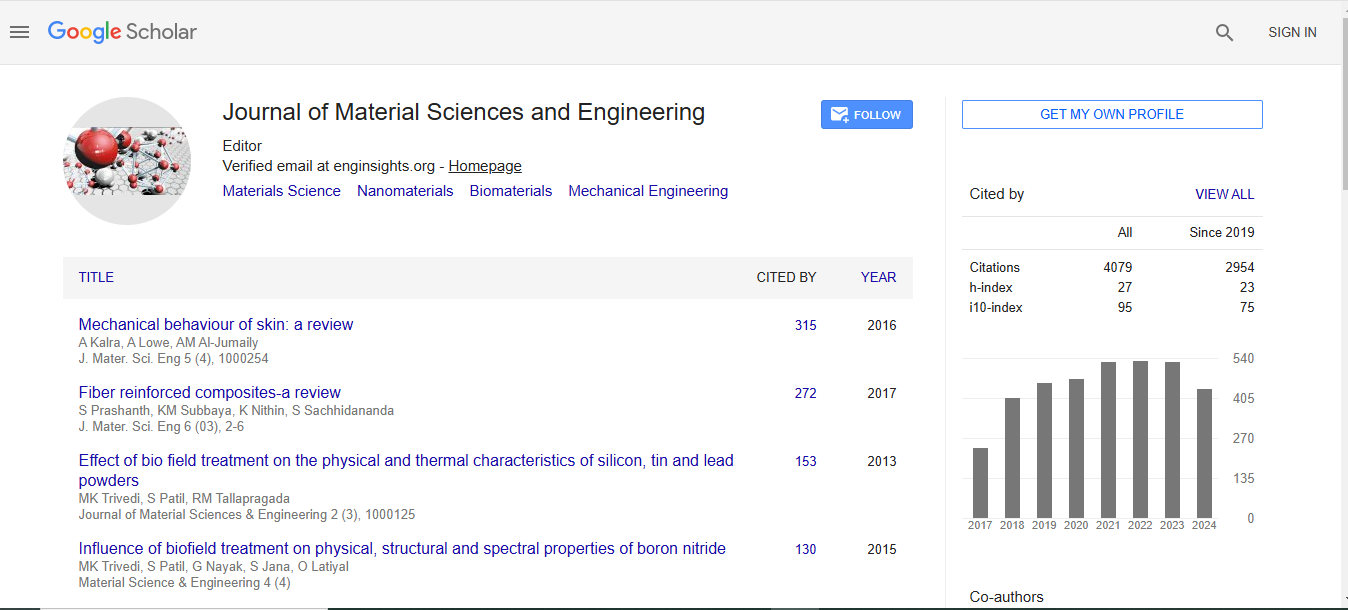
Journal of Material Sciences & Engineering received 3677 citations as per Google Scholar report