Opinion - (2025) Volume 16, Issue 4
Received: 04-Aug-2025, Manuscript No. jar-25-177606;
Editor assigned: 06-Aug-2025, Pre QC No. P-177606;
Reviewed: 20-Aug-2025, QC No. Q-177606;
Revised: 25-Aug-2025, Manuscript No. R-177606;
Published:
01-Sep-2025
, DOI: 10.37421/2155-6113.2025.16.1076
Citation: Nina Petrova. ”Microbicides and MPTs: Advancing
HIV Prevention.” J AIDS Clin Res 16 (2025):1076.
Copyright: © 2025 P. Nina This is an open-access article distributed under the terms of the Creative Commons Attribution License, which permits unrestricted use, distribution
and reproduction in any medium, provided the original author and source are credited.
This trial investigated the comparative effectiveness and safety of the monthly dapivirine vaginal ring (DVR) and daily oral pre-exposure prophylaxis (PrEP) in preventing HIV. It found that both methods provided significant protection against HIV, highlighting the importance of offering diverse prevention options to women, particularly in settings where daily adherence to oral PrEP might be challenging. The study contributes to understanding how best to integrate these tools into prevention strategies [1].
This phase 2 trial evaluated the safety and preliminary efficacy of a dapivirine rectal gel for HIV prevention in men who have sex with men and transgender women. The findings indicated that the rectal gel was well-tolerated and showed potential for reducing HIV acquisition, supporting further development of rectal microbicides as a critical HIV prevention tool for receptive anal intercourse [2].
This review article discusses the significant progress made in developing vaginal multi-purpose prevention technologies (MPTs), which aim to prevent not only HIV but also other sexually transmitted infections (STIs) and unintended pregnancies. It highlights various innovative formulations and delivery systems, emphasizing the potential for MPTs to address multiple sexual health needs with a single product, thereby improving adherence and user appeal [3].
This post-hoc analysis examined adherence patterns to the monthly dapivirine vaginal ring among women and adolescent girls participating in two large clinical trials. The study identified factors influencing adherence and underscored the importance of understanding user preferences and challenges to maximize the effectiveness of vaginal microbicides in real-world settings. Effective adherence strategies are crucial for successful HIV prevention [4].
This Phase 1 study investigated the safety and acceptability of a rectally administered dapivirine gel in both men and women. The findings indicated that the gel was generally safe and well-tolerated, with participants expressing willingness to use it. This early-phase research provided crucial data supporting the continued development of rectal microbicides as a potential HIV prevention strategy [5].
This review provides a comprehensive overview of the latest advancements in microbicide research, detailing the evolution from traditional gel formulations to more sophisticated and user-friendly delivery systems such as vaginal rings, films, and implants. The article emphasizes how these innovations aim to improve efficacy, adherence, and acceptability, ultimately broadening the reach of HIV and STI prevention [6].
This qualitative study explored the preferences and experiences of potential users regarding rectal microbicides for HIV prevention. It delves into factors like perceived benefits, potential barriers, and desirable product characteristics, providing critical insights for product development and implementation strategies that are responsive to user needs and improve uptake [7].
This article reviews the current state of vaginal multipurpose prevention technologies (MPTs), focusing on innovations in drug delivery systems designed to simultaneously protect against HIV, other STIs, and even unintended pregnancy. It discusses the challenges and opportunities in developing safe, effective, and acceptable MPTs to meet the complex sexual health needs of women globally [8].
This paper examines the challenges and opportunities associated with scaling up and implementing the dapivirine vaginal ring (DVR) for HIV prevention in real-world settings. It addresses issues of access, programmatic delivery, user uptake, and integration into existing health services, offering insights into strategies to maximize the public health impact of this prevention tool [9].
This review explores the complex interplay between rectally administered microbicides and the gut microbiome, discussing how this interaction can influence both the efficacy and safety of the product. It highlights the importance of considering microbial communities in the rectal environment during microbicide development to optimize outcomes and minimize potential adverse effects [10].
Research highlights the comparative effectiveness and safety of the monthly dapivirine vaginal ring (DVR) and daily oral pre-exposure prophylaxis (PrEP) in preventing HIV. Both methods provide significant protection, emphasizing the need for diverse prevention options to women, especially where daily adherence to oral PrEP might be challenging [1]. Crucially, understanding adherence patterns to the monthly dapivirine vaginal ring among women and adolescent girls is essential. Factors influencing adherence are being identified to maximize the effectiveness of vaginal microbicides in real-world settings [4].
In parallel, the development of rectal microbicides for HIV prevention is advancing. Phase 2 trials have evaluated the safety and preliminary efficacy of a dapivirine rectal gel in men who have sex with men and transgender women, indicating it was well-tolerated and showed potential for reducing HIV acquisition [2]. Earlier Phase 1 studies established the safety and acceptability of a rectally administered dapivirine gel in both men and women, with participants expressing willingness to use it [5]. User preferences and experiences with rectal microbicides are actively being explored through qualitative studies, which provide critical insights for product development and implementation strategies that are responsive to user needs and improve uptake [7].
Beyond single-focus prevention, significant progress has been made in developing vaginal Multi-purpose Prevention Technologies (MPTs). These technologies aim to prevent not only HIV but also other sexually transmitted infections (STIs) and unintended pregnancies, highlighting innovative formulations and delivery systems. MPTs have the potential to address multiple sexual health needs with a single product, improving adherence and user appeal [3]. Recent reviews reinforce the current state of vaginal MPTs, focusing on innovations in drug delivery systems designed for simultaneous protection against HIV, STIs, and unintended pregnancy. The discussion covers the challenges and opportunities in developing safe, effective, and acceptable MPTs to meet women's complex global sexual health needs [8].
A comprehensive overview of advancements in microbicide research details the evolution from traditional gel formulations to more sophisticated and user-friendly delivery systems such as vaginal rings, films, and implants. These innovations aim to improve efficacy, adherence, and acceptability, ultimately broadening the reach of HIV and STI prevention [6]. Additionally, the complex interplay between rectally administered microbicides and the gut microbiome is being explored. This interaction can influence both the efficacy and safety of the product, underscoring the importance of considering microbial communities in the rectal environment during microbicide development to optimize outcomes and minimize potential adverse effects [10]. However, scaling up and implementing tools like the dapivirine vaginal ring for HIV prevention in real-world settings presents significant challenges and opportunities. Issues of access, programmatic delivery, user uptake, and integration into existing health services must be addressed to maximize the public health impact of this prevention tool [9].
Recent research extensively investigates the comparative effectiveness and safety of the monthly dapivirine vaginal ring (DVR) and daily oral pre-exposure prophylaxis (PrEP) in preventing HIV. It found that both methods provided significant protection against HIV, highlighting the importance of offering diverse prevention options to women, particularly in settings where daily adherence to oral PrEP might be challenging. The study contributes to understanding how best to integrate these tools into prevention strategies. Critical analyses examine adherence patterns to the monthly dapivirine vaginal ring among women and adolescent girls participating in two large clinical trials. The study identified factors influencing adherence and underscored the importance of understanding user preferences and challenges to maximize the effectiveness of vaginal microbicides in real-world settings. Effective adherence strategies are crucial for successful HIV prevention. Further studies assess the practical aspects and challenges of scaling up and implementing the dapivirine vaginal ring (DVR) for HIV prevention in real-world settings. It addresses issues of access, programmatic delivery, user uptake, and integration into existing health services, offering insights into strategies to maximize the public health impact of this prevention tool. Parallel efforts include phase 2 trials evaluating the safety and preliminary efficacy of a dapivirine rectal gel for HIV prevention in men who have sex with men and transgender women. The findings indicated that the rectal gel was well-tolerated and showed potential for reducing HIV acquisition, supporting further development of rectal microbicides as a critical HIV prevention tool for receptive anal intercourse. Earlier phase 1 research investigated the safety and acceptability of a rectally administered dapivirine gel in both men and women. The findings indicated that the gel was generally safe and well-tolerated, with participants expressing willingness to use it. This early-phase research provided crucial data supporting the continued development of rectal microbicides as a potential HIV prevention strategy. Qualitative studies further explored the preferences and experiences of potential users regarding rectal microbicides for HIV prevention. It delves into factors like perceived benefits, potential barriers, and desirable product characteristics, providing critical insights for product development and implementation strategies that are responsive to user needs and improve uptake. The intricate interplay between rectally administered microbicides and the gut microbiome has also been explored, detailing how this interaction influences both product efficacy and safety, emphasizing microbial communities in development. Significant advancements have also occurred in developing vaginal multi-purpose prevention technologies (MPTs), which aim to prevent not only HIV but also other sexually transmitted infections (STIs) and unintended pregnancies. It highlights various innovative formulations and delivery systems, emphasizing the potential for MPTs to address multiple sexual health needs with a single product, thereby improving adherence and user appeal. These developments include comprehensive reviews of current MPTs, focusing on innovations in drug delivery systems designed to simultaneously protect against HIV, other STIs, and even unintended pregnancy. It discusses the challenges and opportunities in developing safe, effective, and acceptable MPTs to meet the complex sexual health needs of women globally. A broader review outlines the latest advancements in microbicide research, detailing the evolution from traditional gel formulations to more sophisticated and user-friendly delivery systems such as vaginal rings, films, and implants. These innovations are designed to improve efficacy, adherence, and acceptability, broadening the reach of HIV and STI prevention efforts.
Indexed at, Google Scholar, Crossref
Indexed at, Google Scholar, Crossref
Indexed at, Google Scholar, Crossref
Indexed at, Google Scholar, Crossref
Indexed at, Google Scholar, Crossref
Indexed at, Google Scholar, Crossref
Indexed at, Google Scholar, Crossref
Indexed at, Google Scholar, Crossref
Indexed at, Google Scholar, Crossref
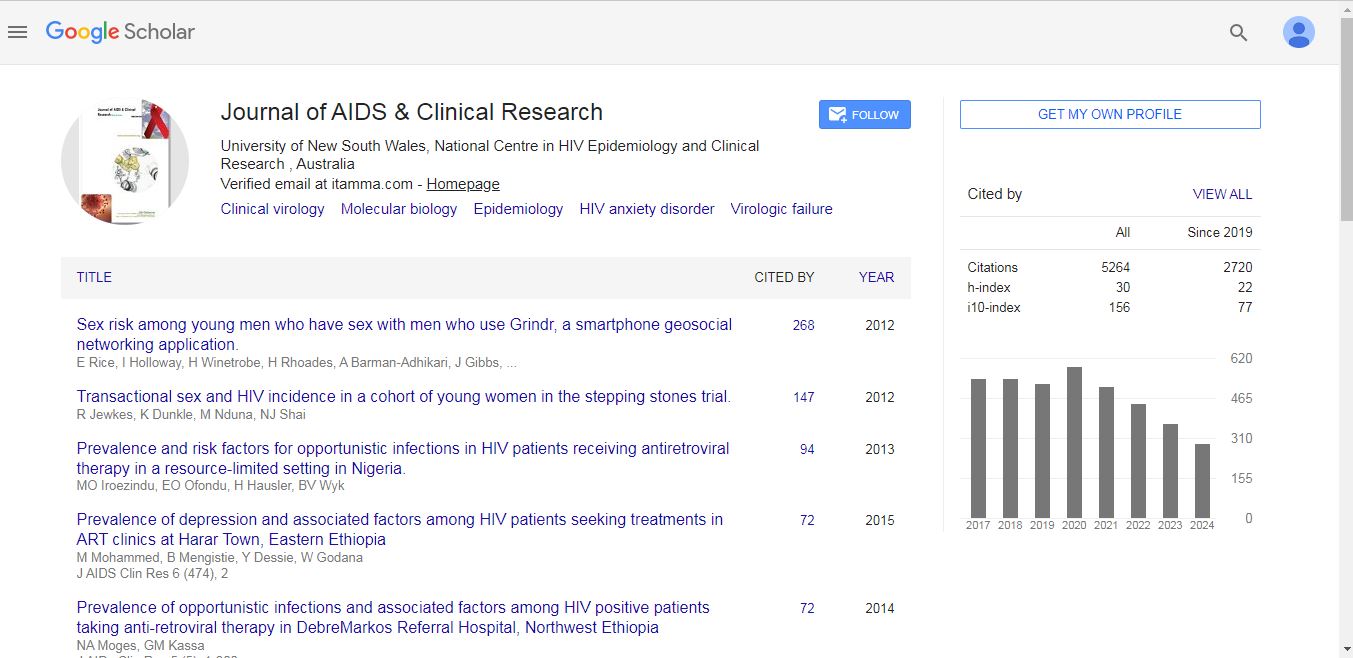
Journal of AIDS & Clinical Research received 5264 citations as per Google Scholar report