Commentary - (2025) Volume 15, Issue 4
Received: 01-Jul-2025, Manuscript No. jnt-26-178952;
Editor assigned: 03-Jul-2025, Pre QC No. P-178952;
Reviewed: 17-Jul-2025, QC No. Q-178952;
Revised: 22-Jul-2025, Manuscript No. R-178952;
Published:
29-Jul-2025
, DOI: 10.37421/2161-0959.2025.15.578
Citation: Jovanic, Marko. ”Managing Electrolyte Imbalances in Chronic Kidney Disease.” J Nephrol Ther 15 (2025):578.
Copyright: © 2025 Jovanic M. This is an open-access article distributed under the terms of the Creative Commons Attribution License, which permits unrestricted use, distribution and reproduction in any medium, provided the original author and source are credited.
Electrolyte imbalances, particularly hyperkalemia, represent a significant clinical challenge in patients with renal failure. Understanding the underlying pathophysiological mechanisms is crucial for effective management and prevention of life-threatening complications. This review will delve into the complexities of these derangements, emphasizing current therapeutic strategies, including pharmacological interventions, dietary modifications, and the indispensable role of renal replacement therapy in maintaining homeostasis [1].
Hyperkalemia in the context of chronic kidney disease (CKD) presents a particularly intricate problem, demanding a comprehensive and multi-faceted therapeutic approach. The impact of various medications, such as renin-angiotensin-aldosterone system inhibitors (RAASi), on potassium balance requires careful consideration. Furthermore, the efficacy of novel potassium binders and the importance of patient education regarding dietary potassium intake are critical aspects of modern management [2].
Sodium and fluid overload are frequent complications in advanced renal failure, directly contributing to the development and exacerbation of hypertension and cardiovascular morbidity. This paper will review the established roles of diuretics, stringent dietary sodium restriction, and the optimization of dialysis strategies in achieving and maintaining fluid balance, while also addressing the risk of hyponatremia [3].
Disturbances in calcium and phosphate metabolism are characteristic features of renal osteodystrophy, a manifestation of chronic kidney disease. The intricate interplay between phosphorus, calcium, parathyroid hormone, and vitamin D in patients with compromised kidney function is a central theme. This article will detail the various pharmacologic agents employed to correct these metabolic abnormalities and their impact on improving bone health [4].
Metabolic acidosis is a highly prevalent condition in individuals with renal failure, primarily attributed to the kidneys' diminished capacity for acid excretion. This review aims to explore the pathophysiology of metabolic acidosis in CKD and to discuss the established indications and significant benefits of alkali therapy, such as the administration of sodium bicarbonate, in enhancing patient outcomes and mitigating disease progression [5].
The meticulous management of magnesium levels in patients with renal failure is of paramount importance, as both hypo- and hypermagnesemia can arise. This article will examine the diverse causes of magnesium derangements in CKD, encompassing medication side effects and dietary influences, and will outline effective therapeutic strategies designed to sustain normal serum magnesium concentrations [6].
Dialysis adequacy is a pivotal factor in the successful management of electrolyte imbalances, particularly in patients with end-stage renal disease. This paper will critically review the influence of different dialysis modalities and the precise prescription parameters on the efficient removal of electrolytes, underscoring the essential need for individualized treatment plans tailored to each patient's unique requirements [7].
This study specifically investigates the combined efficacy of a low-potassium diet implemented alongside potassium-lowering medications for individuals diagnosed with CKD. The findings strongly suggest that this synergistic approach can substantially reduce both the incidence and the overall severity of hyperkalemia, thereby improving the comprehensive management of these complex patients [8].
Hyponatremia in the context of renal failure presents a particularly challenging clinical scenario, carrying the potential for both serious osmotic demyelination syndrome and the undesirable exacerbation of existing fluid overload. This article will systematically outline the established diagnostic criteria and effective therapeutic interventions for hyponatremia, with a crucial emphasis on differentiating between euvolemic, hypervolemic, and hypovolemic states [9].
The recent introduction and widespread adoption of novel potassium binders have substantially transformed the approach to managing hyperkalemia in CKD patients, especially those receiving RAAS inhibitors. This paper provides a comprehensive review of the established efficacy and safety profiles of key agents like patiromer and sodium zirconium cyclosilicate, offering practical guidance for their optimal integration into routine clinical practice [10].
Electrolyte imbalances, notably hyperkalemia, are a substantial clinical concern for individuals experiencing renal failure. The intricate pathophysiological mechanisms driving these derangements necessitate a thorough understanding to guide effective management strategies. This review focuses on the judicious application of medications, dietary interventions, and the critical role of renal replacement therapy in both preventing and treating potentially life-threatening electrolyte abnormalities. Grasping these fundamental principles is indispensable for delivering optimal patient care within the nephrology domain [1].
Hyperkalemia in chronic kidney disease (CKD) is acknowledged as a complex issue that mandates a comprehensive, multi-faceted management strategy. This article critically examines the influence of renin-angiotensin-aldosterone system inhibitors (RAASi) and other nephrotoxic medications on the delicate equilibrium of potassium homeostasis. It further explores the demonstrated efficacy of newly developed potassium binders and emphasizes the vital importance of educating patients about the consumption of potassium-rich foods [2].
Sodium and fluid overload are common occurrences in patients with advanced renal failure, significantly contributing to the development and exacerbation of hypertension and associated cardiovascular complications. This paper undertakes a review of the established role of diuretics, strict dietary sodium restriction, and the meticulous optimization of dialysis strategies in the effective management of fluid balance, while concurrently working to prevent the occurrence of hyponatremia [3].
Hypocalcemia and dysregulation of phosphate metabolism are recognized as hallmark features of renal osteodystrophy, a condition intricately linked to chronic kidney disease. This article meticulously examines the complex interplay between phosphorus, calcium, parathyroid hormone, and vitamin D within the physiological framework of patients suffering from kidney disease. It further provides a detailed account of the pharmacologic agents currently employed to correct these metabolic abnormalities and thereby improve overall bone health [4].
Metabolic acidosis is an exceptionally prevalent condition encountered in patients with renal failure, largely due to the compromised ability of the kidneys to effectively excrete acids. This review delves into the underlying pathophysiology of metabolic acidosis as it manifests in CKD and subsequently discusses the established indications and demonstrable benefits associated with the implementation of alkali therapy, exemplified by sodium bicarbonate, in the pursuit of improved patient outcomes and the prevention of further disease progression [5].
The management of serum magnesium levels in patients afflicted with renal failure is of critical importance, given the potential for both hypomagnesemia and hypermagnesemia to arise. This article undertakes an examination of the varied causes that contribute to magnesium derangements in the context of CKD, including but not limited to, adverse effects from medications and dietary factors. It further outlines comprehensive therapeutic strategies aimed at maintaining normal serum magnesium concentrations [6].
Dialysis adequacy is recognized as playing a pivotal role in the effective management of electrolyte imbalances, particularly in individuals suffering from end-stage renal disease. This paper critically reviews the impact that different dialysis modalities and specific prescription parameters have on the efficient removal of electrolytes, thereby emphasizing the undeniable necessity for the development and implementation of personalized treatment plans [7].
This particular study embarks on an investigation into the evaluated effectiveness of a carefully designed low-potassium diet, when used in conjunction with specifically prescribed potassium-lowering medications, for patients diagnosed with CKD. The findings presented within this study suggest that such a combined therapeutic approach can significantly diminish both the incidence and the overall severity of hyperkalemia, leading to an improvement in the comprehensive management of affected patients [8].
Hyponatremia, when it occurs in patients with renal failure, poses a particularly challenging clinical dilemma, carrying the potential risk for both osmotic demyelination syndrome and the undesirable exacerbation of existing fluid overload. This article provides a clear outline of the established diagnostic criteria and effective therapeutic interventions specifically for hyponatremia, with a critical emphasis placed on accurately differentiating between euvolemic, hypervolemic, and hypovolemic physiological states [9].
The advent of innovative new potassium binders has significantly revolutionized the established approaches to managing hyperkalemia in CKD patients, especially those who are concurrently being treated with RAAS inhibitors. This paper offers a comprehensive review of the demonstrated efficacy and detailed safety profiles of key agents such as patiromer and sodium zirconium cyclosilicate, providing valuable guidance on their optimal utilization within the daily realities of clinical practice [10].
Electrolyte imbalances are a significant concern in renal failure, with hyperkalemia being particularly prominent. Management involves a multi-faceted approach including medications, dietary changes, and renal replacement therapy. Hyperkalemia in CKD is complex, influenced by RAAS inhibitors and other drugs, with new potassium binders showing promise. Fluid and sodium overload contribute to hypertension and cardiovascular issues, managed through diuretics, sodium restriction, and optimized dialysis. Calcium and phosphate homeostasis is disrupted, leading to renal osteodystrophy, addressed with specific pharmacologic agents. Metabolic acidosis is common due to impaired acid excretion, treated with alkali therapy. Magnesium levels must be carefully managed. Dialysis adequacy is crucial for electrolyte removal. Combined dietary and pharmacological strategies improve hyperkalemia management. Hyponatremia presents a diagnostic and therapeutic challenge. Novel potassium binders have improved hyperkalemia management in CKD patients on RAAS inhibitors.
None
None
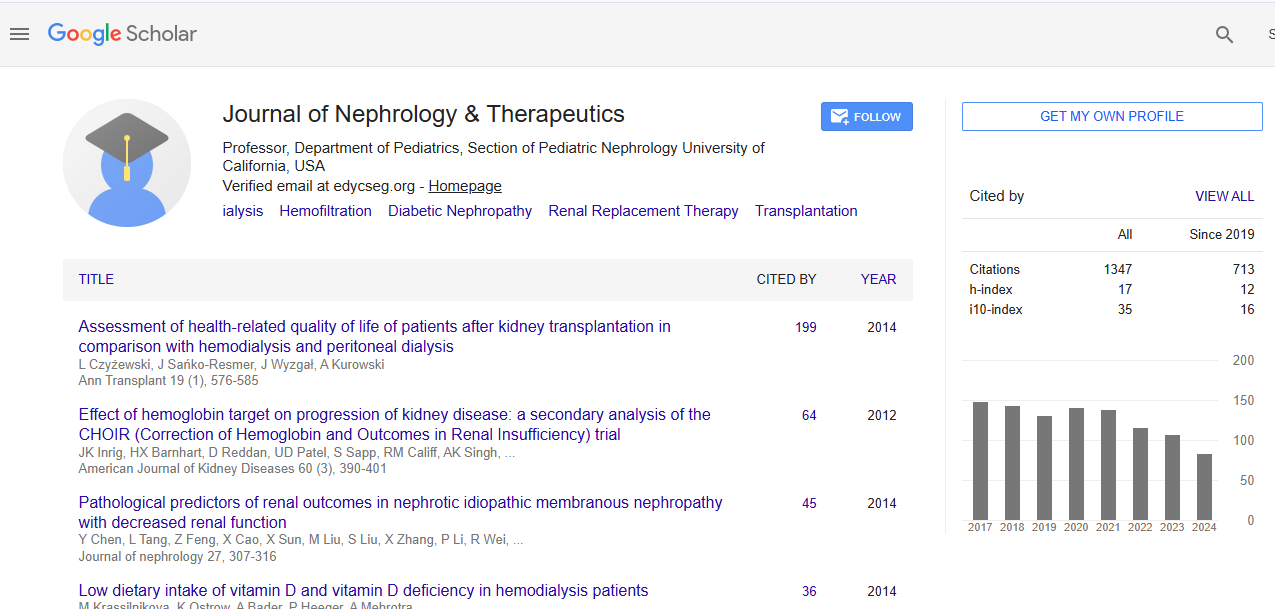
Journal of Nephrology & Therapeutics received 784 citations as per Google Scholar report