Commentary - (2025) Volume 15, Issue 4
Received: 01-Dec-2025, Manuscript No. jttr-25-175455;
Editor assigned: 03-Dec-2025, Pre QC No. P-175455;
Reviewed: 17-Dec-2025, QC No. Q-175455;
Revised: 22-Dec-2025, Manuscript No. R-175455;
Published:
29-Dec-2025
, DOI: 10.37421/2161-0991.2025.15.319
Citation: Müller, Jacob. ”Living Donation: Safety, Equity, Advances, Well-being.” J Transplant Technol Res 15 (2025):319.
Copyright: © 2025 Müller J. This is an open-access article distributed under the terms of the Creative Commons Attribution License, which permits unrestricted use, distribution and reproduction in any medium, provided the original author and source are credited.
This comprehensive review offers a global perspective on living donor kidney transplantation, updating us on the current landscape, ethical challenges, and future directions. It highlights the continued critical role of living donation in addressing organ shortages while also discussing the complexities of donor evaluation, long-term outcomes for both donors and recipients, and the evolving regulatory frameworks worldwide[1].
This study delves into the long-term success rates of living donor liver transplantation (LDLT) within the MELD (Model for End-Stage Liver Disease) allocation system, drawing insights from a single centerâ??s extensive experience. What this really means is that LDLT consistently proves to be a durable and effective treatment, even for patients grappling with advanced liver disease, reinforcing its value as a crucial therapeutic option[2].
This paper focuses on the critical topic of living kidney donor safety, thoroughly reviewing both short-term and long-term outcomes for these altruistic individuals. It underscores the absolute necessity for rigorous pre-donation evaluation and consistent post-donation monitoring, all to ensure that the risks associated with such a generous act remain as minimal as possible[3].
Here's the thing: this article tackles the intricate ethical dilemmas inherent in living donor liver transplantation. It particularly examines concerns around donor autonomy, ensuring truly informed consent, and striving for equitable access to this life-saving procedure. The takeaway is clear: we need robust ethical frameworks to guide choices in this demanding medical field[4].
This scoping review offers a critical look at the racial and ethnic disparities that exist in both access to and outcomes of living donor kidney transplantation. It pinpoints the systemic barriers holding back equitable access and then proposes concrete strategies to overcome them, underscoring how vital it is to address the broader social factors influencing health[5].
This systematic review and meta-analysis thoroughly assesses the innovations in minimally invasive surgical techniques, specifically laparoscopic and robotic approaches, for living donor nephrectomy. The key finding is that these advanced methods deliver outcomes for donor safety and recovery that are comparable to, or even better than, traditional surgery, effectively pushing the boundaries of surgical innovation in living donation[6].
This article provides an international perspective on the absolutely crucial psychological and psychosocial aspects of living organ donation, giving practical guidance for assessment and ongoing support. It stresses that a comprehensive evaluation of a donor's mental health and overall well-being is vital, not just during the initial donation process but importantly, for the years that follow[7].
This national analysis sheds light on the success and evolving trends of paired kidney exchange programs across the United States. It highlights how these innovative strategies are increasingly effective in overcoming compatibility challenges like ABO incompatibility and HLA sensitization, ultimately expanding the pool of available kidneys from living donors and saving more lives[8].
This comprehensive review outlines the current strategies and looks ahead to future directions in immunosuppression management for kidney transplant recipients, which directly impacts the long-term success of living donor transplants. It covers evolving drug regimens and personalized treatment approaches, all aimed at minimizing side effects while effectively preventing rejection, which translates to better long-term graft function and patient survival[9].
This study carefully investigates the long-term quality of life and psychosocial well-being of living kidney donors, offering reassuring evidence that outcomes are generally quite positive. What this really means is that providing robust psychosocial support, both before and after donation, is incredibly important for ensuring these individuals continue to thrive[10].
Living donor kidney transplantation holds a critical role in addressing organ shortages, as evidenced by a global review that details the current landscape, ethical challenges, and future directions. This work emphasizes the importance of complex donor evaluation, long-term outcomes for both donors and recipients, and the constantly evolving regulatory frameworks worldwide. However, racial and ethnic disparities in access to and outcomes of living donor kidney transplantation remain a significant concern, requiring a critical look at systemic barriers and proposing concrete strategies to foster equitable access by addressing broader social factors affecting health [1];[5].
Donor safety is paramount, particularly for living kidney donors. Thorough reviews cover both short-term and long-term outcomes for these altruistic individuals, highlighting the absolute necessity for rigorous pre-donation evaluation and consistent post-donation monitoring. This ensures the risks associated with such a generous act remain minimal. This also applies to the long-term quality of life and psychosocial well-being of living kidney donors, where reassuring evidence suggests generally positive outcomes. This means robust psychosocial support, both before and after donation, is incredibly important for these individuals to thrive. Additionally, studies on living donor liver transplantation (LDLT) in the MELD era demonstrate consistent long-term success rates, proving LDLT as a durable and effective treatment even for patients with advanced liver disease, reinforcing its value as a crucial therapeutic option [3];[10];[2].
Ethical considerations are central to living donor liver transplantation. Articles tackle intricate ethical dilemmas around donor autonomy, truly informed consent, and striving for equitable access. The takeaway is clear: robust ethical frameworks are needed to guide choices in this demanding medical field. Beyond ethics, the psychological and psychosocial aspects of living organ donation are absolutely crucial. An international perspective provides practical guidance for assessment and ongoing support, stressing that comprehensive evaluation of a donor's mental health and overall well-being is vital, not just during the initial donation but importantly, for years that follow [4];[7].
Innovations in surgical techniques are pushing the boundaries of living donation. A systematic review and meta-analysis assesses advancements in minimally invasive approaches, specifically laparoscopic and robotic living donor nephrectomy. The key finding is that these methods deliver comparable or even better outcomes for donor safety and recovery than traditional surgery. Furthermore, national analyses shed light on the success and evolving trends of paired kidney exchange programs. These innovative strategies are increasingly effective in overcoming compatibility challenges like ABO incompatibility and HLA sensitization, ultimately expanding the pool of available kidneys from living donors and saving more lives [6];[8].
Looking ahead, current strategies and future directions in immunosuppression management for kidney transplant recipients directly impact the long-term success of living donor transplants. Comprehensive reviews cover evolving drug regimens and personalized treatment approaches, all aimed at minimizing side effects while effectively preventing rejection. This translates to better long-term graft function and patient survival [9].
Living organ donation remains a vital solution for addressing organ shortages, with a strong focus on both donor and recipient well-being. Global perspectives highlight the current landscape, ethical challenges, and future directions for living donor kidney transplantation, emphasizing thorough donor evaluation and robust regulatory frameworks. Donor safety is paramount, particularly for living kidney donors, necessitating rigorous pre-donation assessments and consistent post-donation monitoring to minimize risks. What this means is that ensuring long-term positive outcomes for these altruistic individuals is a priority. Advances in living donor liver transplantation (LDLT) show consistent long-term success, proving it a durable and effective treatment even for patients with advanced liver disease. Innovations in surgical techniques, specifically laparoscopic and robotic approaches for living donor nephrectomy, are delivering comparable or superior outcomes in donor safety and recovery compared to traditional methods. However, disparities in access to and outcomes of living donor kidney transplantation, particularly racial and ethnic, persist. Addressing systemic barriers and broader social factors is crucial for equitable access. Furthermore, the psychological and psychosocial aspects of living donation require comprehensive international guidelines for assessment and long-term support, ensuring donors' mental health and well-being are maintained for years. Finally, ongoing advancements in immunosuppression management for kidney transplant recipients are key to improving long-term graft function and patient survival by minimizing side effects and preventing rejection. Paired kidney exchange programs further expand the donor pool by overcoming compatibility challenges, saving more lives.
None
None
None
Krista LL, Bertram LK, Amit XG. "Living Donor Kidney Transplantation: A Global Perspective on the Current State of Affairs, Ethical Challenges, and Future Directions".Transplant Rev 37 (2023):100742.
Indexed at, Google Scholar, Crossref
Ravi S, Anupam S, Jai S. "Long-Term Outcomes of Living Donor Liver Transplantation in the MELD Era: A Single-Center Experience".Indian J Surg 85 (2023):707-715.
Indexed at, Google Scholar, Crossref
Hani NI, Ziad ME, Kathryn AM. "Living kidney donation: Safety and outcomes of the donor".Kidney Int 97 (2020):654-661.
Indexed at, Google Scholar, Crossref
Muhammad AS, Abid AM, Riaz A. "Living Donor Liver Transplantation: Ethical Issues and Challenges".J Clin Transl Hepatol 7 (2019):358-361.
Indexed at, Google Scholar, Crossref
Rebecca EP, Jacqueline G, Laura P. "Racial and Ethnic Disparities in Living Donor Kidney Transplantation: A Scoping Review".Am J Kidney Dis 78 (2021):112-124.e1.
Indexed at, Google Scholar, Crossref
Huan Z, Xin Z, Peng Z. "Advances in laparoscopic and robotic living donor nephrectomy: a systematic review and meta-analysis".Clin Exp Nephrol 25 (2021):237-248.
Indexed at, Google Scholar, Crossref
James RR, James CM, Jesse DS. "Psychological and psychosocial aspects of living organ donation: An international perspective on practice and recommendations".Am J Transplant 22 (2022):2715-2726.
Indexed at, Google Scholar, Crossref
Jesse DS, Pranab VK, Lori KK. "Paired Kidney Exchange in the United States: A National Analysis of Outcomes and Trends".Clin J Am Soc Nephrol 15 (2020):697-705.
Indexed at, Google Scholar, Crossref
A. OG, Marwan SA, Athanasios A. "Immunosuppression management in kidney transplant recipients: current landscape and future directions".Nat Rev Nephrol 20 (2024):130-149.
Indexed at, Google Scholar, Crossref
Jesse DS, Emilio DP, David AM. "Long-Term Quality of Life and Psychosocial Outcomes in Living Kidney Donors".Am J Transplant 20 (2020):1903-1912.
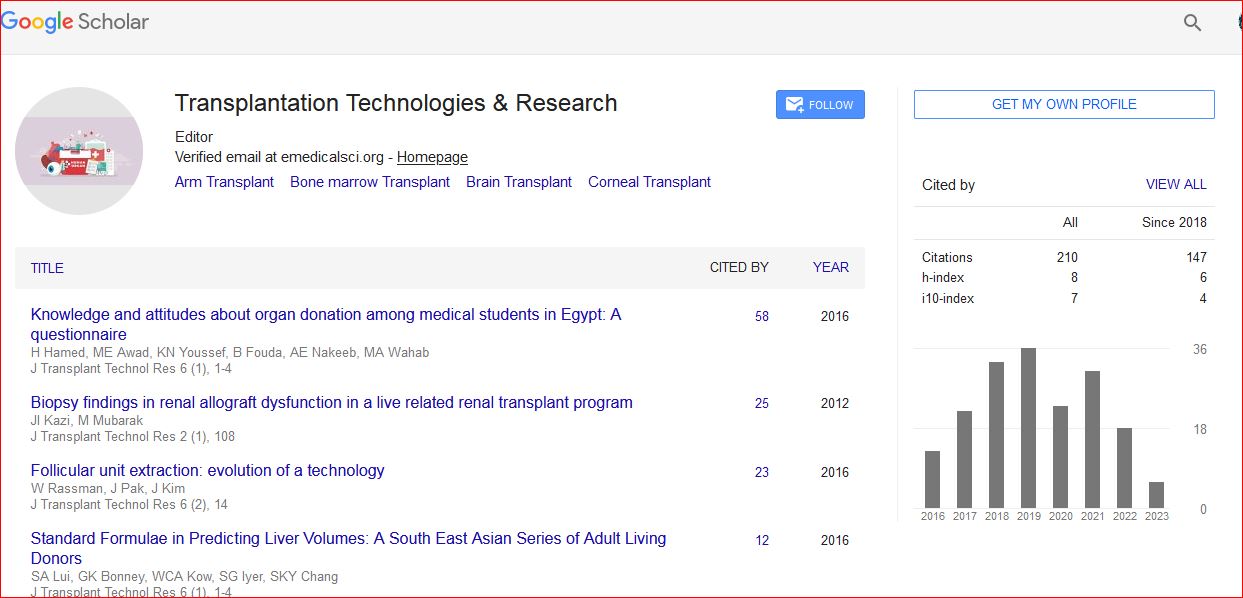
Transplantation Technologies & Research received 223 citations as per Google Scholar report