Short Communication - (2025) Volume 11, Issue 3
Received: 01-May-2025, Manuscript No. aso-26-184622;
Editor assigned: 05-May-2025, Pre QC No. P-184622;
Reviewed: 19-May-2025, QC No. Q-184622;
Revised: 22-May-2025, Manuscript No. R-184622;
Published:
29-May-2025
, DOI: 10.37421/2471-2671.2025.11.172
Citation: Hart, Emily. ”Innovations Revolutionizing Surgical Oncology:
A Precision Future.” Arch Surg Oncol 11 (2025):172.
Copyright: © 2025 Hart E. This is an open-access article distributed under the terms of the Creative Commons Attribution License, which permits unrestricted use, distribution
and reproduction in any medium, provided the original author and source are credited.
Surgical oncology is a dynamic field undergoing rapid transformation, propelled by advancements in our molecular understanding of cancer and the continuous development of innovative technologies. Precision medicine, encompassing targeted therapies and immunotherapies, is increasingly becoming an integral part of surgical planning and the execution of procedures. The adoption of minimally invasive techniques, such as robotic surgery and sophisticated endoscopic procedures, is now commonplace, leading to improved patient outcomes and significantly reduced recovery times. The application of artificial intelligence (AI) in analyzing medical images, aiding in surgical planning, and even providing robotic assistance is poised to further enhance surgical precision and operational efficiency. The future trajectory of surgical oncology is fundamentally linked to a multidisciplinary approach, which embraces these groundbreaking technological and scientific breakthroughs to deliver personalized and highly effective cancer treatments [1].
The integration of genomic profiling and liquid biopsies is profoundly revolutionizing the decision-making process in oncological surgery. These advanced tools provide critical insights into the complex heterogeneity and evolutionary patterns of tumors, thereby enabling the development of more tailored treatment strategies. For surgical oncologists, this translates into improved patient selection for neoadjuvant or adjuvant therapies and a more precise assessment of residual disease. The ongoing evolution and refinement of these diagnostic technologies hold significant promise for further enhancing the precision and overall effectiveness of surgical interventions [2].
Robotic surgery has already made a substantial impact on surgical oncology, offering enhanced precision, superior dexterity, and improved visualization during complex operative procedures. These benefits manifest as smaller incisions, reduced blood loss, shorter hospital stays, and accelerated recovery for patients undergoing treatment for a wide spectrum of cancer types. Continued advancements in robotic platforms and the innovation of novel surgical instruments are expected to further broaden the applications and amplify the benefits of this technology in the years to come [3].
Immunotherapy, particularly in the form of checkpoint inhibitors, has emerged as a formidable weapon in the ongoing battle against cancer. Its synergistic potential when combined with surgical interventions is a subject of intense and active research. The administration of immunotherapy prior to surgery can effectively prime the patient's immune system to recognize and target cancer cells, potentially facilitating more complete surgical resection and reducing the likelihood of disease recurrence. A deep understanding of these intricate interactions is paramount for optimizing comprehensive treatment paradigms in surgical oncology [4].
Artificial intelligence (AI) is on the cusp of transforming surgical oncology by augmenting diagnostic capabilities, refining surgical planning processes, and providing real-time guidance during operative procedures. AI algorithms possess the remarkable ability to analyze intricate imaging data with exceptional accuracy, assist in the precise identification of optimal surgical margins, and even offer predictive insights into patient outcomes. The continued development and rigorous validation of AI tools will be absolutely critical for their widespread and successful adoption into routine clinical practice [5].
Minimally invasive surgical techniques, including laparoscopic and endoscopic approaches, continue to represent a cornerstone of modern surgical oncology. These methods offer considerable advantages concerning patient recovery and the reduction of perioperative morbidity. Future advancements in this area will likely focus on expanding the applicability of these techniques to more challenging oncologic resections and integrating them with enhanced imaging technologies and robotic assistance [6].
The principle of neoadjuvant therapy, which involves administering treatment prior to surgical intervention, is steadily gaining prominence within the field of surgical oncology. This strategic approach has the potential to downstage tumors, thereby improving their resectability, and may even lead to the eradication of micrometastatic disease. The effective integration of systemic therapies such as chemotherapy, targeted agents, and immunotherapy in the neoadjuvant setting necessitates meticulous patient selection and robust, collaborative multidisciplinary teamwork [7].
Adjuvant therapy, administered following surgical resection, remains a critical component in the effort to eliminate any residual cancer cells and significantly reduce the risk of disease recurrence. Ongoing progress in understanding tumor biology and the development of novel therapeutic agents are continually leading to the refinement of adjuvant treatment strategies. The increasing importance of personalized approaches, guided by specific molecular markers, is crucial for tailoring adjuvant therapy to the unique needs of individual patients [8].
The indispensable role of the multidisciplinary team (MDT) in surgical oncology cannot be overstated. Effective communication and seamless collaboration among surgeons, medical oncologists, radiation oncologists, radiologists, pathologists, and other essential specialists are fundamental to ensuring comprehensive patient care and the development of optimal, individualized treatment plans. Future trends are strongly emphasizing the further integration of data sharing and communication platforms to enhance the overall effectiveness of MDTs [9].
Surgical training itself is undergoing a profound metamorphosis, increasingly incorporating advanced simulation, virtual reality (VR), and augmented reality (AR) technologies to enhance the acquisition of surgical skills. These innovative technologies create safe and controlled environments where trainees can practice complex procedures without risk to patients. The overarching focus is shifting towards competency-based training models and the imperative of lifelong learning to effectively keep pace with the rapid and ongoing advancements occurring within surgical oncology [10].
Surgical oncology is currently characterized by rapid evolution, a trajectory driven by significant strides in the molecular understanding of cancer and continuous technological innovation. The paradigm of precision medicine, which includes the application of targeted therapies and immunotherapies, is now an increasingly integrated component of the surgical planning and execution phases. Minimally invasive techniques, exemplified by robotic surgery and advanced endoscopic procedures, are rapidly becoming the standard of care, contributing to improved patient outcomes and accelerated recovery periods. Furthermore, the integration of artificial intelligence (AI) into areas such as image analysis, surgical planning, and even robotic assistance holds considerable promise for further refining surgical precision and overall efficiency. The future of surgical oncology is undeniably contingent upon a comprehensive, multidisciplinary approach that readily embraces these technological and scientific breakthroughs to achieve personalized and highly effective cancer treatment strategies [1].
The incorporation of genomic profiling and the utilization of liquid biopsies are fundamentally revolutionizing the approach to surgical decision-making within the field of oncology. These cutting-edge tools provide invaluable insights into tumor heterogeneity and its evolutionary trajectory, thereby facilitating the development of more precisely tailored treatment strategies. For surgical oncologists, this translates into enhanced capabilities for patient selection for neoadjuvant or adjuvant therapies and a more accurate understanding of the presence and extent of residual disease. The continuous development and refinement of these diagnostic technologies are poised to further augment the precision and efficacy of surgical interventions [2].
Robotic surgery has demonstrably exerted a significant influence on surgical oncology by bestowing greater levels of precision, enhanced dexterity, and superior visualization capabilities during the performance of complex surgical procedures. This technological advancement translates into tangible benefits for patients, including smaller incisions, a reduction in blood loss, shorter hospitalizations, and more rapid recovery across a diverse range of cancer types. The ongoing refinement of robotic platforms and the concurrent development of innovative surgical instruments are expected to considerably expand the scope of applications and amplify the resultant benefits of robotic surgery in the forthcoming years [3].
Immunotherapy, particularly the class of drugs known as checkpoint inhibitors, has firmly established itself as a powerful therapeutic modality in the ongoing fight against cancer. Its potential for synergistic interaction with surgical interventions is currently a focal point of extensive research endeavors. The strategic administration of immunotherapy prior to surgical resection has the capacity to effectively prime the patient's immune system to recognize and mount an attack against cancer cells, thereby potentially enhancing the completeness of surgical resection and diminishing the risk of disease recurrence. A thorough understanding of these complex interactions is critically important for the optimization of treatment paradigms within surgical oncology [4].
Artificial intelligence (AI) is strategically positioned to profoundly transform the landscape of surgical oncology through its capacity for enhanced diagnostic capabilities, improved surgical planning methodologies, and the provision of real-time intraoperative guidance. AI algorithms are adept at analyzing complex imaging data with remarkable accuracy, assisting in the identification of optimal surgical margins, and even predicting patient outcomes with increasing reliability. The continuous development and rigorous validation of AI tools will be a crucial determinant in their widespread adoption and successful integration into routine clinical practice [5].
Minimally invasive surgical techniques, encompassing both laparoscopic and endoscopic approaches, continue to serve as a foundational element of contemporary surgical oncology. These methodologies offer substantial advantages in terms of facilitating patient recovery and minimizing perioperative morbidity. Future developments in this domain are anticipated to concentrate on broadening the application of these techniques to encompass more complex oncologic resections and on integrating them with advanced imaging modalities and robotic assistance [6].
The established concept of neoadjuvant therapy, which involves the administration of treatment before undertaking surgical intervention, is progressively gaining greater acceptance and traction within the realm of surgical oncology. This therapeutic strategy possesses the potential to downstage tumors, thereby enhancing their resectability, and may even contribute to the eradication of micrometastatic disease. The effective integration of systemic therapies, such as chemotherapy, targeted agents, and immunotherapy, within the neoadjuvant setting mandates careful patient selection and demands robust, coordinated multidisciplinary collaboration [7].
Adjuvant therapy, administered after the completion of surgical resection, continues to play a vital role in the comprehensive management of cancer by aiming to eliminate any residual malignant cells and thereby reduce the risk of disease recurrence. Advances in our fundamental understanding of tumor biology, coupled with the development of novel therapeutic agents, are continuously driving the refinement of adjuvant treatment strategies. The increasing emphasis on personalized therapeutic approaches, guided by specific molecular markers, is becoming paramount for the precise tailoring of adjuvant therapy to meet the unique needs of individual patients [8].
The critical role played by the multidisciplinary team (MDT) in the context of surgical oncology is of paramount importance. The establishment of effective lines of communication and fostering seamless collaboration among surgeons, medical oncologists, radiologists, pathologists, and other relevant specialists are essential prerequisites for ensuring comprehensive patient care and for formulating optimal, individualized treatment plans. Future trends are strongly oriented towards the further integration of data management and communication platforms as a means to bolster the overall effectiveness of MDT operations [9].
Surgical training programs are currently undergoing a significant and transformative evolution, actively incorporating advanced simulation techniques, virtual reality (VR), and augmented reality (AR) to enhance the acquisition of essential surgical skills. These sophisticated technologies provide trainees with safe and controlled environments where they can meticulously practice complex procedures. The prevailing shift in focus is towards the implementation of competency-based training models and the cultivation of a commitment to lifelong learning, which are both indispensable for keeping pace with the rapid and continuous advancements occurring within the field of surgical oncology [10].
Surgical oncology is rapidly advancing due to innovations in molecular understanding and technology, including precision medicine, minimally invasive techniques, and AI. Genomic profiling and liquid biopsies are revolutionizing surgical decision-making, while robotic surgery enhances precision and patient recovery. Immunotherapy is showing promise in combination with surgery, and AI is improving diagnostics and planning. Minimally invasive approaches remain key, with ongoing research into expanding their applications. Neoadjuvant and adjuvant therapies are being refined for better patient outcomes, with personalization based on molecular markers becoming crucial. The multidisciplinary team approach is paramount for comprehensive care, and surgical training is evolving with advanced technologies like VR and AR. These advancements collectively aim to achieve personalized and effective cancer treatment.
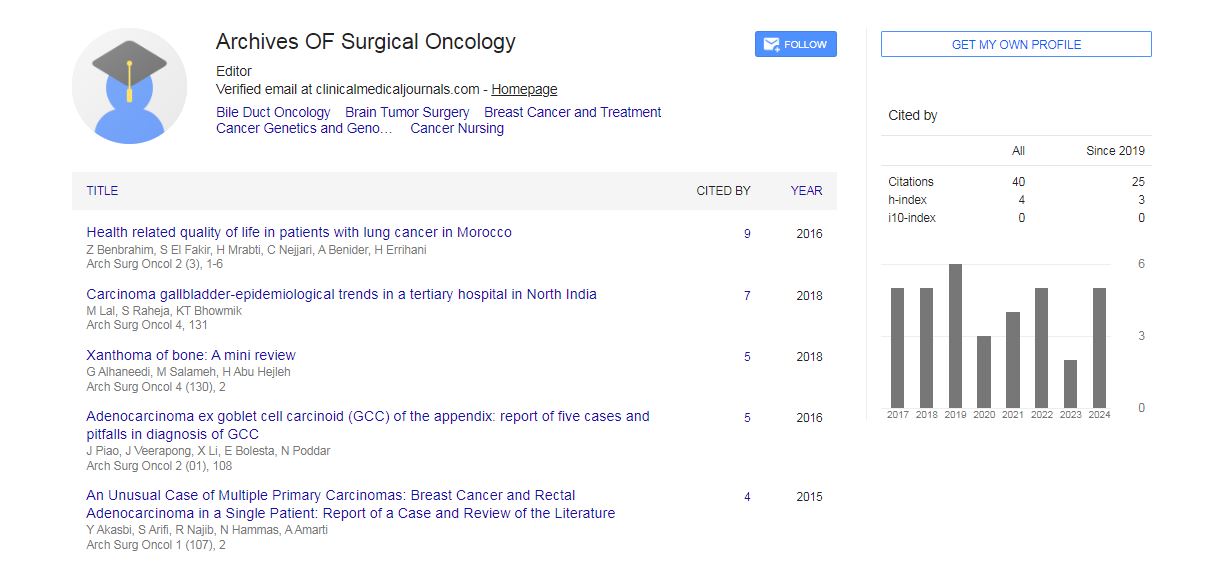
Archives of Surgical Oncology received 37 citations as per Google Scholar report