Brief Report - (2025) Volume 11, Issue 4
Received: 01-Jul-2025, Manuscript No. aso-26-184649;
Editor assigned: 03-Jul-2025, Pre QC No. P-184649;
Reviewed: 17-Jul-2025, QC No. Q-184649;
Revised: 22-Jul-2025, Manuscript No. R-184649;
Published:
29-Jul-2025
, DOI: 10.37421/2471-2671.2025.11.176
Citation: Turner, Isabella. ”Innovations in Modern Oncologic
Surgery and Precision Medicine.” Arch Surg Oncol 11 (2025):176.
Copyright: © 2025 Turner I. This is an open-access article distributed under the terms of the Creative Commons Attribution License, which permits unrestricted use, distribution
and reproduction in any medium, provided the original author and source are credited.
Minimally invasive surgical techniques, including robotic and laparoscopic approaches, are progressively becoming essential in oncologic surgery for solid tumors, offering significant advantages over traditional open procedures. These advanced methods contribute to reduced patient morbidity, accelerated recovery periods, and improved cosmetic results [1].
The integration of cutting-edge imaging technologies, intraoperative navigation systems, and personalized treatment strategies is further enhancing surgical precision and patient selection, ultimately leading to superior oncologic control and elevated quality of life [1].
Precision medicine in oncologic surgery represents a paradigm shift, focusing on tailoring therapeutic interventions based on the unique molecular and genetic profiles of individual tumors. This approach incorporates targeted therapies and immunotherapies alongside surgical resection, frequently guided by preoperative diagnostics and intraoperative molecular imaging, with the aim of optimizing tumor removal while minimizing damage to surrounding healthy tissues and achieving better systemic control [2].
Enhanced Recovery After Surgery (ERAS) protocols are paramount for improving patient outcomes in oncologic surgery by implementing multimodal pathways. These pathways encompass preoperative optimization, refined anesthetic techniques, comprehensive pain management, early patient mobilization, and dedicated nutritional support, collectively leading to shorter hospital stays, fewer postoperative complications, and increased patient satisfaction [3].
The application of artificial intelligence (AI) and machine learning in oncologic surgery presents substantial promise for enhancing diagnostic accuracy, refining surgical planning, and improving risk stratification. AI algorithms possess the capability to analyze extensive datasets, identify intricate patterns, and predict patient outcomes, thereby empowering surgeons with more informed decision-making capabilities [4].
Neoadjuvant and adjuvant therapies, encompassing chemotherapy, radiation, and immunotherapy, are increasingly incorporated into the surgical management of solid tumors. This multimodal strategy is designed to downstage tumors, enhance resectability, and mitigate the risk of recurrence, often resulting in improved survival rates for patients [5].
Intraoperative imaging and navigation systems, such as fluorescence-guided surgery and augmented reality, are fundamentally transforming the landscape of oncologic surgery. These innovative technologies provide real-time visualization of critical anatomical structures and tumor margins, thereby significantly augmenting surgical precision and patient safety [6].
Tumor debulking and cytoreductive surgery continue to be foundational elements in managing advanced solid tumors, particularly within gynecologic and gastrointestinal cancers. The primary objective is to achieve maximal tumor removal to amplify the efficacy of subsequent therapies and thereby enhance patient survival and overall quality of life [7].
The ongoing development of novel surgical materials and devices, including sophisticated staplers, advanced energy devices, and bioresorbable implants, is continuously improving surgical safety and efficiency in oncologic procedures. These technological innovations are specifically designed to minimize tissue damage and promote optimal wound healing [8].
The surgical management of oligometastatic disease signifies a pivotal shift in treatment strategies, where aggressive resection of limited metastatic lesions can potentially lead to durable remission or even cure in carefully selected patients with solid tumors. Success in this approach is critically dependent on meticulous patient selection and robust multidisciplinary collaboration [9].
The burgeoning field of onco-regenerative surgery seeks to harmonize oncologic principles with regenerative medicine techniques to effectively restore function and enhance the quality of life following tumor resection. This involves the strategic application of tissue engineering and advanced reconstructive techniques to rebuild resected organs or tissues, aiming for functional restoration [10].
Minimally invasive surgical techniques, such as robotic and laparoscopic approaches, are now fundamental to oncologic surgery for solid tumors, offering substantial improvements in patient recovery and outcomes compared to open surgery [1].
These methods are characterized by reduced morbidity, shorter recovery times, and enhanced cosmetic results, making them increasingly integral to cancer treatment [1].
The incorporation of advanced imaging, intraoperative navigation, and personalized treatment strategies further refines surgical precision and patient selection, ultimately improving oncologic control and quality of life [1].
Precision medicine in oncologic surgery centers on tailoring treatments to the individual molecular and genetic characteristics of each tumor. This involves integrating targeted therapies and immunotherapies with surgical removal, often informed by preoperative diagnostics and intraoperative molecular imaging, to maximize tumor resection while preserving healthy tissue and improving systemic management [2].
Enhanced Recovery After Surgery (ERAS) protocols are crucial for optimizing patient care in oncologic surgery, employing multimodal strategies that span preoperative preparation, anesthesia, pain control, early mobilization, and nutritional support. Their successful implementation leads to reduced hospital stays, fewer complications, and greater patient satisfaction [3].
Artificial intelligence (AI) and machine learning are showing immense potential in oncologic surgery by improving diagnostic accuracy, surgical planning, and risk stratification. AI algorithms can analyze large datasets to identify patterns and predict outcomes, aiding surgeons in making more informed choices [4].
The integration of neoadjuvant and adjuvant therapies, including chemotherapy, radiation, and immunotherapy, with surgical management is becoming standard practice for solid tumors. This comprehensive approach aims to shrink tumors, make them more operable, and decrease recurrence risk, frequently leading to improved survival [5].
Intraoperative imaging and navigation systems, such as fluorescence-guided surgery and augmented reality, are revolutionizing oncologic surgery by providing real-time visualization of critical structures and tumor margins, thereby enhancing precision and safety [6].
Tumor debulking and cytoreductive surgery remain vital for managing advanced solid tumors, especially in gynecologic and gastrointestinal cancers. The goal is to achieve the most extensive tumor removal possible to improve the effectiveness of subsequent treatments and prolong patient survival and quality of life [7].
Innovations in surgical materials and devices, including advanced staplers, energy devices, and bioresorbable implants, are consistently enhancing safety and efficiency in oncologic procedures. These advancements focus on minimizing tissue trauma and promoting better wound healing [8].
The surgical management of oligometastatic disease represents a significant evolution, where excising limited metastatic sites can result in long-term remission or cure for select patients. Success hinges on careful patient selection and effective multidisciplinary teamwork [9].
Onco-regenerative surgery is an emerging field that combines oncologic principles with regenerative medicine to restore function and improve quality of life post-resection. This field utilizes tissue engineering and reconstructive methods to rebuild surgically removed organs or tissues [10].
Modern oncologic surgery for solid tumors increasingly relies on minimally invasive techniques, such as robotic and laparoscopic approaches, which offer reduced morbidity and faster recovery. Precision medicine tailors treatments to individual tumor profiles, incorporating targeted therapies and immunotherapies alongside surgery. Enhanced Recovery After Surgery (ERAS) protocols optimize patient care through multimodal pathways, leading to better outcomes and satisfaction. Artificial intelligence and machine learning are poised to improve surgical planning and decision-making. Multimodal therapies, including neoadjuvant and adjuvant treatments, are crucial for managing solid tumors. Advanced intraoperative imaging and navigation systems enhance surgical precision and safety. Cytoreductive surgery remains vital for advanced cancers, aiming for maximal tumor removal. Innovations in surgical materials and devices improve safety and efficiency. The management of oligometastatic disease involves aggressive resection of limited metastases. Onco-regenerative surgery aims to restore function and quality of life using tissue engineering and reconstructive techniques.
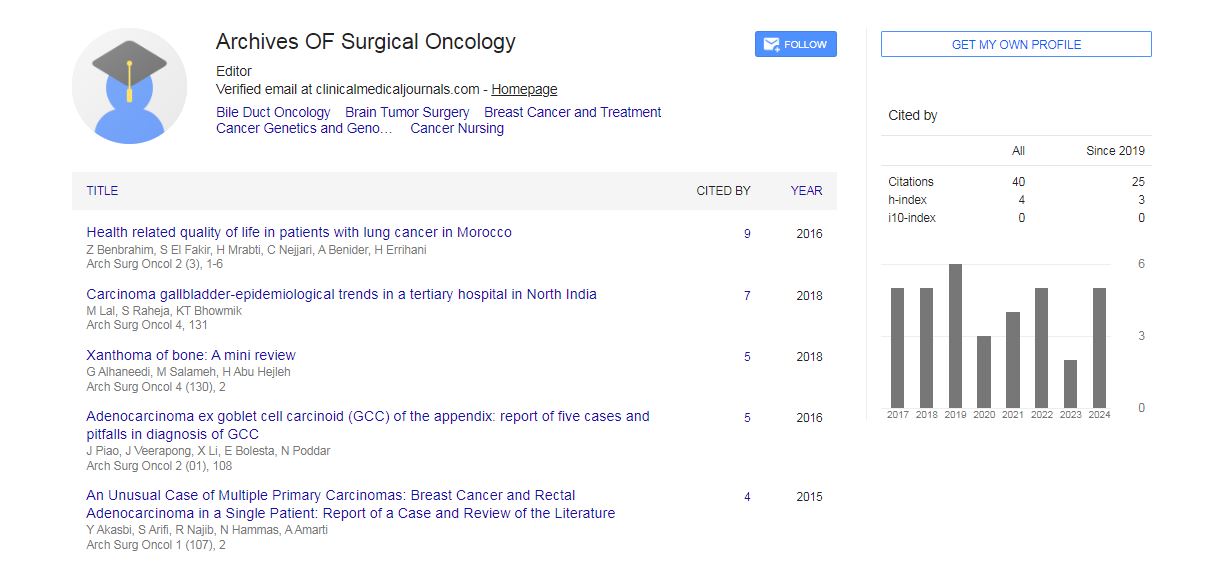
Archives of Surgical Oncology received 37 citations as per Google Scholar report