Commentary - (2025) Volume 17, Issue 4
Received: 01-Aug-2025, Manuscript No. jbabm-26-182342;
Editor assigned: 03-Aug-2025, Pre QC No. P-182342;
Reviewed: 17-Aug-2025, QC No. Q-182342;
Revised: 24-Aug-2025, Manuscript No. R-182342;
Published:
31-Aug-2025
, DOI: 10.37421/1948-593X.2025.17.501
Citation: Rao, Ananya. ”Imaging Bioanalysis: Disease Diagnosis, Therapeutic Monitoring.” J Bioanal Biomed 17 (2025):501.
Copyright: © 2025 Rao A. This is an open-access article distributed under the terms of the Creative Commons Attribution License, which permits unrestricted use, distribution and reproduction in any medium, provided the original author and source are credited.
The landscape of bioanalysis is being profoundly reshaped by remarkable advancements in imaging-based techniques, offering unprecedented clarity into biological processes and their roles in health and disease. These innovative methodologies are not only enhancing our understanding of complex biological systems but are also revolutionizing diagnostic capabilities and therapeutic monitoring. The development of novel fluorescent probes has been a significant driver, enabling researchers to visualize specific molecular targets with enhanced sensitivity and specificity, thus illuminating cellular structures and functions at the molecular level. These probes, when coupled with advanced microscopy, allow for the detailed study of cellular dynamics and pathological changes in real-time, paving the way for more personalized medical interventions. [1] Complementing these hardware and probe developments, the integration of artificial intelligence (AI) with imaging technologies is transforming the analysis of bioimaging data. Machine learning algorithms are proving instrumental in automating complex tasks such as image segmentation, feature extraction, and quantitative analysis, thereby significantly improving the efficiency and accuracy of bioanalytical workflows. This AI-driven approach is accelerating the identification of subtle biomarkers in complex biological samples and the tracking of dynamic cellular events, which is crucial for accelerating drug discovery and diagnostic processes. [2] A notable area of progress lies in super-resolution microscopy, a suite of techniques that transcends the diffraction limit of light to visualize biological structures with exceptional detail. Methods such as STORM, PALM, and SIM provide clarity into subcellular components, protein interactions, and the intricate architecture of cellular organelles. The enhanced visualization offered by super-resolution microscopy is critical for unraveling complex biological mechanisms and detecting minute pathological alterations that might otherwise remain undetected. [3] Underpinning many of these imaging advancements is the continuous innovation in the design and application of fluorescent and bioluminescent probes. Researchers are developing probes with superior photostability, quantum yield, and target specificity, which are essential for high-quality live-cell imaging, in vivo tracking, and multiplexed detection of multiple analytes. These next-generation probes are instrumental in studying disease progression and evaluating the effectiveness of therapeutic agents. [4] The synergistic application of multiple imaging modalities, known as multimodal imaging, represents another frontier in bioanalysis. By combining the strengths of techniques like fluorescence, MRI, and PET, researchers can achieve a more comprehensive understanding of biological systems. This integrated approach overcomes the limitations inherent in single modalities, providing both anatomical localization and molecular or functional information, which is particularly beneficial for understanding complex diseases such as cancer and its microenvironment. [5] Furthermore, the evolution of label-free imaging techniques, including Raman spectroscopy and optical coherence tomography (OCT), is enabling the visualization and analysis of biological samples without the need for exogenous labels. These techniques preserve the native state of cells and tissues, offering an unbiased perspective on cellular mechanics and morphology. Their potential applications span high-throughput screening, point-of-care diagnostics, and fundamental research into cellular structures. [6] Intravital microscopy has emerged as a powerful tool for studying dynamic biological processes within living organisms in real-time. This technology allows for the direct observation of cellular behavior, immune responses, and drug distribution in vivo. The high temporal and spatial resolution achievable with intravital microscopy provides invaluable insights into disease pathogenesis and the efficacy of therapeutic interventions at the most relevant biological scale. [7] Quantitative phase imaging (QPI) is another promising label-free technique that offers quantitative insights into cell morphology and dynamics. QPI measures optical path length variations, allowing for the characterization of cellular refractive index, thickness, and dry mass. This non-invasive approach is highly valuable for studying cellular processes such as division, migration, and apoptosis, providing a detailed understanding of cellular behavior without the need for staining. [8] The integration of biosensors with imaging platforms is further enhancing biomolecular detection and analysis. These hybrid systems combine the exquisite sensitivity of biosensors with the spatial and temporal resolution of imaging technologies, enabling the detection of analytes in complex biological matrices. Such advancements are critical for early disease detection, monitoring therapeutic drug levels, and identifying pathogens. [9] Looking ahead, the field of imaging-based bioanalytical techniques faces exciting prospects and persistent challenges. Future developments are expected to focus on miniaturization, integration of imaging systems, sophisticated AI for data interpretation, and the creation of biocompatible probes for in vivo applications. Addressing these challenges will undoubtedly lead to more precise, efficient, and personalized biomedical analysis, further solidifying the pivotal role of imaging in modern medicine. [10]
Recent breakthroughs in imaging-based bioanalytical techniques are significantly impacting disease diagnosis and therapeutic monitoring by providing unprecedented sensitivity and spatial resolution for studying biological processes at the molecular and cellular levels. The development of novel fluorescent probes, coupled with enhanced microscopy methods and advanced image analysis algorithms, enables non-invasive, real-time monitoring of critical biological events such as drug delivery, cellular dynamics, and pathological changes. This progress is a crucial step towards the realization of personalized medicine, offering tailored diagnostic and therapeutic strategies. [1] The synergy between artificial intelligence (AI) and advanced imaging techniques is a defining characteristic of modern bioanalysis. Machine learning algorithms are revolutionizing data analysis by automating image segmentation, feature extraction, and quantification, thereby enhancing both the speed and accuracy of results. The application of AI in identifying biomarkers within histological slides and tracking cellular events in live-cell imaging is significantly accelerating drug discovery and diagnostic workflows, making complex analyses more tractable and efficient. [2] Super-resolution microscopy techniques, including STORM, PALM, and SIM, are pushing the boundaries of biological visualization by achieving resolutions beyond the diffraction limit of light. These methods are indispensable for visualizing subcellular components, protein-protein interactions, and the fine architecture of cellular organelles. The enhanced clarity provided by these techniques is fundamental to a deeper understanding of complex biological mechanisms and the identification of subtle pathological alterations that are key indicators of disease. [3] Central to the progress in imaging-based bioanalysis is the ongoing development of advanced fluorescent and bioluminescent probes. The design principles are focused on creating probes with improved photostability, quantum yield, and remarkable target specificity. These probes are essential for a wide range of applications, including live-cell imaging, in vivo tracking, and multiplexed detection of multiple analytes simultaneously, providing critical data for understanding disease progression and assessing therapeutic efficacy. [4] Multimodal imaging, which integrates various imaging modalities such as fluorescence, MRI, and PET, offers a comprehensive approach to biological insights. By combining different techniques, researchers can overcome the limitations of individual modalities, achieving precise anatomical localization alongside detailed molecular and functional information. This integrated perspective is particularly valuable for investigating complex diseases like cancer, where a thorough understanding of the tumor microenvironment and treatment response is paramount. [5] Label-free imaging techniques, such as Raman spectroscopy and optical coherence tomography (OCT), are offering new avenues for biological analysis by allowing visualization without the need for exogenous labels. This preservation of native cellular and tissue structures provides an unbiased view of biological samples. These methods hold significant potential for applications in high-throughput screening, point-of-care diagnostics, and the study of cellular mechanics and morphology in both healthy and diseased states. [6] Intravital microscopy plays a critical role in the study of dynamic biological processes occurring within living organisms. This technique allows for real-time observation of cellular behavior, immune responses, and drug distribution in vivo, providing unparalleled insights into disease pathogenesis. The high temporal and spatial resolution achieved through intravital microscopy is crucial for evaluating the efficacy of therapeutic interventions at the most biologically relevant scale. [7] Quantitative phase imaging (QPI) is an emerging label-free technique that provides quantitative information about cell morphology and dynamics by measuring optical path length variations. QPI enables the characterization of refractive index, thickness, and dry mass of cells without the need for invasive labeling. This makes it a powerful tool for studying cellular processes such as cell division, migration, and apoptosis in their natural state. [8] The integration of biosensors with imaging platforms is leading to enhanced detection and analysis of biomolecules. These hybrid systems leverage the sensitivity of biosensors and the spatial-temporal resolution of imaging to detect analytes in complex biological matrices. Applications are diverse, ranging from early disease detection and monitoring of therapeutic drug levels to pathogen identification, thereby advancing diagnostic capabilities. [9] The future outlook for imaging-based bioanalytical techniques points towards further integration and sophistication. Key areas for development include the miniaturization and integration of imaging systems, the creation of more advanced AI tools for data interpretation, and the development of probes with improved biocompatibility and targeting for in vivo applications. Overcoming these challenges will further drive the field towards more precise, efficient, and personalized biomedical analysis. [10]
This review highlights significant advancements in imaging-based bioanalytical techniques, focusing on their impact on disease diagnosis and therapeutic monitoring. Key areas explored include novel fluorescent probes, enhanced microscopy methods, and AI-driven image analysis, which collectively offer unprecedented sensitivity and spatial resolution for studying biological processes. Super-resolution microscopy, multimodal imaging, and label-free techniques like Raman spectroscopy and OCT are discussed for their roles in visualizing cellular structures and dynamics without invasive labeling. Intravital microscopy and quantitative phase imaging are presented as powerful tools for real-time in vivo analysis and label-free cell characterization, respectively. The integration of biosensors with imaging platforms further enhances biomolecular detection. The review concludes by outlining future directions, emphasizing miniaturization, AI integration, and advanced probe development for more precise and personalized biomedical analysis.
None
None
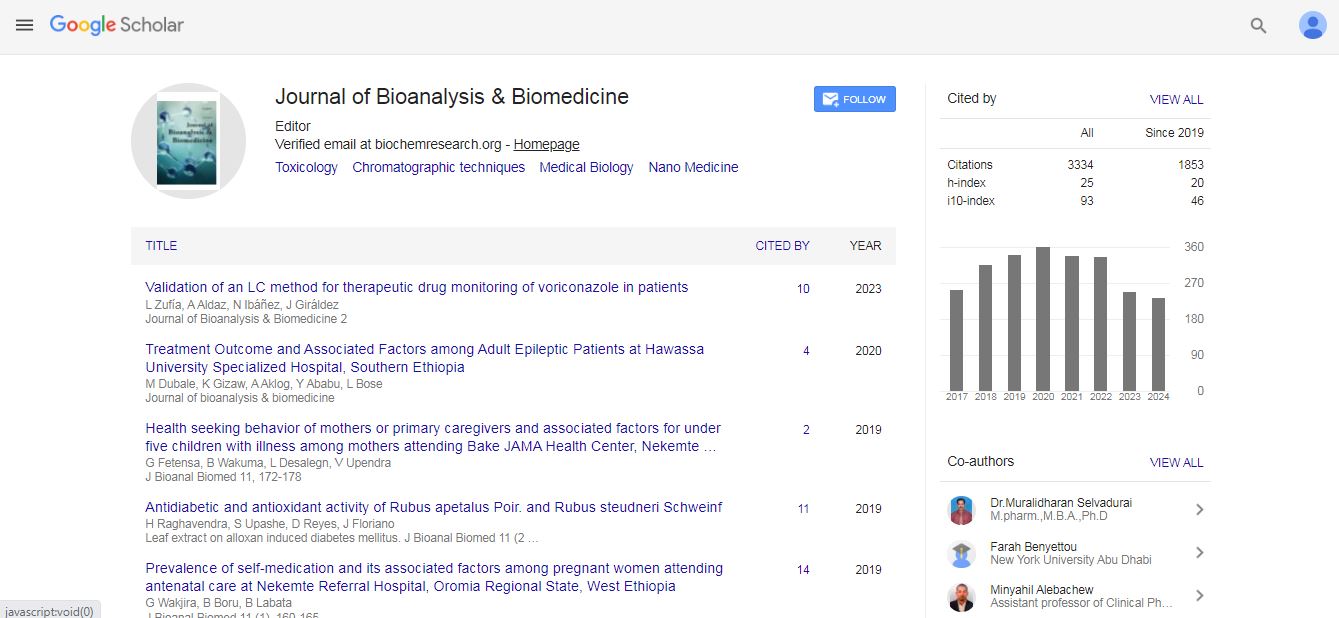
Journal of Bioanalysis & Biomedicine received 3099 citations as per Google Scholar report