Research Article - (2025) Volume 11, Issue 1
Yams (Dioscorea spp.), especially the non-domesticated wild types, are orphan food resources in Kenya. There is minimal documentation on wild yam diversity in Kenya, despite the fact that they are harvested for a variety of uses, and are threatened with rapid disappearance due to habitat loss. To contribute to their conservation and preserve indigenous knowledge for potential development of new cultivars and future research, the identity and diversity of wild yams in some parts of Kenya was investigated. Sixty (60) wild yam accessions from thirteen (13) surveyed, selected and georeferenced localities including Kombosang (KB1), Moigutwo (MB1), Kasaka (KB2), Mormorio (MB2a and MB2b), Kapkwang (KB3a, KB3b and KB3as) and Katimok Forest (KB4a and KB4b), Kolol (KEa, KEb and KEc), Turesia (TE, TEs1 and TEs2), Kapseret Forest (KUa, KUb and KUc), Chepsangor (CN1a), Chepkomiat (CN2a and CN2b), Nyakomisaro Stream (NK) and Lugusi (LKa) were collected, dried and identified using taxonomic available keys/information. The identities of twelve (12) yam-like accessions from Katimok Forest (KB4c*), Chepsangor (CN1b*), Chepkomiat (CN2c*) and Lugusi (LKb*) were also determined. A questionnaire was employed to collect data on indigenous knowledge and the proportion of the locals who could identify and name wild yam was calculated. The distribution of wild yams in North Rift, South Nyanza and Western regions of Kenya, was described. The sixty wild yam accessions belonged to three species, thus: Dioscorea schimperiana Kunth. (KB1, MB1, MB2, KB3a, KE1, TE, KUa, CNa, NK and LKa), Dioscorea bulbifera L. (KB4a, KEc and KUb) and Dioscorea quartiniana A. Rich. (KB2, MB2b, KB3b, KEb, KUc and CN2b). Accessions KB3as and TEs1 were considered Dioscorea schimperiana Kunth.sub-species 1 while TEs2 was considered as sub-species 2. On the average, only smaller proportions (below 40%) of respondents in all the localities could identify and give the local name of the wild yams. Dioscorea schimperiana Kunth was widespread in North Rift, South Nyanza and Western Kenya while D. quartiniana and D. bulbifera were limited to North Rift. This study is the first to contribute to classification of wild yams found in Kenya. The results show that diverse wild yam species exist in various geographical locations in Kenya, but only a few members of local communities are knowledgeable about these wild yams.
Yams (Dioscorea spp) are herbaceous or woody climbing tuberbearing plants with distinct annual cycle of growth. Although a few species of yam have been domesticated, there are many other species that are wild. Some of the wild yams have edible tubers, and some are useful as medicinal plants in America, Asia and Africa. These wild yams constitute staple food for hunter-gatherers living in forests in Central Africa and Uganda and is used as famine food by some communities in Kenya [1].
Yams belong to the genus Dioscorea in the family Dioscoreaceae, order Dioscoreales. Most authors have estimated the number of yam species to be over 600, reported the genus Dioscorea to be comprised of 633 species, but in the recent past. Thus, the taxonomy of yams is complex and further groupings could emerge based on recent molecular biology techniques. The genus Dioscorea is also divided into different sections, based on gross morphological traits (Burkill, 1960), especially the direction of twining of the growing shoot on the support (Coursey, 1961). The most important sections in the genus Dioscorea include; Enantiophyllum, Lasiophyton, Combilium, Opsophyton and Macrogynodium (Bai and Ekanayake, 1998;
Dounias, 2001). The growing shoots of yams in the section Enantiophyllum that include D. alata, D. cayenensis, D. opposite, D. japonica and D. rotundata, twine to the right (anticlockwise) on their support and all are edible. The other sections, namely Opsophyton (e.g Dioscorea bulbifera), Lasiophyton (e.g Dioscorea pentaphylla, Dioscorea dumetorum and D. hispida) Combilium (e.g D. esculenta), Macrogynodium (e.g D. trifida) and Macroura (e.g Dioscorea sansibarensis Pax.) have vines which twine to the left (clockwise).
Wild yam is common in uncultivated or undisturbed environments, including damp woods and swamps, thickets, roadsides, fence rows and hedges. The major yam species which are also important food crops in most parts of the world originated in three distinct regions of the world: Southeast Asia, West Africa and Tropical America, which are also considered the main centers of yam domestication and diversity. Yams can grow from sea level to highland ecological zones, depending on the species, and even clones. Generally, yams grow best at moderate to high temperatures. The response to water availability is, however, more varied, and although high temperatures and limited water supply may be tolerated by some established yams, such conditions in the early growth stages can cause high mortality [2].
Yams are globally distributed, but mostly found throughout the tropics and sub-tropics with a few members in the temperate regions of the world, implying sub-tropical to tropical climate is the most suitable for yam growth. The wild yams occur in both Africa and Asia. For instance, in India, 26 Dioscorea spp are reported, and of them, 13 are reported in Similipal Biosphere Reserve (SBR) in Odisha. Out of these 13 species, only D. alata is cultivated, and the remaining species grow in the wild. Over 40 species of wild yams have been reported in Madagascar while about 50 named species occur in Mainland Continental Africa; thus summing to about 90 species for the whole continent which translates to about 23-26% of the 350-400 species currently recognized worldwide. However, reported absence of wild yams in the four deserts in Africa; namely Sahara in the north, Danakil in the northeast, Namib Desert in the southwest and Kalahari in the south-center, and also in regions with annual rainfall less than 200 mm. Ethiopia is an isolated center of yam cultivation in East Africa. The current yam taxonomic status in Kenya comprise ten species, both wild and cultivated types. The documented wild yam species include Dioscorea dumetorum Pax., Dioscorea asteriscus Burkill, Dioscorea schimperiana Kunth, Dioscorea gilettii and Dioscorea odoratissima Pax, and Dioscorea kituiensis whereas the main cultivated species is Dioscorea minutiflora Engl. Other cultivated species that are present in low distribution are Dioscorea alata L., Dioscorea bulbifera L. and Dioscorea odoratissima Pax. that are grown for food by mainly elderly farmers in the Eastern, Central, Western and Coastal regions of the country.
Although most edible yams have been classified to the species level, each species usually has a number of varieties which have not been adequately studied and characterized. In spite of the over 600 and about 90 yam species identified in the world and Africa respectively, only a few have been identified in Kenya. To date, only few studies have been undertaken concerning the diversity and distribution of landraces of Dioscorea spp. in Eastern and Central Kenya. It is hypothesized that there are still many wild yam species that have not been identified but are at high risk of genetic erosion or even extinction due to habitat loss and shifting cultivation practices in many parts of Kenya. This study was therefore initiated to investigate the diversity of wild yams in some regions in Kenya, with the aim of establishing the yam species status and distribution, to guide future research, conservation and genetic improvement policies and programs [3].
Survey, mapping and descriptions of the study sites
A survey was carried out with guidance by experienced local elders in six Counties in three regions of Kenya including Baringo, Elgeyo-Marakwet, Uasin Gishu and Nandi (North Rift), Kisii (South Nyanza) and Kakamega (Western), to identify and map sites with wild yams. Thirteen locations were selected for this study. These locations were; Kombosang, Moigutwo, Kasaka, Mormorio, Kapkwang and Katimok Forest (Baringo), Kolol and Turesia (Elgeyo-Marakwet), Kapseret Forest (Uasin Gishu), Chepsangor and Chepkomiat (Nandi), Lugusi (Kakamega) and Nyakomisaro Stream (Kisii). The locations and brief descriptions of the selected sites are presented in Figure 1 and Table 1 respectively.
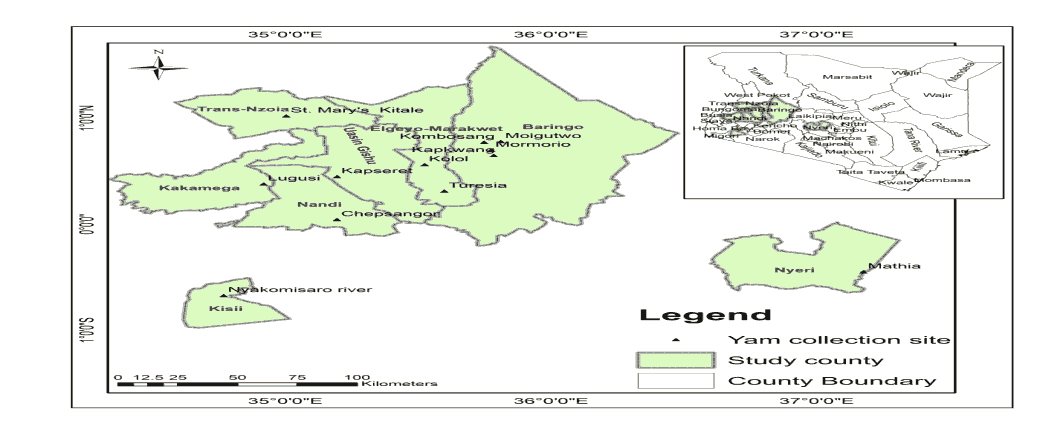
Figure 1: A map of Kenya showing the sites and counties where the wild yam accessions were found and collected.
The study involved wild yam accessions in situ in different selected localities. Identification, taking inventory and collection of wild yam specimens of each accession was carried out in the field. The stem, leaf and floral morphological features including stem colour, presence/absence of prickles, presence/absence of vine bulbils, leaf shape and apex, twining direction, inflorescence type, and number of lowers per inflorescence among other traits were recorded. During the field work, each wild yam species/sub-species discovered was locally named, photographed and their samples were collected. Their collection sites were georeferenced using GPS and their respective co-ordinates and altitudes were recorded (Table 1).
| Locality | yam accession code | County | Region | Habitat | Altitude (m) |
|---|---|---|---|---|---|
| Kombosang | KB1 | Baringo | North Rift | Gentle to steep rocky slopes, wet or dry, with thickets of trees and shrubs in Mesente Range | 1297 |
| Moigutwo | MB1 | Baringo | North Rift | Gentle to steep rocky slopes, wet or dry, with thickets of trees and shrubs | 1814 |
| Mormorio | MB2a | Baringo | North Rift | Gentle to steep rocky slopes, wet or dry, with thickets of trees and shrubs | 1655 |
| Mormorio | MB2b | Baringo | North Rift | Gentle to steep rocky slopes, wet or dry, with thickets of trees and shrubs | 1655 |
| Kasaka | KB2 | Baringo | North Rift | Gentle rocky slopes dry, with thickets of trees and shrubs | 1455 |
| Kapkwang | KB3a | Baringo | North Rift | Steep rocky slopes, wet or dry, with thickets of trees and shrubs | 2110 |
| Kapkwang | KB3as | Baringo | North Rift | Gentle to steep rocky slopes, wet or dry, with thickets of trees and shrubs | 2111 |
| Kapkwang | KB3b | Baringo | North Rift | Gentle to steep rocky slopes, wet or dry, with thickets of trees and shrubs | 2110 |
| Katimok Forest | KB4a | Baringo | North Rift | Moist/wet habitats, tropical deep and forest edges. | 2234 |
| Katimok Forest | KB4b | Baringo | North Rift | Moist/wet and dry habitats, tropical deep and forest edges. | 2234 |
| Katimok Forest | KB4c | Baringo | North Rift | Forest edges and rocky forest outskirts | 2234 |
| Kolol | KEa | Elgeyo-Marakwet | North Rift | Moist/wet and dry habitats, gentle and steep rocky slopes | 1782 |
Table 1. Brief descriptions of the sites where the yam accessions were found.
After the field work in each locality, interviews were conducted on villagers using a questionnaire, and the collected specimens and/or photographs of the different yam species.
Questions asked were mainly related to the folk nomenclature and distribution of yam in the localities.
All the voucher specimens of the wild yam accessions were deposited in the University of Eldoret Herbarium. Taxonomists from University of Eldoret and National Museum of Kenya identified the wild yam accessions.
Identification of the field live and herbarium specimens was carried out based on their shoot morphological traits, and named using available taxonomic keys/information and the data compared to those from previous studies.
Identity of the wild yam accessions
The 60 wild yam accessions which were collected across the six counties in Kenya belonged to three different species that were also reported by their local names (Table 2). Despite the local communities being knowledgeable, the proportion of respondents who identified and named the different wild yam varied according to community and locality [4]. The three wild yam species as identified and reported by their botanical and local names were: Dioscorea schimperiana Kunth. that included accessions KB1, MB1, MB2a, KB3a, KB4b, KEa, TE, KUa, CN1a, CN2a, NK and LKa. Two accessions of KB3as from Kapkwang locality in Baringo county and two accessions, TEs1 and TEs2 from Turesia in Elgeyo-Marakwet County uniquely contained prickled vines and were considered sub-species of Dioscorea schimperiana Kunth. Furthermore, sub-species KB3as and TEs1 had green prickled vines while TEs2 had dark brown prickled vines and floral parts (Plate 1b), hence were considered as Dioscorea schimperiana Kunth. sub-species 1 and 2 respectively.
| Yam accession | Ethnic group | County | |||
|---|---|---|---|---|---|
| Code | Number | Local name | Botanical name | ||
| KB1 | 3 | Nyakanwo | Dioscorea schimperianaKunth. | Arror/Tugen | Baringo |
| MB1 | 3 | Nyakanwo | Dioscorea schimperianaKunth. | Arror/Tugen | Baringo |
| KB3as | 2 | Nyakanwo | Dioscorea schimperianaKunth. | Arror/Tugen | Baringo |
| KEa | 3 | Akanwet | Dioscorea schimperianaKunth. | Keiyo | Elgeyo-Marakwet |
| TE | 3 | Akanwet | Dioscorea schimperianaKunth. | Keiyo | Elgeyo-Marakwet |
| TEs1 | 2 | Akanwet | Dioscorea schimperianaKunth. ssp 1 | Keiyo | Elgeyo-Marakwet |
| TEs2 | 2 | Akanwet | Dioscorea schimperianaKunth. ssp 2 | Keiyo | Elgeyo-Marakwet |
| KUa | 2 | Akanwet | Dioscorea schimperianaKunth. | Nandi | Uasin Gishu |
| CN1a | 3 | Akanwet | Dioscorea schimperianaKunth. | Nandi | Nandi |
| CN2a | 2 | Akanwet | Dioscorea schimperianaKunth. | Nandi | Nandi |
| NK | 3 | Omotabararia | Dioscorea schimperiana Kunth. | Abagusi | Nandi |
| LKa | 3 | Limbama | Dioscorea schimperianaKunth. | Luhya/Bukusu | Kakamega |
Table 2. The local and botanical names of the wild yam accessions in North Rift, South Nyanza and Western regions of Kenya.
The Dioscorea schimperiana Kunth. Were also known by different names in different localities, and the respondents who could identify and locally name D. schimperiana proportionately varied (Figure 1). Thus, 11.2% (Kombosang), 10.2% (Moigutwo), 11.9% (Mormorio), 7.5% (Kapkwang) and 5.2% (Katimok Forest) of Arror/Tugen respondents in Baringo County revealed that D. schimperiana plant is known as Nyakanwo. A small proportion of Keiyo respondents in Kolol (6.7%) and Turesia (6.0%) localities in Elgeyo-Marakwet County, named it Akanwet. Dioscorea quartiniana A. Rich. included fifteen (15) accessions (Table 2; Plate 1a), that included KB2(3), KB3b (15), KEb (3), KUc (3) and CN2b (3) locally known as Sekawet by 33.3% and 20.8% of Arror/Tugen respondents in Kasaka and Mormorio localities respectively, and Sita by 25% of Arror/Tugen respondents in Kapkwang locality in Baringo County (Figure 2). A smaller proportion (20.8%) of Keiyo informants in Kolol locality in Elgeyo- Marakwet County referred Dioscorea quartiniana as Sakawat, but it was unknown to the members of Nandi ethnic group in both Nandi and Uasin Gishu Counties.
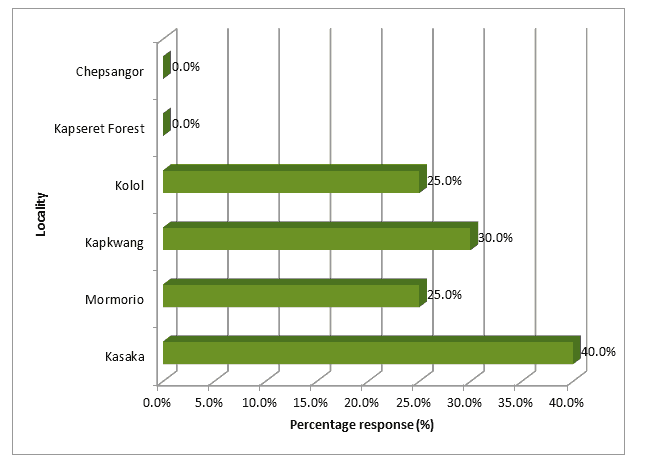
Figure 2: Proportion of respondents that identified and locally named D. quartiniana in the selected localities.
Distribution of the wild yam species
Wild yams were found in all the thirteen selected localities. However, there were differences in the types of species present among the localities
Kolol and Kapseret Forest localities in the respective Elgeyo- Marakwet and Uasin Gishu Counties, had the highest (3) number of wild yam species that included D. Schimperiana, D. quartiniana and D. bulbifera, followed by Katimok Forest, Mormorio and Kapkwang (Baringo County) and Chepkomiat in Nandi County, each with two (2) species namely, D. Schimperiana and D. quartiniana. Kombosang, Moigutwo, Kasaka (Baringo County), Chepsangor (Nandi County), Nyakomisaro stream (Kisii County) and Lugusi (Kakamega County), each had only one (1) species, D. schimperiana.
From a broader perspective, all the three wild yam species were found in North Rift whereas only one species, Dioscorea schimperiana was present in South Nyanza and Western Regions. Generally, D. schimperiana was found in twelve out of the thirteen localities in the three regions of Kenya.
Dioscorea schimperiana occurred in a range of habitats; moist/wet and dry habitats of river/stream riparian, gentle to steep rocky slopes, forest edges and rocky forest outskirts. It was found in Kombosang, Moigutwo, Mormorio, Kapkwang, Katimok Forest, Kolol, Turesia, Kapseret Forest, Chepsangor and Chepkomiat (North Rift), Nyakomisaro stream (South Nyanza) and Lugusi (Western) localities. It was absent only in Kasaka locality. Generally, D. schimperaiana was found in North Rift, South Nyanza and Western regions of Kenya. It was found in an altitude between 1297 - 2110 m above the sea level.
The folk taxonomy of wild yam by the various communities living in the study area, and the ecology of wild yam, mirrors trends of local naming of yam in many parts of the world. For example, D. bulbifera that has been named Nyakanwo (Arror/Tugen), Akanwet (Nandi), Omotabararia (Abagusi) and Limbama (Bukusu/Luhya) in the respective Baringo, Elgeyo-Marakwet, Uasin Gishu/Nandi, Kisii and Kakamega Counties, is named Pita aalu by local communities in India. However, two different yam species have been assigned the same local name because their shoots have very similar characteristics. For instance, D. bulbifera and D. schimperiana were both called Nyakanwo by Arror/Tugen or Akanwet by Keiyo and Nandi ethnic communities. Although the folk taxonomy is important in identification of yam, it could not distinguish closely similar members of different species or sub-species, hence the use of botanical system of nomenclature. Nonetheless, the folk taxonomy and botanical nomenclature have been applied the world over in the study of Dioscorea spp. The six (6) accessions of D. schimperiana, KB3as that was found in Baringo County, and TEs1 and TEs2 in Elgeyo-Marakwet County, that had uniquely prickled vines, were considered sub-species within this species. Dioscorea schimperiana was found in almost all habitats which could be the reason for its widespread distribution. Also, Kabuye, reported presence of wild D. schimperiana locally known as Yagniat by the Kipsigis ethnic group in Kericho County. Moreover, Dioscorea schimperiana were also found in Trans- Nzoia County. Furthermore, the findings were similar to reports by Burkill, and Coursey that D. schimperiana occurs in the wild throughout most of the savannah regions of tropical Africa. However, it has been domesticated and cultivated in Cameroon, West Africa, but D. schimperiana has not been domesticated and cultivated inKenya, yet the results imply wider distribution of wild D. schimperiana in Kenya. Hence, this wild yam species is a potential candidate for domestication in the country [5].
The study found a new wild yam species, Dioscorea quartiniana A. Rich. (KB2, KB3a, KEb, KUc and CN2b) which was little known among the Arror/Tugen and Keiyo communities and even unknown by Nandi group. The results indicated the presence of D. quartiniana accessions only in the Counties of North Rift regions of Kenya. It is a wild yam species that is common and distributed in sub-Saharan Africa, from Senegal to Sudan, throughout tropical Africa to South Africa and in Madagascar. However, it was found in cultivation in Eastern Nigeria, and occasionally cultivated for food in Cameroon. Furthermore, similar to the findings, D. quartiniana is a climbing tuber geophyte which is extremely variable and occurs in a range of forests, grassland habitats and rocky areas. In spite of its occurrence in altitude between 1455-2003 m, it has been reported to occur in altitude ranging between 0-2280 m above sea level hence it is also widely spread in Kenya.
Dioscorea bulbifera (KB4a, KEc and KUc) which was little known to the locals is a newly found wild yam. There is no literature information about wild D. bulbifera in Kenya. Its presence deep or at forest edges in the protected Katimok and Kapseret forests, as well as spring riparian at Kolol in Baringo, Uasin Gishu and Elgeyo-Marakwet counties respectively, qualifies D. bulbifera as a forest species. Furthermore, its occurrence in humid or wet habitats within an altitude range of 1882-2003 m above sea level suggests it is a highland species. However, reported cultivation of D. bulbifera by elderly members of Meru (Meru Central) and Taita (Taita Taveta) where D. bulbifera is locally known as Carungai (Meru) and Nduu (Taita), but added that D. bulbifera has a smaller distribution in Kenya. FarmBizAfrica reported a D. bulbifera that was under cultivation in Mathioya, in Murang’a County, and Mathira sub-county in Nyeri County. Past research work indicated that Dioscorea bulbifera is common in wild state in tropical Asia and Africa but occurs in cultivation in Oceania and the West Indies and has been in cultivation for many centuries.
In general, yam landraces from the eastern region of Kenya have exhibited the widest diversity suggesting the region as a possible centre of dispersal and domestication of yams in Kenya. Wild type, Dioscorea odoratissima was found in Malaba forest whereas Muthamia et al., (2014) found it in cultivation in two farms in Western Kenya where it was given different local names such as Chihama or Embama (Luhya) and Emodo (Teso). Members of Teso ethnic group could not distinguish between Dioscorea alata and Dioscorea odoratissima, giving them same name, Emodo because the two have closely similar shoot systems. Milne-Redhead, discovered wild yam, Dioscorea gilettii that was identified near Moyale in northern Kenya and in Sidamo and Bale Provinces in Southern Ethiopia, reported a closely related species, Dioscorea kituiensis which was found in woodlands of Eastern Kenya in Kitui and some regions in Meru.
The study discovered three (3) different wild yam species that included D. schimperiana, D. quartiniana, and D. bulbifera in North Rift, South Nyanza and Western regions of Kenya. Some D. schimperiana variants (KB3as, TEs1 and TEs2) were considered D. schimperiana sub- species. Dioscorea schimperiana and D. quartiniana are the most widely distributed while Dioscorea bulbifera was the least distributed in the three regions. There is need for more research on diversity, uses, conservation, domestication and genetic improvement of wild yam in Kenya.
The authors declare that they do not have competing interests.
Chemwetich Joseph Rotich was involved in draft and paper write up while Too Emily Jepkosgei and Onkware Augustino Osoro provided the technical advice and paper editing. Finally, all authors approved the final manuscript.
Authors are greatly indebted to the different people who assisted during the survey, mapping and collection of yam accessions in different counties. They include Felix Kiptala, Mary Bowen (Baringo), Robert Chemase (Elgeyo-Marakwet), Abraham Cheruiyot (Uasin Gishu), Lagat Nicholas (Nandi), Evans Osoro (Kisii), Barasa Meshack (Kakamega). We appreciate Mr Benard Wanjohi, from University of Eldoret and Christopher Chesire, National Museums of Kenya, for the taxonomic classification of the yam accessions. We are also thankful to local communities of the selected villages for sharing information of wild yam.