Short Communication - (2025) Volume 16, Issue 4
Received: 04-Aug-2025, Manuscript No. jar-25-177609;
Editor assigned: 06-Aug-2025, Pre QC No. P-177609;
Reviewed: 20-Aug-2025, QC No. Q-177609;
Revised: 25-Aug-2025, Manuscript No. R-177609;
Published:
01-Sep-2025
, DOI: 10.37421/2155-6113.2025.16.1079
Citation: Okoye, Linda. ”HIV-TB Co-infection: Navigating Complexities
in Care.” J AIDS Clin Res 16 (2025):1079.
Copyright: © 2025 Okoye L. This is an open-access article distributed under the terms of the Creative Commons Attribution License, which permits unrestricted use, distribution
and reproduction in any medium, provided the original author and source are credited.
Managing HIV and TB together often means navigating tricky drug interactions between antiretrovirals and anti-TB medications. It's crucial to pick regimens carefully to avoid treatment failures and serious side effects, a common challenge in co-infected patients[1].
Pinpointing latent TB infection in people living with HIV is tough, with traditional tests like TST and newer IGRA assays showing varied accuracy. This review breaks down their diagnostic performance, highlighting the need for better tools tailored for immunocompromised individuals[2].
When HIV patients start antiretroviral therapy while also battling TB, some develop TB-IRIS, a paradoxical worsening of symptoms. This comprehensive review explains what causes this inflammatory response, how doctors recognize it, and the best ways to manage it, which is essential for improved patient outcomes[3].
A shorter course of rifapentine-isoniazid offers a promising way to prevent TB in HIV-positive children and adolescents. This study demonstrates its efficacy and safety, suggesting a more practical and tolerable option for prophylactic treatment in this vulnerable group[4].
Too many HIV/TB co-infected patients in Sub-Saharan Africa experience poor TB treatment outcomes. This meta-analysis identifies key factors that predict these adverse results, underscoring the urgency for targeted interventions to improve care in resource-limited settings[5].
Treating drug-resistant TB in people living with HIV presents a significant hurdle. This review summarizes current treatment outcomes, revealing the complexities involved and emphasizing the need for robust treatment strategies and better access to newer, more effective drugs[6].
Getting an early and accurate TB diagnosis in HIV-positive individuals is critical but often delayed. This systematic review explores various biomarkers that could potentially accelerate diagnosis, which is vital for starting timely treatment and curbing disease spread[7].
Sticking to treatment is vital for both HIV and TB, but it's particularly challenging when patients have both conditions. This review sheds light on adherence rates for antiretroviral and anti-TB therapies in co-infected patients in Africa, pointing to common barriers and effective support strategies[8].
Developing an effective TB vaccine is a global health priority, especially for people living with HIV who are at higher risk. This review discusses the latest advancements in TB vaccine research and the specific considerations needed to ensure these vaccines are safe and effective for immunocompromised populations[9].
Children living with HIV face unique challenges when it comes to TB, from difficult diagnosis to complex treatment regimens. This article outlines these specific issues and highlights opportunities for improving the prevention, diagnosis, and management of TB in this young, vulnerable population[10].
Managing co-infection with HIV and Tuberculosis (TB) presents significant treatment complexities, primarily due to tricky drug interactions between antiretrovirals and anti-TB medications. Choosing the right regimens carefully is crucial to avoid treatment failures and severe side effects, a common challenge in co-infected patients[1].
Adding to this complexity, treating drug-resistant TB in people living with HIV is a substantial hurdle. Research highlights the intricacies involved and underscores the pressing need for robust treatment strategies and improved access to newer, more effective drugs[6]. In Sub-Saharan Africa, specifically, a high number of HIV/TB co-infected patients experience poor TB treatment outcomes. Identifying key factors that predict these adverse results is essential, as it highlights the urgency for targeted interventions to improve care in resource-limited settings[5].
Pinpointing latent TB infection in individuals living with HIV is notoriously difficult. Traditional tests like TST and newer IGRA assays show varied accuracy, emphasizing the need for better diagnostic tools specifically tailored for immunocompromised individuals[2]. Complementing this, getting an early and accurate TB diagnosis in HIV-positive individuals is critical but often delayed. Systematic reviews are exploring various biomarkers that could potentially accelerate diagnosis, which is vital for initiating timely treatment and curbing disease spread effectively[7].
For vulnerable populations, especially children and adolescents living with HIV, a shorter course of rifapentine-isoniazid offers a promising and practical way to prevent TB. Studies demonstrate its efficacy and safety, suggesting a more tolerable option for prophylactic treatment in this group[4]. Furthermore, children living with HIV face unique challenges with TB, ranging from difficult diagnosis to complex treatment regimens. Outlining these specific issues helps identify opportunities for improving the prevention, diagnosis, and management of TB in this young population[10]. A notable complication, Tuberculosis-Associated Immune Reconstitution Inflammatory Syndrome (TB-IRIS), can arise when HIV patients start antiretroviral therapy while battling TB. This paradoxical worsening of symptoms requires a clear understanding of its causes, recognition, and effective management strategies to improve patient outcomes[3].
Sticking to treatment is paramount for both HIV and TB, but it becomes particularly challenging when patients have both conditions. Reviews highlight adherence rates for antiretroviral and anti-TB therapies in co-infected patients in Africa, pointing to common barriers and effective support strategies[8]. Looking ahead, developing an effective TB vaccine remains a global health priority, especially for people living with HIV who are at higher risk. Research on TB vaccine development needs to consider specific factors to ensure these vaccines are safe and effective for immunocompromised populations[9].
Managing HIV and Tuberculosis (TB) together involves navigating complex drug interactions between antiretrovirals and anti-TB medications, making careful regimen selection crucial to prevent treatment failures and severe side effects. Pinpointing latent TB infection in people living with HIV remains a diagnostic challenge, with current tests showing varied accuracy and highlighting the need for tailored tools for immunocompromised individuals. For HIV patients initiating antiretroviral therapy, the risk of developing TB-associated Immune Reconstitution Inflammatory Syndrome (TB-IRIS) necessitates a clear understanding of its causes, recognition, and management for better patient outcomes. A shorter course of rifapentine-isoniazid offers a promising and practical approach for preventing TB in HIV-positive children and adolescents. Across Sub-Saharan Africa, many HIV/TB co-infected patients face poor TB treatment outcomes, with identifiable predictors calling for urgent, targeted interventions. Treating drug-resistant TB in HIV-positive individuals is another significant hurdle, underscoring the demand for robust strategies and access to effective new drugs. Achieving an early and accurate TB diagnosis in HIV-positive individuals is vital but often delayed, prompting exploration into biomarkers that could accelerate detection. Adherence to both HIV and TB therapies is critical, yet challenging for co-infected patients in Africa, pointing to common barriers and effective support strategies. Furthermore, advancing TB vaccine development is a global health priority, with specific considerations for safety and efficacy in immunocompromised populations. Lastly, HIV-positive children face unique complexities in TB diagnosis, treatment, and management, presenting opportunities for improved care.
Indexed at, Google Scholar, Crossref
Indexed at, Google Scholar, Crossref
Indexed at, Google Scholar, Crossref
Indexed at, Google Scholar, Crossref
Indexed at, Google Scholar, Crossref
Indexed at, Google Scholar, Crossref
Indexed at, Google Scholar, Crossref
Indexed at, Google Scholar, Crossref
Indexed at, Google Scholar, Crossref
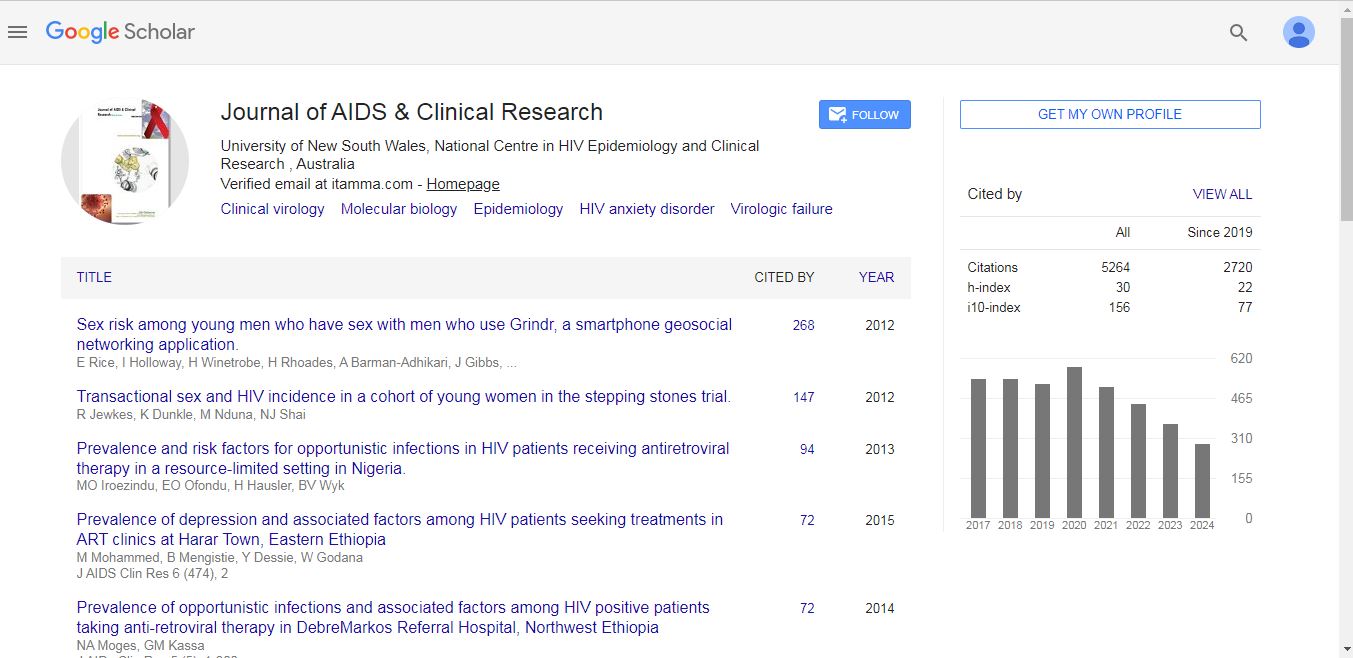
Journal of AIDS & Clinical Research received 5264 citations as per Google Scholar report