Short Communication - (2025) Volume 16, Issue 3
Received: 02-Jun-2025, Manuscript No. jar-25-176624;
Editor assigned: 04-Jun-2025, Pre QC No. P-176624;
Reviewed: 18-Jun-2025, QC No. Q-176624;
Revised: 23-Jun-2025, Manuscript No. R-176624;
Published:
30-Jun-2025
, DOI: 10.37421/2155-6113.2025.16.1069
Citation: Camila Rodríguez. ”HIV’s New Era: Chronic Challenges,
Integrated Care.” J AIDS Clin Res 16 (2025):1069.
Copyright: © 2025 R. Camila This is an open-access article distributed under the terms of the Creative Commons Attribution License, which permits unrestricted use,
distribution and reproduction in any medium, provided the original author and source are credited.
Neurocognitive impairment (NCI) remains a significant concern for people living with HIV (PLWH) even with effective antiretroviral therapy (ART). While ART has reduced severe forms of NCI, milder forms persist, impacting daily functioning and quality of life. This systematic review and meta-analysis highlight the ongoing prevalence of NCI, suggesting that inflammatory and metabolic factors, alongside viral reservoirs, may contribute to these persistent challenges, necessitating continuous monitoring and intervention strategies.[1].
Stigma significantly impacts the mental health of people living with HIV, affecting their engagement in care. This study explores how perceived and internalized stigma contributes to mental health challenges such as depression and anxiety, and subsequently acts as a barrier to consistent care, medication adherence, and overall well-being. Addressing stigma through integrated mental health support and community-based interventions is crucial for improving health outcomes for PLWH.[2].
As people with HIV are living longer due to effective ART, they face an increased burden of age-associated comorbidities and polypharmacy. This review highlights the complexities of managing conditions like cardiovascular disease, renal dysfunction, bone disease, and neurocognitive disorders in older PLWH. It emphasizes the need for comprehensive, integrated care models that address multiple chronic conditions and medication management to improve quality of life and reduce treatment burden.[3].
People living with HIV have a higher risk of cardiovascular disease (CVD) compared to the general population, attributed to chronic inflammation, immune activation, and metabolic effects of HIV itself and some ART regimens. This article reviews current perspectives on the pathophysiology of CVD in PLWH, including accelerated atherosclerosis, and discusses strategies for screening, prevention, and management, underscoring the importance of tailored risk assessment.[4].
Kidney disease remains a significant challenge for people living with HIV despite advances in antiretroviral therapy. This review highlights the various forms of renal pathology encountered, including HIV-associated nephropathy (HIVAN), chronic kidney disease (CKD) linked to prolonged inflammation, and drug-induced nephrotoxicity from certain ART agents. It emphasizes the need for regular renal function monitoring and careful selection of ART regimens to preserve kidney health.[5].
The spectrum of opportunistic infections (OIs) in people living with HIV has significantly changed with the widespread use of potent antiretroviral therapy (ART). While classic OIs like Pneumocystis pneumonia and Kaposi's sarcoma have decreased, newer or re-emerging infections, along with drug-resistant forms, pose ongoing challenges. This review outlines the evolving landscape of OIs, stressing the importance of vigilant surveillance and tailored prophylactic strategies in the current ART era.[6].
Bone health is a critical concern for people living with HIV, who experience higher rates of low bone mineral density and fractures compared to the general population. This article focuses on assessing fracture risk and managing bone disease, considering factors such as chronic inflammation, ART-related effects, and traditional risk factors. It highlights the need for routine bone density screening and interventions like vitamin D supplementation, calcium intake, and antiresorptive therapies to mitigate fracture risk.[7].
The incidence and types of HIV-associated malignancies have shifted significantly since the advent of potent antiretroviral therapy (ART). While AIDS-defining cancers like Kaposi's sarcoma have declined, non-AIDS defining cancers, particularly lymphomas and certain solid tumors, remain prevalent and are often diagnosed at later stages. This review discusses these changing trends, emphasizing the role of chronic inflammation, immune dysregulation, and coinfections in cancer development among PLWH and the need for early detection strategies.[8].
Chronic inflammation and immune activation persist in people living with HIV even under successful ART, contributing to non-AIDS comorbidities and accelerated aging. This article delves into the drivers of chronic inflammation, including residual viral replication, microbial translocation, and co-infections, and explores potential interventions to mitigate its adverse effects. Understanding these mechanisms is crucial for developing novel therapeutic strategies aimed at improving long-term health outcomes beyond viral suppression.[9].
Liver disease continues to be a leading cause of morbidity and mortality among people living with HIV, with new challenges emerging in the ART era. This review discusses the complex interplay of HIV infection itself, coinfections (especially hepatitis B and C viruses), alcohol use, and drug hepatotoxicity in contributing to liver damage. It emphasizes the need for comprehensive screening, vaccination, and tailored management strategies for liver diseases in PLWH.[10].
Living with HIV in the current era of effective Antiretroviral Therapy (ART) has shifted the focus from immediate survival to managing long-term health challenges. Despite viral suppression, Neurocognitive Impairment (NCI) continues to be a notable concern for People Living with HIV (PLWH). Milder forms of NCI persist, significantly impacting daily functioning and overall quality of life. This persistence is often linked to inflammatory and metabolic factors, as well as lingering viral reservoirs, highlighting a need for ongoing monitoring and specialized interventions [1]. Beyond physical health, the profound impact of stigma on the mental well-being of PLWH is undeniable. Perceived and internalized stigma create substantial barriers, contributing to mental health issues like depression and anxiety, and ultimately hindering consistent engagement in care and medication adherence. Addressing this requires integrated mental health support and community-focused strategies to improve health outcomes [2].
As PLWH are living longer due to ART advancements, they face an increasing burden of age-associated comorbidities and the complexities of polypharmacy. This includes managing conditions such as cardiovascular disease, renal dysfunction, bone disease, and ongoing neurocognitive disorders in an aging population. Comprehensive, integrated care models are essential to address these multiple chronic conditions effectively and to manage medication regimens, aiming to enhance quality of life and reduce treatment burden for older PLWH [3]. A specific concern in this demographic is the elevated risk of Cardiovascular Disease (CVD) compared to the general population. This increased risk is primarily driven by chronic inflammation, immune activation, and the metabolic effects of both HIV infection itself and certain ART regimens. Tailored risk assessment, screening, prevention, and management strategies are vital to combat accelerated atherosclerosis and other cardiovascular complications [4].
Maintaining organ health presents further challenges. Kidney disease, for instance, remains a persistent issue, encompassing HIV-associated nephropathy (HIVAN), chronic kidney disease (CKD) linked to inflammation, and drug-induced nephrotoxicity from specific ART agents. Regular renal function monitoring and careful ART selection are crucial for preserving kidney health [5]. Similarly, the spectrum of Opportunistic Infections (OIs) in PLWH has evolved dramatically. While classic OIs have decreased with potent ART, new or re-emerging infections, including drug-resistant forms, pose continuous threats. Vigilant surveillance and customized prophylactic strategies are necessary in this evolving landscape [6]. Bone health is another critical area, with PLWH experiencing higher rates of low bone mineral density and fractures. Chronic inflammation, ART-related effects, and traditional risk factors all contribute. Routine bone density screening, alongside interventions like vitamin D and calcium supplementation, and antiresorptive therapies, are recommended to mitigate fracture risk [7].
The incidence and types of HIV-associated malignancies have also changed significantly. AIDS-defining cancers have declined, yet non-AIDS defining cancers, particularly lymphomas and specific solid tumors, remain prevalent and often present at later stages. Chronic inflammation, immune dysregulation, and coinfections play key roles in cancer development among PLWH, underscoring the importance of early detection strategies [8]. Here's the thing, chronic inflammation and immune activation persist even in successfully treated PLWH, driving many non-AIDS comorbidities and contributing to accelerated aging. Understanding the driversâ??like residual viral replication, microbial translocation, and co-infectionsâ??is essential for developing targeted interventions to improve long-term outcomes beyond just viral suppression [9]. Finally, liver disease is a leading cause of morbidity and mortality. The complex interplay of HIV infection, coinfections (especially hepatitis B and C), alcohol use, and drug hepatotoxicity contributes to liver damage, necessitating comprehensive screening, vaccination, and tailored management approaches [10].
Effective antiretroviral therapy (ART) has transformed HIV into a manageable chronic condition, significantly extending the lifespan of people living with HIV (PLWH). However, this success introduces new challenges. Neurocognitive Impairment (NCI) persists in milder forms, impacting daily life, driven by inflammatory and metabolic factors, alongside viral reservoirs. Stigma remains a profound barrier, severely affecting mental health, care engagement, and medication adherence for PLWH. As PLWH age, they face an increased burden of comorbidities and polypharmacy, necessitating integrated care for conditions like Cardiovascular Disease (CVD), renal dysfunction, bone disease, and neurocognitive disorders. Chronic inflammation and immune activation are central to many of these long-term issues, contributing to accelerated aging and a higher risk of CVD, kidney disease, and non-AIDS defining cancers. The spectrum of Opportunistic Infections (OIs) and HIV-associated malignancies has evolved, with a decrease in classic AIDS-defining conditions but an increase in drug-resistant infections and non-AIDS defining cancers, often diagnosed late. Bone health is a significant concern due to chronic inflammation and ART effects, requiring regular screening and interventions. Liver disease, driven by HIV, coinfections like hepatitis B and C, alcohol, and drug hepatotoxicity, remains a leading cause of morbidity. Addressing these diverse and complex challenges demands continuous monitoring, tailored interventions, integrated care models, and robust support systems to enhance the quality of life for PLWH.
Indexed at, Google Scholar, Crossref
Indexed at, Google Scholar, Crossref
Indexed at, Google Scholar, Crossref
Indexed at, Google Scholar, Crossref
Indexed at, Google Scholar, Crossref
Indexed at, Google Scholar, Crossref
Indexed at, Google Scholar, Crossref
Indexed at, Google Scholar, Crossref
Indexed at, Google Scholar, Crossref
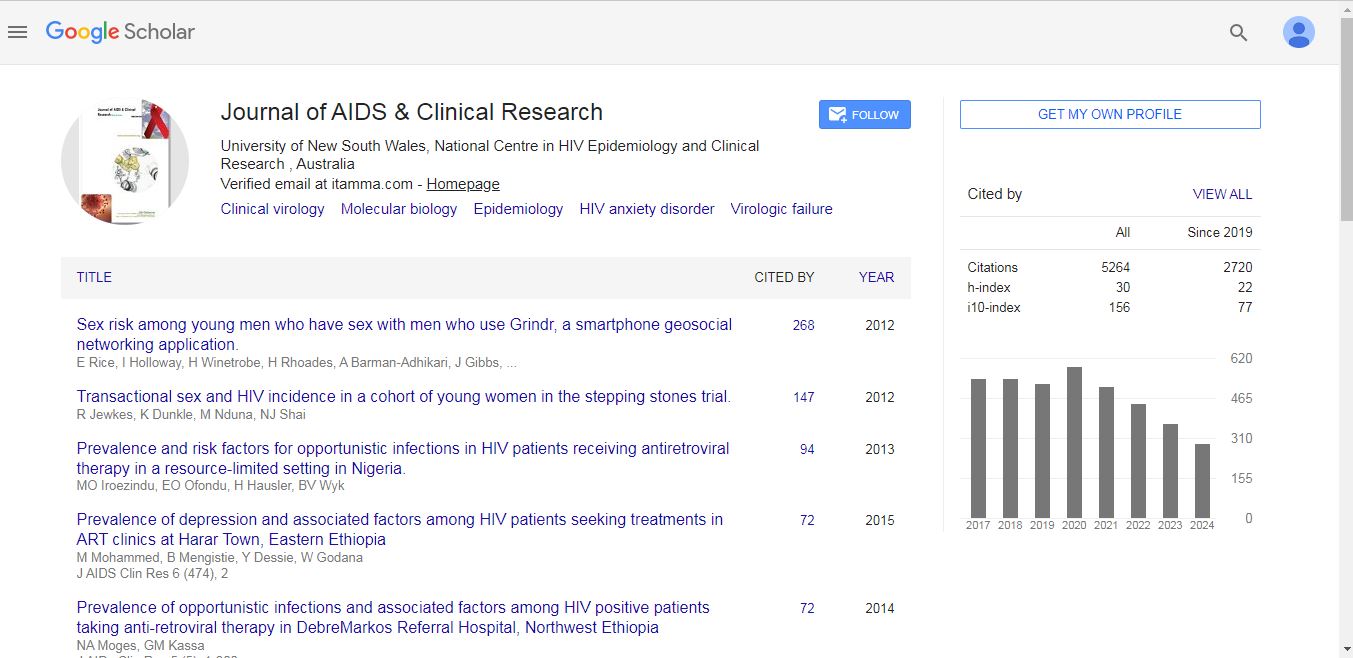
Journal of AIDS & Clinical Research received 5264 citations as per Google Scholar report