Brief Report - (2025) Volume 16, Issue 3
Received: 01-May-2025, Manuscript No. jch-26-178756;
Editor assigned: 05-May-2025, Pre QC No. P-178756;
Reviewed: 19-May-2025, QC No. Q-178756;
Revised: 24-May-2025, Manuscript No. R-178756;
Published:
29-May-2025
, DOI: 10.37421/2157-7099.2025.16.794
Citation: Al-Nasser, Fatima. ”Histochemistry: Visualizing Disease For Better Outcomes.” J Cytol Histol 16 (2025):794.
Copyright: © 2025 Al-Nasser F. This is an open-access article distributed under the terms of the Creative Commons Attribution License, which permits unrestricted use, distribution and reproduction in any medium, provided the original author and source are credited.
Histochemistry stands as a cornerstone in the intricate process of disease characterization, offering unparalleled precision at the molecular and cellular levels. This fundamental technique empowers researchers and clinicians to pinpoint specific antigens, proteins, carbohydrates, and lipids within tissue samples, which is indispensable for accurate diagnosis, prognosis prediction, and the strategic planning of therapeutic interventions. Its application is particularly vital in distinguishing between diverse tumor types, understanding the nuances of inflammatory conditions, and identifying infectious agents, thereby providing a comprehensive view of pathological mechanisms [1].
The advancement and widespread application of immunohistochemistry (IHC) and in situ hybridization (ISH) have profoundly transformed how diseases are understood and classified. These powerful methodologies facilitate the visualization and precise localization of specific biomolecules within the cellular architecture of tissues, delivering diagnostic accuracy that was previously unattainable. For instance, IHC plays a crucial role in the accurate classification of various tumors by identifying lineage-specific markers, while ISH is instrumental in detecting viral or bacterial nucleic acids, thereby confirming infectious etiologies [2].
Histochemistry offers critical insights into the metabolic dysregulations that underpin many diseases. Specialized staining techniques, such as periodic acid-Schiff (PAS) staining, can effectively reveal abnormal glycogen accumulation characteristic of metabolic disorders. Similarly, oil red O staining is invaluable for highlighting lipid deposits in conditions like atherosclerosis or fatty liver disease. These direct visual assessments of biochemical abnormalities serve as a powerful complement to traditional biochemical analyses [3].
Within the challenging domain of infectious diseases, histochemistry emerges as an invaluable tool for both identifying causative pathogens and elucidating complex host-pathogen interactions. A range of special stains can precisely detect bacteria, fungi, and parasites within tissue samples, offering a vital diagnostic avenue when microbiological cultures are negative or yield slow results. A prime example is the Gomori methenamine silver (GMS) stain, which is essential for the visualization of fungi in critical conditions such as Pneumocystis pneumonia [4].
The diagnostic significance of histochemistry also extends robustly into the characterization of autoimmune and inflammatory disorders. The ability to identify specific immune cell populations and detect their secreted products, including critical cytokines or immunoglobulins, through IHC, is pivotal in discerning the underlying disease mechanisms and guiding the selection of appropriate treatment strategies. This capability is especially important when dealing with complex systemic conditions that affect multiple organ systems [5].
Histochemical staining techniques provide essential means for assessing the extent of tissue damage and monitoring the intricate processes of tissue repair. For instance, Masson's trichrome stain effectively highlights collagen deposition, serving as a key indicator of fibrosis, a hallmark feature in chronic liver disease or kidney fibrosis. Understanding the specific extent and nature of fibrosis is paramount for accurate disease staging and for predicting patient outcomes [6].
In the complex field of neurodegenerative diseases, histochemistry plays a fundamental role in identifying the characteristic pathological hallmarks, such as the presence of abnormal protein aggregates. Specific staining for amyloid-beta, tau protein, or alpha-synuclein offers crucial diagnostic evidence for conditions like Alzheimer's disease, frontotemporal dementia, and Parkinson's disease, respectively. This detailed visualization capability is essential for differentiating between these challenging neurological disorders [7].
Histochemistry serves as a critical component in the diagnosis and precise subtyping of cancers. Immunohistochemical markers are indispensable for accurately determining the origin of tumors, distinguishing between benign and malignant lesions, and evaluating crucial prognostic factors, including cell proliferation rates (e.g., using Ki-67) or hormone receptor status (e.g., ER, PR in breast cancer). This level of specificity is vital for the implementation of personalized and effective treatment approaches [8].
The continuous development of novel histochemical stains, coupled with advancements in sophisticated imaging technologies, significantly enhances the sensitivity and specificity with which diseases can be characterized. The integration of these detailed histological findings with complementary molecular data provides a holistic and comprehensive understanding of disease pathogenesis, ultimately paving the way for earlier and more accurate diagnoses [9].
Histochemistry also plays a pivotal role in the evaluation of therapeutic response by enabling the monitoring of dynamic changes in cellular and molecular markers within diseased tissues. For instance, assessing the reduction in specific inflammatory markers or quantifying the presence of apoptotic cells can serve as direct indicators of treatment efficacy, thereby facilitating timely and informed adjustments to patient management strategies [10].
Histochemical techniques are fundamental to disease characterization, offering precise molecular and cellular insights. They enable the identification of specific antigens, proteins, carbohydrates, and lipids in tissue samples, which is crucial for accurate diagnosis, prognosis, and targeted therapies. These methods are essential for differentiating between various tumor types, inflammatory conditions, and infectious diseases, providing a deep understanding of pathological processes [1].
The advent and integration of immunohistochemistry (IHC) and in situ hybridization (ISH) have revolutionized disease diagnostics and characterization. These techniques allow for the direct visualization and precise localization of specific molecules within the tissue's cellular environment, offering unparalleled diagnostic precision. For example, IHC is indispensable for classifying tumors by identifying lineage-specific markers, while ISH can detect viral or bacterial nucleic acids, confirming infectious etiologies [2].
Histochemistry provides invaluable information regarding metabolic alterations associated with various diseases. Techniques like periodic acid-Schiff (PAS) staining can detect glycogen accumulation in metabolic disorders, and oil red O staining highlights lipid deposits in conditions such as atherosclerosis or fatty liver disease. These methods offer a direct visual assessment of biochemical abnormalities, effectively complementing biochemical analyses [3].
In the context of infectious diseases, histochemistry is vital for identifying pathogens and understanding the intricate interactions between hosts and pathogens. Special stains can detect bacteria, fungi, and parasites within tissues, facilitating diagnosis when cultures are negative or slow to yield results. For instance, Gomori methenamine silver (GMS) stain is critical for visualizing fungi in conditions like Pneumocystis pneumonia [4].
The diagnostic utility of histochemistry significantly extends to the characterization of autoimmune and inflammatory disorders. Identifying specific immune cell populations and their secreted products, such as cytokines or immunoglobulins, through IHC helps elucidate the underlying disease mechanisms and guides treatment strategies. This is particularly important for complex conditions affecting multiple organs [5].
Histochemical staining plays a crucial role in assessing tissue damage and monitoring repair processes. For example, Masson's trichrome stain can highlight collagen deposition, indicating fibrosis, a key feature in chronic liver disease or kidney fibrosis. Understanding the extent and nature of fibrosis is critical for staging disease accurately and predicting patient outcomes [6].
Within neurodegenerative diseases, histochemistry is fundamental for identifying pathological hallmarks like protein aggregates. Staining for amyloid-beta, tau protein, or alpha-synuclein provides essential evidence for conditions such as Alzheimer's disease, frontotemporal dementia, and Parkinson's disease, respectively. This detailed visualization aids in differentiating these complex neurological disorders [7].
Histochemistry plays a key role in cancer diagnosis and subtyping. Immunohistochemical markers are essential for determining tumor origin, differentiating between benign and malignant lesions, and assessing prognostic factors like proliferation (e.g., Ki-67) or hormone receptor status (e.g., ER, PR in breast cancer). This specificity is critical for developing personalized treatment approaches [8].
The ongoing development of novel histochemical stains and advanced imaging techniques is continuously improving the sensitivity and specificity of disease characterization. Integrating these histological findings with molecular data provides a comprehensive understanding of disease pathogenesis, enabling earlier and more accurate diagnoses [9].
Histochemistry aids in evaluating therapeutic response by monitoring changes in cellular and molecular markers within diseased tissues. For example, assessing the reduction of specific inflammatory markers or the presence of apoptotic cells can indicate treatment efficacy, allowing for timely adjustments to patient management [10].
Histochemistry and related techniques like immunohistochemistry (IHC) and in situ hybridization (ISH) are crucial for disease diagnosis and characterization. They enable precise identification of molecular and cellular components within tissues, aiding in the classification of tumors, inflammatory conditions, infectious diseases, and neurodegenerative disorders. These methods are essential for assessing metabolic alterations, tissue damage, and therapeutic responses. Advances in staining and imaging, combined with molecular data, enhance diagnostic accuracy and personalized treatment strategies. Special stains are vital for detecting pathogens and characterizing hallmarks of diseases like fibrosis and protein aggregation. Ultimately, histochemistry provides critical visual evidence that complements biochemical and molecular analyses, leading to improved patient outcomes.
None
None
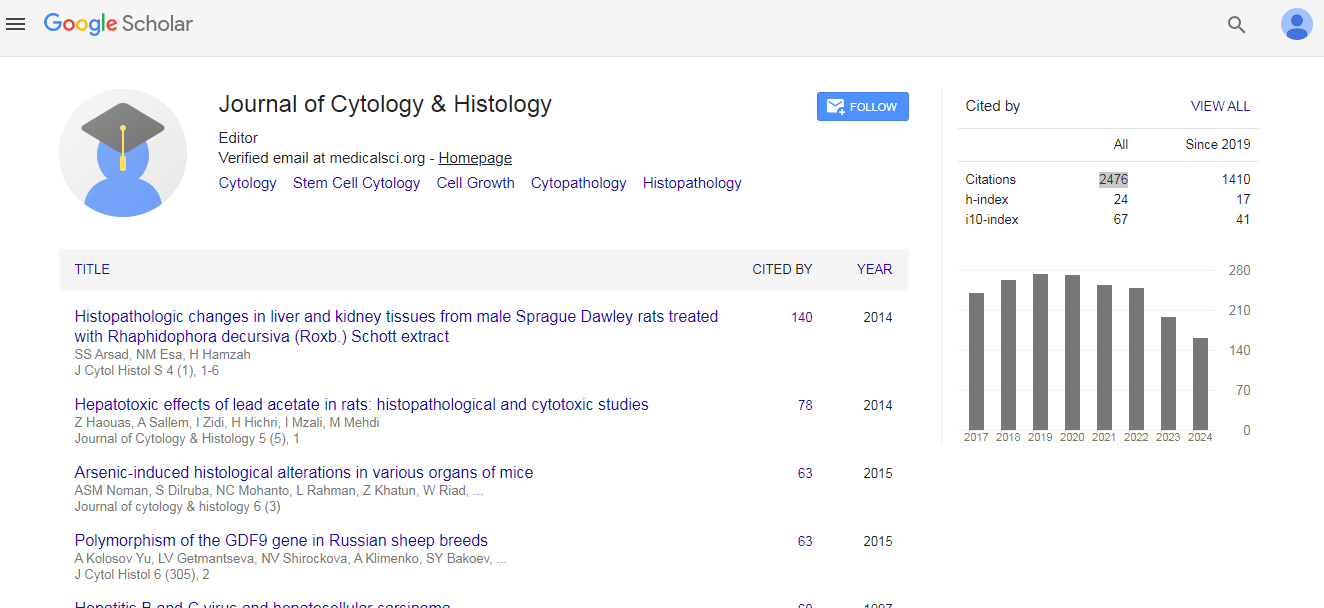
Journal of Cytology & Histology received 2476 citations as per Google Scholar report