Short Communication - (2025) Volume 14, Issue 6
Received: 03-Nov-2025, Manuscript No. aim-25-178062;
Editor assigned: 05-Nov-2025, Pre QC No. P-178062;
Reviewed: 19-Nov-2025, QC No. Q-178062;
Revised: 24-Nov-2025, Manuscript No. R-178062;
Published:
29-Nov-2025
, DOI: 10.37421/2427-5162.2025.14.605
Citation: Mehra, Ananya. ”Herbal Adaptogens: Stress Resilience and Cognitive Health.” Alt Integr Med 14 (2025):605.
Copyright: © 2025 Mehra A. This is an open-access article distributed under the terms of the Creative Commons Attribution License, which permits unrestricted use, distribution and reproduction in any medium, provided the original author and source are credited.
Herbal adaptogens, a class of natural compounds derived from botanicals, are garnering significant attention for their remarkable capacity to aid the human body in managing stress and enhancing overall resilience. These plant-based substances possess the unique ability to modulate the intricate stress response system, thereby fostering a state of physiological and psychological equilibrium. By mitigating the detrimental effects often associated with chronic stress, adaptogens contribute to improved mood, sharper cognitive function, and a general elevation in well-being. Their influence extends to key regulatory pathways such as the hypothalamic-pituitary-adrenal (HPA) axis, which plays a pivotal role in the body's reaction to stressors [1].
The HPA axis stands as a central neuroendocrine system responsible for orchestrating the body's response to various forms of stress. Adaptogens have demonstrated a notable capacity to modulate the activity of this axis, intervening in the cascade of hormonal and neural signals. Specifically, they can influence the release of critical stress hormones, including cortisol, thereby preventing the dysregulation that can arise from prolonged exposure to stressors. This modulation is instrumental in cultivating a more balanced physiological state, promoting a less reactive demeanor and bolstering inherent resilience [2].
Among the diverse array of adaptogenic herbs, certain species like Ashwagandha (Withania somnifera) and Rhodiola rosea have emerged as particularly potent agents in the realm of stress management. Clinical investigations have substantiated their efficacy in diminishing perceived stress levels and enhancing mental performance even under demanding conditions. These herbs have been observed to lower cortisol concentrations, alleviate symptoms of anxiety, and boost cognitive faculties such as memory and concentration [3].
Beyond their impact on the HPA axis, adaptogens also exert influence over other vital physiological systems that are deeply involved in the stress response. Notably, they help to balance the activity of the sympathetic nervous system (SNS), often referred to as the 'fight or flight' response, and the parasympathetic nervous system (PNS), responsible for 'rest and digest' functions. By facilitating a downregulation of the SNS and an upregulation of the PNS, adaptogens promote a state of calmness and aid in recovery from stressful episodes [4].
The neuroprotective properties of adaptogens represent another significant area of scientific inquiry. These botanical agents are believed to combat oxidative stress and inflammation within the brain, thereby safeguarding neuronal integrity and preserving cognitive health, particularly in the face of chronic stress. This protective action is thought to contribute to more stable mood regulation, potentially reduce the risk of neurodegenerative conditions, and enhance overall brain resilience [5].
Adaptogens have also shown considerable promise in ameliorating psychological distress, specifically targeting symptoms of anxiety and depression, which are frequently exacerbated by prolonged stress. Their capacity to rebalance neurotransmitter systems and fine-tune the stress response contributes to improved mood and greater emotional stability. Emerging research is exploring their potential as adjunctive therapies for mood disorders, offering a natural avenue for mental health support [6].
The fundamental concept of stress resilience, defined as the ability to effectively adapt to and recover from challenging experiences, is significantly supported by adaptogens. They function as a crucial buffer against the cumulative negative effects of chronic stress, facilitating the body's return to a state of homeostasis and strengthening its capacity to withstand future stressors. This comprehensive approach to stress management highlights a key benefit of integrating adaptogens into daily life [7].
Ongoing research is diligently working to unravel the intricate molecular pathways through which adaptogens exert their effects. These investigations are shedding light on their ability to modulate the expression of genes associated with stress, influence cellular energy metabolism, and bolster the body's intrinsic antioxidant defense mechanisms. A deeper understanding of these biochemical interactions provides a robust scientific foundation for their therapeutic applications in promoting stress resilience and overall health [8].
The incorporation of adaptogens into therapeutic strategies for stress-related disorders represents a promising frontier in the field of integrative health. Their inherent ability to bolster the body's natural stress management systems, coupled with a favorable safety profile, positions them as valuable adjuncts to conventional medical treatments. This perspective underscores a holistic approach to health, addressing both the physiological and psychological dimensions of stress [9].
Looking ahead, future research endeavors concerning herbal adaptogens are poised to focus on several key areas. The execution of larger, meticulously designed clinical trials will be essential to further clarify their efficacy and establish optimal dosages for specific stress-related conditions. Moreover, the development of personalized therapeutic approaches, tailored to individual stress profiles and genetic predispositions, will be a critical component of advancing their application. The exploration of novel adaptogenic compounds and synergistic combinations also holds considerable promise for the development of more effective interventions aimed at enhancing stress resilience [10].
Herbal adaptogens, natural compounds found in plants, are gaining significant recognition for their ability to assist the body in managing stress and bolstering resilience. These botanicals work by modulating the body's stress response system, promoting a state of balance, and reducing the negative physiological and psychological consequences of chronic stress. Their effects are observed in crucial areas such as the hypothalamic-pituitary-adrenal (HPA) axis and other stress-related pathways, leading to improvements in mood, cognitive function, and overall well-being [1].
The HPA axis is fundamental to the body's stress response, and adaptogens can effectively modulate its activity. By influencing the secretion of stress hormones like cortisol, adaptogens help to prevent the dysregulation associated with chronic stress, supporting a more stable physiological state and enhancing resilience. Current research is investigating how specific compounds within adaptogenic herbs interact with HPA axis receptors and signaling pathways [2].
Certain adaptogenic herbs, including Ashwagandha (Withania somnifera) and Rhodiola rosea, have demonstrated significant clinical benefits in reducing perceived stress and improving mental performance under stressful conditions. Studies indicate that these herbs can lower cortisol levels, alleviate anxiety symptoms, and enhance cognitive functions such as memory and concentration. The active components like withanolides and rosavins are believed to be responsible for these effects [3].
In addition to their influence on the HPA axis, adaptogens also impact other physiological systems involved in stress management. They contribute to balancing the sympathetic nervous system (SNS) and the parasympathetic nervous system (PNS), which govern the 'fight or flight' and 'rest and digest' responses, respectively. By downregulating the SNS and upregulating the PNS, adaptogens promote calmness and improve recovery from stress, often measurable through heart rate variability [4].
Neuroprotective effects are another key area of adaptogen research. By combating oxidative stress and inflammation in the brain, these herbs help preserve neuronal function and cognitive health, especially during periods of chronic stress. This protective action may lead to better mood regulation, a reduced risk of neurodegenerative diseases, and enhanced brain resilience. The exact molecular mechanisms are still under investigation [5].
Adaptogens show promise in improving psychological well-being by reducing symptoms of anxiety and depression, which are common outcomes of prolonged stress. Their ability to rebalance neurotransmitter systems and modulate the stress response contributes to enhanced mood and emotional stability. Research is exploring their use as complementary therapies for mood disorders, offering natural support for mental health [6].
The core concept of stress resilience, the capacity to adapt to and recover from stressors, is significantly enhanced by adaptogens. They act as a buffer against the harmful effects of chronic stress, promoting a return to homeostasis and improving the ability to cope with future stressors. This holistic approach to stress management is a primary advantage of using adaptogens [7].
Research into the molecular mechanisms of adaptogens is revealing their complex actions, including their ability to modify stress-related gene expression, influence cellular energy metabolism, and boost antioxidant defenses. Understanding these biochemical interactions provides a scientific basis for their use in promoting stress resilience and overall health [8].
The integration of adaptogens into therapeutic strategies for stress-related disorders offers a promising approach within integrative health. Their capacity to support the body's intrinsic stress management systems, without significant side effects, makes them valuable complements to conventional treatments, emphasizing a holistic view of health that addresses both physical and mental aspects of stress [9].
Future research on herbal adaptogens will likely focus on larger clinical trials to confirm efficacy and optimal dosages for specific stress conditions. Personalized approaches based on individual stress profiles and genetic factors will also be crucial. Exploring new adaptogenic compounds and synergistic combinations holds potential for advancing interventions for stress resilience [10].
Herbal adaptogens are natural compounds that enhance the body's ability to manage stress and build resilience. They modulate the stress response system, particularly the HPA axis, promoting balance and reducing the negative impacts of chronic stress. Specific herbs like Ashwagandha and Rhodiola rosea have shown benefits in lowering cortisol, reducing anxiety, and improving cognitive function. Adaptogens also influence the autonomic nervous system, promoting calmness and aiding recovery. Furthermore, they offer neuroprotection by combating oxidative stress and inflammation in the brain, supporting cognitive health and mood. Their use in integrative health approaches for stress-related disorders is promising, with future research focusing on larger trials and personalized interventions.
None
None
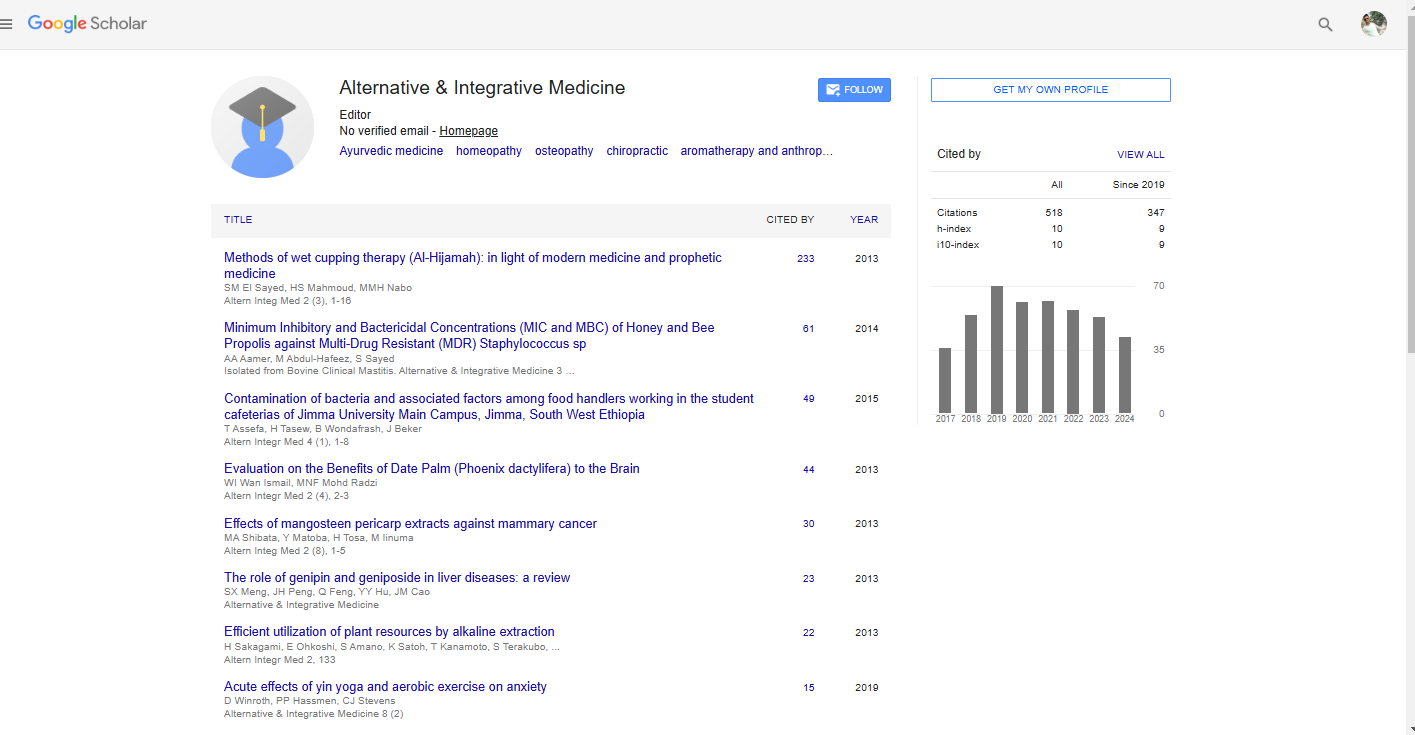
Alternative & Integrative Medicine received 476 citations as per Google Scholar report