Perspective - (2025) Volume 11, Issue 4
Received: 01-Aug-2025, Manuscript No. jctt-26-188418;
Editor assigned: 04-Aug-2025, Pre QC No. P-188418;
Reviewed: 18-Aug-2025, QC No. Q-188418;
Revised: 22-Aug-2025, Manuscript No. R-188418;
Published:
29-Aug-2025
, DOI: 10.37421/2471-9323.2024.10.336
Citation: Rojas, Camila. ”Hair Science and Cosmetic Innovation for Healthier Beauty.” J Cosmo Tricho 11 (2025):336.
Copyright: © 2025 Rojas C. This is an open-access article distributed under the terms of the Creative Commons Attribution License, which permits unrestricted use, distribution and reproduction in any medium, provided the original author and source are credited.
The field of hair care is experiencing a transformative era, driven by a deeper scientific understanding of hair biology and coupled with rapid cosmetic innovation. This advancement is profoundly shaping how we approach hair health and aesthetic enhancements. Recent breakthroughs in trichology are illuminating the complex lifecycle of the hair follicle and the critical role of scalp health in overall hair vitality. These insights are paving the way for novel ingredients and formulations aimed at repairing damage, stimulating growth, and preserving color, alongside an exploration of cutting-edge treatments and styling technologies. A significant trend is the growing emphasis on personalized hair solutions, underpinned by a more sophisticated scientific appreciation of individual hair needs and concerns. Central to understanding hair's resilience and susceptibility to damage is the intricate structure and function of the hair cuticle. Research is actively examining how external environmental factors and various chemical treatments can compromise its integrity. This investigation is delving into the molecular mechanisms that underlie hair damage and loss, with the goal of developing new strategies for prevention and effective repair. The application of advanced imaging techniques allows for the visualization of cuticle damage at a nanoscale, correlating structural alterations with diminished hair performance. These findings are invaluable for the creation of more potent hair conditioning and protective products. Furthermore, the scalp microbiome has emerged as a crucial area of investigation, significantly influencing hair health and growth patterns. The delicate balance of microorganisms residing on the scalp plays a vital role in regulating follicular function and maintaining hair vitality. Researchers are identifying specific microbial species associated with healthy scalps and robust hair growth, as well as those linked to prevalent scalp conditions such as dandruff and hair loss. The implications for cosmetic formulations are substantial, leading to the development of innovative treatments utilizing probiotics and prebiotics to restore microbial equilibrium and foster a healthier environment for hair. The efficacy of advanced delivery systems in hair care formulations is also a significant area of focus. This research investigates how encapsulating active ingredients can enhance their penetration and ensure sustained release within the hair shaft and scalp. Various encapsulation technologies, including liposomes and nanoparticles, are being evaluated for their capacity to deliver essential nutrients and therapeutic agents. These systems hold immense potential for improving the performance of hair growth stimulants, anti-hair loss treatments, and conditioning agents, offering a more precise and effective approach to hair therapy. The genetic and epigenetic factors that dictate hair texture, color, and growth patterns are increasingly being explored. This research aims to identify specific genes and their variations that contribute to the vast diversity of hair phenotypes observed across different human populations. Additionally, the study explores how environmental influences and lifestyle choices can epigenetically modify gene expression patterns related to hair biology. A comprehensive understanding of these complex interactions is foundational for developing personalized hair care solutions that are precisely tailored to an individual's genetic predispositions and environmental exposures. The detrimental impact of pollution and environmental stressors on hair health is another critical area of investigation. This research is focused on elucidating the mechanisms through which pollutants inflict damage on the hair fiber and scalp. Studies are examining the oxidative stress induced by airborne particles and ultraviolet radiation, which can lead to cuticle degradation and ultimately hair thinning. The article provides a review of protective ingredients and antioxidant strategies currently employed in cosmetic formulations to counteract these harmful effects, emphasizing the growing necessity for hair products that offer robust environmental defense. The burgeoning trend of 'clean beauty' within the hair care industry is being examined through the lens of scientific evidence regarding naturally derived ingredients and their efficacy. This review synthesizes research on botanical extracts, essential oils, and plant-based proteins commonly used in shampoos, conditioners, and styling products. The study addresses the increasing consumer demand for sustainable and ethically sourced ingredients, while also critically evaluating the scientific validation of 'natural' claims and investigating potential allergenic reactions. Insights are offered on the formulation of effective and safe hair products that adhere to the principles of clean beauty. The profound influence of nutrition on hair health and growth is a cornerstone of trichology. This research investigates how specific vitamins, minerals, and proteins impact the hair follicle cycle and keratin production. It examines the correlation between nutritional deficiencies and issues such as hair loss and compromised hair quality, as well as the demonstrated benefits of dietary supplementation. The study provides evidence-based recommendations for nutritional interventions designed to support optimal hair health, reinforcing the intrinsic link between internal well-being and external hair appearance. Innovations in hair color technology represent a dynamic area of research, with a focus on advancements in permanent, semi-permanent, and temporary coloring agents. This exploration delves into the chemical mechanisms governing color deposition, lift, and resistance to fading. It also highlights the development of gentler formulations designed to minimize hair damage during the coloring process. Emerging trends such as color-depositing conditioners and temporary color sprays are also being evaluated for their performance and consumer appeal. The overarching goal is to achieve vibrant, long-lasting color while simultaneously improving hair integrity. Finally, the intricate process of hair styling and its subsequent effects on hair structure and overall appearance are under detailed examination. This paper delves into the physics and chemistry underlying heat styling, chemical treatments such as perms and relaxers, and various forms of mechanical manipulation. The research evaluates the potential for damage associated with different styling methods and proposes techniques and product formulations that effectively minimize stress on the hair fiber. Valuable insights are provided on achieving desired styles while diligently preserving hair health and integrity, encompassing both traditional and novel styling technologies.
The scientific exploration of hair biology and cosmetic innovation is ushering in a new era for hair care, focusing on enhancing hair health and transforming aesthetics. Modern trichology is significantly advancing our understanding of the hair follicle's lifecycle and the critical importance of scalp health. This deeper knowledge is driving the development of novel ingredients and formulations designed for hair repair, stimulating growth, and ensuring color longevity, complemented by an examination of emergent trends in hair care treatments and styling technologies. A key development is the increasing demand for personalized hair solutions, which are informed by a more profound scientific comprehension of individual hair needs and specific concerns. The structure and function of the hair cuticle are central to understanding hair integrity, with ongoing research investigating how external elements and chemical treatments affect its condition. This work explores the molecular pathways involved in hair damage and loss, proposing innovative strategies for both prevention and repair. The utilization of sophisticated imaging techniques allows for the nanoscale visualization of cuticle damage, enabling a correlation between structural changes and compromised hair performance. The insights gained are instrumental in formulating more effective hair conditioning and protective products. Concurrently, the scalp microbiome's role in hair health and growth is gaining significant attention. The research elucidates how the microbial balance on the scalp influences follicular function and the vitality of hair. Key microbial species associated with healthy scalps and effective hair growth are being identified, alongside those linked to common scalp ailments such as dandruff and hair thinning. The implications for cosmetic product development are considerable, leading to the creation of scalp treatments incorporating probiotics and prebiotics to re-establish microbial equilibrium and cultivate a more conducive environment for hair health. Investigating advanced delivery systems in hair care products reveals their potential for enhancing the efficacy of active ingredients. This study focuses on the encapsulation of these ingredients to improve their absorption and prolong their release within the hair shaft and scalp. Technologies such as liposomes and nanoparticles are being assessed for their capability to deliver vital nutrients and therapeutic agents. These systems demonstrate a strong potential to boost the performance of hair growth enhancers, anti-hair loss treatments, and conditioning agents, offering a more precise and efficient method for hair therapy. Research into the genetic and epigenetic determinants of hair phenotypes, including texture, color, and growth patterns, is providing a more nuanced understanding of individual hair characteristics. This work identifies specific genes and their variations that contribute to the diverse range of human hair types. Moreover, it investigates how environmental factors and lifestyle choices can epigenetically influence gene expression related to hair biology. Comprehending these complex interactions is crucial for creating personalized hair care strategies that align with an individual's genetic makeup and environmental exposures. The impact of environmental stressors, such as pollution, on hair health is a growing concern addressed by current research. This study examines the pathways through which pollutants damage the hair fiber and scalp, particularly focusing on oxidative stress induced by airborne particles and UV radiation, which can lead to cuticle damage and hair thinning. The research reviews existing protective ingredients and antioxidant strategies used in cosmetic formulations to mitigate these negative effects, highlighting the need for hair products that offer environmental protection. The trend towards 'clean beauty' in the hair care sector is being analyzed from a scientific perspective, evaluating the efficacy of naturally derived ingredients. This paper reviews existing research on botanical extracts, essential oils, and plant-based proteins used in hair products. It addresses consumer preferences for sustainable and ethically sourced ingredients while also scrutinizing the scientific evidence supporting 'natural' claims and potential adverse reactions. The findings offer guidance for formulating safe and effective hair products aligned with clean beauty principles. Nutrition's critical role in maintaining hair health and promoting growth is a fundamental aspect of trichology. This research examines how specific vitamins, minerals, and proteins influence the hair follicle cycle and keratin production. It investigates the links between nutritional deficiencies and conditions like hair loss and poor hair quality, as well as the positive effects of dietary supplements. The study offers evidence-based recommendations for nutritional approaches to support optimal hair health, underscoring the connection between internal health and external hair appearance. Advancements in hair color technology are a significant focus, with innovations in permanent, semi-permanent, and temporary coloring agents being explored. The research covers the chemical processes involved in color application, lifting, and resistance to fading, as well as the development of gentler formulations that minimize hair damage. Emerging products like color-depositing conditioners and temporary color sprays are also being assessed for their effectiveness and market appeal, aiming for vibrant, long-lasting color with improved hair integrity. Lastly, the complex area of hair styling and its structural and aesthetic impacts is being thoroughly investigated. This paper examines the physics and chemistry of heat styling, chemical treatments, and mechanical manipulation, evaluating the damage potential of various methods. It proposes techniques and product formulations that reduce stress on the hair fiber, providing insights into achieving desired styles while preserving hair health and integrity through both conventional and novel styling technologies.
This collection of research explores various facets of hair science and cosmetic innovation. Studies examine the intricate relationship between hair biology and cosmetic advancements, focusing on trichology, hair follicle function, and scalp health. The structure and repair of the hair cuticle, the influence of the scalp microbiome, and the potential of advanced delivery systems for active ingredients are investigated. Genetic and epigenetic factors influencing hair phenotypes, the damaging effects of environmental stressors, and the science behind 'clean beauty' ingredients are also discussed. Furthermore, the role of nutrition in hair health, innovations in hair color technology, and the impact of styling practices on hair structure are detailed. The overarching theme is the pursuit of healthier, aesthetically pleasing hair through scientific understanding and technological development, with an increasing emphasis on personalized solutions and sustainable practices.
None
None
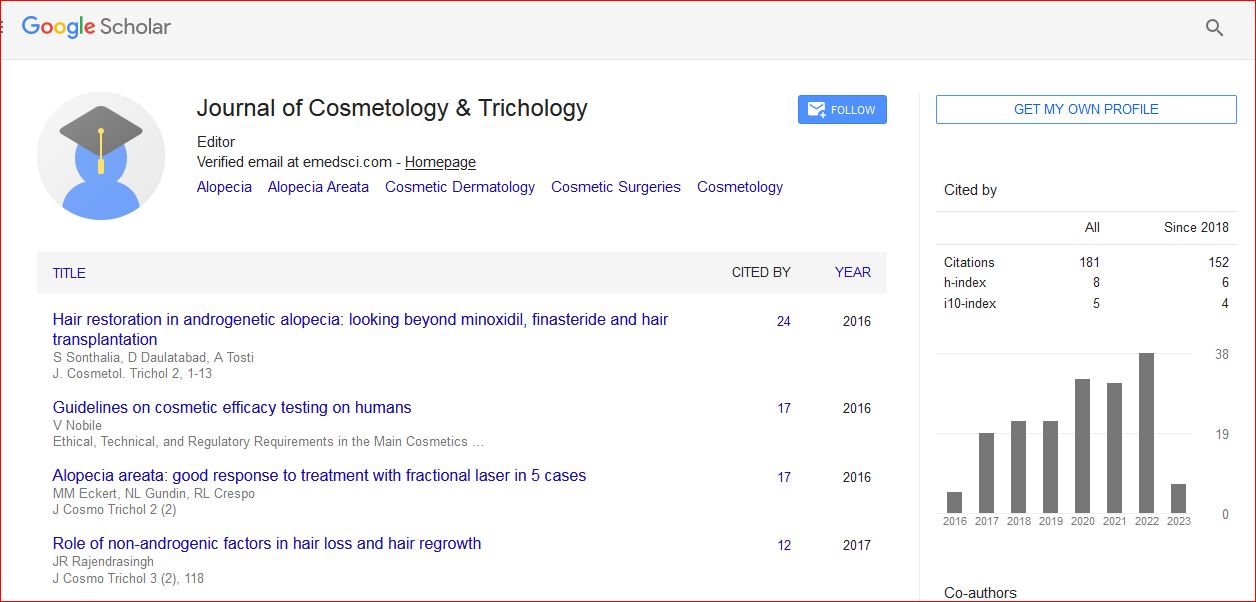
Journal of Cosmetology & Trichology received 180 citations as per Google Scholar report