Opinion - (2025) Volume 15, Issue 4
Received: 02-Aug-2025, Manuscript No. jeat-26-188635;
Editor assigned: 04-Aug-2025, Pre QC No. P-188635;
Reviewed: 18-Aug-2025, QC No. Q-188635;
Revised: 25-Aug-2025, Manuscript No. R-188635;
Published:
01-Sep-2025
, DOI: 10.37421/2161-0525.2025.15.857
Citation: Siddiqui, Ayesha. ”Groundwater Contaminants: Human
Health and Environmental Risk.” J Environ Anal Toxicol 15 (2025):857.
Copyright: © 2025 Siddiqui A. This is an open-access article distributed under the terms of the Creative Commons Attribution License, which permits unrestricted use,
distribution and reproduction in any medium, provided the original author and source are credited.
Groundwater, a vital source of drinking and irrigation water, is increasingly threatened by a diverse array of chemical contaminants, posing significant risks to public health and ecosystems. The study by Afsal et al. (2022) investigated the presence and toxicological impact of heavy metals and pesticides in groundwater within the Jamia Millia Islamia region, identifying lead, arsenic, and organochlorine pesticides at concerning levels, and demonstrating their dose-dependent cytotoxic and genotoxic effects, thus underscoring the urgent need for improved water quality monitoring and remediation strategies[1].
Furthermore, research by Li et al. (2023) assessed the chronic toxicity of a mixture of common groundwater contaminants, specifically nitrates and volatile organic compounds (VOCs), on human kidney cell lines. Their findings revealed significant oxidative stress, inflammation, and impaired cellular function due to prolonged exposure, highlighting synergistic toxic effects and the complexity of assessing real-world groundwater contamination scenarios[2].
The genotoxic and mutagenic potential of emerging contaminants like per- and polyfluoroalkyl substances (PFAS) in groundwater has been a focus of study by Johnson et al. (2021). Their in vitro assays indicated that certain PFAS compounds can induce DNA damage and chromosomal aberrations at detected concentrations, providing crucial data on their genotoxicity and potential long-term health implications, necessitating regulatory action[3].
Garcia et al. (2020) explored the neurotoxic effects of organophosphate pesticides commonly found in agricultural groundwater. Their in vivo studies in rodent models showed that exposure to these pesticides at contaminated drinking water levels resulted in significant alterations in neurotransmitter levels, synaptic plasticity, and behavioral deficits, indicating a potential for lasting neurological damage from chronic, low-dose exposure[4].
In the realm of endocrine disruption, Chen et al. (2023) examined the impact of chemicals like bisphenol A (BPA) and phthalates in groundwater on reproductive health. Their cell-based assays and animal models demonstrated interference with hormone signaling pathways, leading to reproductive abnormalities and developmental issues, emphasizing the silent threat of EDCs in drinking water[5].
Silva et al. (2022) delved into the hepatotoxicity of pharmaceutical residues and their metabolites in groundwater. Their in vitro studies on human liver cells revealed that these compounds, even at low concentrations, can induce oxidative stress, endoplasmic reticulum stress, and cell death, highlighting the growing concern of pharmaceutical contamination and its potential to cause liver damage[6].
The carcinogenic potential of arsenic in contaminated groundwater has been extensively studied by Sharma et al. (2021). Long-term exposure studies in animal models established a clear link between arsenic exposure and the development of various cancers, particularly skin, bladder, and lung cancer, reinforcing the critical need for effective arsenic remediation[7].
Rossi et al. (2023) investigated the immunotoxic effects of lead contamination in groundwater. Their studies on developing and adult animal models revealed significant alterations in immune cell function, increased susceptibility to infections, and dysregulation of immune responses, underscoring lead's impact on the immune system and its far-reaching health consequences[8].
Developmental toxicity associated with atrazine, a herbicide found in groundwater, was examined by Lee et al. (2020). Their research on aquatic organisms and mammalian cell cultures indicated that atrazine can disrupt crucial hormonal pathways for development, leading to abnormalities in reproductive organs and other developmental defects, raising concerns about wildlife and potential human health risks[9].
Finally, Tanaka et al. (2022) evaluated the cellular oxidative stress and DNA damage induced by chromium in contaminated groundwater. In vitro studies using human fibroblast cells exposed to hexavalent chromium showed significant increases in reactive oxygen species (ROS) production, lipid peroxidation, and DNA strand breaks, emphasizing chromium's genotoxic and oxidative stress-inducing potential[10].
The contamination of groundwater with a spectrum of hazardous chemicals presents a multifaceted challenge to public health and environmental sustainability. A comprehensive study by Afsal et al. (2022) focused on the Jamia Millia Islamia region, employing advanced analytical techniques to quantify heavy metals and pesticides in groundwater. Their findings revealed significant concentrations of lead, arsenic, and specific organochlorine pesticides, which were subsequently linked to dose-dependent cytotoxic and genotoxic effects in toxicological assessments, thus highlighting the imperative for enhanced water quality monitoring and remediation efforts[1].
In parallel, Li et al. (2023) investigated the chronic toxicity of a mixture of nitrates and volatile organic compounds (VOCs) on human kidney cell lines. This research demonstrated that prolonged exposure to environmentally relevant concentrations of these common groundwater contaminants induced substantial oxidative stress, inflammation, and compromised cellular functions. Notably, the study identified synergistic toxic effects when these pollutants were present together, suggesting a greater health risk than individual exposures[2].
Per- and polyfluoroalkyl substances (PFAS), a class of emerging contaminants, were the subject of a genotoxicity and mutagenicity assessment by Johnson et al. (2021). Their work utilized a series of in vitro assays, including the Ames test and micronucleus assay, to evaluate PFAS in contaminated groundwater. The results indicated that specific PFAS compounds could induce DNA damage and chromosomal aberrations at levels detected in these water sources, providing critical data on their genotoxic potential and the need for regulatory intervention[3].
The neurotoxic implications of organophosphate pesticides, frequently detected in agricultural groundwater, were explored by Garcia et al. (2020) through in vivo studies. Using a rodent model, exposure to these pesticides at concentrations found in contaminated drinking water led to significant disruptions in neurotransmitter levels, synaptic plasticity, and marked behavioral deficits, including impaired motor coordination and cognitive function, underscoring the potential for lasting neurological damage[4].
Chen et al. (2023) focused on the impact of endocrine-disrupting chemicals (EDCs) such as bisphenol A (BPA) and phthalates, which are present in groundwater, on reproductive health. Through cell-based assays and animal models, their research demonstrated that exposure to these EDCs can interfere with vital hormone signaling pathways, leading to reproductive abnormalities and developmental issues, thereby emphasizing the hidden risks associated with EDCs in drinking water[5].
Regarding hepatotoxicity, Silva et al. (2022) examined the effects of a mixture of pharmaceutical residues and their metabolites found in groundwater. Their in vitro studies on human liver cells indicated that these compounds, even at low concentrations, could trigger oxidative stress, endoplasmic reticulum stress, and ultimately lead to cell death, raising concerns about the widespread issue of pharmaceutical contamination in water sources and its potential to cause liver damage[6].
Sharma et al. (2021) provided further evidence on the carcinogenic potential of arsenic in contaminated groundwater. Their long-term exposure studies in animal models established a strong correlation between arsenic exposure and the development of various cancers, specifically skin, bladder, and lung cancer, reinforcing the classification of arsenic as a potent carcinogen and highlighting the critical need for effective remediation strategies in affected areas[7].
Lead contamination in groundwater and its subsequent immunotoxic effects were investigated by Rossi et al. (2023). Their research, conducted on developing and adult animal models, revealed substantial alterations in immune cell function, an increased susceptibility to infections, and dysregulation of immune responses following lead exposure, emphasizing the detrimental impact of lead on the immune system and its broader health implications[8].
Developmental toxicity associated with atrazine, a prevalent herbicide in groundwater, was assessed by Lee et al. (2020). Their studies, involving aquatic organisms and mammalian cell cultures, indicated that atrazine can disrupt essential hormonal pathways crucial for development, resulting in abnormalities of reproductive organs and other developmental defects, which raises significant concerns for wildlife and potential human health impacts[9].
Lastly, Tanaka et al. (2022) evaluated the induction of cellular oxidative stress and DNA damage by chromium in contaminated groundwater. Their in vitro experiments with human fibroblast cells exposed to hexavalent chromium demonstrated significant increases in reactive oxygen species (ROS) production, lipid peroxidation, and DNA strand breaks, confirming the genotoxic and oxidative stress-inducing properties of chromium as a common groundwater pollutant[10].
This collection of research highlights the pervasive and detrimental impacts of various chemical contaminants found in groundwater on human health. Studies reveal significant toxicological effects from heavy metals like lead and arsenic, pesticides such as organochlorines and organophosphates, emerging contaminants like PFAS, common pollutants like nitrates and VOCs, endocrine disruptors like BPA and phthalates, pharmaceutical residues, and industrial chemicals like chromium. These contaminants have been linked to cytotoxic, genotoxic, neurotoxic, carcinogenic, immunotoxic, developmental, and hepatotoxic effects, often exacerbated by synergistic interactions in mixtures. The research underscores the critical need for stringent water quality monitoring, effective remediation strategies, and regulatory action to safeguard public health from contaminated groundwater sources.
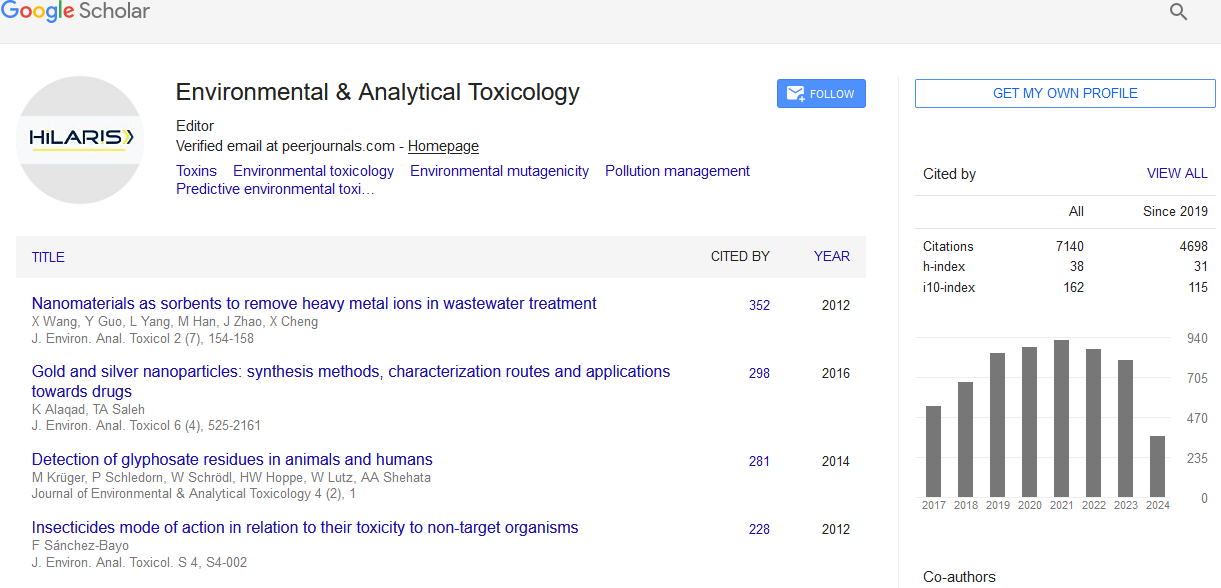
Environmental & Analytical Toxicology received 6818 citations as per Google Scholar report