Short Communication - (2025) Volume 16, Issue 3
Received: 01-Apr-2025, Manuscript No. .hycr-25-172522;
Editor assigned: 03-Apr-2025, Pre QC No. P-172522;
Reviewed: 17-Apr-2025, QC No. Q-172522;
Revised: 22-Apr-2025, Manuscript No. R-172522;
Published:
29-May-2025
, DOI: 10.37421/2157-7587.2025.16.604
Citation: García, Sofia. ”Global Environmental Issues and Sustainable Solutions.” Hydrol Current Res 16(2025):604.
Copyright: © 2025 García S. This is an open-access article distributed under the terms of the Creative Commons Attribution License, which permits unrestricted use, distribution
and reproduction in any medium, provided the original author and source are credited.
The challenges facing global ecosystems and human societies are increasingly complex, demanding comprehensive scientific inquiry and integrated solutions. This body of research delves into various critical environmental concerns, from the overarching threat of climate change to localized issues of pollution and resource management, while also highlighting strategies for enhancing sustainability. A key theme emerging from these studies is the profound impact of climate change. A systematic review and meta-analysis, for example, meticulously explores how rising temperatures, altered precipitation patterns, and extreme weather events extensively impact global biodiversity. This leads to species range shifts, population declines, and significant ecosystem disruptions across diverse biomes, underscoring an urgent call for conservation and mitigation efforts to safeguard Earthâ??s biological richness [1].
In a related vein, the multifaceted impacts of deforestation on climate change are comprehensively examined. Forest clearing drastically reduces carbon sequestration, releases stored carbon into the atmosphere, and alters local and regional climate patterns. These actions exacerbate global warming and further threaten biodiversity, highlighting the indispensable role of forest conservation in climate regulation [10].
Beyond climate, pollution represents another significant environmental burden. A comprehensive global review on plastic pollution in marine ecosystems details its profound impacts on biodiversity and ecosystem functioning. The article covers the detrimental effects on marine organisms through entanglement, ingestion, and chemical leaching, emphasizing widespread ecological damage and calling for urgent policy interventions and behavioral changes to curb plastic waste [3].
Similarly, the link between air pollution and cardiovascular disease mortality is a critical concern. A systematic review and meta-analysis synthesizes recent findings, demonstrating that exposure to various air pollutants significantly increases the risk of heart attacks, strokes, and other cardiovascular events, stressing the vital importance of cleaner air policies for public health and disease prevention [8].
Resource scarcity also features prominently in these investigations. One global review focuses on the severe problem of soil degradation and its profound implications for food security worldwide. It outlines various degradation processes, including erosion, salinization, and nutrient depletion, explaining how these factors diminish agricultural productivity, threaten livelihoods, and contribute to food scarcity, thus advocating for sustainable land management practices [6].
Another global perspective tackles water scarcity, exploring various management strategies to address diminishing freshwater resources. This includes approaches from demand-side management and water-saving technologies to supply-side solutions like desalination and wastewater treatment, emphasizing the necessity of integrated water resource management, policy reforms, and international cooperation to ensure water security for all [7].
Amidst these challenges, solutions and sustainable transitions are also explored. A critical review assesses the environmental impacts and sustainability of various renewable energy systems. It examines the life cycle implications of solar, wind, hydro, and bioenergy technologies, highlighting both their benefits in reducing greenhouse gas emissions and their potential challenges, such as land use, raw material consumption, and waste generation. This guides more sustainable energy transitions [4].
Urban planning plays a crucial role here, as evidenced by a systematic review quantifying the diverse ecosystem services provided by urban green infrastructureâ??such as parks, green roofs, and street trees. It highlights their critical role in improving air quality, mitigating urban heat island effects, managing stormwater, and enhancing human well-being, underscoring the importance of integrating nature-based solutions into urban design for more resilient and livable cities [2].
Furthermore, systemic approaches to sustainability are investigated. A systematic review critically evaluates the application of Life Cycle Assessment (LCA) to circular economy strategies. It identifies how LCA helps quantify environmental impacts and benefits of circular approaches, such as reuse, repair, and recycling, providing crucial insights for designing more sustainable products and systems and moving beyond linear economic models [9].
Underlying many of these issues is the concept of environmental justice. A systematic review investigates the intricate links between environmental justice and health disparities, revealing how marginalized communities disproportionately bear the burden of environmental pollution and climate change impacts. It underscores the critical need for equitable policies and community engagement to address these systemic injustices and promote healthier outcomes for all populations [5].
Collectively, these studies offer a comprehensive snapshot of contemporary environmental science, pinpointing problems and proposing essential strategies for a more sustainable and equitable future.
The collective research sheds light on a spectrum of pressing environmental issues and explores diverse approaches to sustainability and mitigation. A significant portion of these investigations centers on the pervasive impacts of climate change. For instance, detailed analysis reveals the extensive consequences of global warming on biodiversity, where rising temperatures, altered precipitation patterns, and extreme weather events directly contribute to species range shifts, population declines, and widespread ecosystem disruptions across various biomes. These findings strongly advocate for comprehensive conservation strategies and vigorous climate mitigation efforts to safeguard Earthâ??s biological richness [1]. In tandem with this, the intricate relationship between deforestation and climate change is thoroughly examined. Clearing forests significantly impairs carbon sequestration, leading to substantial releases of stored carbon into the atmosphere and altering regional climate dynamics, thereby intensifying global warming and further jeopardizing biodiversity. This emphasizes the vital necessity of preserving forest ecosystems [10].
Pollution, in its various forms, represents another critical environmental threat highlighted by this body of work. A global review comprehensively addresses plastic pollution within marine ecosystems, detailing its profound and multifaceted impacts on biodiversity and the proper functioning of these delicate systems. The review points to the detrimental effects on marine organisms through physical entanglement, ingestion of plastic particles, and chemical leaching, ultimately emphasizing the widespread ecological damage and calling for urgent policy interventions alongside significant behavioral changes to effectively curb plastic waste [3]. Similarly, the insidious effects of air pollution on human health are a major focus. A systematic review and meta-analysis of recent studies synthesize findings on the direct link between air pollution exposure and cardiovascular disease mortality. It reveals that various air pollutants substantially increase the risk of serious health events like heart attacks and strokes, underscoring the critical importance of implementing cleaner air policies for robust public health and effective disease prevention [8].
Beyond pollution and climate, the scarcity of vital resources is a recurring theme with profound societal implications. A global review meticulously examines the severe issue of soil degradation and its direct consequences for worldwide food security. This study outlines various degradation processes, including erosion, salinization, and nutrient depletion, explaining how these factors lead to diminished agricultural productivity, threaten livelihoods, and contribute to global food scarcity. The imperative for adopting sustainable land management practices is a key takeaway [6]. Complementing this, a global perspective on water scarcity delves into a range of management strategies aimed at addressing the dwindling freshwater resources. It encompasses both demand-side management techniques, such as water-saving technologies, and supply-side solutions, including desalination and advanced wastewater treatment. The overarching message emphasizes the urgent need for integrated water resource management, significant policy reforms, and robust international cooperation to ensure universal water security [7].
The research also presents various sustainable solutions and frameworks designed to mitigate these environmental challenges. Urban green infrastructure, for example, is highlighted for the diverse ecosystem services it provides, such as improving air quality, moderating urban heat island effects, effectively managing stormwater, and significantly enhancing human well-being. This work strongly supports the integration of nature-based solutions into urban planning to foster more resilient and livable cities [2]. Furthermore, a critical review comprehensively assesses the environmental impacts and overall sustainability of various renewable energy systems. This includes an examination of the life cycle implications of technologies like solar, wind, hydro, and bioenergy. It judiciously balances their significant benefits in reducing greenhouse gas emissions with potential challenges such as substantial land use, raw material consumption, and waste generation, offering guidance for achieving more sustainable energy transitions [4].
Finally, the systemic dimensions of sustainability are explored, particularly through the lens of the circular economy and environmental justice. A systematic review evaluates the application of Life Cycle Assessment (LCA) to circular economy strategies, identifying its utility in quantifying the environmental impacts and benefits of circular approaches like reuse, repair, and recycling. This provides crucial insights for designing more sustainable products and systems, moving decisively beyond traditional linear economic models [9]. An equally important systematic review investigates the intricate connections between environmental justice and health disparities. This research reveals how marginalized communities disproportionately bear the burden of environmental pollution and the impacts of climate change. It highlights the critical necessity for equitable policies and robust community engagement to address these systemic injustices and ultimately promote healthier outcomes for all populations [5]. These studies collectively offer a vital framework for understanding and addressing the multifaceted environmental challenges of our time.
The compiled research paints a clear picture of pressing global environmental issues and potential pathways for sustainability. Climate change stands out as a major threat, driving significant impacts on biodiversity through rising temperatures, altered precipitation, and extreme weather, leading to species range shifts and ecosystem disruptions [1]. This global challenge is further compounded by deforestation, which diminishes carbon sequestration and exacerbates warming, highlighting the critical need for forest conservation [10]. Marine ecosystems face severe threats from plastic pollution, with extensive ecological damage reported due to entanglement, ingestion, and chemical leaching, necessitating urgent policy changes and behavioral shifts [3]. Air quality is another critical concern, as exposure to various pollutants significantly increases the risk of cardiovascular disease mortality, emphasizing the need for cleaner air policies for public health [8]. Beyond pollution, resource scarcity presents formidable challenges. Soil degradation, caused by erosion, salinization, and nutrient depletion, directly impacts agricultural productivity and global food security [6]. Similarly, diminishing freshwater resources demand integrated management strategies, including water-saving technologies, desalination, and wastewater treatment, coupled with policy reforms and international cooperation [7]. On a more positive note, the reviews also explore solutions and sustainable practices. Urban green infrastructure, for example, offers diverse ecosystem services, improving air quality, mitigating urban heat island effects, and managing stormwater, which are vital for resilient and livable cities [2]. The environmental impacts and sustainability of renewable energy systemsâ??like solar, wind, hydro, and bioenergyâ??are critically assessed, acknowledging their benefits in reducing greenhouse gas emissions while also identifying challenges in land use and raw material consumption [4]. Furthermore, the application of Life Cycle Assessment is crucial for evaluating circular economy strategies, providing insights for designing more sustainable products and moving beyond linear models [9]. Addressing these complex issues requires a holistic approach, recognizing the intricate links between environmental justice and health disparities, where marginalized communities often bear disproportionate burdens from pollution and climate impacts, calling for equitable policies and community engagement [5].
None
None
Indexed at, Google Scholar, Crossref
Indexed at, Google Scholar, Crossref
Indexed at, Google Scholar, Crossref
Indexed at, Google Scholar, Crossref
Indexed at, Google Scholar, Crossref
Indexed at, Google Scholar, Crossref
Indexed at, Google Scholar, Crossref
Indexed at, Google Scholar, Crossref
Indexed at, Google Scholar, Crossref
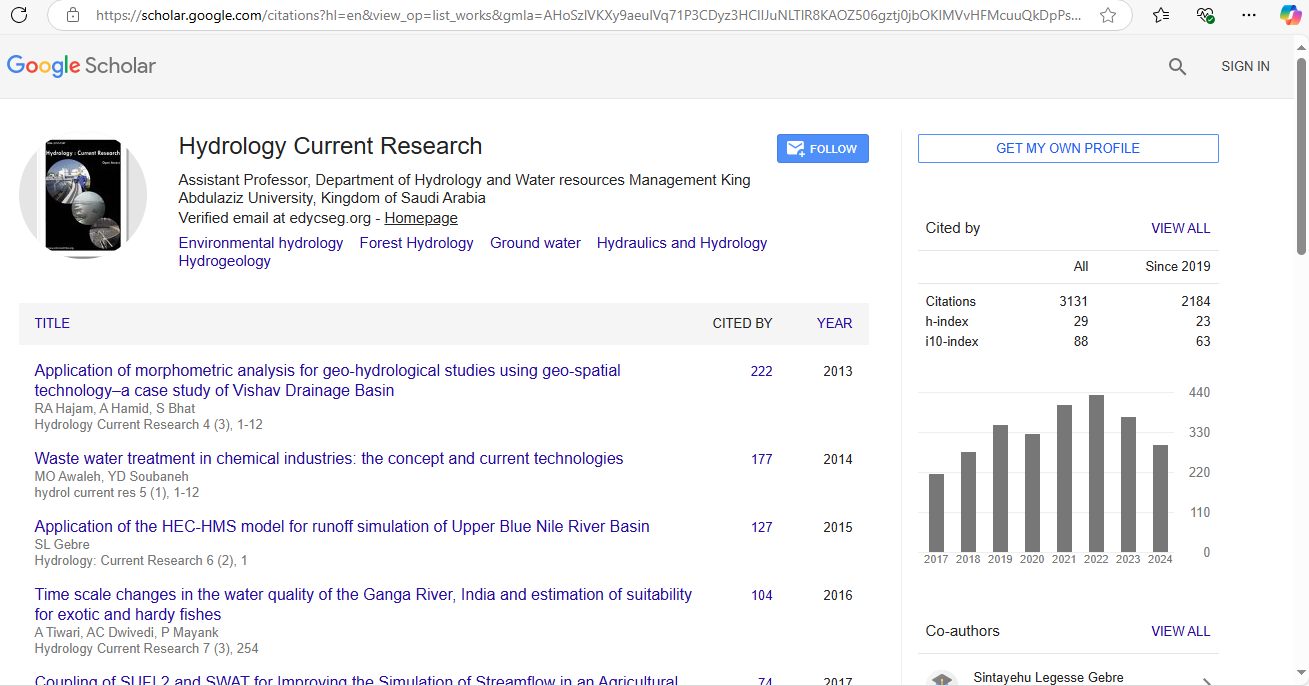
Hydrology: Current Research received 2843 citations as per Google Scholar report