Perspective - (2025) Volume 16, Issue 3
Received: 01-Apr-2025, Manuscript No. hycr-25-172521;
Editor assigned: 03-Apr-2025, Pre QC No. P-172521;
Reviewed: 17-Apr-2025, QC No. Q-172521;
Revised: 22-Apr-2025, Manuscript No. R-172521;
Published:
29-May-2025
, DOI: 10.37421/2157-7587.2025.16.603
Citation: Malhotra, Arjun. ”Global Environmental Challenges: Threats and Solutions.” Hydrol Current Res 16(2025):603.
Copyright: © 2025 Malhotra A. This is an open-access article distributed under the terms of the Creative Commons Attribution License, which permits unrestricted use,
distribution and reproduction in any medium, provided the original author and source are credited.
Our planet faces significant environmental threats that demand immediate and coordinated global action. The accelerating impacts of climate change on biodiversity are particularly alarming, as rising temperatures, altered precipitation patterns, and extreme weather events push species toward extinction and disrupt critical ecosystems. Comprehensive strategies integrating climate mitigation with conservation efforts are thus essential to safeguard life on Earth [1].
Another pervasive issue is the widespread presence of microplastics across diverse environmental compartments, from oceans to terrestrial areas and even the atmosphere. These tiny particles, stemming from various sources, disrupt trophic levels, lead to ingestion by organisms, and facilitate contaminant transport, highlighting an urgent need for effective monitoring, reduction, and remediation strategies [2].
The transition to renewable energy sources, such as solar and wind power, offers substantial environmental benefits, including reduced greenhouse gas emissions and improved air quality, simultaneously decreasing reliance on finite fossil fuels. While promising, scaling these solutions presents challenges in grid integration, land use, and resource requirements, which demand robust policy support and continuous technological innovation for a sustainable energy future [3].
Water scarcity and pollution represent escalating global crises, intricately linked to population growth, climate change, and industrialization. Addressing these complex issues requires innovative, sustainable solutions like advanced wastewater treatment, efficient irrigation techniques, and integrated water resource management. Holistic approaches and international cooperation are paramount to ensure future water security [4].
Moreover, deforestation severely degrades essential ecosystem services, profoundly affecting climate regulation, water purification, soil fertility, and biodiversity support. The economic and social repercussions of this loss are particularly severe for local communities dependent on forest resources, emphasizing the critical need for effective forest conservation and restoration policies to maintain ecological balance and human well-being [5].
Environmental air pollution poses a significant global health burden, with various pollutants, including particulate matter, ozone, and nitrogen oxides, contributing to a range of respiratory diseases, cardiovascular issues, neurological disorders, and premature mortality. Mitigating this pervasive threat requires stringent policy interventions, advanced technological solutions, and comprehensive public awareness campaigns worldwide [6].
Sustainable agriculture practices play a crucial role in both environmental protection and global food security. Methods such as organic farming, agroforestry, reduced tillage, and integrated pest management improve soil health, conserve biodiversity, enhance water efficiency, and reduce chemical use. Advocating for wider adoption of these practices is key to building resilient food systems and reducing agriculture's ecological footprint [7].
In urban settings, green infrastructure serves as a vital nature-based solution to address various environmental challenges. Elements like parks, green roofs, vertical gardens, and permeable pavements improve air quality, mitigate the urban heat island effect, manage stormwater, enhance biodiversity, and promote human well-being. Integrated planning and design are crucial to maximize the ecological and social benefits of these green spaces in rapidly urbanizing environments [8].
Ocean acidification, caused by increased absorption of atmospheric CO2, has profound and multifaceted impacts on marine ecosystems and human societies. This drop in pH critically affects calcifying organisms like corals and shellfish, disrupts marine food webs, and threatens fisheries. Reducing global CO2 emissions is an urgent imperative to mitigate these irreversible changes and protect the health of our oceans [9].
Finally, the circular economy emerges as a transformative model essential for achieving environmental sustainability, shifting away from the traditional linear "take-make-dispose" approach. Its principles of waste prevention, resource efficiency, reuse, repair, and recycling significantly reduce environmental pressures, conserve natural resources, and minimize pollution, necessitating systemic changes across industries and policy frameworks to foster a truly circular and sustainable economic system [10].
The ongoing climate crisis presents a multifaceted challenge to global ecosystems and human societies. The escalating impacts of climate change on biodiversity are particularly alarming, as rising temperatures, altered precipitation, and extreme weather events accelerate species extinction and disrupt ecological balances. Urgent global action is necessary, integrating climate mitigation with robust conservation efforts to safeguard life [1]. This issue is further compounded by the profound effects of ocean acidification, where increased absorption of atmospheric CO2 leads to a significant drop in oceanic pH. Such acidification critically harms calcifying marine organisms like corals and shellfish, destabilizes marine food webs, and ultimately jeopardizes global fisheries. Mitigating these irreversible changes demands a substantial reduction in global CO2 emissions to protect ocean health [9].
Environmental pollution, in various forms, also poses severe threats. The pervasive presence of microplastics across all environmental compartmentsâ??from aquatic systems to terrestrial ecosystems and the atmosphereâ??is a pressing concern. Microplastics are ingested by organisms, disrupt trophic levels, and act as vectors for contaminants, necessitating urgent development of effective monitoring, reduction, and remediation strategies [2]. Concurrently, air pollution constitutes a significant global health burden, with pollutants such as particulate matter, ozone, and nitrogen oxides contributing to a wide range of respiratory, cardiovascular, and neurological disorders, as well as premature mortality. Addressing this widespread threat requires stringent policy interventions, advanced technological solutions, and extensive public awareness campaigns worldwide [6].
Resource degradation, particularly concerning water and forests, further exacerbates environmental challenges. Global water scarcity and pollution are escalating crises driven by factors including population growth, climate change, and industrialization. Sustainable solutions, such as advanced wastewater treatment, efficient irrigation, water reuse, and integrated water resource management, are crucial. These measures, combined with international cooperation, are essential for ensuring future water security [4]. Similarly, deforestation severely diminishes vital ecosystem services, impacting climate regulation, water purification, soil fertility, and biodiversity. The loss of these services carries significant economic and social consequences, especially for forest-dependent communities. Therefore, implementing effective forest conservation and restoration policies is paramount for maintaining ecological balance and human well-being [5].
Despite these challenges, innovative solutions and sustainable practices offer a pathway towards a more resilient future. The global transition to renewable energy sources exemplifies this, providing substantial environmental benefits through reduced greenhouse gas emissions and improved air quality, thereby lessening reliance on finite fossil fuels. While challenges exist in scaling these technologies, including grid integration and resource requirements, continuous policy support and technological innovation are critical for achieving a sustainable energy future [3]. Furthermore, sustainable agriculture practices are instrumental in simultaneously achieving environmental protection and global food security. Techniques like organic farming, agroforestry, reduced tillage, and integrated pest management improve soil health, conserve biodiversity, enhance water efficiency, and minimize chemical use. Promoting wider adoption of these practices is vital for building robust food systems and reducing agriculture's environmental footprint [7].
Urban environments are also embracing nature-based solutions. Urban green infrastructure, encompassing elements like parks, green roofs, vertical gardens, and permeable pavements, actively contributes to improved air quality, mitigates the urban heat island effect, enhances stormwater management, boosts biodiversity, and promotes human well-being. Integrated planning and design are key to maximizing the ecological and social benefits of these green spaces in rapidly urbanizing contexts [8]. Finally, the concept of a circular economy offers a transformative paradigm shift from the traditional linear "take-make-dispose" model. By prioritizing waste prevention, resource efficiency, reuse, repair, and recycling, this approach significantly reduces environmental pressures, conserves natural resources, and minimizes pollution. Systemic changes across industries and policy frameworks are essential to foster a truly circular and sustainable economic system [10].
The global environment faces a complex array of interconnected challenges. Climate change stands out as a critical threat, directly impacting biodiversity by altering ecosystems and pushing species towards extinction, underscoring the immediate need for concerted global mitigation and conservation efforts. Simultaneously, the pervasive presence of microplastics across all environmental compartmentsâ??from oceans to the atmosphereâ??presents significant ecological risks, disrupting food webs and facilitating contaminant transport. Addressing this requires robust monitoring and remediation strategies. Another pressing issue is the escalating crisis of water scarcity and pollution, driven by demographic and industrial pressures. Sustainable solutions like advanced wastewater treatment and efficient irrigation are vital, alongside international collaboration for water security. Deforestation continues to degrade essential ecosystem services globally, with profound implications for climate regulation, water quality, and biodiversity, impacting local communities severely. Furthermore, air pollution imposes a substantial global health burden, causing various diseases. Mitigating this demands stringent policies and technological advancements. On a positive note, the shift to renewable energy sources offers significant environmental benefits, though successful scaling requires overcoming integration challenges through innovation and policy support. Sustainable agriculture practices are gaining traction for their dual role in environmental protection and ensuring food security, promoting methods that improve soil health and conserve biodiversity. Urban areas are finding solutions in green infrastructure, which enhances air quality, manages stormwater, and boosts overall well-being. The marine environment also faces dire threats from ocean acidification, which harms calcifying organisms and marine food webs, emphasizing the urgency of reducing CO2 emissions. Ultimately, embracing a circular economy model, which prioritizes waste prevention, reuse, and recycling, is crucial for achieving comprehensive environmental sustainability by minimizing resource depletion and pollution.
None
None
Indexed at, Google Scholar, Crossref
Indexed at, Google Scholar, Crossref
Indexed at, Google Scholar, Crossref
Indexed at, Google Scholar, Crossref
Indexed at, Google Scholar, Crossref
Indexed at, Google Scholar, Crossref
Indexed at, Google Scholar, Crossref
Indexed at, Google Scholar, Crossref
Indexed at, Google Scholar, Crossref
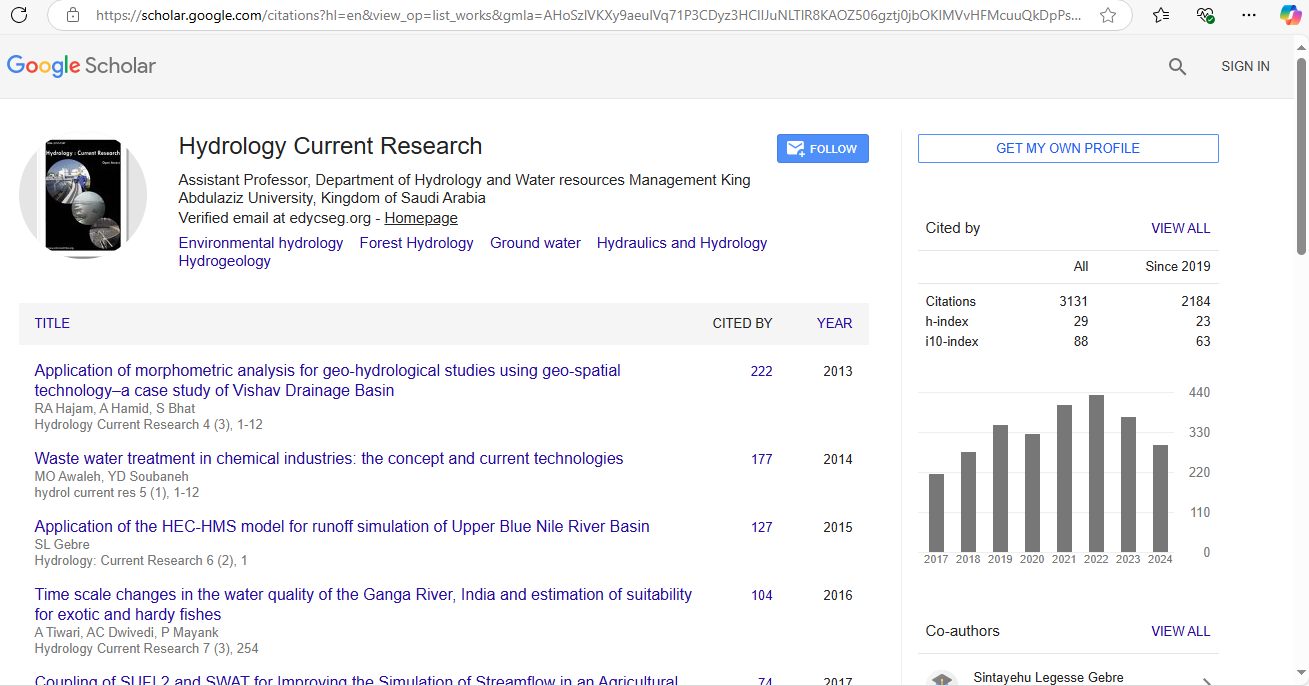
Hydrology: Current Research received 2843 citations as per Google Scholar report