Short Communication - (2025) Volume 13, Issue 6
Received: 01-Dec-2025, Manuscript No. JGPR-26-190238;
Editor assigned: 03-Dec-2025, Pre QC No. P-190238;
Reviewed: 17-Dec-2025, QC No. Q-190238;
Revised: 22-Dec-2025, Manuscript No. R-190238;
Published:
29-Dec-2025
, DOI: 10.37421/2329-9126.2025.13.648
Citation: Nowak, Katarzyna. ”General Practice’s Multifaceted Role in Maternal Healthcare.” J Gen Pract 13 (2025):648.
Copyright: © 2025 Nowak K. This is an open-access article distributed under the terms of the Creative Commons Attribution License, which permits unrestricted use, distribution and reproduction in any medium, provided the original author and source are credited.
The landscape of maternal health monitoring within general practice is a critical area of focus, with significant implications for early risk detection and the overall improvement of perinatal outcomes. General practitioners play a pivotal role in integrating routine screenings, risk assessment tools, and comprehensive patient education into their primary care management of pregnant individuals, thereby enhancing the quality of care provided during this crucial life stage. The effectiveness of telehealth services in revolutionizing routine antenatal care within general practice settings is a growing area of investigation. Remote monitoring and virtual consultations are proving to be instrumental in improving accessibility to healthcare services, boosting patient satisfaction, and ensuring better adherence to prescribed care schedules, particularly for women residing in rural or underserved regions. Managing gestational diabetes mellitus (GDM) within primary care presents a unique set of challenges for general practitioners. These hurdles often include time constraints inherent in busy practice schedules, limited access to specialized medical support, and the frequent absence of standardized protocols for GDM management, necessitating innovative approaches. The impact of early life interventions delivered through general practice on maternal mental health in the postpartum period is a significant concern. Structured screening for antenatal and postnatal depression, coupled with prompt referral to appropriate mental health support services, has been shown to yield considerable benefits in safeguarding maternal well-being. The implementation of robust risk stratification tools within general practice aims to identify pregnant women who are at a higher risk of experiencing adverse pregnancy outcomes. This approach underscores the importance of clear guidelines for patient referral and subsequent management, ensuring that high-risk individuals receive the necessary specialized care. General practitioners are essential in the detection and management of pre-eclampsia within the community setting. Their role encompasses understanding diagnostic criteria, implementing effective monitoring strategies, and establishing clear referral pathways to secondary care when necessary, thereby mitigating potential complications. The integration of lifestyle modification advice into routine general practice consultations for pregnant women is a key component of antenatal care. While practitioners acknowledge the importance of advising on diet and exercise, the consistent delivery and patient uptake of this advice can be variable, highlighting a need for enhanced support tools. The utilization of digital health technologies for maternal health monitoring in primary care settings is rapidly evolving. Applications designed for tracking vital signs, managing chronic conditions during pregnancy, and improving communication between patients and healthcare providers offer significant potential for enhancing care efficiency and personalization. General practitioners face specific challenges when managing domestic violence during pregnancy, including difficulties with screening, encouraging disclosure, and providing adequate support to affected individuals. Addressing these challenges requires specialized training and robust links with external support services. The effectiveness of general practice-based smoking cessation programs for pregnant women is well-documented. These structured programs, delivered by primary care physicians, have been shown to significantly increase quit rates among pregnant smokers, leading to improved birth outcomes.
Maternal health monitoring in general practice is pivotal for early identification of risks and the enhancement of perinatal outcomes. The integration of routine screenings, risk assessment tools, and patient education within primary care settings is fundamental for effective management of pregnant individuals, with enhanced training and collaborative models being advocated to bolster general practitioners' capabilities in this vital area [1].
Telehealth services are increasingly being integrated into general practice for routine antenatal care, demonstrating significant effectiveness. Remote monitoring and virtual consultations have been proven to improve accessibility, patient satisfaction, and adherence to care schedules, particularly benefiting women in rural areas, thereby complementing traditional in-person visits and elevating the continuity and quality of maternal care [2].
General practitioners encounter several challenges in managing gestational diabetes mellitus (GDM) within primary care settings. These obstacles include time constraints, restricted access to specialist support, and the need for standardized protocols, suggesting that improved training, multidisciplinary collaboration, and accessible decision-support tools are crucial for enhancing GDM management in general practice [3].
Early life interventions delivered in general practice have a notable impact on maternal mental health postpartum. Structured screening for antenatal and postnatal depression, combined with timely referral to appropriate support services, underscores the pivotal role general practitioners play in safeguarding maternal well-being and preventing the escalation of mental health issues [4].
The implementation of risk stratification tools in general practice is vital for identifying pregnant women at high risk of adverse outcomes. This process involves addressing challenges in integrating these tools into routine workflows and emphasizes the importance of clear referral and management guidelines, advocating for a stepped approach to care ensuring timely specialist access for those most in need [5].
General practitioners are instrumental in managing pre-eclampsia within the community, requiring a thorough understanding of diagnostic criteria, monitoring strategies, and referral pathways. Consistent patient education about warning signs and effective communication between primary and secondary care are highlighted as essential for optimal management and the prevention of serious complications [6].
The delivery of lifestyle advice for pregnant women within general practice consultations is an important aspect of antenatal care. Although practitioners recognize the significance of advising on diet and exercise, the consistent uptake and delivery can be variable, pointing to a need for patient-friendly resources and brief intervention training to improve the effectiveness of these discussions [7].
Digital health technologies offer promising applications for maternal health monitoring in primary care settings. These technologies can facilitate tracking vital signs, managing chronic conditions during pregnancy, and enhancing communication between patients and providers, ultimately improving efficiency and personalizing care, provided equitable access and data security are maintained [8].
General practitioners face significant challenges in managing domestic violence during pregnancy, encompassing screening, disclosure, and support provision. Enhanced training, clear protocols, and strong connections with specialist services are critical for creating a supportive and safe environment for affected individuals within general practice [9].
Well-structured, general practice-based smoking cessation programs have demonstrated significant effectiveness in improving pregnancy outcomes. These programs can increase quit rates among pregnant smokers, leading to enhanced birth weights and reduced risks of preterm birth, advocating for their wider implementation as evidence-based interventions [10].
This collection of research highlights the multifaceted role of general practice in maternal healthcare. Key areas of focus include the importance of integrated maternal health monitoring for early risk detection and improved perinatal outcomes, as well as the increasing utility of telehealth for enhancing antenatal care accessibility and patient experience. The challenges faced by general practitioners in managing specific conditions like gestational diabetes and pre-eclampsia are examined, alongside the impact of primary care interventions on maternal mental health and the effectiveness of lifestyle advice and smoking cessation programs. The use of risk stratification tools and digital health technologies is also explored as ways to improve safety and efficiency. Finally, the critical need for training and support in managing sensitive issues such as domestic violence during pregnancy is emphasized.
None
None
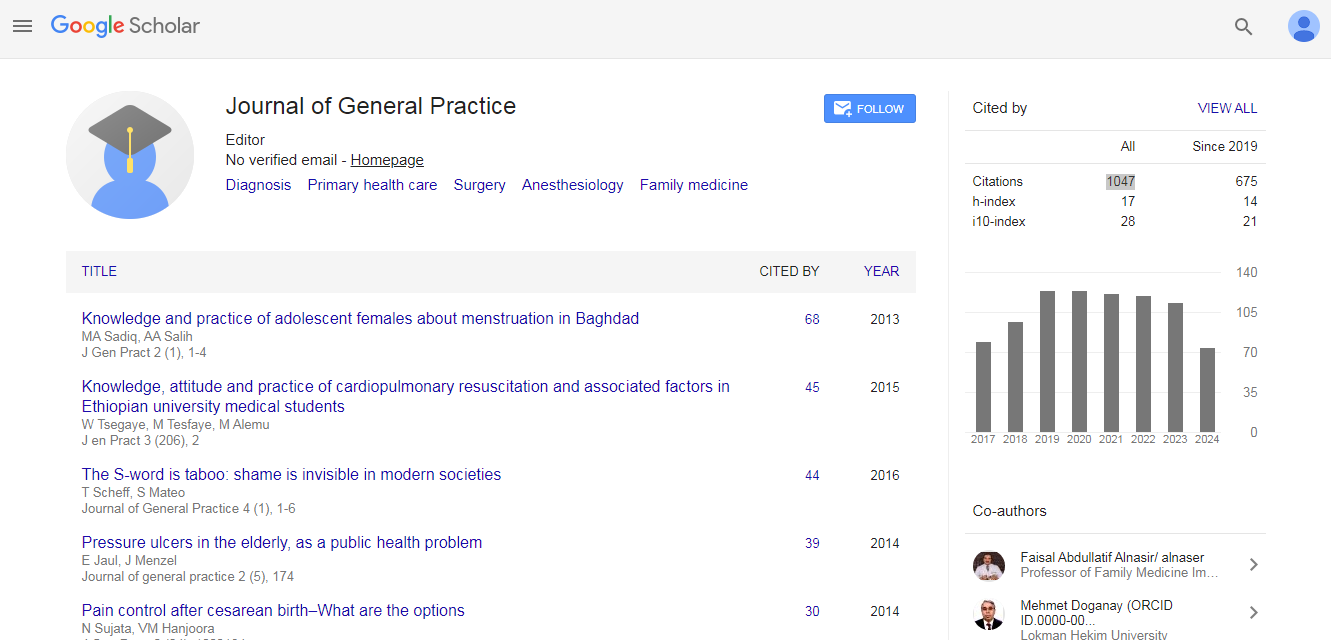
Journal of General Practice received 1047 citations as per Google Scholar report