Short Communication - (2025) Volume 15, Issue 2
Received: 02-Jun-2025, Manuscript No. jpdbd-25-164666;
Editor assigned: 04-Jun-2025, Pre QC No. P-164666;
Reviewed: 16-Jun-2025, QC No. Q-164666;
Revised: 23-Jun-2025, Manuscript No. R-164666;
Published:
30-Jun-2025
, DOI: 10.37421/2153-0769.2025.15.422
Citation: Mason, George. “Gaining Insights into Environmental Impacts via Environmental Metabolomics.” Metabolomics 15 (2025): 422.
Copyright: © 2025 Mason G. This is an open-access article distributed under the terms of the Creative Commons Attribution License, which permits unrestricted use, distribution, and reproduction in any medium, provided the original author and source are credited.
Environmental metabolomics is an emerging field that leverages the power of metabolite profiling to investigate and understand the complex interactions between organisms and their environments. At its core environmental metabolomics involves the comprehensive analysis of small molecules or metabolites that are the end products of cellular processes. These metabolites provide a snapshot of the physiological state of an organism at a given point in time. As such they serve as sensitive indicators of environmental stress and change allowing researchers to gain insights into the ways in which organisms respond to different environmental conditions including pollution temperature shifts habitat destruction and other anthropogenic pressures.The application of metabolomics in environmental science offers a new lens through which scientists can assess ecological health and detect early warning signals of environmental degradation. Unlike traditional methods which often rely on observable changes such as population decline or physical deformities metabolomics enables a much earlier detection of stress responses at the molecular level. This early detection is crucial for timely intervention and can help prevent irreversible damage to ecosystems. The integration of metabolomics with other omics technologies such as genomics proteomics and transcriptomics further enhances our ability to map out the intricate biological responses to environmental factors offering a systems-level understanding that is both detailed and dynamic [1].
Environmental metabolomics can be applied to a wide range of ecosystems including aquatic terrestrial and atmospheric environments. In aquatic ecosystems for example researchers can collect water samples and analyze the metabolites of resident organisms such as fish algae or invertebrates to identify changes in water quality or the presence of pollutants. These changes may include elevated levels of stress-related compounds alterations in energy metabolism or the accumulation of toxic metabolites. Such data can provide valuable information about the sources and effects of contamination including the presence of heavy metals pesticides pharmaceuticals or microplastics. Moreover by comparing metabolite profiles over time scientists can track how ecosystems are evolving and whether they are recovering or deteriorating in response to environmental stressors. One of the strengths of environmental metabolomics lies in its ability to detect subtle changes that might not be apparent through other methods. This sensitivity is particularly important in cases of chronic low-level pollution which might not cause immediate visible harm but can nonetheless have significant long-term effects on organism health and ecosystem stability. For example exposure to endocrine-disrupting chemicals at sub-lethal concentrations might not result in immediate mortality but can lead to metabolic changes that affect reproduction development and immune function. Through the use of advanced analytical techniques such as nuclear magnetic resonance spectroscopy and mass spectrometry environmental metabolomics can pinpoint these changes providing a deeper understanding of how pollutants impact biological systems at the cellular level.
Environmental metabolomics also plays a crucial role in ecotoxicology by helping to identify biomarkers of exposure and effect. Biomarkers are specific molecules whose presence or concentration can be linked to particular environmental stressors. By identifying reliable biomarkers researchers can develop diagnostic tools that are both rapid and non-invasive. These tools can then be used to monitor the health of wildlife populations assess the impact of specific pollutants and evaluate the effectiveness of remediation efforts. Furthermore since metabolite profiles are often species-specific environmental metabolomics can aid in the identification of vulnerable species and help prioritize conservation efforts. The field of environmental metabolomics is not without its challenges. One major hurdle is the complexity of biological samples which often contain thousands of different metabolites. Distinguishing meaningful signals from background noise requires robust experimental design careful sample preparation and sophisticated data analysis. Additionally environmental samples are inherently variable due to factors such as temperature seasonality and geographical location. This variability can complicate the interpretation of results and requires the use of appropriate controls and statistical models. Despite these challenges ongoing advancements in analytical technology bioinformatics and computational modeling are helping to overcome these obstacles and are driving the field forward [2].
Another area where environmental metabolomics is making a significant impact is in the study of climate change. As global temperatures rise and weather patterns become more unpredictable organisms are being forced to adapt to new conditions. These adaptations are often reflected in changes to their metabolic profiles. For instance plants exposed to drought conditions may accumulate osmoprotectants and antioxidants to mitigate water stress while marine organisms facing ocean acidification may alter their energy metabolism and ion regulation. By monitoring these metabolic shifts scientists can gain insights into the mechanisms of adaptation and resilience and predict which species are most at risk from climate change. This knowledge is invaluable for developing strategies to protect biodiversity and maintain ecosystem services [3]. In addition to monitoring environmental stressors environmental metabolomics can be used to study natural ecological processes such as nutrient cycling symbiosis and trophic interactions. For example by analyzing the metabolite exchanges between mycorrhizal fungi and plant roots researchers can better understand how nutrients are transferred and how these interactions are influenced by soil conditions. Similarly metabolomics can reveal how microbial communities in the ocean contribute to carbon and nitrogen cycling and how these processes are affected by environmental changes. This information is critical for modeling ecosystem dynamics and for managing natural resources in a sustainable manner.
The integration of environmental metabolomics with other scientific disciplines is expanding the scope and applicability of the field. For instance combining metabolomics with remote sensing data allows for the spatial mapping of metabolic changes across large geographic areas. This approach can be particularly useful in tracking the spread of pollution or in assessing the health of forests and coral reefs over time. Similarly linking metabolomic data with ecological modeling can improve the accuracy of predictions about ecosystem responses to various stressors. This interdisciplinary approach is essential for addressing the complex and interconnected challenges facing the environment today [4,5].
Google Scholar Cross Ref Indexed at
Google Scholar Cross Ref Indexed at
Google Scholar Cross Ref Indexed at
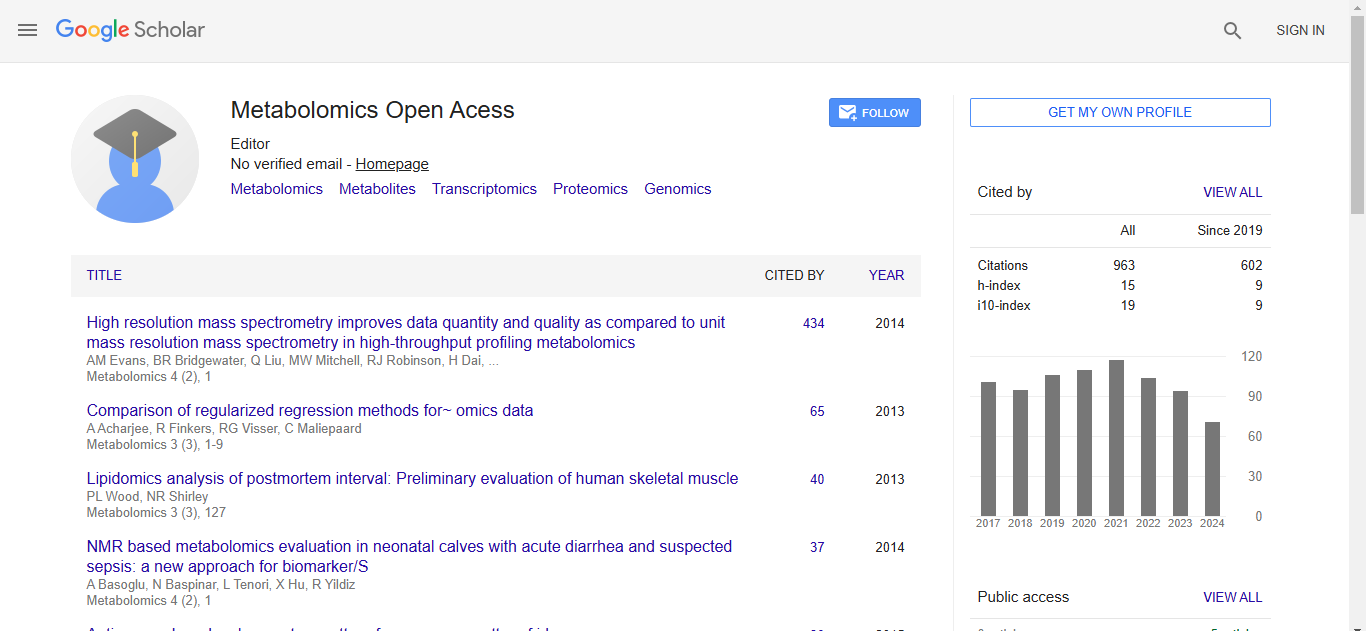
Metabolomics:Open Access received 895 citations as per Google Scholar report