Commentary - (2025) Volume 16, Issue 5
Received: 01-Oct-2025, Manuscript No. jbmbs-26-183412;
Editor assigned: 03-Oct-2025, Pre QC No. P-183412;
Reviewed: 17-Oct-2025, QC No. Q-183412;
Revised: 22-Oct-2025, Manuscript No. R-183412;
Published:
29-Oct-2025
, DOI: 10.37421/2155-6180.2025.16.297
Citation: Popescu, Ana. ”Functional Data Analysis: Unlocking Biomedical Insights.” J Biom Biosta 16 (2025):297.
Copyright: © 2025 Popescu A. This is an open-access article distributed under the terms of the Creative Commons Attribution License, which permits unrestricted use, distribution and reproduction in any medium, provided the original author and source are credited.
Functional Data Analysis (FDA) provides a robust framework for the examination of biomedical data that naturally present as continuous or curve-like measurements, encompassing longitudinal observations, time series, and spectral data. This methodology offers a more profound understanding of biological processes by treating entire functions as individual observations, moving beyond the limitations of traditional point-wise analytical approaches. Key applications within biomedical research include the modeling of disease progression over time, the evaluation of treatment efficacy, and the detailed analysis of complex biological signals such as electrocardiograms (ECGs) and gene expression profiles. FDA's ability to reveal subtle patterns and variations, often missed by conventional techniques, is instrumental in advancing diagnostic precision and facilitating personalized medicine strategies. Furthermore, its inherent flexibility in accommodating varying sample sizes and irregular sampling intervals makes it exceptionally well-suited for the diverse and often challenging nature of biomedical datasets [1].
The application of functional principal component analysis (FPCA) is a significant development for dimensionality reduction and pattern discovery within high-dimensional biomedical datasets, particularly in the context of longitudinal clinical trials. FPCA is adept at capturing the primary modes of variation present in functional data, thereby enabling the identification of critical trajectories related to disease progression or the response to therapeutic interventions. This technique is crucial for uncovering latent heterogeneity within patient cohorts, which in turn facilitates more focused subgroup analyses and a more nuanced understanding of treatment efficacy across varied patient profiles. The advantages offered by FPCA include augmented statistical power and enhanced interpretability of results when contrasted with traditional multivariate methods when applied to functional measurements [2].
Functional regression models are pivotal for analyzing the intricate relationships between functional predictors and scalar or functional responses within the biomedical domain. This approach is especially valuable for assessing how complete biological curves, such as growth trajectories or gene expression patterns, exert influence on health outcomes or the development of diseases. The literature explores various functional regression techniques, including functional linear models and functional generalized additive models, illustrating their practical utility through examples drawn from patient monitoring and epidemiological studies. A significant benefit is the capacity to fully capture the continuous nature of biological processes, thereby avoiding the information loss that can result from the discretization or aggregation of functional data [3].
Functional clustering presents a powerful methodology for identifying distinct patient subgroups based on their longitudinal disease trajectories. By conceptualizing patient health records as functional data, clustering algorithms can effectively reveal natural groupings that may correlate with different disease phenotypes or varying response patterns to therapies. Research in this area demonstrates that functional clustering can significantly improve the identification of patient subgroups, paving the way for more personalized treatment strategies and a deeper comprehension of disease heterogeneity. This approach offers superior sensitivity to the temporal dynamics of disease progression compared to traditional clustering methods applied to cross-sectional data [4].
Functional smoothing techniques are essential for analyzing longitudinal biomedical data that are often characterized by noise and sparsity. Smoothing enables the estimation of underlying smooth functional forms from discrete, and frequently irregular, observations, a process that is critical for robust statistical inference in clinical settings. The methodological landscape includes various smoothing approaches, such as local polynomial regression and spline-based methods, which are applied to model growth curves, drug concentration-time profiles, and physiological signals. The reliable modeling of biological processes, even with limited or noisy data, is fundamentally dependent on these smoothing techniques [5].
Functional classification methods are being developed and applied to predict health outcomes based on functional biomedical measurements, including time-series data from wearable sensors or spectral data from medical imaging. Functional classifiers learn from complete functional observations, allowing them to discern complex temporal or spectral patterns associated with different disease states or prognoses. Various functional classification algorithms have been reviewed, with illustrative examples provided for early disease detection and risk stratification. This methodology offers a more sensitive alternative to classification techniques that rely solely on summary statistics derived from functional data [6].
The development of functional models tailored for the analysis of correlated longitudinal data is a critical advancement in biomedical research. Many biomedical studies involve repeated measurements across multiple subjects, where observations within a single subject are inherently correlated, and subjects themselves often exhibit distinct trajectories. This necessitates methods that can simultaneously account for within-subject correlation and between-subject functional variability, often employing techniques such as functional mixed-effects models. Applications are diverse, including the analysis of growth patterns in pediatric cohorts or treatment response in clinical trials with multiple measurements per patient, ultimately leading to more accurate and dependable inferences [7].
The application of functional data analysis techniques within neuroimaging has shown immense promise, particularly for the analysis of time-series data derived from functional magnetic resonance imaging (fMRI) or electroencephalography (EEG). FDA allows researchers to conceptualize entire brain activity signals, whether over time or space, as functional observations, thereby facilitating the identification of complex spatio-temporal patterns linked to cognitive processes or neurological disorders. This approach enhances both the sensitivity and interpretability of neuroimaging studies, contributing to a more profound understanding of brain function and dysfunction [8].
The synergy between functional data analysis and machine learning algorithms is opening new avenues in biomedical applications. This integration enables the creation of highly sophisticated predictive models capable of handling complex, high-dimensional functional data, such as genomic or proteomic profiles. The field explores various functional machine learning techniques, including functional support vector machines and functional neural networks, demonstrating their efficacy in tasks like disease prediction, patient stratification, and drug discovery. The core advantage lies in the ability to harness the rich informational content embedded within the functional form of biological data [9].
Novel methods for analyzing functional time-to-event data in clinical research are being introduced to address the limitations of traditional survival analysis. Standard approaches often discretize time or rely on summary statistics, which can lead to a loss of valuable information from continuous time-dependent covariates or functional event processes. Functional time-to-event models allow for the integration of functional predictors and the detailed analysis of complex event processes, resulting in more precise risk assessment and a better understanding of disease progression dynamics. These models are particularly useful when analyzing patient survival based on continuous physiological monitoring data or functional imaging biomarkers [10].
Functional Data Analysis (FDA) offers a sophisticated approach to dissecting biomedical data characterized by their continuous or curve-like nature. These include longitudinal measurements, time series, and spectral data. By treating entire functional forms as observations, FDA moves beyond traditional point-wise analyses to provide a richer understanding of underlying biological processes. Its applications span modeling disease progression, understanding treatment effects over time, and analyzing complex signals like ECGs and gene expression profiles, enabling the identification of subtle patterns for more precise diagnostics and personalized medicine. The adaptability of FDA to varying sample sizes and irregular sampling times makes it highly suitable for diverse biomedical datasets [1].
Functional Principal Component Analysis (FPCA) serves as a powerful tool for dimensionality reduction and pattern discovery in high-dimensional biomedical data, with a particular focus on longitudinal clinical trials. FPCA effectively identifies the primary modes of variation within functional data, allowing for the discernment of key trajectories in disease progression or treatment response. This method is instrumental in uncovering hidden heterogeneity within patient cohorts, which in turn supports more targeted subgroup analyses and a deeper understanding of treatment efficacy across different patient profiles. The advantages of FPCA include enhanced statistical power and more interpretable results compared to conventional multivariate methods when dealing with functional measurements [2].
Functional regression models are employed to analyze the relationships between functional predictors and scalar or functional responses in biomedical research. These models are vital for assessing how entire biological curves, such as growth trajectories or gene expression profiles, impact health outcomes or disease development. Various functional regression techniques, including functional linear and generalized additive models, are discussed and illustrated with examples from patient monitoring and epidemiological studies. The core advantage lies in its ability to capture the continuous nature of biological processes, circumventing the information loss associated with data discretization or aggregation [3].
Functional clustering is utilized for identifying distinct patient subgroups based on their longitudinal disease trajectories. By representing patient health records as functional data, clustering algorithms can reveal natural groupings that may correspond to different disease phenotypes or therapeutic response patterns. Studies highlight how functional clustering enhances the identification of patient subgroups, leading to more personalized treatment strategies and a better understanding of disease heterogeneity. This approach is more sensitive to the temporal dynamics of disease progression than traditional clustering methods applied to cross-sectional data [4].
Functional smoothing techniques are employed for the analysis of longitudinal biomedical data that are frequently sparse and noisy. These methods allow for the estimation of underlying smooth functional forms from discrete, often irregular, observations, which is crucial for robust statistical inference in clinical settings. Techniques such as local polynomial regression and spline-based approaches are discussed for modeling growth curves, drug concentration-time profiles, and physiological signals. This is essential for building reliable models of biological processes, even when faced with limited or noisy data points [5].
Functional classification methods are applied to predict health outcomes based on functional biomedical measurements, such as time-series data from wearable sensors or spectral data from medical imaging. These classifiers learn from entire functional observations, enabling them to detect complex temporal or spectral patterns associated with different disease states or prognoses. A review of various functional classification algorithms is presented, with examples provided for early disease detection and risk stratification. This offers a more sensitive approach to classification compared to methods relying on summary statistics of functional data [6].
Functional models are being developed to analyze correlated longitudinal data in biomedical research, addressing situations where repeated measurements on multiple subjects exhibit within-subject correlation and between-subject functional variability. Functional mixed-effects models are a key technique used to account for these complexities. Applications include the analysis of growth patterns in pediatric studies or treatment response in clinical trials with multiple measurements per patient, leading to more accurate and reliable inferences [7].
The application of functional data analysis techniques in neuroimaging is significant, particularly for analyzing time-series data from fMRI or EEG. FDA enables researchers to treat entire brain activity signals over time or space as functional observations, facilitating the identification of complex spatio-temporal patterns related to cognitive processes or neurological disorders. These functional methods enhance the sensitivity and interpretability of neuroimaging studies, contributing to a deeper understanding of brain function and dysfunction [8].
The integration of functional data analysis with machine learning algorithms enhances biomedical applications by enabling the development of sophisticated predictive models for complex, high-dimensional functional data like genomic or proteomic profiles. Functional machine learning techniques, including functional support vector machines and functional neural networks, are discussed for their effectiveness in disease prediction, patient stratification, and drug discovery. The primary advantage is the ability to leverage the rich information contained within the functional form of biological data [9].
Functional time-to-event data analysis methods are introduced for clinical research to overcome the limitations of traditional survival analysis, which often discretizes time or uses summary statistics, potentially losing information from continuous time-dependent covariates. These models allow for the incorporation of functional predictors and the analysis of complex event processes, leading to more precise risk assessment and a better understanding of disease progression dynamics. Examples include analyzing patient survival based on continuous physiological monitoring data or functional imaging biomarkers [10].
Functional Data Analysis (FDA) provides advanced methods for analyzing continuous biomedical data like longitudinal measurements and time series. Techniques such as functional principal component analysis (FPCA), functional regression, clustering, smoothing, and classification are used to extract rich information, identify patterns, and improve understanding of biological processes. FPCA aids in dimensionality reduction and uncovering patient subgroups, while functional regression models relationships between functional predictors and outcomes. Functional clustering identifies distinct patient groups based on disease trajectories, and smoothing techniques handle noisy, sparse data. Classification methods predict outcomes from functional data, and functional mixed-effects models account for correlated longitudinal data. FDA also integrates with machine learning for predictive modeling and is applied in specialized areas like neuroimaging and time-to-event analysis, ultimately leading to more precise diagnostics and personalized medicine.
None
None
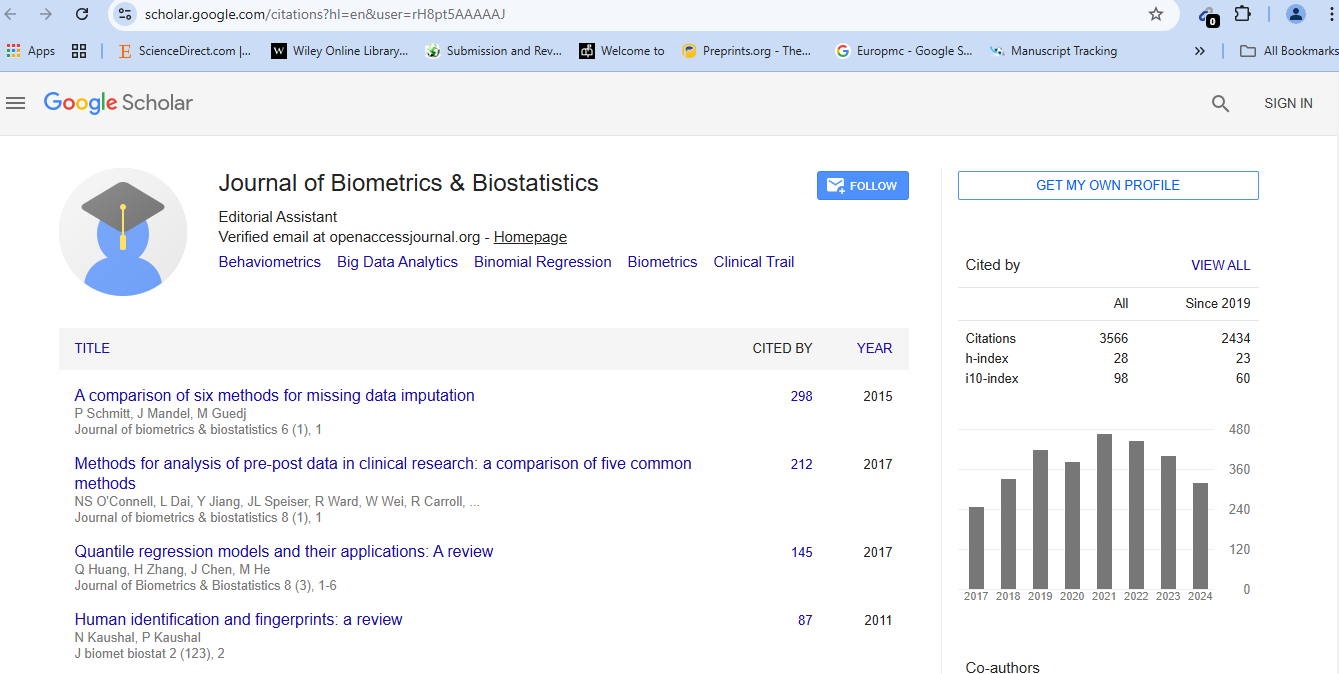
Journal of Biometrics & Biostatistics received 3496 citations as per Google Scholar report