Commentary - (2025) Volume 14, Issue 4
Received: 04-Aug-2025, Manuscript No. jees-26-187899;
Editor assigned: 06-Aug-2025, Pre QC No. P-187899;
Reviewed: 20-Aug-2025, QC No. Q-187899;
Revised: 25-Aug-2025, Manuscript No. R-187899;
Published:
30-Aug-2025
, DOI: 10.37421/2332-0796.2025.14.193
Citation: Al-Harbi, Noura. ”FPGAs: Enabling Advancements in
Modern Control Systems.” J Electr Electron Syst 14 (2025):193.
Copyright: © 2025 Al-Harbi N. This is an open-access article distributed under the terms of the Creative Commons Attribution License, which permits unrestricted use,
distribution and reproduction in any medium, provided the original author and source are credited.
The integration of Field-Programmable Gate Arrays (FPGAs) into advanced electronic control systems is revolutionizing various industries by offering unparalleled flexibility and performance. FPGAs provide significant advantages, including substantial parallel processing capabilities, dynamic reconfigurability, and real-time responsiveness, making them exceptionally well-suited for handling intricate control tasks across a wide spectrum of applications, from robotics to automotive systems and industrial automation. Their hardware-level implementation allows for the achievement of highly efficient and adaptable control solutions [1].
For industrial environments, the development of reconfigurable architectures has become crucial for enhancing system adaptability. A reconfigurable FPGA-based architecture for a digital PID controller has been presented, emphasizing the flexibility and efficiency gained. This approach facilitates on-the-fly adjustments to controller parameters and structure, leading to improved system performance and a greater ability to adapt to changing operational conditions, a key requirement in modern industrial processes [2].
In the domain of robotics, precise and rapid motion control is paramount. The development of high-performance FPGA-based trajectory tracking controllers for robotic manipulators addresses the complex, real-time computational demands inherent in achieving precise motion. FPGA implementation is highlighted for its ability to optimize computational efficiency and minimize latency, thereby enabling smoother and more accurate trajectory following, which is critical for advanced robotic applications [3].
Controlling nonlinear systems with uncertainties and disturbances presents significant challenges. An FPGA implementation of an adaptive fuzzy sliding mode controller tackles these issues by leveraging the parallel processing capabilities of FPGAs. This allows for the simultaneous execution of fuzzy logic and sliding mode control algorithms, resulting in faster response times and enhanced system stability, offering a robust solution for complex nonlinear dynamics [4].
In multi-robot systems, synchronized and efficient operation is essential for coordinated tasks. The design and implementation of an FPGA-based distributed control system for multi-robot coordination emphasizes the role of FPGAs in enabling high-speed communication and parallel processing. This architecture supports flexible reconfiguration and scalability, allowing for dynamic system adjustments and facilitating seamless coordination among multiple agents [5].
Within the automotive sector, the demand for sophisticated control strategies is rapidly increasing. The hardware acceleration of model predictive control (MPC) algorithms using FPGAs for automotive applications addresses the significant computational demands of MPC. FPGA implementation drastically reduces execution time, allowing for higher control frequencies and enabling more advanced and responsive control for vehicle dynamics and driver-assistance systems [6].
For critical industrial applications, maintaining system stability and performance under uncertain conditions is of utmost importance. The development of FPGA-based robust nonlinear controllers for uncertain systems focuses on achieving stability and performance despite variations in system parameters and external disturbances. The FPGA architecture efficiently executes complex nonlinear control laws, significantly improving response time and precision [7].
Digital signal processing (DSP) plays a pivotal role in modern control systems, enabling real-time data manipulation. The use of FPGAs for implementing high-speed DSP units within electronic control systems is explored, highlighting the advantages for demanding tasks like filtering and adaptive algorithms. FPGA implementation reduces latency and increases throughput, thereby enhancing overall control system performance [8].
Intelligent control strategies, such as those employing fuzzy logic and neural networks, are increasingly being implemented in hardware for enhanced performance. An FPGA-based intelligent control system for power electronic converters demonstrates the utility of FPGAs in implementing these complex algorithms efficiently. This approach results in fast dynamic response, robustness, and reduced system complexity, proving beneficial for power electronics applications [9].
Ensuring continuous operation and safety in critical industrial applications necessitates fault-tolerant control. The design of an FPGA-based fault-tolerant control system for such applications showcases the ability of FPGAs to implement redundant architectures and real-time fault detection mechanisms. This ensures operational continuity and safety even in the event of component failures, a crucial aspect for reliability [10].
Field-Programmable Gate Arrays (FPGAs) are emerging as a dominant technology for developing advanced electronic control systems due to their inherent advantages in parallel processing, reconfigurability, and real-time performance. These attributes make them indispensable for complex control tasks in fields such as robotics, automotive engineering, and industrial automation. The ability to implement control logic directly in hardware allows for highly efficient and flexible solutions that can be tailored to specific application requirements [1].
In industrial control, adaptability and efficiency are key. A reconfigurable FPGA-based architecture for a digital PID controller exemplifies this by enabling dynamic parameter and structural adjustments. This flexibility is crucial for optimizing system performance and ensuring adaptability to evolving operational conditions, thereby enhancing the overall robustness and responsiveness of industrial processes [2].
For robotic manipulators, achieving precise and fluid motion is essential. High-performance FPGA-based trajectory tracking controllers are designed to meet these demands by leveraging the parallel processing power of FPGAs. This leads to significant reductions in computational latency and improvements in processing speed, which are critical for enabling smoother, more accurate, and highly responsive robotic movements [3].
Addressing the complexities of nonlinear systems with inherent uncertainties requires sophisticated control strategies. FPGA implementation of adaptive fuzzy sliding mode controllers allows for the simultaneous execution of complex algorithms, enhancing control system performance. This parallel processing capability results in faster reaction times and improved stability, making it a suitable solution for systems operating under uncertain or dynamic conditions [4].
Multi-robot systems necessitate efficient communication and coordinated actions. An FPGA-based distributed control system architecture facilitates this by providing high-speed communication channels and parallel processing capabilities. The inherent reconfigurability and scalability of FPGAs allow for the dynamic integration and management of multiple robots, ensuring synchronized and effective collaborative behaviors [5].
In the automotive industry, the computational intensity of advanced control algorithms like Model Predictive Control (MPC) is a significant challenge. FPGA acceleration of MPC significantly reduces execution times, enabling higher control frequencies. This advancement is vital for developing more sophisticated and responsive control systems for vehicle dynamics and complex driver-assistance features [6].
For critical industrial applications, the reliability and safety of control systems are non-negotiable. FPGA-based robust nonlinear controllers are designed to maintain stability and performance even when faced with system uncertainties and disturbances. Their hardware implementation allows for the efficient execution of complex nonlinear control laws, leading to superior response times and enhanced precision in demanding environments [7].
Digital Signal Processing (DSP) is fundamental to many control system functionalities, especially for real-time data manipulation. FPGAs excel at hardware acceleration for demanding DSP tasks, such as advanced filtering and adaptive algorithms. By implementing these functions in hardware, latency is reduced, and throughput is increased, directly contributing to the enhanced performance of the entire control system [8].
Intelligent control systems, incorporating algorithms like fuzzy logic and neural networks, benefit greatly from hardware implementation. An FPGA-based intelligent control system for power electronic converters showcases how FPGAs can efficiently implement these complex algorithms, leading to rapid dynamic responses, increased robustness against parameter variations, and a reduction in overall system complexity for improved performance [9].
Fault tolerance is a critical requirement for control systems in safety-critical industrial settings. FPGA-based fault-tolerant control systems enable the development of redundant architectures and real-time fault detection and isolation mechanisms. This ensures uninterrupted operation and enhances safety by mitigating the impact of component failures, thereby increasing the system's overall reliability [10].
This collection of research highlights the pervasive adoption and significant advantages of Field-Programmable Gate Arrays (FPGAs) in modern electronic control systems. FPGAs are enabling advancements across diverse applications, including robotics, automotive systems, industrial automation, and power electronics. Their key benefits include enhanced parallel processing, reconfigurability, and real-time performance, which are crucial for handling complex control tasks, nonlinear systems, and digital signal processing. The papers showcase FPGA implementations for trajectory tracking, adaptive controllers, distributed systems, model predictive control, and fault-tolerant systems, demonstrating superior performance, reduced latency, and improved robustness compared to traditional software-based approaches. The research underscores the growing importance of FPGAs in delivering efficient, flexible, and reliable control solutions.
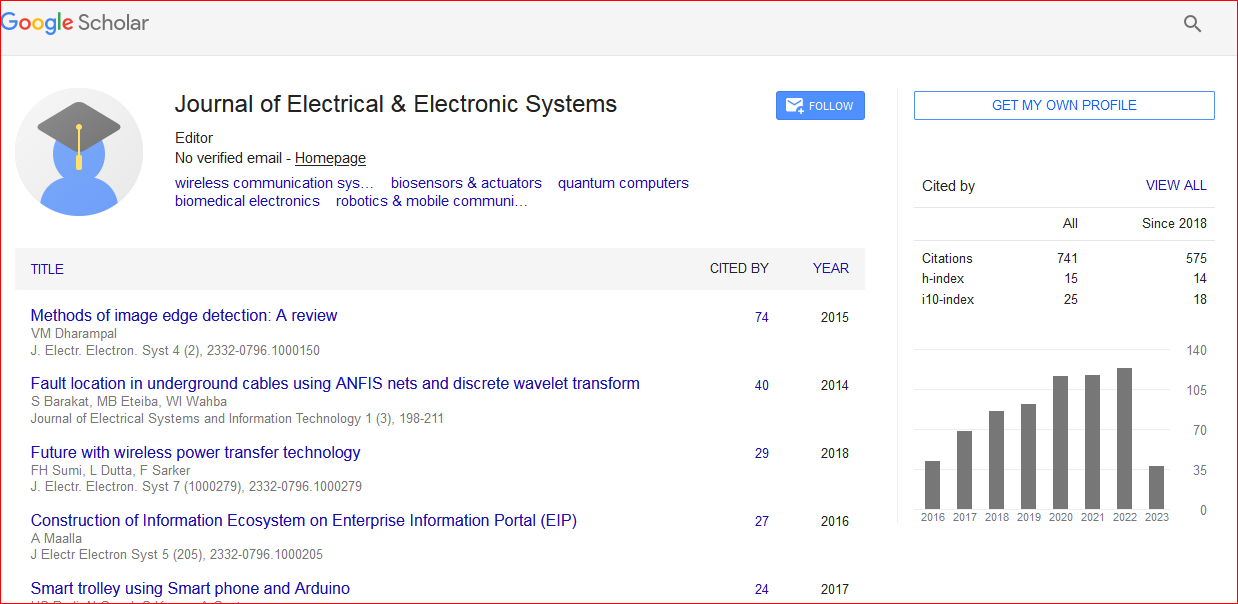
Journal of Electrical & Electronic Systems received 733 citations as per Google Scholar report