Commentary - (2025) Volume 11, Issue 2
Received: 01-Apr-2025, Manuscript No. jctt-26-188385;
Editor assigned: 03-Apr-2025, Pre QC No. P-188385;
Reviewed: 17-Apr-2025, QC No. Q-188385;
Revised: 22-Apr-2025, Manuscript No. R-188385;
Published:
29-Apr-2025
, DOI: 10.37421/2471-9323.2024.10.313
Citation: Romano, Alessandro. ”Diverse Strategies for Hair Health and Growth.” J Cosmo Tricho 11 (2025):313.
Copyright: © 2025 Romano A. This is an open-access article distributed under the terms of the Creative Commons Attribution License, which permits unrestricted use, distribution and reproduction in any medium, provided the original author and source are credited.
The field of aesthetic practices and trichology is increasingly exploring innovative approaches to enhance beauty and hair health, integrating traditional knowledge with scientific advancements. This review delves into various therapeutic modalities that address concerns related to hair loss and scalp revitalization, aiming to provide insights for achieving optimal aesthetic outcomes and restoring follicular vitality. One significant area of focus is the application of herbal and botanical therapies, which leverage the power of natural ingredients to promote hair growth and improve scalp condition. These traditional remedies are being investigated for their scientific basis and efficacy in revitalizing the hair and scalp, offering a gentler alternative or complement to conventional treatments [1].
Advancements in dermatological procedures have introduced minimally invasive techniques like micro-needling, which has shown promise in stimulating hair growth. This method, when combined with topical treatments, can enhance the absorption of active ingredients and trigger the body's natural regenerative processes, particularly for conditions such as androgenetic alopecia [2].
Another cutting-edge therapeutic agent gaining attention is the use of exosomes derived from mesenchymal stem cells. These extracellular vesicles possess regenerative properties that can modulate the inflammatory microenvironment and stimulate stem cell activity, offering a novel strategy for hair follicle regeneration and treating various forms of alopecia [3].
Platelet-rich plasma (PRP) therapy has also emerged as a popular and effective treatment for hair thinning and loss. By concentrating growth factors from a patient's own blood, PRP can stimulate hair follicles and promote hair growth, providing a personalized and autologous treatment option [4].
The role of antioxidants in protecting hair and scalp health is another critical aspect being explored. These compounds combat oxidative stress, which can contribute to hair aging and loss, by neutralizing free radicals and safeguarding cellular integrity, with specific antioxidants found in natural extracts showing particular promise [5].
Low-level laser therapy (LLLT) is a non-invasive photobiological treatment that has demonstrated efficacy in stimulating hair growth. By delivering specific wavelengths of light to the scalp, LLLT can promote cellular activity within hair follicles, leading to increased hair density and thickness in various types of alopecia [6].
Essential oils, known for their diverse therapeutic properties, are also being investigated for their impact on hair growth and scalp health. Their antimicrobial, anti-inflammatory, and stimulating effects can create a healthier scalp environment conducive to hair regeneration and growth [7].
For individuals seeking immediate cosmetic solutions, scalp micro-pigmentation offers a viable option for creating the illusion of fuller hair. This technique involves depositing pigment into the scalp to replicate the appearance of hair follicles, significantly enhancing aesthetic appeal for those experiencing hair thinning or baldness [8].
Furthermore, cosmetic science continues to innovate with ingredients like peptides, which are being incorporated into formulations designed to stimulate hair growth. These peptides can signal hair follicles to enter the growth phase, offering a targeted approach to hair enhancement and addressing hair loss concerns effectively [10].
The intersection of aesthetic practices and trichology is marked by a continuous exploration of novel and traditional interventions aimed at enhancing beauty and promoting hair health. This burgeoning field draws upon diverse disciplines, from botany to advanced regenerative medicine, to address the complex factors contributing to hair loss and scalp conditions. The overarching goal is to offer effective and aesthetically pleasing solutions that restore confidence and well-being. The utilization of herbal and botanical therapies represents a foundational approach, grounded in centuries of empirical knowledge. These natural remedies, ranging from essential oils to plant extracts, are now being subjected to rigorous scientific scrutiny to validate their mechanisms of action and clinical efficacy in revitalizing the scalp and stimulating hair growth. Their appeal lies in their perceived safety and the growing consumer interest in natural products [1].
In parallel, technological advancements have led to the development of minimally invasive procedures such as micro-needling. This technique, by creating controlled micro-injuries on the scalp, initiates a cascade of healing responses that include the release of growth factors and enhanced absorption of concurrently applied therapeutic agents. Its application in androgenetic alopecia shows significant potential for hair restoration [2].
The realm of regenerative medicine offers some of the most exciting avenues, with exosomes from mesenchymal stem cells emerging as potent therapeutic agents. These nanoscale vesicles act as messengers, carrying bioactive molecules that can modulate cellular behavior, reduce inflammation, and promote the regeneration of damaged hair follicles, presenting a promising future for alopecia treatment [3].
Platelet-rich plasma (PRP) therapy continues to be a widely adopted and researched modality. The autologous nature of PRP, derived from the patient's own blood, minimizes the risk of adverse reactions. The concentrated growth factors within PRP are believed to rejuvenate dormant follicles and prolong the anagen (growth) phase of the hair cycle, leading to increased hair density and thickness [4].
The detrimental effects of oxidative stress on hair and scalp health are increasingly recognized, highlighting the importance of antioxidants. These compounds, found in both natural sources and formulated products, play a crucial role in protecting hair follicles from environmental damage and aging, thereby contributing to the prevention and treatment of hair loss [5].
Low-level laser therapy (LLLT) employs specific wavelengths of light to stimulate cellular metabolism within the hair follicles. This photobiomodulation approach has been shown to increase blood circulation to the scalp, reduce inflammation, and promote hair growth, offering a non-pharmacological option for individuals suffering from various forms of alopecia [6].
Essential oils, derived from aromatic plants, possess a range of beneficial properties including antimicrobial, anti-inflammatory, and stimulant effects. When incorporated into scalp treatments, they can create an optimal environment for hair growth by addressing underlying scalp conditions and promoting follicle health [7].
For aesthetic enhancement, scalp micro-pigmentation provides a sophisticated solution to camouflage hair loss. This technique creates a dense appearance of hair follicles by tattooing tiny dots onto the scalp, effectively simulating a closely shaved head or adding density to thinning areas, thereby improving the visual impact of hair loss [8].
Finally, the strategic use of peptides in cosmetic formulations represents an advanced approach to hair enhancement. These short chains of amino acids can interact with cellular signaling pathways, encouraging hair follicles to enter and remain in the growth phase, offering targeted and scientifically-backed solutions for improving hair density and vitality [10].
This compilation of research explores diverse approaches to enhancing hair health and aesthetic appearance, addressing concerns of hair loss and scalp revitalization. It covers traditional herbal and botanical therapies, alongside modern innovations such as micro-needling combined with topical treatments, and the therapeutic potential of exosomes derived from mesenchymal stem cells. Platelet-rich plasma (PRP) therapy, antioxidant benefits for hair protection, and low-level laser therapy (LLLT) for stimulating hair growth are also detailed. The review further examines the application of essential oils for scalp health and hair growth, scalp micro-pigmentation as a cosmetic solution, and the use of peptides in cosmeceuticals for hair loss. Keratin treatments for hair smoothing are also considered, highlighting the multifaceted strategies available for improving hair quality and addressing hair loss concerns.
None
None
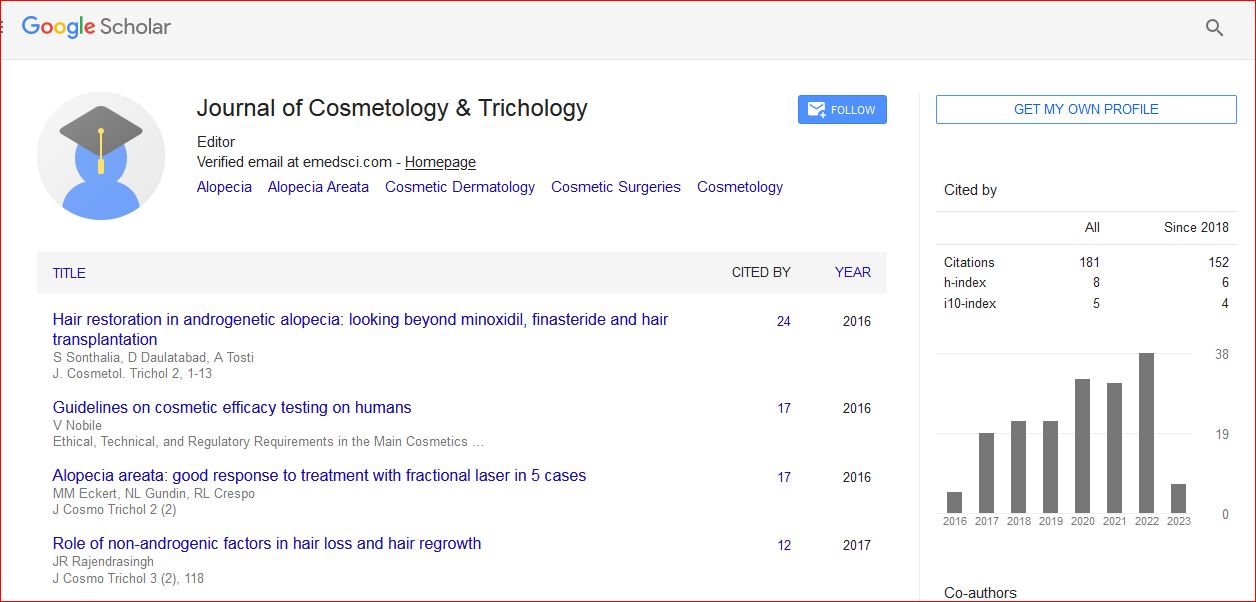
Journal of Cosmetology & Trichology received 180 citations as per Google Scholar report