Research Article - (2025) Volume 16, Issue 4
Received: 08-Jul-2025, Manuscript No. jbsbe-25-167697;
Editor assigned: 10-Jul-2025, Pre QC No. P-167697;
Reviewed: 25-Jul-2025, QC No. Q-167697;
Revised: 01-Aug-2025, Manuscript No. R-167697;
Published:
08-Aug-2025
, DOI: 10.5281/zenodo.17829186
Citation: Shinde, Shashikant Kisanrao, Ganesh Sunil Nhivekar,
Sushant R. Pol and Bharat T Jadhav, et al. "Development of 3D Printed
Microfluidics Lab-on-Chip Colorimetric System in Rapid Testing of Nutrient for
Precision Agriculture: Simulation and Validation." J Biosens Bioelectron 16
(2025): 520.
Copyright: © 2025 Shinde SK, et al. This is an open-access article distributed
under the terms of the Creative Commons Attribution License, which permits
unrestricted use, distribution, and reproduction in any medium, provided the
original author and source are credited.
The advancement of microfluidic systems enables rapid development of Lab-On-Chip (LOC) for the applications in different fields, such as biomedical diagnostics, environmental monitoring, healthcare and agriculture. Microfluidics LOC is integrated device platform for manipulations of fluids within microscale to perform one or more laboratory functions. Smart technologies have now penetrated every aspect of modern life and is ubiquitous. 3D printed sensors, Internet Of Things (IOT) and smartphone have been used as point of care device. A similar approach can be extended in precision agriculture for nutrient detection. The integration of Microfluidics Lab- On -Chip (LOC), smart sensing and IOT presents a transformative approach to nutrient management in precision agriculture. 3D printed Microfluidics LOC technologies enable the precise analysis of nutrients and allowing for real-time monitoring and optimization of plant growth conditions. Integrating electronic sensors within the microfluidic systems, farmers can receive continuous data on nutrient levels for enhancing decision-making processes. This collaborative approach not only streamlines rapid nutrient detection but also promotes sustainable agriculture. The proposed system has simulation comparison of Y channel and Y serpentine channel with chamber mixer in COMSOL with 3D printed chip design validation. We integrate design simulation and experimental validation.
Microfluidics lab-on-chip • Simulation • 3D printing • IOT • Colorimetry • Precision agriculture
Digitization in agriculture is revolutionizing by leveraging cutting-edge technologies to optimize resource use and enhance crop productivity [1]. The use of smart sensor technology in precision agriculture is mainly focused on soil, water and nutrient analysis. In precision agriculture soil and plant testing is a valuable tool for determining the fertilizer needs, growth and maximizing the fertilizer efficiency [2]. The soil macronutrients like Nitrogen (N), Phosphorus (P) and Potassium (K) are essential for crop growth [3]. Emerging technologies like microfluidics-based Lab-On-a-Chip (LOC) which enable rapid, on-site nutrient detection [4]. Soil sample and plant petiole sap analysis in laboratory is common practice [5]. Accurate, sensitive laboratory methods require bulky and expensive instrumentation, labor intensive sample preparation with expert operators and personnel [6]. Device miniaturization can be achieved using Lab-On Chip (LOC) technology which integrates several functions on single chip. This technology employs microchannels, mixer of microfluidics [7,8]. Integrating detector to a LOC is critical for any analytical device. A number of technologies have been used in LOC devices, including electrochemical, mechanical and optical methods [9]. Microfluidic LOC technology with colorimetry utilizes miniaturized fluid channels to analyse soil and plant nutrient levels efficiently [10]. These chips require minimal sample volume, reduce reagent consumption and provide rapid results compared to conventional laboratory methods. Integration of optical sensing colorimetry is a crucial interface for LOC systems by providing a user-friendly platform for data visualization and analysis [11].
The microfluidics Lab -On –a- Chip (LOC), technology implies those techniques that perform various laboratory operations on a miniaturized scale. LOC is a device, which can scale the single or multiple laboratory functions down to chip-format [12]. The size of this chip ranges from millimetre to few square centimetres. LOC is the integration of fluidics, electronics, optics and sensors. A microfluidics device consists of micromixer, microchannel and microchamber. Microfluidics work on the principle of capillary action that allows the movement of fluids in capillaries or microchannels passively [13]. Micromixer are generally designed with channel as the mixing path and increase mixing and chamber for detection [14-16].
In this context there is a need to develop real time and portable rapid testing, analysis and quantification devices. In this paper concentration distribution, pressure for the fluid flow and velocity field to determine whether fluid flow in microchannel was observed. Also, paper explain geometry, numerical simulation and development to form micromixer, microchannel and microchamber design with 3D printing fabrication. The contribution offered by the current work is modelling and simulation of microfluidics channel and mixing with COMSOL Multiphysics (6.0) and development of 3D printed microfluidics serpentine channel and mixer for sample and reagent mixing. The proposed integration of microfluidic LOC, colorimetry and IOT in nutrient detection marks a significant advancement in precision agriculture [17-20].
Micromixer and microchannel modelling
A CAD design (.dxf file) from SolidWorks is imported in COMSOL (6.0) for geometry modelling for 2 inlet and 1 outlet Y and Serpentine microchannel, micromixer with chamber as shown in Figures 1 and 2. PolyDiMethylSiloxane (PDMS) used as boundary material with water liquid as domain material. Build with physical controlled mesh with fine element size as shown in Figures 3-8.
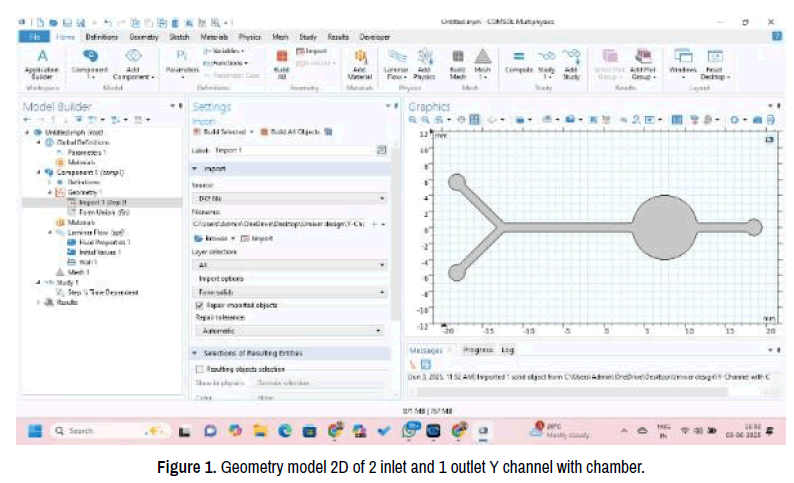
Figure 1. Geometry model 2D of 2 inlet and 1 outlet Y channel with chamber.
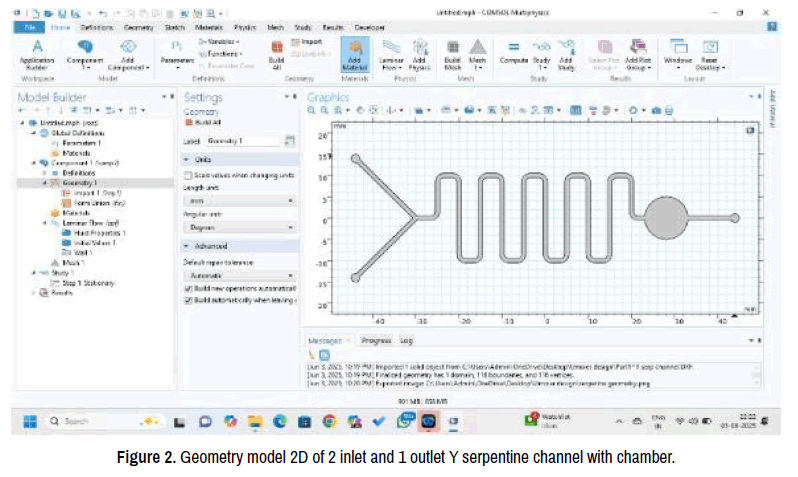
Figure 2. Geometry model 2D of 2 inlet and 1 outlet Y serpentine channel with chamber.
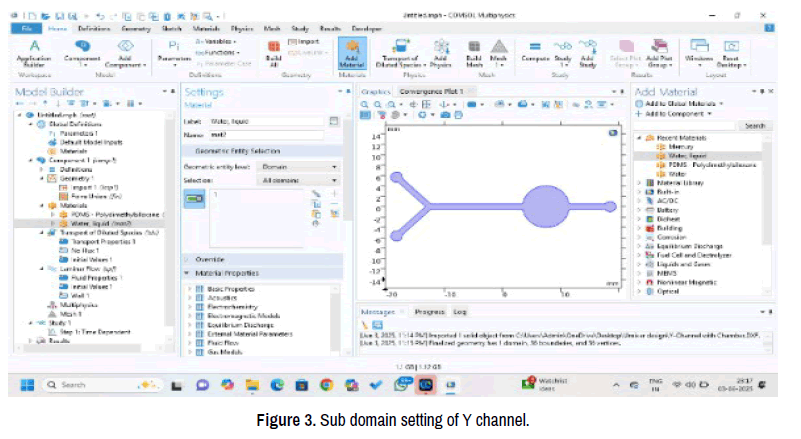
Figure 3. Sub domain setting of Y channel.
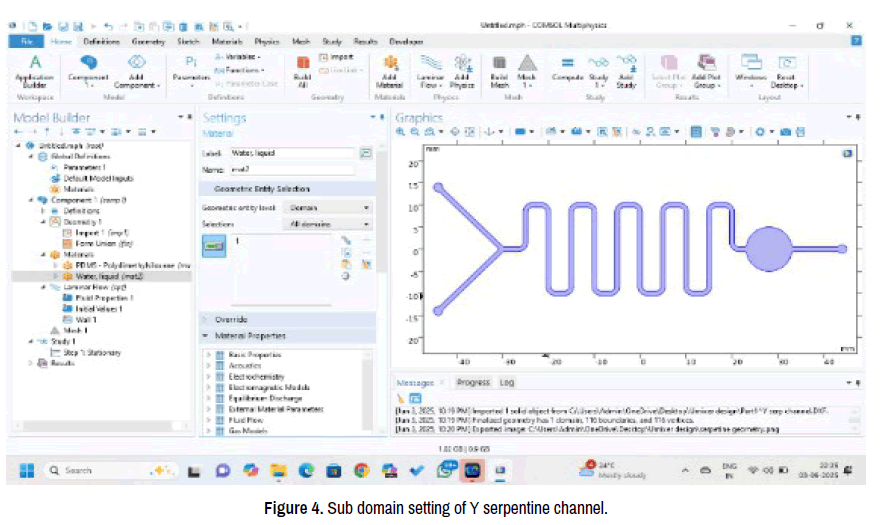
Figure 4. Sub domain setting of Y serpentine channel.
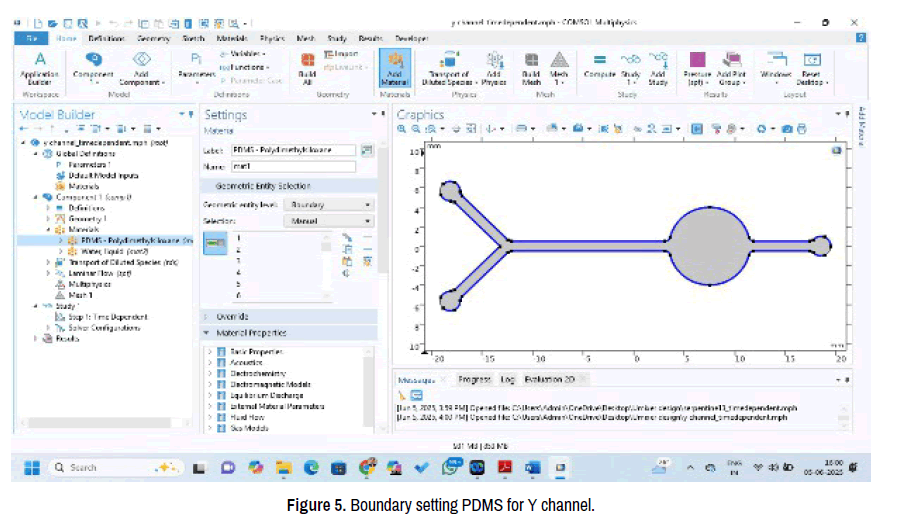
Figure 5. Boundary setting PDMS for Y channel.
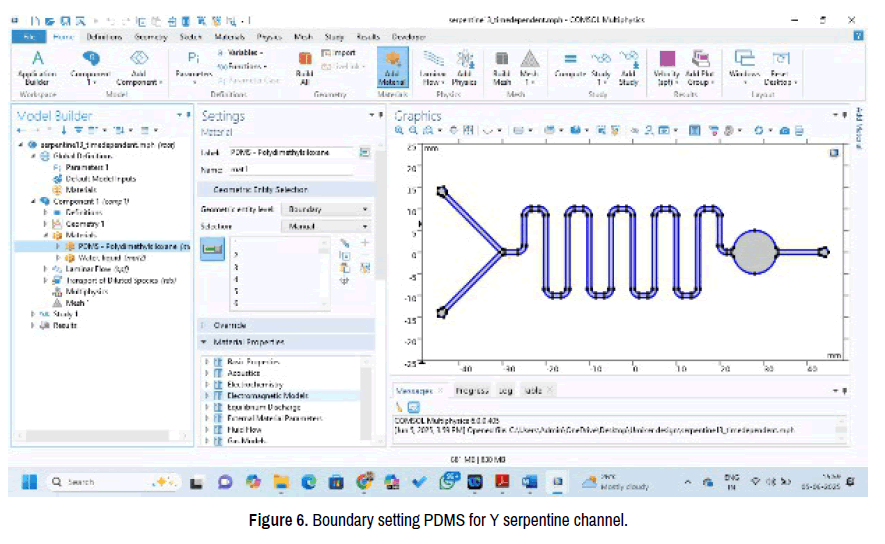
Figure 6. Boundary setting PDMS for Y serpentine channel.
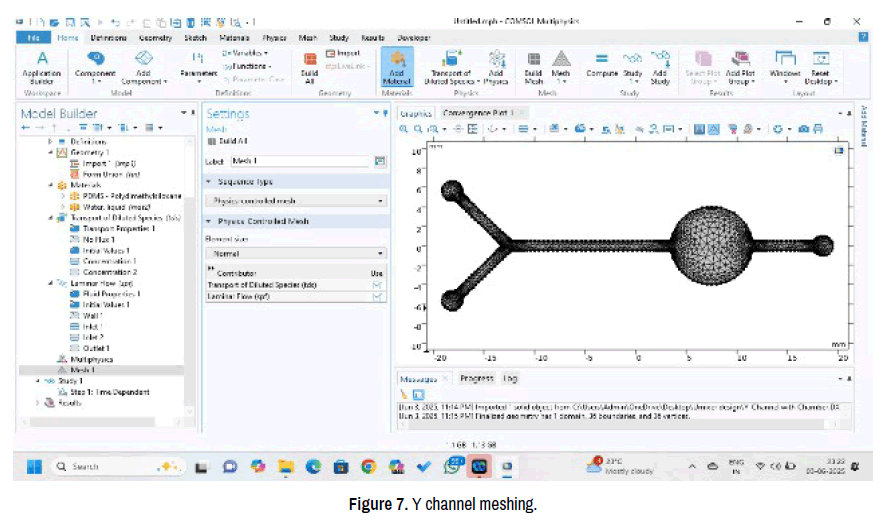
Figure 7. Y channel meshing.
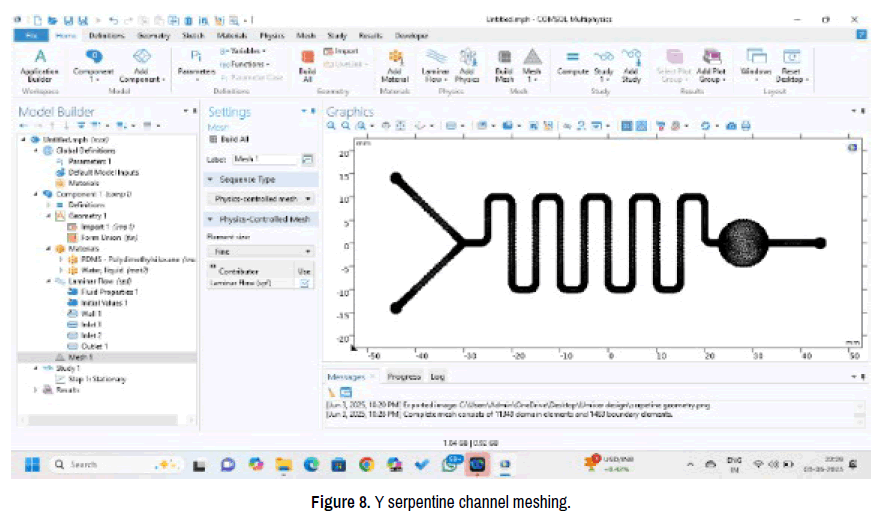
Figure 8. Y serpentine channel meshing.
A COMSOL (6.0) Multiphysics software was used for fluid flow experiments in microchannel, micromixer and chamber in Y channel with chamber and Y serpentine channel with chamber. Time dependent study for laminar flow has been conducted. Figures 9 and 10 shows variation of velocity with length of channel. Figures 11 and 12 shows variation of surface pressure. Concentration of channel was shown in Figures 13 and 14.
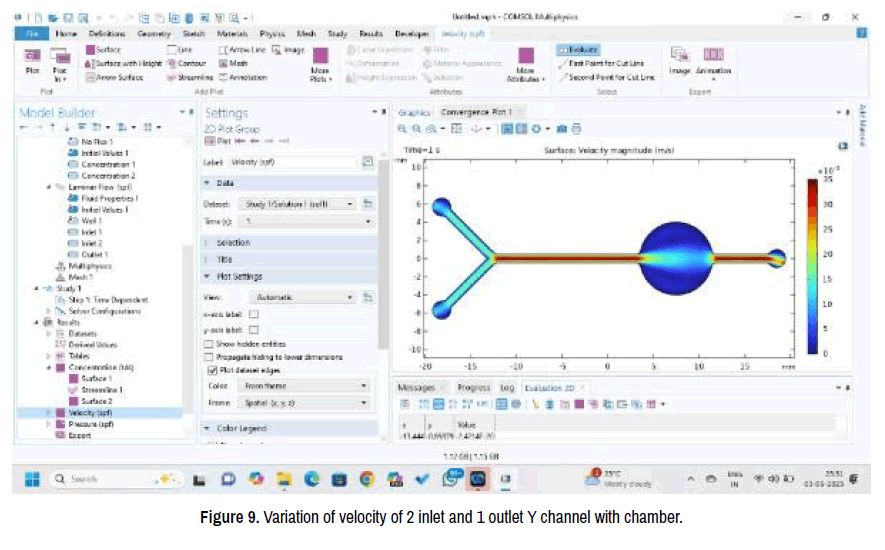
Figure 9. Variation of velocity of 2 inlet and 1 outlet Y channel with chamber.
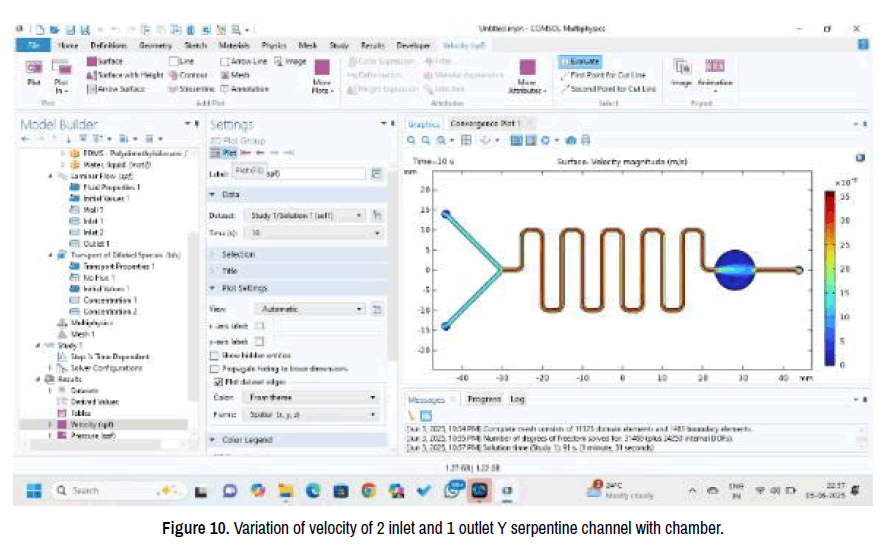
Figure 10. Variation of velocity of 2 inlet and 1 outlet Y serpentine channel with chamber.
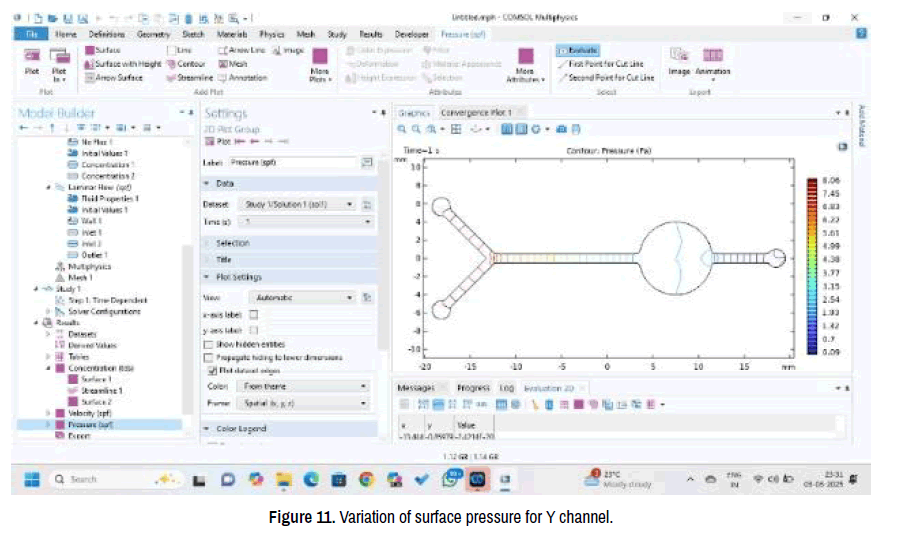
Figure 11. Variation of surface pressure for Y channel.
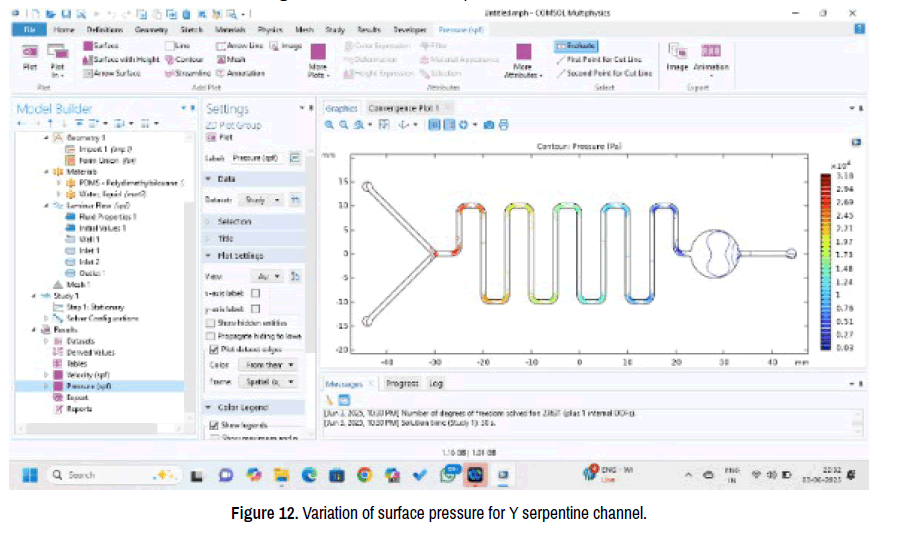
Figure 12. Variation of surface pressure for Y serpentine channel.
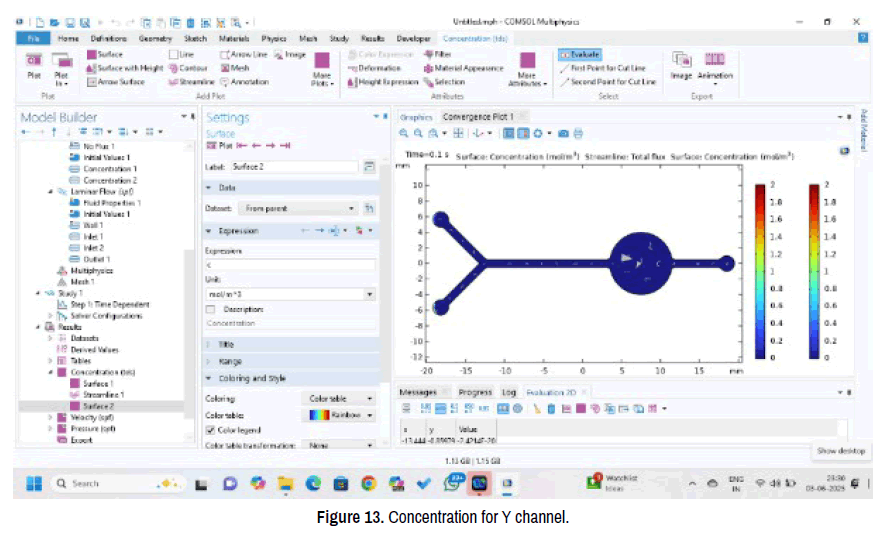
Figure 13. Concentration for Y channel.
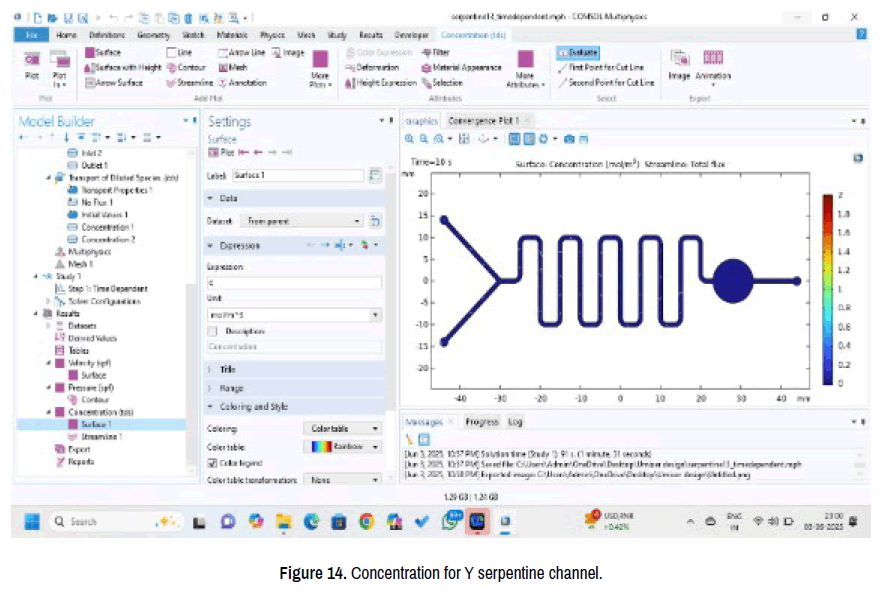
Figure 14. Concentration for Y serpentine channel.
The mixing process in this type of micromixer is obtained by guiding two sample liquids in channel before chamber, hence mixing is accomplished before chamber which is used for detection. At microscale level, fluid properties become controlled, less time and required minimal quantity of reagents and sample. Mixing occurs properly at chamber.
When validating design and fabricating microfluidics device it is important to be able to mix samples and reagents quickly and easily. Prototype of design parameter using SLA 3D printer and resin material is shown in Figures 14-18.
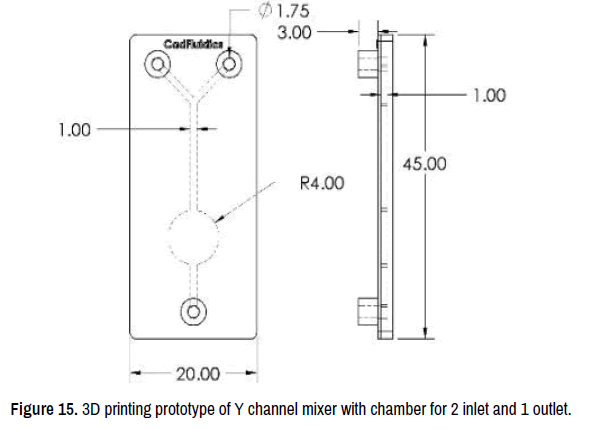
Figure 15. 3D printing prototype of Y channel mixer with chamber for 2 inlet and 1 outlet.
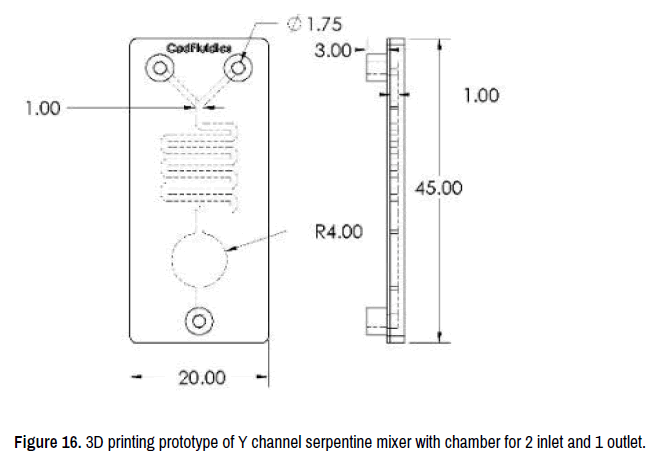
Figure 16. 3D printing prototype of Y channel serpentine mixer with chamber for 2 inlet and 1 outlet.
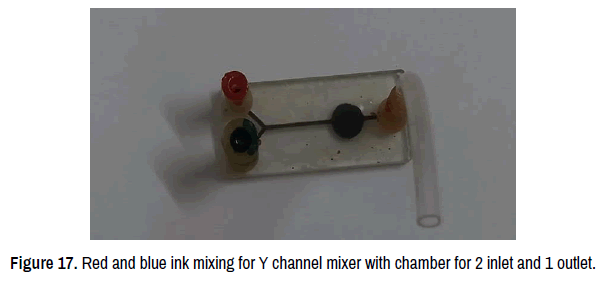
Figure 17. Red and blue ink mixing for Y channel mixer with chamber for 2 inlet and 1 outlet.
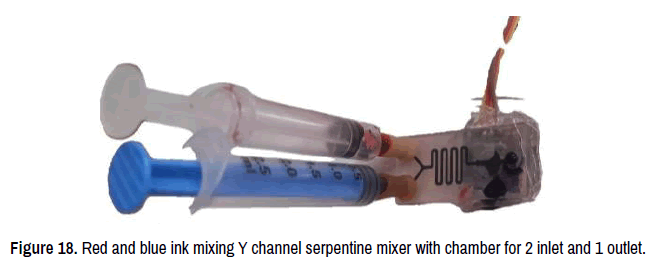
Figure 18. Red and blue ink mixing Y channel serpentine mixer with chamber for 2 inlet and 1 outlet.
In this paper, we have compared Y channel with chamber and Y channel serpentine with chamber mixer and simulated a method which can be used for colorimetric detection. Velocity, surface pressure and concentration were also compared for Y channel and Y serpentine channel mixer. The serpentine channel achieved over 90% mixing efficiency at a flow rate of 1 ml/min. Validating modelling in COMSOL Multiphysics 3D printed protype was fabricated. This study of modelling and simulation for microfluidics mixer can be useful for hardware testing of colorimetric detection of plant sap fluid. Our simple model assesses the viability of utilizing 3D printed microfluidics mixer in point of care applications in precision agriculture and optical absorbance path for maximum sensitivity. Simulation results guided the final geometry optimization. In future IoT, optical detection can be integrated for portable lab on chip application of nutrient detection.
The development of these project is supported by Department of Electronics, Yashavantrao Chavan Institute of Science, Satara, Constituent college of Karmaveer Bhaurao Patil University, Satara, Maharashtra, India. We also thankful ISTEM for COMSOL software support.
There are no conflicts of interest to declare.
Google Scholar, Cross Ref, Indexed at
Google Scholar, Cross Ref, Indexed at
Google Scholar, Cross Ref, Indexed at
Google Scholar, Cross Ref, Indexed at
Google Scholar, Cross Ref, Indexed at
Google Scholar, Cross Ref, Indexed at
Google Scholar, Cross Ref, Indexed at
Google Scholar, Cross Ref, Indexed at
Google Scholar, Cross Ref, Indexed at
Google Scholar, Cross Ref, Indexed at
Google Scholar, Cross Ref, Indexed at
Google Scholar, Cross Ref, Indexed at
Google Scholar, Cross Ref, Indexed at
Google Scholar, Cross Ref, Indexed at
Google Scholar, Cross Ref, Indexed at
Biosensors & Bioelectronics received 6207 citations as per Google Scholar report