Brief Report - (2025) Volume 11, Issue 5
Received: 01-Oct-2025, Manuscript No. cdp-26-185490;
Editor assigned: 03-Oct-2025, Pre QC No. P-185490;
Reviewed: 17-Oct-2025, QC No. Q-185490;
Revised: 22-Oct-2025, Manuscript No. R-185490;
Published:
29-Oct-2025
, DOI: 10.37421/2572-0791.2025.11.195
Citation: Rahman, Noor. ”Depression’s Complex Neurobiology: A Multifaceted Outlook.” Clin Depress 11 (2025):195.
Copyright: © 2025 Rahman N. This is an open-access article distributed under the terms of the Creative Commons Attribution License, which permits unrestricted use, distribution and reproduction in any medium, provided the original author and source are credited.
The intricate neurobiological underpinnings of clinical depression are increasingly understood through various systemic dysregulations. A significant area of focus is the monoaminergic systems, particularly the roles of serotonin and norepinephrine, whose dysregulation is a known contributor to mood disturbances in depression [1].
Complementing this, the hypothalamic-pituitary-adrenal (HPA) axis plays a critical role in the body's stress response, and its chronic activation is a hallmark observed in individuals with depression [1].
Further insights come from the study of neurotrophic factors, with diminished levels of Brain-Derived Neurotrophic Factor (BDNF) impacting neuronal plasticity and resilience, crucial elements for mental well-being [1].
The involvement of inflammatory processes and altered connectivity within specific brain networks, such as the default mode network and the salience network, are also recognized as key mechanisms contributing to the pathophysiology of depression [1].
Beyond the monoaminergic systems, the glutamate system has emerged as a critical player in the pathophysiology of major depressive disorder. Imbalances in glutamatergic neurotransmission, involving NMDA and AMPA receptors, can lead to excitotoxicity and impaired synaptic plasticity, profoundly contributing to depressive symptoms [2].
Consequently, the glutamate system presents promising potential therapeutic targets for depression treatment [2].
Emerging research highlights the significant connection between the gut microbiome and brain function in the context of depression. The bidirectional communication pathway, known as the gut-brain axis, suggests that dysbiosis in gut microbiota can influence neurotransmitter production, neuroinflammation, and stress reactivity, thereby contributing to the development of depression [3].
This understanding opens avenues for therapeutic interventions targeting the gut microbiome for depression treatment [3].
The role of neuroinflammation in the development and maintenance of clinical depression is also a critical area of investigation. Evidence points to increased pro-inflammatory cytokines and heightened microglial activation in depressed individuals, suggesting an inflammatory cascade that negatively impacts neuronal function and exacerbates depressive symptomatology [4].
Furthermore, the impact of early life stress on depression development is deeply intertwined with epigenetic modifications and long-term changes in stress response systems. Adverse childhood experiences can alter gene expression, leading to increased vulnerability to depression in adulthood by affecting the HPA axis and neural circuits involved in emotional regulation [5].
Significant alterations in brain connectivity are consistently observed in individuals with major depressive disorder. These include functional and structural changes in various brain networks, such as the default mode network, salience network, and central executive network, whose disrupted interplay contributes to cognitive and emotional deficits characteristic of depression [6].
Circadian rhythm disruption is another notable factor contributing to the pathophysiology of depression. Altered sleep-wake cycles and changes in the expression of clock genes can significantly impact mood regulation, energy levels, and cognitive function, ultimately contributing to the development and exacerbation of depressive symptoms [7].
Chronotherapy is being explored as a potential treatment approach for these disruptions [7].
The endocannabinoid system's contribution to mood regulation and its implications in depression are also being actively explored. Alterations in endocannabinoid signaling, involving key molecules like anandamide and 2-arachidonoylglycerol, can influence stress response, neuroinflammation, and synaptic plasticity, playing a recognized role in the pathophysiology of depression [8].
Oxidative stress is increasingly implicated in the pathogenesis of depression. Evidence suggests increased markers of oxidative damage and compromised antioxidant defense mechanisms in depressed individuals, contributing to neuronal damage, inflammation, and neurotransmitter dysfunction, all of which are implicated in the complex mechanisms of depression [9].
Finally, the serotonin transporter (SERT) is a crucial element in understanding depression. Genetic variations and functional alterations in SERT can significantly influence serotonin availability in the synaptic cleft, thereby impacting mood regulation. This pathway is central to the mechanism of action of selective serotonin reuptake inhibitors (SSRIs), a primary class of antidepressants used to treat depression [10].
The neurobiological landscape of clinical depression is multifaceted, with prominent dysregulation observed in monoaminergic systems, particularly serotonin and norepinephrine, which directly impacts mood regulation [1].
Concurrently, the hypothalamic-pituitary-adrenal (HPA) axis, a central component of the stress response, exhibits chronic activation in depressed individuals, underscoring its significant involvement [1].
Research also highlights the role of neurotrophic factors like BDNF; their reduced levels are associated with compromised neuronal plasticity and resilience, fundamental for maintaining mental health [1].
Furthermore, inflammatory processes and aberrant connectivity within key brain networks, including the default mode network and salience network, are recognized as critical contributors to the underlying pathophysiology of depression [1].
The glutamatergic system is another critical area of investigation for major depressive disorder. Dysfunction within this system, characterized by imbalances in glutamatergic neurotransmission affecting NMDA and AMPA receptors, can lead to excitotoxicity and impaired synaptic plasticity, directly contributing to the manifestation of depressive symptoms [2].
Consequently, the modulation of the glutamate system represents a significant area for developing novel therapeutic strategies for depression [2].
The intricate connection between the gut microbiome and brain function is increasingly being elucidated in the context of depression. The gut-brain axis facilitates bidirectional communication, and disruptions in the gut microbiota, or dysbiosis, can influence neurotransmitter synthesis, neuroinflammatory responses, and stress reactivity, thereby playing a causal role in the development of depression [3].
This understanding opens new therapeutic avenues by targeting the gut microbiome for depression management [3].
Neuroinflammation is a substantial factor in the development and persistence of clinical depression. Studies consistently report elevated levels of pro-inflammatory cytokines and increased microglial activation in depressed populations, suggesting that chronic inflammatory cascades can impair neuronal function and contribute to depressive symptomatology [4].
The profound impact of early life stress on the development of depression is mediated by epigenetic modifications and lasting alterations in stress response systems. Adverse experiences during childhood can lead to changes in gene expression, increasing an individual's vulnerability to depression in adulthood by affecting the HPA axis and the neural circuits governing emotional regulation [5].
Altered brain connectivity is a consistent finding in major depressive disorder. Functional and structural changes in crucial brain networks, such as the default mode network, salience network, and central executive network, and their impaired interplay, are strongly linked to the cognitive and emotional deficits that define depression [6].
Disruptions in circadian rhythms are also implicated in the pathophysiology of depression. Irregular sleep-wake patterns and altered expression of clock genes can negatively affect mood regulation, energy levels, and cognitive performance, thereby contributing to the onset and worsening of depressive symptoms [7].
Chronotherapy is being explored as a promising intervention for these circadian disturbances [7].
The endocannabinoid system plays a role in mood regulation and is implicated in depression. Dysregulation in endocannabinoid signaling, involving neurotransmitters like anandamide and 2-arachidonoylglycerol, can influence stress reactivity, neuroinflammation, and synaptic plasticity, all of which are relevant to the underlying mechanisms of depression [8].
Oxidative stress is a significant contributor to the pathogenesis of depression. Elevated markers of oxidative damage and reduced antioxidant defense capacity in depressed individuals suggest that oxidative stress can lead to neuronal injury, inflammation, and impaired neurotransmitter function, all of which are implicated in the complex etiology of depression [9].
The serotonin transporter (SERT) is a key molecular target in the study of depression. Variations in SERT genetics and its functional status directly influence serotonin availability in the synapse, impacting mood regulation. This is the fundamental mechanism targeted by SSRIs, a primary pharmacological intervention for depression [10].
Depression is a complex disorder with multifactorial origins. Key neurobiological mechanisms include dysregulation in monoaminergic systems, particularly serotonin and norepinephrine, and chronic activation of the HPA axis. Neurotrophic factors like BDNF are diminished, affecting neuronal plasticity. Neuroinflammation, characterized by increased pro-inflammatory cytokines and microglial activation, also plays a significant role. Early life stress can lead to epigenetic changes and increased vulnerability. Altered brain connectivity within networks like the default mode and salience networks contributes to cognitive and emotional deficits. Circadian rhythm disruptions and dysfunctions in the glutamate and endocannabinoid systems are also implicated. Oxidative stress contributes to neuronal damage and inflammation. The serotonin transporter (SERT) is central to serotonin signaling and a target for antidepressant medications.
None
None
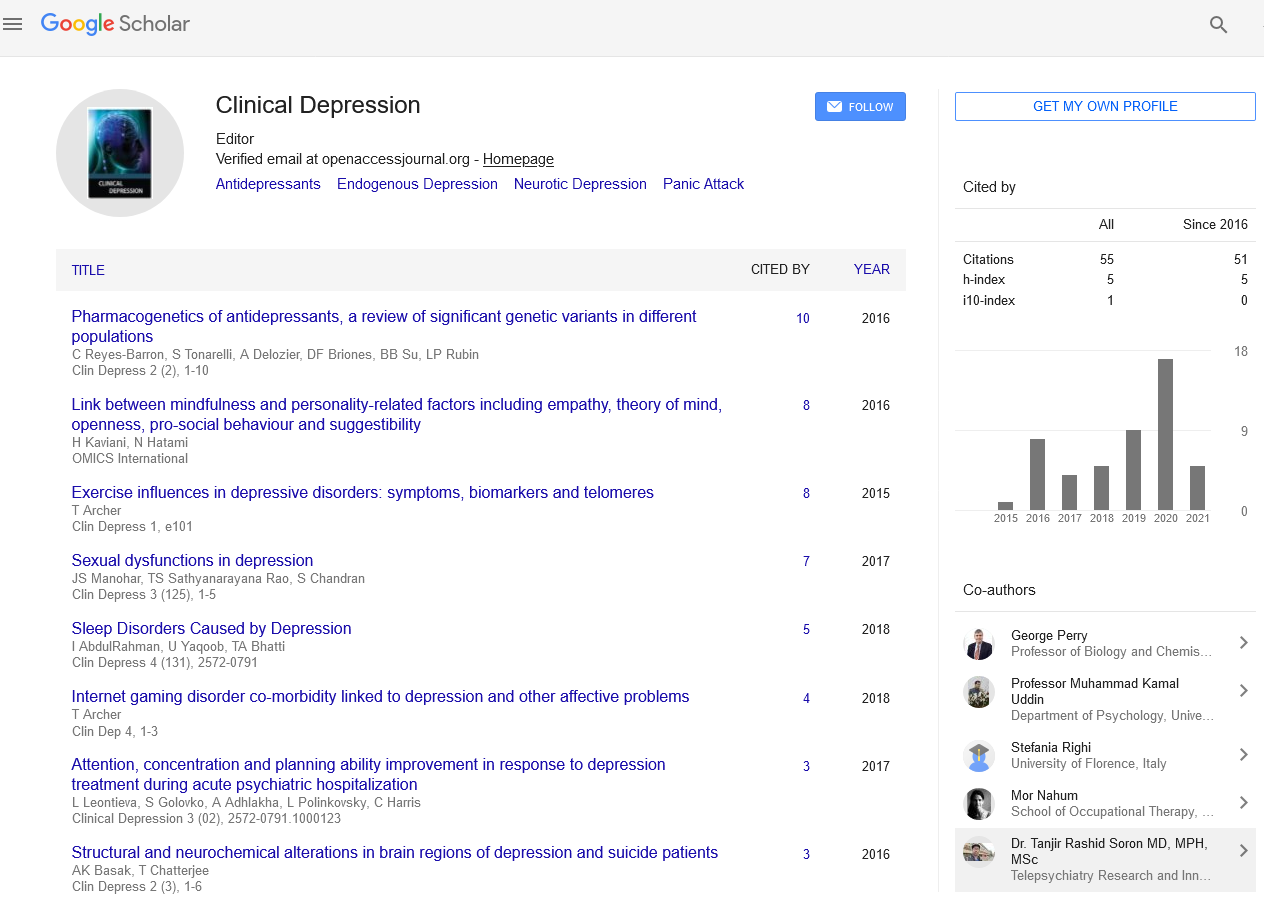
Clinical Depression received 89 citations as per Google Scholar report