Commentary - (2025) Volume 15, Issue 2
Received: 02-Jun-2025, Manuscript No. jpdbd-25-164663;
Editor assigned: 04-Jun-2025, Pre QC No. P-164663;
Reviewed: 16-Jun-2025, QC No. Q-164663;
Revised: 23-Jun-2025, Manuscript No. R-164663;
Published:
30-Jun-2025
, DOI: 10.37421/2153-0769.2025.15.420
Citation: Jeffrey, Alireza. “Delving into the Metabolome through Profiling Techniques.” Metabolomics 15 (2025): 420.
Copyright: © 2025 Jeffrey A. This is an open-access article distributed under the terms of the Creative Commons Attribution License, which permits unrestricted use, distribution, and reproduction in any medium, provided the original author and source are credited.
Delving into the metabolome through profiling techniques represents a critical frontier in understanding the complexity of biological systems. The metabolome itself refers to the complete set of small-molecule chemicals found within a biological sample. These molecules include a wide array of metabolites such as amino acids lipids sugars nucleotides and other intermediates and products of metabolism. What makes the study of the metabolome particularly intriguing is its dynamic nature and close reflection of an organism’s physiological state. This makes metabolomics a powerful tool not only for basic biological research but also for applications in medicine environmental science agriculture and biotechnology. The journey into the metabolome starts with the recognition that every cell tissue or organism generates a unique metabolic signature. These signatures fluctuate in response to internal processes and external stimuli such as diet disease environmental changes or pharmaceutical interventions. Because of this sensitivity the metabolome can serve as a snapshot of the biochemical activities occurring within a system at a particular point in time. Capturing this snapshot with accuracy precision and depth requires robust metabolite profiling techniques [1].
Metabolite profiling is essentially the identification and quantification of metabolites in a sample. This may sound straightforward but the complexity of biological samples where thousands of metabolites coexist across a wide range of concentrations makes this a highly challenging endeavor. These molecules differ in terms of polarity volatility stability and abundance. Some are highly hydrophilic while others are hydrophobic. Some exist in picomolar concentrations while others are much more abundant. Hence no single profiling technique is sufficient on its own. Rather multiple complementary methods are used to ensure the comprehensive capture of metabolic information. One of the most commonly employed techniques in metabolite profiling is mass spectrometry. Mass spectrometry allows researchers to identify and quantify metabolites based on their mass-to-charge ratio. This method is often coupled with chromatographic separation techniques such as gas chromatography or liquid chromatography. Gas chromatography is typically used for volatile compounds or those that can be derivatized to become volatile. On the other hand liquid chromatography is more suitable for thermally unstable or nonvolatile compounds. By combining chromatography with mass spectrometry researchers can first separate complex mixtures into individual components and then analyze each component with high specificity and sensitivity [2].
Another core technique in metabolomics is nuclear magnetic resonance spectroscopy. NMR spectroscopy provides detailed information about the structure dynamics and environment of molecules based on their magnetic properties. Unlike mass spectrometry NMR is non-destructive and highly reproducible making it particularly useful for longitudinal studies or when preserving the sample is critical. However NMR is generally less sensitive than mass spectrometry and may not detect low-abundance metabolites without concentration steps or enhanced instrumentation. In addition to these core methods advanced platforms such as Fourier-transform ion cyclotron resonance and time-of-flight analyzers are employed to push the boundaries of resolution and sensitivity in mass spectrometry. These platforms can provide ultra-high resolution allowing researchers to distinguish between compounds that differ by only a fraction of a Dalton. Similarly innovations in microfluidics and lab-on-a-chip technologies are making it possible to conduct metabolite profiling with minimal sample volumes which is particularly advantageous in clinical settings or in studies involving rare samples. Sample preparation is a critical step that influences the quality and reliability of metabolite profiling. Biological samples such as blood urine saliva tissue or cell extracts must be handled with care to avoid degradation or loss of metabolites. This often involves rapid quenching of metabolic activity using cold temperatures or solvents followed by extraction procedures tailored to the specific class of metabolites being studied. For example polar metabolites may be extracted using methanol-water mixtures while nonpolar metabolites such as lipids may require chloroform-methanol extraction. The choice of extraction method can significantly influence the range and type of metabolites detected [3].
Data generated from metabolite profiling techniques are highly complex and voluminous. As a result bioinformatics and computational tools are indispensable for data processing normalization analysis and interpretation. Raw spectral data must be processed to remove noise align peaks and annotate compounds. Databases such as the Human Metabolome Database METLIN and KEGG provide reference spectra and compound information that help in metabolite identification. Statistical tools including multivariate analyses like principal component analysis and partial least squares discriminant analysis are commonly used to discern patterns and relationships within the data. These tools allow researchers to identify biomarkers differentiate between experimental groups and generate hypotheses for further study. An important consideration in metabolite profiling is the distinction between targeted and untargeted approaches. Targeted metabolomics involves the quantification of a predefined set of metabolites usually those related to a specific pathway or biological question. This approach offers high sensitivity and accuracy but is limited in scope. Untargeted metabolomics on the other hand aims to capture as many metabolites as possible without prior knowledge. This exploratory approach is ideal for hypothesis generation biomarker discovery and uncovering novel metabolic pathways but it often requires more intensive data processing and validation [4,5].
Metabolite profiling is increasingly being integrated with other omics technologies such as genomics transcriptomics and proteomics to provide a more holistic view of biological systems. This integrative approach known as systems biology helps to connect the dots between genetic information gene expression protein activity and metabolic output. For example changes in gene expression identified through transcriptomics can be correlated with changes in metabolite levels to infer enzyme activities and regulatory mechanisms. Such multi-layered data integration is crucial for understanding complex diseases like cancer diabetes or neurodegenerative disorders where multiple biological pathways are disrupted.
Google Scholar Cross Ref Indexed at
Google Scholar Cross Ref Indexed at
Google Scholar Cross Ref Indexed at
Google Scholar Cross Ref Indexed at
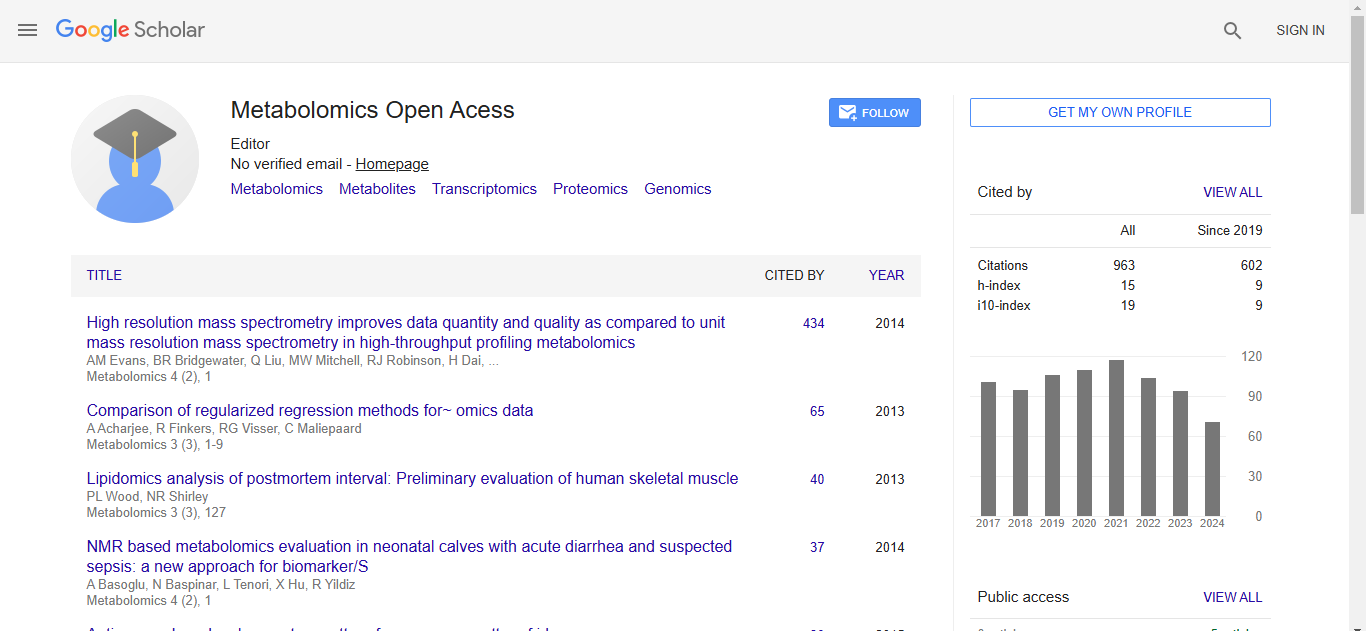
Metabolomics:Open Access received 895 citations as per Google Scholar report