Short Communication - (2025) Volume 16, Issue 3
Received: 01-May-2025, Manuscript No. jnmrt-26-186373;
Editor assigned: 05-May-2025, Pre QC No. P-186373;
Reviewed: 19-May-2025, QC No. Q-186373;
Revised: 22-May-2025, Manuscript No. R-186373;
Published:
29-May-2025
, DOI: 10.37421/2155-9619.2025.16.654
Citation: Wei, Chen. ”Deep Learning Revolutionizes Cardiac
Sarcoidosis Quantification.” J Nucl Med Radiat Ther 16 (2025):654.
Copyright: © 2025 Wei C. This is an open-access article distributed under the terms of the Creative Commons Attribution License, which permits unrestricted use, distribution
and reproduction in any medium, provided the original author and source are credited.
The precise quantification of cardiac involvement in sarcoidosis is a critical aspect of patient management and prognosis, and automated segmentation algorithms are emerging as powerful tools to achieve this goal [1].
These advanced computational techniques, particularly those leveraging deep learning, offer substantial advantages over traditional manual segmentation methods, enhancing accuracy, reproducibility, and efficiency in assessing myocardial inflammation and fibrosis, which are hallmarks of cardiac sarcoidosis [1].
Machine learning algorithms are increasingly being applied to delineate myocardial scar tissue in cardiac magnetic resonance imaging (CMR), enabling accurate scar burden quantification and differentiation between transmural and non-transmural scar, vital for risk stratification in various cardiomyopathies, including sarcoidosis [2].
The standardization of scar quantification through these advanced methods promises to improve the reliability of diagnostic and prognostic assessments [2].
A robust deep learning-based framework has been developed for the automated segmentation of the left ventricle from cardiac MRI, demonstrating high accuracy and robustness [3].
This capability provides consistent volumetric and functional measurements, which are foundational for precisely quantifying cardiac structure and function, essential for monitoring disease progression in conditions like cardiac sarcoidosis where subtle changes significantly impact management [3].
A novel approach utilizing convolutional neural networks (CNNs) has been presented for segmenting myocardial regions of interest (ROIs) in 3D cardiac MRI [4].
This algorithm is designed to effectively handle anatomical variations and image artifacts, achieving superior segmentation quality compared to traditional methods, with accurate segmentation of myocardial tissue being paramount for quantifying inflammatory infiltrates and fibrotic changes characteristic of cardiac sarcoidosis [4].
The U-Net architecture has been employed for automated segmentation of cardiac chambers in cardiac MRI, demonstrating effectiveness in generating accurate and consistent segmentations [5].
This consistency is essential for deriving reliable quantitative metrics of chamber volumes and function, which are critical for evaluating the impact of sarcoidosis on cardiac hemodynamics and overall heart health [5].
An end-to-end deep learning model has been introduced for the automatic segmentation of the myocardium in cardiac MRI, focusing on improving both efficiency and accuracy [6].
This model significantly reduces manual segmentation time while maintaining high Dice scores, indicating excellent overlap with ground truth, a direct advancement for the quantitative assessment of myocardial inflammation and fibrosis in cardiac sarcoidosis [6].
Deep learning algorithms are being evaluated for their performance in segmenting cardiac structures within late gadolinium-enhanced (LGE) cardiac MRI, a technique crucial for identifying scar tissue in sarcoidosis [7].
Comparative studies of different network architectures highlight the potential of deep learning to automate and standardize scar quantification, leading to more reliable prognostic information [7].
A robust automated segmentation method for the right ventricle (RV) in cardiac MRI has been developed and validated [8].
Accurate RV segmentation is crucial for comprehensive cardiac assessment, and its application in sarcoidosis can help evaluate the disease's impact on all cardiac chambers, with the proposed method demonstrating high accuracy and efficiency, contributing to a more complete understanding of cardiac dysfunction in affected patients [8].
A novel deep learning framework for automated segmentation of cardiac structures in 4D CT angiography (CTA) data has been presented [9].
While not directly cardiac MRI, the principles of automated segmentation using deep learning are transferable and can be adapted for PET-CT data, which is crucial for sarcoidosis, to precisely delineate inflammatory lesions and assess their impact on cardiac anatomy and function, thereby improving diagnostic accuracy and treatment planning [9].
Finally, the application of deep learning for the quantitative analysis of myocardial inflammation using PET imaging is being explored, specifically focusing on automated segmentation techniques to delineate regions of elevated FDG uptake [10].
These methods enable more accurate and objective quantification of disease burden, facilitating better treatment response assessment and patient management in cardiac sarcoidosis [10].
Automated segmentation algorithms are at the forefront of improving the precise quantification of cardiac involvement in sarcoidosis, offering significant advancements over manual methods [1].
Deep learning and other advanced computational techniques enhance accuracy, reproducibility, and efficiency in assessing myocardial inflammation and fibrosis, key indicators for diagnosis and monitoring of cardiac sarcoidosis [1].
Machine learning methodologies are being employed to precisely segment myocardial scar tissue in cardiac magnetic resonance imaging (CMR) [2].
This capability allows for accurate delineation of scar burden and differentiation between transmural and non-transmural scar, which is essential for effective risk stratification in various cardiomyopathies, including sarcoidosis, and promises to standardize scar quantification for improved diagnostic reliability [2].
A deep learning-based framework has been developed for the automated segmentation of the left ventricle from cardiac MRI, delivering high accuracy and robustness [3].
The consistent volumetric and functional measurements provided by this framework are fundamental for precise quantification of cardiac structure and function, crucial for tracking disease progression in conditions such as cardiac sarcoidosis, where subtle changes have significant clinical implications [3].
A convolutional neural network (CNN) based approach has been introduced for the segmentation of myocardial regions of interest (ROIs) in 3D cardiac MRI [4].
This algorithm is engineered to manage anatomical variations and image artifacts, yielding superior segmentation quality compared to conventional methods. Precise segmentation of myocardial tissue is paramount for quantifying inflammatory infiltrates and fibrotic changes characteristic of cardiac sarcoidosis, thus aiding in accurate disease assessment [4].
The U-Net architecture is effectively utilized for the automated segmentation of cardiac chambers within cardiac MRI datasets [5].
This model's ability to generate accurate and consistent segmentations is vital for deriving dependable quantitative metrics of chamber volumes and function, which are critical for evaluating the extent to which sarcoidosis impacts cardiac hemodynamics and overall cardiac health [5].
An end-to-end deep learning model has been proposed for the automatic segmentation of the myocardium in cardiac MRI, with a primary focus on enhancing both operational efficiency and diagnostic accuracy [6].
This model demonstrates a substantial reduction in the time required for manual segmentation while achieving high Dice scores, signifying excellent agreement with ground truth data. This advancement directly supports the quantitative assessment of myocardial inflammation and fibrosis in the context of cardiac sarcoidosis [6].
Studies are evaluating the performance of deep learning algorithms in segmenting cardiac structures within late gadolinium-enhanced (LGE) cardiac MRI, a technique instrumental in identifying scar tissue associated with sarcoidosis [7].
Comparisons across various network architectures underscore the significant potential of deep learning to automate and standardize scar quantification, leading to more dependable prognostic information [7].
A validated, robust automated segmentation method for the right ventricle (RV) in cardiac MRI has been developed [8].
Accurate segmentation of the RV is essential for a comprehensive cardiac evaluation. In sarcoidosis, this capability can help assess the disease's effect on all cardiac chambers. The proposed method exhibits high accuracy and efficiency, contributing to a more thorough understanding of cardiac dysfunction in affected patients [8].
A novel deep learning framework for the automated segmentation of cardiac structures has been developed for 4D CT angiography (CTA) data [9].
Although this application is not directly cardiac MRI, the underlying principles of deep learning-based automated segmentation are transferable. These techniques can be adapted for PET-CT imaging, which is crucial for sarcoidosis, to accurately delineate inflammatory lesions and evaluate their impact on cardiac anatomy and function, thereby improving diagnostic precision and treatment planning [9].
The application of deep learning for quantitative analysis of myocardial inflammation in PET imaging is an active area of research, particularly concerning automated segmentation techniques for delineating regions of elevated FDG uptake [10].
Such methods enable more precise and objective quantification of disease burden, which is instrumental in assessing treatment response and optimizing patient management in cardiac sarcoidosis [10].
Automated segmentation algorithms, particularly those employing deep learning, are revolutionizing the quantification of cardiac involvement in sarcoidosis. These methods significantly improve accuracy, reproducibility, and efficiency in assessing myocardial inflammation and fibrosis compared to manual techniques. Advanced machine learning algorithms are used to segment scar tissue in cardiac MRI, aiding risk stratification. Deep learning frameworks accurately segment cardiac chambers and the left ventricle, providing essential volumetric and functional measurements for disease monitoring. Convolutional neural networks and U-Net architectures are instrumental in precise myocardial and chamber segmentation. These advancements in automated segmentation of cardiac MRI and PET imaging enable more objective disease burden assessment, leading to improved diagnosis, prognosis, and personalized patient management in cardiac sarcoidosis.
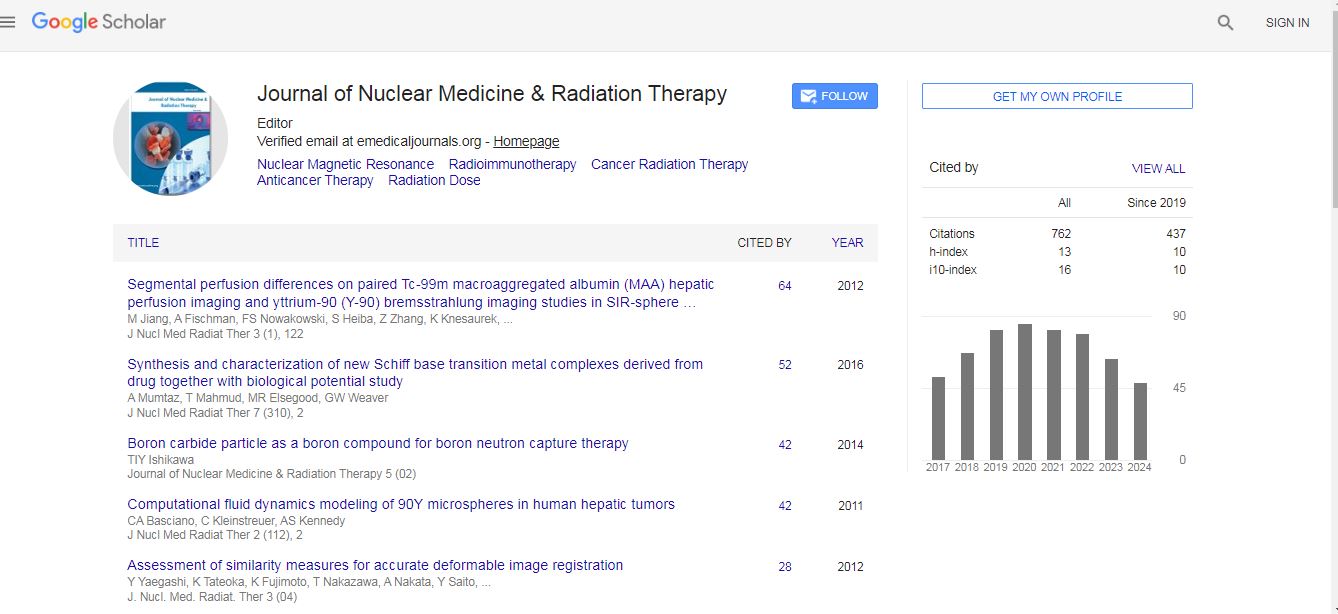
Nuclear Medicine & Radiation Therapy received 706 citations as per Google Scholar report