Short Communication - (2025) Volume 16, Issue 4
Received: 02-Jul-2025, Manuscript No. jch-26-178779;
Editor assigned: 04-Jul-2025, Pre QC No. P-178779;
Reviewed: 17-Jul-2025, QC No. Q-178779;
Revised: 23-Jul-2025, Manuscript No. R-178779;
Published:
30-Jul-2026
, DOI: 10.37421/2157-7099.2025.16.811
Citation: Malhotra, Sunil P.. ”Cytomorphology: Biomarker For Therapeutic Efficacy Assessment.” J Cytol Histol 16 (2025):811.
Copyright: © 2025 Malhotra P. Sunil This is an open-access article distributed under the terms of the Creative Commons Attribution License, which permits unrestricted use, distribution and reproduction in any medium, provided the original author and source are credited.
The field of oncology has witnessed significant advancements in therapeutic interventions, leading to a deeper understanding of their impact on cellular structures. Cytomorphological changes, observable alterations in cell appearance, have emerged as crucial indicators in assessing the efficacy of these treatments and understanding the underlying biological mechanisms. This exploration delves into how various therapeutic modalities, ranging from traditional chemotherapy to cutting-edge targeted therapies and immunotherapies, induce distinct cytomorphological shifts in cancer cells. These shifts are not merely visual changes; they serve as vital diagnostic and prognostic markers, assisting clinicians in evaluating treatment response and unraveling the complexities of drug resistance in cancer [1].
Targeted therapies, designed to specifically inhibit molecular pathways essential for cancer cell growth and survival, often manifest in characteristic cytomorphological alterations. In the context of lung cancer, for instance, novel targeted agents such as EGFR and ALK inhibitors have been investigated for their effects on cellular morphology. Research in this area highlights specific cellular features, including nuclear pleomorphism and cytoplasmic vacuolation, which correlate with the effectiveness of these targeted treatments and can even predict the potential development of resistance, thereby guiding the refinement of therapeutic strategies [2].
Chemotherapeutic agents, a cornerstone of cancer treatment for decades, exert their effects by interfering with fundamental cellular processes like DNA replication and cell division. The cytomorphological consequences of these interventions can be profound and are often indicative of the drug's mechanism of action. Studies examining the impact of different chemotherapeutic agents on breast cancer cells, for example, have identified characteristic changes such as karyorrhexis, chromatin condensation, and various features associated with apoptosis, providing valuable insights into how these drugs work and their clinical implications for monitoring treatment progress [3].
The advent of vaccines has revolutionized the prevention of certain cancers, particularly those linked to viral infections. Human papillomavirus (HPV) vaccines, for instance, aim to prevent cervical cancer by targeting the virus that causes it. Research has explored the cytomorphological effects of these vaccines on cervical lesions, analyzing cellular changes that correlate with viral clearance and the regression of precancerous lesions. This information is vital for establishing effective follow-up management strategies for individuals who have received the vaccine [4].
Immunotherapy represents a paradigm shift in cancer treatment, harnessing the patient's own immune system to fight cancer. The cytomorphological evaluation of tumor samples from patients undergoing immunotherapy, particularly in conditions like melanoma, can reveal important insights into the immune response. This includes the recognition of tumor-infiltrating lymphocytes and reactive changes within the tumor cells themselves, which serve as crucial indicators of both the immune system's activity and the overall effectiveness of the immunotherapy [5].
Beyond oncology, cytomorphological analysis plays a significant role in managing other chronic diseases, such as viral hepatitis. In the case of chronic hepatitis B, antiviral therapies aim to suppress viral replication and reduce liver inflammation. Studies investigating the cytomorphological adaptations in liver cells during such antiviral treatment have detailed cellular changes, inflammatory markers, and potential regenerative processes. These observations are critical for assessing treatment success and monitoring the progression of the disease [6].
The treatment of hematological malignancies, including leukemias and lymphomas, often involves complex therapeutic regimens such as chemotherapy and bone marrow transplantation. Cytomorphological examination of blood and bone marrow cells during these treatments provides a dynamic view of the evolving cellular landscape. Observing alterations in the morphology and differentiation of hematopoietic cells offers valuable insights into the effectiveness of the therapeutic interventions and the patient's recovery trajectory [7].
Radiation therapy is another established modality for cancer treatment, particularly for solid tumors. Its effects on cellular morphology can be significant and are closely monitored to evaluate treatment outcomes. Research focusing on the cytomorphological changes induced by radiation therapy in oral squamous cell carcinoma, for instance, details cellular damage, inflammatory responses, and differentiation patterns observed after treatment. This information is crucial for assessing the efficacy of radiotherapy and for planning subsequent adjuvant therapies [8].
In the realm of neurological disorders, cytomorphological analysis is increasingly being used to assess the impact of therapeutic interventions. Following ischemic stroke, for example, neuroprotective therapies aim to preserve neuronal function and promote brain repair. Studies exploring the cytomorphological correlates of neuroprotection examine changes in neurons and glial cells, identifying markers of recovery and neuronal survival. This provides a basis for evaluating the effectiveness of interventions designed to facilitate brain repair [9].
Finally, cytomorphological assessments are integral to the monitoring of hormone replacement therapy (HRT), particularly in gynecological conditions. Examining endometrial cells during HRT can reveal specific cellular features that indicate whether the therapy is achieving its intended effect and can also help identify potential risks. This detailed cytomorphological evaluation aids clinicians in making informed decisions and effectively monitoring patients undergoing HRT [10].
The dynamic interplay between therapeutic interventions and cellular morphology is a cornerstone of modern medicine, offering profound insights into treatment efficacy and disease progression. In the context of cancer, diverse therapeutic modalities induce distinct cytomorphological shifts that serve as critical diagnostic and prognostic indicators. Chemotherapy, targeted therapies, and immunotherapy, for instance, all elicit observable changes in cell appearance, aiding in the assessment of treatment response and the understanding of drug resistance mechanisms. The meticulous analysis of these cytomorphological alterations is increasingly vital for the implementation of personalized medicine approaches in oncology [1].
Novel targeted therapies have revolutionized the treatment of many cancers, including lung cancer. These agents specifically disrupt molecular pathways crucial for tumor growth, leading to characteristic cytomorphological changes. For example, research on EGFR and ALK inhibitors in non-small cell lung cancer has identified specific cellular features, such as nuclear pleomorphism and cytoplasmic vacuolation, which correlate with treatment effectiveness and can predict the emergence of resistance, thus informing future therapeutic strategies [2].
Chemotherapy, a long-standing pillar of cancer treatment, induces a spectrum of cytomorphological responses that reflect its mechanism of action. In breast cancer, various chemotherapeutic agents have been shown to cause distinct alterations, including karyorrhexis, chromatin condensation, and the hallmarks of apoptosis. These observed changes provide critical insights into drug efficacy and are essential for monitoring treatment response in clinical settings [3].
The impact of preventative measures, such as vaccines, on cellular health can also be assessed through cytomorphological analysis. Following vaccination against human papillomavirus (HPV), studies have investigated the cytomorphological changes in cervical lesions. These alterations are correlated with viral clearance and lesion regression, offering valuable information for the development and refinement of post-vaccination follow-up management strategies [4].
Immunotherapy has emerged as a powerful tool against various cancers, including melanoma, by stimulating the body's immune system. Cytomorphological examination of tumor samples from patients receiving immunotherapy can reveal key indicators of immune response. This includes the identification of tumor-infiltrating lymphocytes and reactive changes in tumor cells, which are direct markers of treatment effectiveness and immune system engagement [5].
The application of cytomorphological assessment extends beyond cancer to the management of chronic viral infections, such as chronic hepatitis B. Antiviral therapies for this condition aim to control viral replication and mitigate liver damage. Cytomorphological studies in this area have detailed cellular adaptations, inflammatory responses, and regenerative changes within hepatocytes, providing a measure of treatment success and disease trajectory [6].
In the management of hematological malignancies, such as leukemia and lymphoma, cytomorphological analysis plays a crucial role in monitoring treatment progress. Chemotherapy and bone marrow transplantation are common treatment modalities, and the evaluation of cytomorphological evolution in hematopoietic cells provides critical insights into the effectiveness of these interventions and the patient's overall recovery [7].
Radiation therapy, a well-established cancer treatment, induces characteristic cytomorphological changes that are vital for assessing its impact. Research on radiation-induced changes in oral squamous cell carcinoma meticulously documents cellular damage, inflammatory reactions, and differentiation patterns post-treatment. This detailed analysis is indispensable for evaluating treatment outcomes and planning subsequent therapeutic strategies [8].
The neurological sciences also benefit from cytomorphological evaluations, particularly in the context of neuroprotective therapies for conditions like ischemic stroke. By examining changes in neurons and glial cells, researchers can identify cellular markers associated with recovery and neuronal survival, providing a foundation for assessing the efficacy of interventions aimed at brain repair and regeneration [9].
Finally, cytomorphological assessments are instrumental in evaluating the effects of hormone replacement therapy (HRT). In the endometrium, specific cellular features observed during HRT can indicate therapeutic response and potential risks. This detailed cytomorphological evaluation is crucial for guiding clinical decision-making and ensuring appropriate patient monitoring during HRT [10].
This collection of studies highlights the critical role of cytomorphological changes in assessing the efficacy of various therapeutic interventions across different medical fields. From cancer treatments like chemotherapy, targeted therapies, and immunotherapy to antiviral therapies for hepatitis B, radiation therapy for oral cancer, and neuroprotective treatments for stroke, observable alterations in cell morphology serve as vital biomarkers. These changes aid in diagnosing treatment response, predicting outcomes, understanding drug resistance, and guiding personalized medicine. The research emphasizes the value of meticulous cytological analysis in clinical decision-making and patient management, demonstrating its broad applicability from oncology to neurology and infectious diseases.
None
None
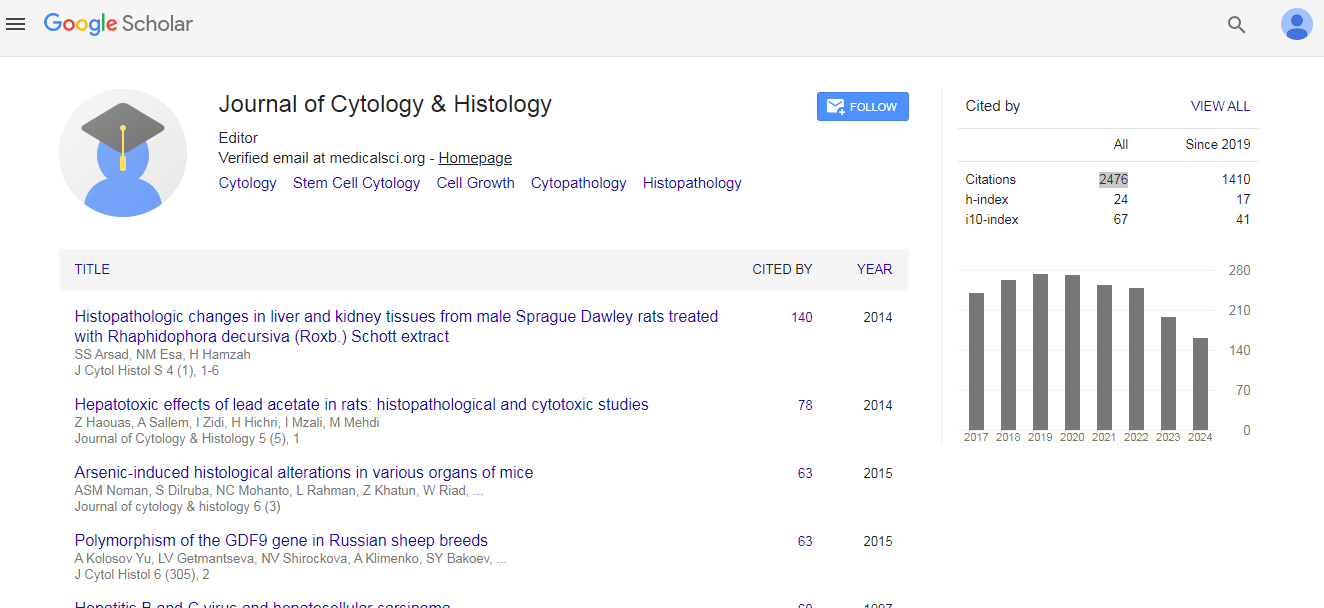
Journal of Cytology & Histology received 2476 citations as per Google Scholar report