Opinion - (2025) Volume 11, Issue 4
Received: 01-Aug-2025, Manuscript No. jctt-26-188417;
Editor assigned: 04-Aug-2025, Pre QC No. P-188417;
Reviewed: 18-Aug-2025, QC No. Q-188417;
Revised: 22-Aug-2025, Manuscript No. R-188417;
Published:
29-Aug-2025
, DOI: 10.37421/2471-9323.2024.10.335
Citation: Wei, Chen. ”Cosmetic Science: Skin, Hair, and Holistic Beauty Innovations.” J Cosmo Tricho 11 (2025):335.
Copyright: © 2025 Wei C. This is an open-access article distributed under the terms of the Creative Commons Attribution License, which permits unrestricted use, distribution and reproduction in any medium, provided the original author and source are credited.
The intricate connection between hair and skin health is a burgeoning area of research, with cosmetic ingredients playing a pivotal role in influencing both. Recent scientific endeavors have illuminated the scalp microbiome, revealing its critical involvement in hair growth disorders and offering new avenues for treatment [1].
Simultaneously, advancements in understanding skin barrier function have led to the development of novel, scientifically-backed formulations aimed at improving skin appearance and resilience [1].
The pursuit of youthful skin has long been a focus of cosmetic science, with ongoing investigations into the molecular mechanisms underlying skin aging. Antioxidants derived from natural sources are showing significant promise in mitigating oxidative stress, a primary factor in photoaging, thereby contributing to the preservation of skin's functional and aesthetic qualities [2].
Delivering active cosmetic ingredients effectively to the skin remains a significant challenge, prompting innovation in delivery systems. Technologies such as liposomes and nanoparticles are being critically examined for their potential to enhance the bioavailability and efficacy of active compounds, crucial for skin rejuvenation and therapeutic applications [3].
Understanding the fundamental biology of the hair follicle is essential for developing targeted hair care solutions. Research into specific signaling pathways, such as the Wnt/β-catenin pathway, is identifying potential targets for cosmetic interventions designed to stimulate hair regeneration and combat hair loss [4].
The impact of environmental pollution on skin health is a growing concern, with studies detailing the detrimental effects of particulate matter and UV radiation. This has spurred the development of cosmetic ingredients and formulations designed to provide protective benefits against these external aggressors [5].
The efficacy of specific peptides in stimulating collagen synthesis and improving skin elasticity is well-documented, providing a strong scientific basis for their incorporation into anti-aging cosmetic products [6].
These peptides act through defined biochemical pathways to enhance skin's structural integrity. Emerging research in epigenetics is shedding light on how external factors and lifestyle choices can influence gene expression related to hair characteristics, such as color and texture. This opens up possibilities for personalized hair care strategies that go beyond superficial treatment [7].
Ceramides, essential lipids naturally present in the skin, are vital for maintaining a healthy skin barrier. Formulations designed to replenish ceramide levels are proving effective in improving skin hydration and protecting against environmental damage, particularly for dry and sensitive skin types [8].
The ubiquitous presence of electronic devices necessitates an understanding of their impact on skin. Research investigating the damage caused by blue light, including oxidative stress and cellular degradation, highlights the need for protective ingredients in daily skincare routines [9].
Vitamin C derivatives are gaining attention for their multifaceted benefits in cosmetic applications. Their antioxidant properties and potential to enhance hair shaft integrity and scalp health make them valuable ingredients for improving hair shine and strength [10].
The relationship between hair and skin health is complex and deeply intertwined, with cosmetic ingredients playing a significant role in modulating these interactions. Pioneering research has recently shed light on the scalp microbiome, uncovering its critical influence on hair growth disorders and paving the way for innovative therapeutic approaches. Concurrently, significant strides have been made in deciphering the mechanisms that govern skin barrier function, leading to the creation of advanced formulations designed to enhance skin's appearance and resilience through scientific innovation [1].
In the realm of anti-aging cosmetics, investigations into the molecular underpinnings of skin aging are continuously advancing. Natural antioxidants, in particular, are demonstrating a remarkable capacity to counteract oxidative stress, a principal contributor to photoaging, thereby facilitating the preservation of skin's youthful characteristics and functional integrity [2].
The successful delivery of active cosmetic ingredients to their intended sites of action within the skin remains a key area of development. Advanced delivery systems, including liposomes and nanoparticles, are being rigorously studied for their ability to augment the bioavailability and therapeutic efficacy of cosmetic actives, which is crucial for achieving desirable outcomes in skin rejuvenation and treatment [3].
A foundational understanding of hair follicle biology is paramount for the development of efficacious hair care interventions. Current research is focusing on elucidating specific signaling pathways, such as the Wnt/β-catenin cascade, which are implicated in hair follicle development and regeneration, thereby identifying potential targets for stimulating hair growth and mitigating hair loss [4].
The pervasive issue of environmental pollution poses a significant threat to skin health, with scientific studies detailing the deleterious effects of pollutants like particulate matter and UV radiation on the skin's protective barrier and aging processes. This has consequently driven the innovation of cosmetic ingredients and formulations engineered to offer robust environmental defense [5].
The scientific validation of specific peptide functionalities in stimulating collagen production and enhancing skin elasticity provides a strong rationale for their inclusion in sophisticated anti-aging cosmetic products. These peptides operate via well-defined biochemical pathways to bolster the skin's structural support and firmness [6].
Exciting developments in the field of epigenetics are revealing how environmental exposures and lifestyle choices can exert influence over gene expression patterns that dictate hair characteristics, such as color and texture. This emergent understanding offers promising prospects for tailoring personalized hair care solutions [7].
Ceramides, a class of essential lipids inherently present in the stratum corneum, are indispensable for maintaining optimal skin barrier integrity. Topical formulations that aim to replenish ceramide levels are proving highly effective in improving skin hydration and fortifying the barrier against environmental insults, proving particularly beneficial for managing dry and sensitive skin conditions [8].
The pervasive use of digital devices necessitates a thorough understanding of their potential dermatological impact. Research focused on the detrimental effects of blue light, including its role in inducing oxidative stress and cellular damage, underscores the imperative for incorporating protective ingredients into daily skincare regimens [9].
Vitamin C derivatives are increasingly recognized for their diverse beneficial effects in cosmetic science. Their potent antioxidant capabilities and their potential to reinforce hair shaft integrity and promote scalp health make them highly valuable ingredients for enhancing hair's aesthetic appeal and overall well-being [10].
This collection of research highlights advancements in cosmetic science focusing on both skin and hair health. Studies explore the scalp microbiome's role in hair disorders, the use of natural antioxidants for anti-aging, and innovative delivery systems for active ingredients. Research also delves into hair follicle signaling pathways, the impact of environmental pollution on skin, and the benefits of peptides and ceramides for skin rejuvenation. Furthermore, the effects of blue light on skin aging and the applications of vitamin C derivatives in hair care are examined. A holistic approach to beauty, recognizing the interconnectedness of hair and skin, is emphasized.
None
None
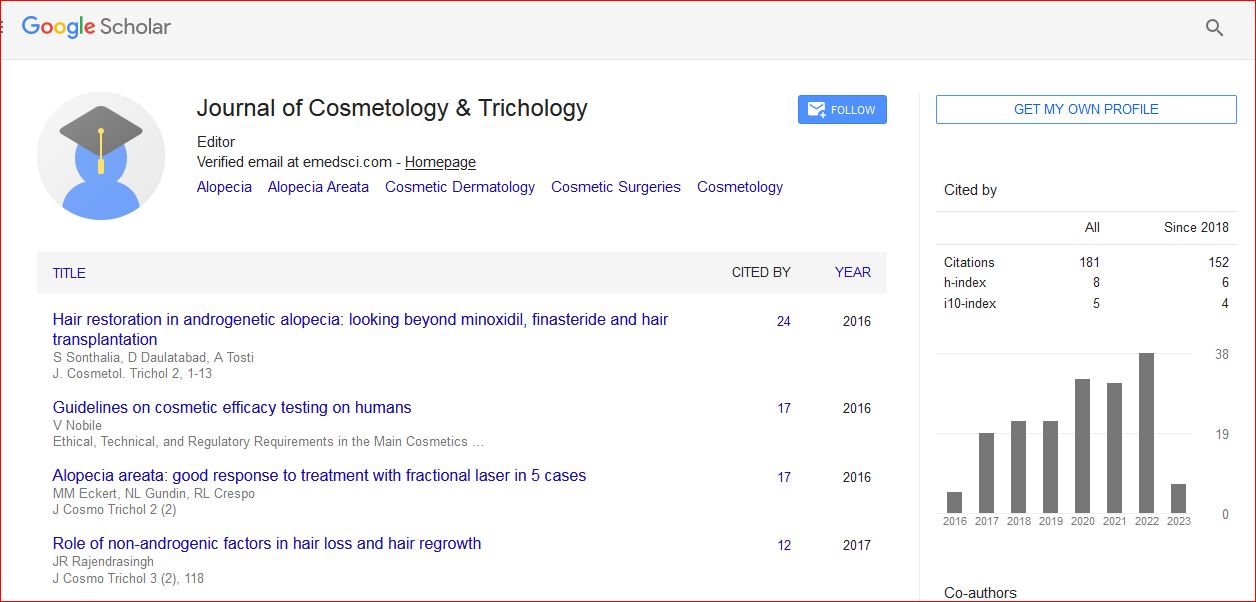
Journal of Cosmetology & Trichology received 180 citations as per Google Scholar report