Opinion - (2025) Volume 15, Issue 6
Received: 01-Nov-2025, Manuscript No. Jsmds-25-175851;
Editor assigned: 03-Nov-2025, Pre QC No. P-175851;
Reviewed: 17-Nov-2025, QC No. Q-175851;
Revised: 24-Nov-2025, Manuscript No. R-175851;
Published:
01-Dec-2025
, DOI: 10.37421/2161-0673.2025.15.459
Citation: Storm, Helena. "Comprehensive Lifestyle for Optimal Heart Health." J Sports Med Doping Stud 15 (2025):459.
Copyright: © 2025 Storm H. This is an open-access article distributed under the terms of the Creative Commons Attribution License, which permits unrestricted use, distribution
and reproduction in any medium, provided the original author and source are credited.
Cardiovascular disease (CVD) remains a leading global health concern, necessitating comprehensive prevention and management strategies. Emerging research consistently highlights the indispensable role of cardiorespiratory fitness (CRF) and regular physical activity in mitigating CVD risk and fostering overall cardiovascular health. This body of evidence underscores the notion that lifestyle choices are powerful determinants of long-term well-being. A clear inverse relationship exists between higher CRF levels and the prevalence of various cardiovascular disease risk factors, including hypertension, dyslipidemia, obesity, and type 2 diabetes [1].
What this really means is that a more fit heart and lung system directly correlates with a lower likelihood of developing these common conditions. Beyond risk factors, CRF acts as a powerful and independent predictor of both all-cause and cardiovascular disease mortality [3].
Even modest improvements in CRF can yield substantial reductions in health risks, often outweighing the impact of other traditional risk factors, emphasizing its central role in clinical practice and public health initiatives. The American Heart Association regularly reinforces the critical importance of physical activity. Updated scientific statements provide comprehensive recommendations for all age groups, stressing that even minimal physical activity offers health benefits, with greater gains achieved through increased intensity and duration [2].
This perspective encourages broader participation, removing the barrier of needing to achieve high-intensity workouts immediately. Exercise, here's the thing, isn't just a recommendation; it functions as a potent therapeutic intervention. It's akin to medicine for both preventing and managing CVD, operating through physiological mechanisms such as improved endothelial function, better blood pressure regulation, favorable lipid profiles, and enhanced glucose metabolism [4].
Tailored exercise prescriptions are becoming a fundamental component of CVD patient care, recognizing its profound physiological benefits. Specific training modalities also demonstrate significant efficacy. High-intensity interval training (HIIT), for instance, has been shown to effectively improve CRF and reduce several cardiovascular risk factors in adults diagnosed with metabolic syndrome [5].
This offers an efficient and potent exercise modality, particularly for at-risk populations. The ability to monitor physical activity and estimate CRF has also advanced with the expanding utility of wearable devices [6].
These tools promote self-monitoring, provide real-time feedback, and support interventions aimed at increasing activity levels, although limitations in accuracy and standardization still present avenues for future research. But physical activity isn't the only piece of the puzzle. Dietary patterns profoundly impact cardiovascular health. Heart-healthy diets, rich in fruits, vegetables, whole grains, lean proteins, and healthy fats, while limiting processed foods, sugary drinks, and excessive sodium, are foundational [7].
These nutritional guidelines support overall cardiovascular fitness and general well-being. Furthermore, let's break it down, prolonged sedentary behavior is independently linked to an increased risk of CVD risk factors in adults [8].
This holds true even for individuals who meet recommended physical activity guidelines, implying that excessive sitting time contributes to adverse outcomes like higher blood pressure, dyslipidemia, and impaired glucose metabolism. Reducing sedentary time is therefore as crucial as promoting regular exercise. Environmental factors also play a considerable role in shaping physical activity levels and, consequently, cardiovascular health. Aspects like walkability, access to green spaces, and urban design can either facilitate or hinder active lifestyles [9].
Creating supportive environments is thus critical for promoting population-level physical activity. Finally, an often-overlooked yet essential component is sleep quality. Insufficient or disrupted sleep intricately relates to the development and progression of various cardiovascular diseases by impacting blood pressure regulation, glucose metabolism, inflammation, and endothelial function [10].
Optimizing sleep is an integral part of a holistic approach to maintaining and improving cardiovascular fitness. In conclusion, the collective evidence underscores a multifaceted approach to cardiovascular health. It emphasizes not only structured exercise and high CRF but also dietary habits, reduced sedentary time, supportive environments, and adequate sleep. These elements, when addressed comprehensively, form the cornerstone of effective CVD prevention and health promotion.
The science behind cardiovascular health consistently points to cardiorespiratory fitness (CRF) and regular physical activity as paramount for preventing disease and promoting overall well-being. A strong body of evidence demonstrates a clear inverse relationship between higher CRF levels and a reduced risk of developing common cardiovascular conditions such as hypertension, dyslipidemia, obesity, and type 2 diabetes [1]. This isn't just about general health; improving CRF, even by small margins, can lead to significant reductions in health risks, often carrying more weight than some traditional risk factors. Moreover, CRF stands as an independent and powerful predictor of both all-cause and cardiovascular disease mortality [3]. These findings highlight why assessing and promoting CRF should be central to clinical practice and public health strategies.
Beyond general fitness, specific guidelines and interventions for physical activity are continuously updated to reflect the latest research. The American Heart Association, for example, frequently updates its scientific statements, reinforcing the critical role of regular physical activity for cardiovascular health. These guidelines provide comprehensive recommendations for adults and children alike, emphasizing that any amount of physical activity offers tangible benefits, with greater gains typically observed as intensity and duration increase [2]. This encourages a broad spectrum of engagement, making activity accessible to more people. What's more, exercise has earned its place as a potent therapeutic intervention, much like medicine, effectively preventing and managing cardiovascular disease. Its benefits stem from physiological improvements in endothelial function, blood pressure regulation, lipid profiles, and glucose metabolism [4]. This understanding advocates for the integration of tailored exercise prescriptions as a fundamental part of patient care.
Targeted exercise modalities also prove effective for specific populations. High-intensity interval training (HIIT), for instance, has demonstrated significant efficacy in improving CRF and reducing several cardiovascular risk factors among adults diagnosed with metabolic syndrome [5]. This provides an efficient and powerful exercise option for those at higher risk. The advancement of technology has further supported these efforts, with wearable devices increasingly utilized for tracking physical activity and estimating CRF [6]. These devices empower individuals through self-monitoring, offer real-time feedback, and support interventions aimed at increasing activity levels. While beneficial, it's worth noting that current limitations in accuracy and standardization suggest ongoing areas for research and development to fully integrate them into clinical applications.
The pursuit of optimal cardiovascular health extends beyond just physical activity and fitness; it encompasses a broader array of lifestyle factors. Dietary patterns play a foundational role, with updated scientific statements from the American Heart Association emphasizing the benefits of diets rich in fruits, vegetables, whole grains, lean protein, and healthy fats, while simultaneously limiting processed foods, sugary drinks, and excessive sodium [7]. These habits are crucial for supporting overall cardiovascular fitness. Additionally, prolonged sedentary behavior is now recognized as an independent risk factor for cardiovascular disease [8]. Even individuals who meet physical activity guidelines can face adverse health outcomes from excessive sitting time, including higher blood pressure, dyslipidemia, and impaired glucose metabolism. Therefore, reducing sedentary time is as important as engaging in regular exercise.
Furthermore, environmental influences and often-overlooked lifestyle elements significantly contribute to cardiovascular well-being. Environmental factors, such as urban design, walkability, and access to green spaces, can either facilitate or hinder active lifestyles [9]. Shaping supportive environments is crucial for promoting physical activity at a population level. Finally, the intricate relationship between sleep quality, sleep disorders, and cardiovascular health cannot be overstated. Insufficient or disrupted sleep contributes to cardiovascular disease progression by negatively impacting blood pressure regulation, glucose metabolism, inflammation, and endothelial function [10]. Optimizing sleep, therefore, becomes an essential, albeit frequently overlooked, component of a holistic approach to maintaining and improving cardiovascular fitness. Addressing these interconnected lifestyle and environmental factors collectively creates a robust strategy for cardiovascular health promotion.
Current research strongly emphasizes the profound impact of cardiorespiratory fitness (CRF) and physical activity on cardiovascular health. A clear inverse relationship exists between higher CRF levels and various cardiovascular disease (CVD) risk factors, including hypertension, dyslipidemia, obesity, and type 2 diabetes. This positions CRF as a critical, modifiable lifestyle factor for CVD prevention. Improving CRF, even modestly, can significantly reduce health risks, often more effectively than addressing some traditional risk factors. Regular physical activity is central to maintaining cardiovascular health. Recommendations for adults and children stress that any activity offers benefits, with greater gains from increased intensity and duration. Exercise acts as a potent therapeutic intervention, comparable to medicine, both in preventing and managing CVD by improving endothelial function, blood pressure, lipid profiles, and glucose metabolism. High-intensity interval training (HIIT), for instance, has shown effectiveness in improving CRF and reducing risk factors in individuals with metabolic syndrome. Beyond structured exercise, several other lifestyle components play vital roles. Heart-healthy dietary patterns, rich in fruits, vegetables, whole grains, and lean proteins, are foundational. Minimizing sedentary behavior is also critical, as excessive sitting independently contributes to adverse cardiovascular outcomes, even for active individuals. Environmental factors, such as walkability and access to green spaces, can significantly influence physical activity levels. Furthermore, optimizing sleep quality is an essential, often overlooked, aspect, given its intricate relationship with blood pressure, glucose metabolism, and inflammation. Wearable devices offer expanding utility in tracking activity and estimating CRF, supporting self-monitoring and interventions, though accuracy limitations exist. Collectively, these findings advocate for a comprehensive, multi-faceted approach to promote cardiovascular fitness and overall well-being.
None
None
Indexed at, Google Scholar, Crossref
Indexed at, Google Scholar, Crossref
Indexed at, Google Scholar, Crossref
Indexed at, Google Scholar, Crossref
Indexed at, Google Scholar, Crossref
Indexed at, Google Scholar, Crossref
Indexed at, Google Scholar, Crossref
Indexed at, Google Scholar, Crossref
Indexed at, Google Scholar, Crossref
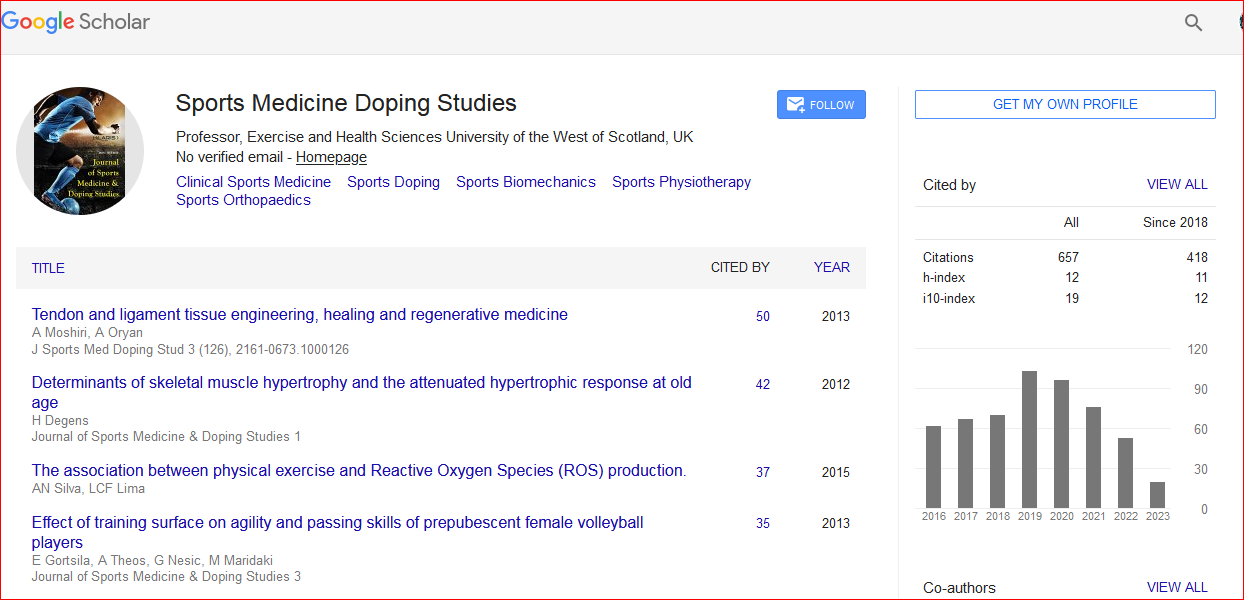
Journal of Sports Medicine & Doping Studies received 1022 citations as per Google Scholar report