Perspective - (2025) Volume 9, Issue 2
Received: 02-Apr-2025, Manuscript No. jgge-25-173727;
Editor assigned: 04-Apr-2025, Pre QC No. P-173727;
Reviewed: 18-Apr-2025, QC No. Q-173727;
Revised: 23-Apr-2025, Manuscript No. R-173727;
Published:
30-Apr-2025
, DOI: 10.37421/2684-4567.2025.9.164
Citation: Thompson, Emily J.. ”Comparative Genomics: Insights into Life, Disease.” J Genet Genom 09 (2025):164.
Copyright: © 2025 Thompson J. Emily This is an open-access article distributed under the terms of the Creative Commons Attribution License, which permits unrestricted use,
distribution and reproduction in any medium, provided the original author and source are credited.
This research provides a deep dive into the comparative genomics of SARS-CoV-2 and its close coronavirus relatives. The insights gained here are crucial for understanding the virus's origin, evolution, and mechanisms of host adaptation. We're talking about identifying unique genomic features that distinguish SARS-CoV-2, which is vital for developing targeted diagnostics and therapeutics. It's a foundational piece for our understanding of pandemic-level threats, offering critical perspectives on viral behavior and potential interventions. [1] Here's the thing, comparative genomics allows us to really map out the host adaptation and evolutionary journey of the Mycobacterium tuberculosis complex. This study uses that approach to uncover the genetic underpinnings of how this pathogen adapts to different hosts and environments. Understanding these dynamics is critical for battling tuberculosis, giving us clues for better control strategies and vaccine development. Such insights are essential for global health initiatives aimed at eradicating the disease. [2] What this really means is, by comparing human and primate genomes, we can pinpoint the distinct genetic changes that might have led to what we call 'humanness'. This investigation dives into those specific genomic differences, looking for answers to one of biology's biggest questions. It helps us appreciate the subtle yet profound genetic shifts that define our species, providing a deeper understanding of human evolutionary history. [3] This study leverages comparative genomics to scout for novel resistance genes in Mycobacterium tuberculosis. Finding new resistance mechanisms is a constant race against superbugs, and this approach is really effective. It's about staying ahead, identifying the genetic elements that allow the bacteria to evade current treatments, and paving the way for new drug development, which is crucial for combating rising antibiotic resistance. [4] This paper uses comparative genomics to map the evolutionary journey of human papillomaviruses (HPVs). It helps us understand how these viruses have diversified and adapted over time. Unpacking their genetic evolution is key to developing more effective vaccines and treatments for HPV-related diseases, including various cancers, thereby improving public health outcomes significantly. [5] Let's break it down: this study focuses on the comparative genomics of Mycoplasma pneumoniae, specifically looking at its multilocus sequence types. By comparing these genetic variants, researchers can gain a clearer picture of the pathogen's diversity, epidemiology, and how it spreads. This knowledge is important for tracking outbreaks and managing infections, contributing to more effective public health interventions. [6] This work uses comparative genomics to examine Methicillin-Resistant Staphylococcus aureus (MRSA) isolates from different regions of Iran. Understanding the regional genetic variations of MRSA helps track its spread and evolution. It's about mapping the genomic landscape of a dangerous superbug, which informs public health responses and helps develop more localized treatment strategies, making a significant impact on clinical practice. [7] This study delves into the functional characterization of antibiotic resistance genes in Klebsiella pneumoniae using comparative genomics. It's about identifying exactly which genes are giving this bacterium its resistance. Knowing this helps us understand the mechanisms of resistance better, which is essential for designing new antibiotics and fighting against multidrug-resistant infections, a pressing challenge in modern medicine. [8] Here's an interesting comparison: the genomics of the lab strain Escherichia coli K-12 versus its wild-type counterpart. This work highlights the genetic changes that occur during domestication, giving us insights into bacterial adaptation and evolution. It's a fundamental look at how a microbe's genome shifts when it moves from a natural environment to a controlled one, offering valuable lessons in microbial genetics. [9] This paper uses comparative genomics to dissect the pathogenicity and virulence of Vibrio parahaemolyticus. It's about understanding what makes this bacterium harmful, identifying the specific genes responsible for causing disease. These insights are incredibly valuable for food safety and public health, helping to prevent outbreaks and develop countermeasures against this pathogen, ensuring safer food supplies and protecting communities. [10]
The field of comparative genomics offers crucial insights into viral evolution and pathogenicity, informing public health strategies. This research provides a deep dive into the comparative genomics of SARS-CoV-2 and its close coronavirus relatives. The insights gained here are crucial for understanding the virus's origin, evolution, and mechanisms of host adaptation. We're talking about identifying unique genomic features that distinguish SARS-CoV-2, which is vital for developing targeted diagnostics and therapeutics. It's a foundational piece for our understanding of pandemic-level threats, providing critical context for global health preparedness [1]. Similarly, comparative genomics helps map the evolutionary journey of human papillomaviruses (HPVs). It aids in understanding how these viruses have diversified and adapted over time. Unpacking their genetic evolution is key to developing more effective vaccines and treatments for HPV-related diseases, including various cancers, thereby improving patient outcomes and preventative measures [5].
Comparative genomics plays a significant role in understanding the complex pathogen Mycobacterium tuberculosis. Here's the thing, this approach allows us to really map out the host adaptation and evolutionary journey of the Mycobacterium tuberculosis complex. This study uses that approach to uncover the genetic underpinnings of how this pathogen adapts to different hosts and environments. Understanding these dynamics is critical for battling tuberculosis, giving us clues for better control strategies and vaccine development, which are essential for global eradication efforts [2]. Furthermore, comparative genomics is leveraged to scout for novel resistance genes in Mycobacterium tuberculosis. Finding new resistance mechanisms is a constant race against superbugs, and this approach is really effective. It's about staying ahead, identifying the genetic elements that allow the bacteria to evade current treatments, and paving the way for new drug development to combat emerging drug resistance [4].
What this really means is, comparative genomics is indispensable in the ongoing battle against antibiotic-resistant bacteria, a major public health crisis. This work examines Methicillin-Resistant Staphylococcus aureus (MRSA) isolates from different regions of Iran. Understanding the regional genetic variations of MRSA helps track its spread and evolution. It's about mapping the genomic landscape of a dangerous superbug, which informs public health responses and helps develop more localized treatment strategies to mitigate its impact [7]. In a similar vein, this study delves into the functional characterization of antibiotic resistance genes in Klebsiella pneumoniae using comparative genomics. It's about identifying exactly which genes are giving this bacterium its resistance. Knowing this helps us understand the mechanisms of resistance better, which is essential for designing new antibiotics and fighting against multidrug-resistant infections, thereby preserving treatment options [8].
Other bacterial pathogens also benefit greatly from comparative genomic studies, offering insights into their epidemiology and virulence. Let's break it down: this study focuses on the comparative genomics of Mycoplasma pneumoniae, specifically looking at its multilocus sequence types. By comparing these genetic variants, researchers can gain a clearer picture of the pathogen's diversity, epidemiology, and how it spreads. This knowledge is important for tracking outbreaks and managing infections effectively within communities [6]. Additionally, this paper uses comparative genomics to dissect the pathogenicity and virulence of Vibrio parahaemolyticus. It's about understanding what makes this bacterium harmful, identifying the specific genes responsible for causing disease. These insights are incredibly valuable for food safety and public health, helping to prevent outbreaks and develop countermeasures against this pathogen, safeguarding public well-being [10]. Here's an interesting comparison: the genomics of the lab strain Escherichia coli K-12 versus its wild-type counterpart. This work highlights the genetic changes that occur during domestication, giving us insights into bacterial adaptation and evolution. It's a fundamental look at how a microbe's genome shifts when it moves from a natural environment to a controlled one, illuminating principles of microbial genetics [9].
Beyond the realm of pathogens, comparative genomics extends to understanding our own species and evolutionary history. By comparing human and primate genomes, we can pinpoint the distinct genetic changes that might have led to what we call 'humanness'. This investigation dives into those specific genomic differences, looking for answers to one of biology's biggest questions. It helps us appreciate the subtle yet profound genetic shifts that define our species, offering a deeper perspective on human identity and our place in the tree of life [3].
Comparative genomics is a powerful approach that helps us understand various biological phenomena, from viral evolution to bacterial adaptation and even what makes humans unique. Researchers use this method to analyze the genetic makeup of different organisms, revealing key insights into their origins, evolution, and interactions with hosts or environments. For instance, comparative studies shed light on SARS-CoV-2's unique genomic features, which is vital for developing diagnostics and treatments for pandemic threats. Similarly, by mapping the evolutionary journey of Mycobacterium tuberculosis, we uncover genetic underpinnings of host adaptation, crucial for better tuberculosis control and vaccine development. This approach also pinpoints distinct genetic changes between human and primate genomes, exploring fundamental questions about human identity. Moreover, comparative genomics is indispensable in the fight against antibiotic resistance, helping identify novel resistance genes in pathogens like Mycobacterium tuberculosis, Klebsiella pneumoniae, and Methicillin-Resistant Staphylococcus aureus (MRSA). It further aids in tracking the diversity and spread of pathogens such as Mycoplasma pneumoniae and Vibrio parahaemolyticus by dissecting their virulence mechanisms. These genomic comparisons extend to understanding viral evolution in human papillomaviruses (HPVs) and even genetic shifts in domesticated bacterial strains like Escherichia coli K-12. Overall, comparative genomics is a foundational tool, driving advancements in public health, disease management, and our understanding of life itself.
None
None
1. Rui-Fan L, Xin Z, Jie L. "Comparative genomics of SARS-CoV-2 and related coronaviruses: what have we learned?".Emerg Microbes Infect 9 (2020):978-989.
Indexed at, Google Scholar, Crossref
2. Anastasios GT, Christos B, Aikaterini K. "Comparative genomics reveals host adaptation and evolutionary dynamics of Mycobacterium tuberculosis complex".Front Microbiol 14 (2023):1124675.
Indexed at, Google Scholar, Crossref
3. Darlene O, Yuri G, Juhi P. "Comparative Genomics for Discerning Differences in Human and Primate Genomes: What Makes Us Human?".Curr Genomics 21 (2020):519-532.
Indexed at, Google Scholar, Crossref
4. Muthukrishnan S, Karthick G, Brinda P. "Comparative genomics for identifying novel resistance genes in Mycobacterium tuberculosis".Int J Mycobacteriol 9 (2020):348-353.
Indexed at, Google Scholar, Crossref
5. Hongling M, Qianqian S, Yun S. "Comparative genomics reveals the evolutionary landscape of human papillomaviruses".Cell Death Discov 8 (2022):425.
Indexed at, Google Scholar, Crossref
6. Lidan X, Bin Z, Bin X. "Comparative Genomics of the Multilocus Sequence Types of Mycoplasma pneumoniae".Front Cell Infect Microbiol 12 (2022):839082.
Indexed at, Google Scholar, Crossref
7. Mahtab Z, Amir B, Mahdi K. "Comparative Genomics of Methicillin-Resistant Staphylococcus aureus Isolates From Different Regions of Iran".Front Cell Infect Microbiol 12 (2022):968953.
Indexed at, Google Scholar, Crossref
8. Yiming Z, Chunya M, Dongmei W. "Comparative genomics and functional characterization of antibiotic resistance genes in Klebsiella pneumoniae".Front Cell Infect Microbiol 13 (2023):1135231.
Indexed at, Google Scholar, Crossref
9. Chengxin D, Shanshan S, Bin Z. "Comparative Genomics of the Escherichia coli Strain K-12 and Its Wild-Type Counterpart".Front Microbiol 12 (2021):714798.
Indexed at, Google Scholar, Crossref
10. Jesus V, Elva C, Jose MM. "Comparative Genomics to Study Pathogenicity and Virulence in Vibrio parahaemolyticus".Pathogens 9 (2020):716.
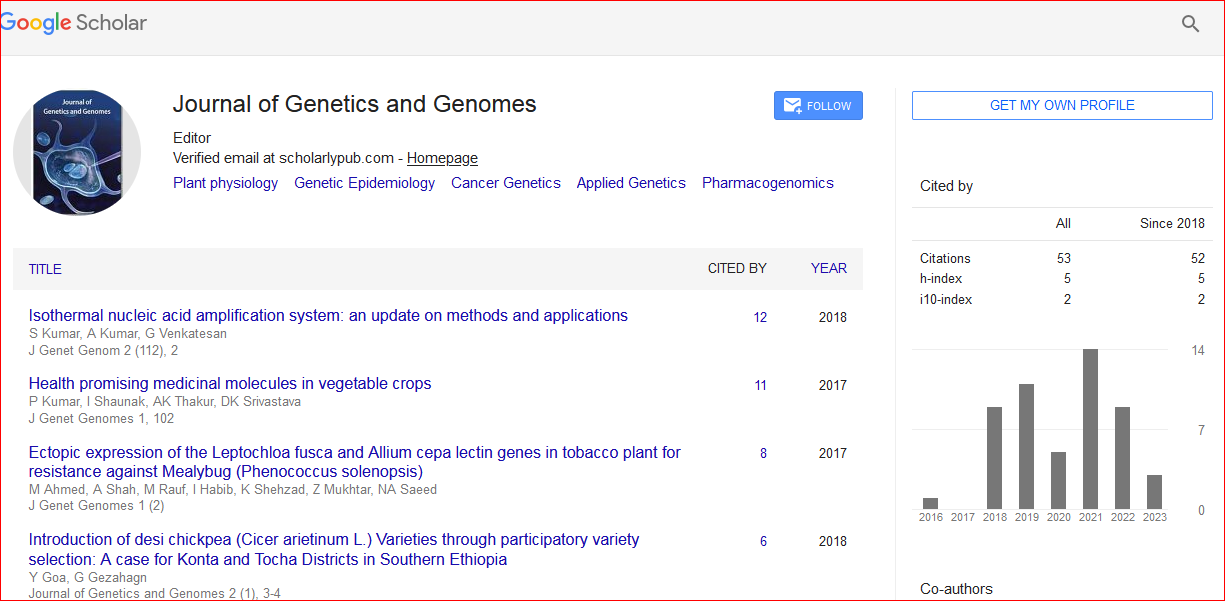
Journal of Genetics and Genomes received 65 citations as per Google Scholar report