Short Communication - (2025) Volume 16, Issue 5
Received: 01-Sep-2025, Manuscript No. bej-26-182531;
Editor assigned: 03-Sep-2025, Pre QC No. P-182531;
Reviewed: 17-Sep-2025, QC No. Q-182531;
Revised: 22-Sep-2025, Manuscript No. R-182531;
Published:
29-Sep-2025
, DOI: 10.37421/2161-6219.2025.16.580
Citation: Rashid, Samiha. ”Business’s Role In Economic Growth
And Society.” Bus Econ J 16 (2025):580.
Copyright: © 2025 Rashid S. This is an open-access article distributed under the terms of the Creative Commons Attribution License, which permits unrestricted use,
distribution and reproduction in any medium, provided the original author and source are credited.
Businesses are the fundamental pillars of market economies, serving as the primary engines for innovation, job creation, and the efficient allocation of resources. Their inherent drive for profit compels them to actively respond to the evolving demands of consumers, thereby fostering a dynamic and responsive marketplace. This engagement extends beyond mere economic transactions to encompass corporate social responsibility, wherein businesses can make substantial positive contributions to societal development, moving beyond purely economic indicators to cultivate a more sustainable and equitable economic landscape [1].
The trajectory of market economies is inextricably intertwined with the continuous evolution of business practices. As businesses adeptly adapt to shifting market conditions and embrace technological advancements, they inherently reshape the very structures of the economy. This transformation is exemplified by the burgeoning significance of digital platforms and the rise of the gig economy, which are fundamentally altering traditional employment paradigms and consumption behaviors, presenting a complex array of both opportunities and challenges for economic policy formulation and implementation [2].
Small and medium-sized enterprises (SMEs) occupy a critically important position in maintaining the vibrancy and resilience of market economies. They are consistently recognized as significant contributors to job creation and play a pivotal role in stimulating local economic development initiatives. Their inherent capacity for innovation and their agility in catering to specific niche markets contribute substantially to a diversified economic base, thereby enhancing the overall resilience of economies when faced with external shocks and volatilities. Consequently, the implementation of policies specifically designed to support SMEs is deemed vital for achieving sustained and robust economic growth [3].
Robust corporate governance mechanisms are indispensable for ensuring that businesses operate in a manner that not only benefits shareholders but also extends positive impacts to other stakeholders and society at large. The establishment of effective governance frameworks promotes essential principles of transparency, accountability, and ethical conduct, all of which are critical for building and maintaining public trust and for ensuring the long-term sustainability of market economies. Conversely, the presence of weak governance structures can significantly contribute to market failures and engender economic instability [4].
Innovation, which is frequently propelled by substantial business investments in research and development (R&D) initiatives, stands as a primary catalyst for economic progress within market economies. Businesses that proactively invest in the adoption of new technologies and the refinement of existing processes are able to cultivate distinct competitive advantages, significantly boost overall productivity, and successfully introduce novel goods and services to the market. This iterative cycle of innovation and competition ultimately fuels economic dynamism and drives progress forward [5].
The pervasive force of globalization has profoundly reshaped the multifaceted role of businesses within the complex ecosystem of market economies. Multinational corporations (MNCs) now operate with a global reach, extending their influence across national borders and significantly impacting international trade patterns, global investment flows, and the diffusion of technological innovations. While this global integration presents numerous opportunities for economic growth and development, it also necessitates a careful and deliberate consideration of critical issues such as labor standards, environmental sustainability, and the complexities of regulatory coordination on an international scale [6].
The financial sector, encompassing a diverse array of businesses such as banks, investment firms, and insurance companies, plays an absolutely critical role in the effective functioning and stability of market economies. It is instrumental in facilitating capital formation, adeptly managing financial risks, and efficiently enabling a wide spectrum of economic transactions. The overall health and stability of these financial businesses directly influence the availability of credit for other enterprises and individual consumers, thereby exerting a significant impact on overall economic activity and future growth prospects [7].
Increasingly, ethical considerations and a strong commitment to corporate social responsibility (CSR) are becoming integral components of the role that businesses play in contemporary market economies. Both consumers and investors are actively expecting businesses to operate with a heightened sense of environmental and social consciousness, contributing positively and constructively to the broader fabric of society. The genuine embrace of CSR principles can lead to a tangible enhancement of brand reputation, attract and retain top talent, and foster the long-term viability and resilience of businesses, effectively aligning economic objectives with the pursuit of social well-being [8].
The overarching regulatory environment plays a crucial and formative role in shaping the operational landscape and strategic direction of businesses operating within market economies. While government regulations are sometimes perceived as impediments, they are nonetheless essential for maintaining fair and equitable competition, providing robust protection for consumers and the environment, and effectively preventing various forms of market failures. Businesses are required to navigate this intricate web of regulations, and their proactive engagement with policymakers can significantly influence the development of more effective, efficient, and responsive market frameworks [9].
Entrepreneurship is undeniably a cornerstone of dynamic and thriving market economies, with new ventures frequently introducing groundbreaking innovations and actively challenging the established dominance of incumbent firms. Entrepreneurs possess the critical ability to identify emerging market opportunities, effectively mobilize necessary resources, and courageously undertake significant risks. In doing so, they serve as powerful drivers of economic growth and are instrumental in the creation of new employment opportunities. Therefore, providing robust support for entrepreneurial activities emerges as a key policy priority for fostering sustained economic development [10].
Businesses are intrinsically fundamental to the very existence and operation of market economies, serving as the primary architects of innovation, the principal creators of employment opportunities, and the most efficient facilitators of resource allocation. Their relentless pursuit of profit acts as a powerful incentive, compelling them to be highly responsive to the ever-changing demands and preferences of consumers, which in turn cultivates a vibrant and dynamic marketplace. This deep engagement extends beyond the purely economic realm to encompass the crucial domain of corporate social responsibility, where businesses possess the capacity to exert a profoundly positive influence on societal development, moving far beyond simple economic metrics to foster a more sustainable and equitable economic future for all [1].
The continuous development and maturation of market economies are intrinsically linked to the ongoing evolution of business methodologies and practices. As businesses demonstrate an increasing capacity to adapt to the fluctuating conditions of the market and to embrace and integrate technological advancements, they inevitably reshape the underlying economic structures. This evolution is particularly evident in the growing prominence of digital platforms and the expansion of the gig economy, both of which are actively transforming conventional employment models and consumption patterns, thereby introducing a complex interplay of opportunities and challenges that demand careful consideration from economic policymakers [2].
Small and medium-sized enterprises (SMEs) are recognized as vital contributors to the overall vitality and robustness of market economies. They are a consistent and significant source of new job creation and actively promote and sustain local economic development initiatives. Their inherent capability for innovation and their particular skill in adapting to and serving niche markets contribute significantly to a diversified economic foundation, thereby enhancing the resilience of economies against unforeseen external shocks. Consequently, the implementation of well-designed policies that specifically support SMEs is essential for achieving sustained and meaningful economic growth [3].
Effective corporate governance mechanisms are absolutely essential for ensuring that businesses operate in a manner that is beneficial not only to their shareholders but also to a broader spectrum of stakeholders and to society as a whole. The establishment of strong governance promotes critical values of transparency, accountability, and ethical conduct, which are indispensable for building and maintaining trust and for securing the long-term viability of market economies. Conversely, deficiencies in corporate governance can lead to detrimental market failures and contribute to economic instability [4].
Innovation, frequently stimulated by substantial business investments directed towards research and development (R&D), serves as a principal driver of economic progress within the framework of market economies. Businesses that make strategic investments in new technologies and improved processes are able to establish and maintain competitive advantages, significantly enhance productivity levels, and introduce novel products and services to the market, ultimately leading to improved living standards. This continuous and iterative process of innovation and competition is what powerfully fuels economic dynamism [5].
Globalisation has been a transformative force, significantly altering the fundamental role that businesses play in the complex landscape of market economies. Multinational corporations (MNCs) now routinely operate across national borders, exerting considerable influence on international trade patterns, global investment flows, and the widespread diffusion of technology. While this global integration presents substantial opportunities for economic advancement and development, it simultaneously mandates a thoughtful and careful consideration of critical issues such as labor standards, the environmental impact of operations, and the necessity for coordinated regulatory approaches on an international level [6].
The financial sector, which comprises a diverse range of businesses including banks, investment firms, and insurance providers, is of paramount importance for the smooth functioning and overall stability of market economies. It plays a crucial role in facilitating the accumulation of capital, effectively managing financial risks, and enabling a vast array of economic transactions. The intrinsic health and stability of financial businesses have a direct and profound impact on the accessibility of credit for other enterprises and for consumers, thereby influencing the trajectory of overall economic activity and its future growth prospects [7].
Ethical considerations and a dedicated commitment to corporate social responsibility (CSR) are increasingly becoming fundamental aspects of the role that businesses fulfill within contemporary market economies. Both consumers and investors are increasingly expecting businesses to conduct their operations in a sustainable manner and to actively contribute positively to the well-being of society. The strategic adoption of CSR principles can lead to a significant enhancement of brand reputation, attract and retain highly skilled talent, and foster the long-term viability and success of businesses, thereby creating a synergistic alignment between economic objectives and societal welfare [8].
The regulatory framework established by governments plays a significant role in shaping how businesses operate and interact within market economies. While regulations may sometimes be viewed as burdensome, they are essential for ensuring fair competition, protecting consumers and the environment, and preventing market failures. Businesses must navigate this complex regulatory landscape, and their engagement with regulatory bodies can influence the development of more effective and efficient market structures [9].
Entrepreneurship stands as a fundamental element of dynamic market economies, with new businesses frequently spearheading disruptive innovations and challenging the dominance of established companies. Entrepreneurs possess the crucial ability to identify market opportunities, effectively gather and deploy resources, and take on considerable risks. By doing so, they are instrumental in driving economic growth and generating employment. Consequently, providing support for entrepreneurial ventures is a key policy objective for fostering economic development [10].
Businesses are central to market economies, driving innovation, creating jobs, and allocating resources. Their profit motive ensures responsiveness to consumer demands, fostering a dynamic marketplace, while corporate social responsibility contributes to societal development. The evolution of business practices, particularly digital transformation and the gig economy, reshapes economic structures. Small and medium-sized enterprises (SMEs) are vital for job creation and local development, contributing to economic resilience. Effective corporate governance is crucial for transparency, accountability, and long-term sustainability, preventing market failures. Innovation, fueled by business investment, is a key economic progress driver. Globalization has expanded the reach of businesses, impacting trade and investment, necessitating attention to labor and environmental standards. The financial sector is critical for capital formation and risk management, influencing overall economic activity. Ethical considerations and CSR are increasingly important, enhancing brand reputation and aligning economic goals with social well-being. Regulation ensures fair competition and protects stakeholders, while entrepreneurship drives growth through innovation and risk-taking.
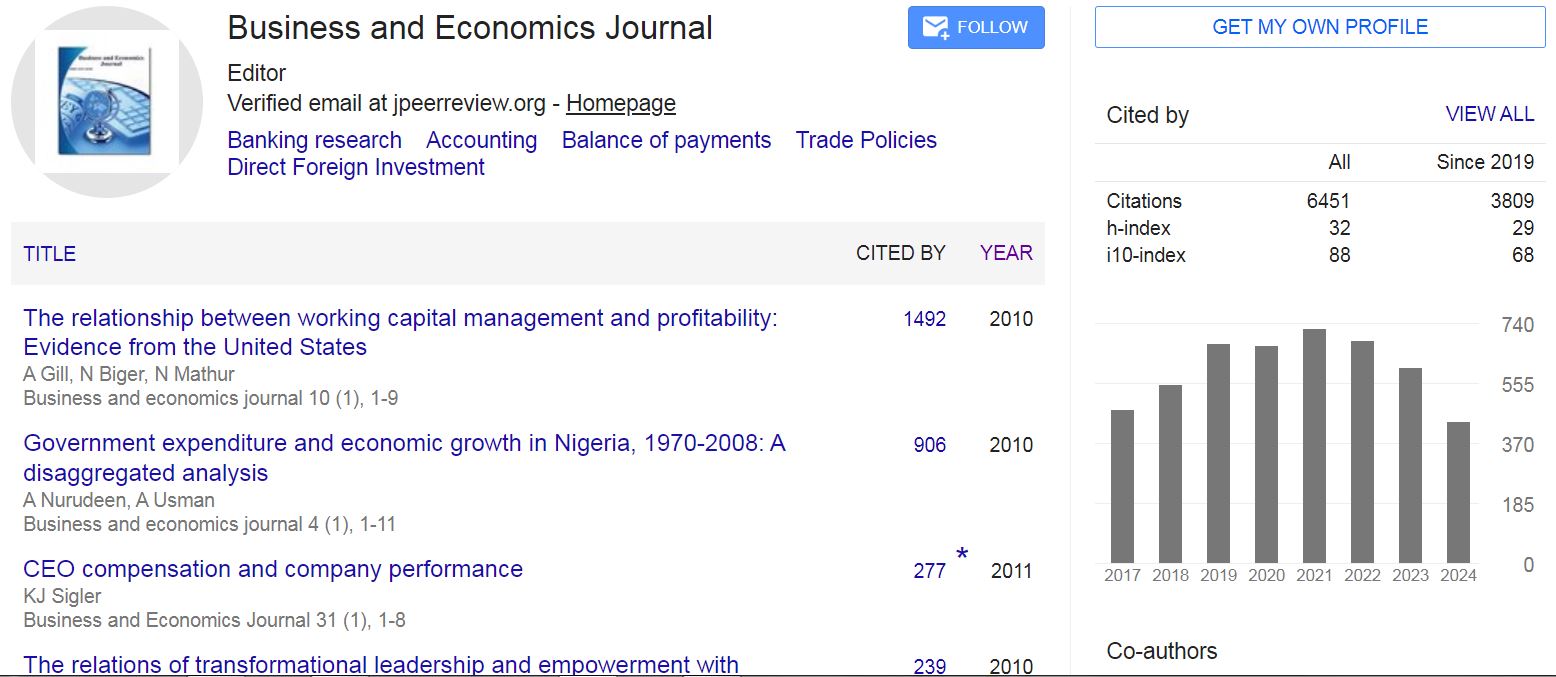
Business and Economics Journal received 6451 citations as per Google Scholar report