Brief Report - (2025) Volume 16, Issue 3
Received: 01-May-2025, Manuscript No. bej-26-182415;
Editor assigned: 05-May-2025, Pre QC No. P-182415;
Reviewed: 19-May-2025, QC No. Q-182415;
Revised: 22-May-2025, Manuscript No. R-182415;
Published:
29-May-2025
, DOI: 10.37421/2161-6219.2025.16.553
Citation: Ferrara, Lorenzo. "Businesses: Engines of Economic
Development and Innovation." Bus Econ J 16 (2025):553.
Copyright: © 2025 Ferrara L. This is an open-access article distributed under the terms of the Creative Commons Attribution License, which permits unrestricted use,
distribution and reproduction in any medium, provided the original author and source are credited.
Business enterprises are undeniably fundamental pillars supporting the architecture of economic development across the globe. They serve as primary engines for innovation, meticulously crafting new products, services, and processes that drive progress and enhance quality of life. Their proactive engagement in job creation offers avenues for individual livelihood and contributes significantly to the overall prosperity of nations. Through their contributions to national income via taxation and strategic investments, businesses play a direct role in public welfare and infrastructure development. They are instrumental in the efficient distribution of resources, ensuring that capital and labor are channeled to their most productive uses within the economy. By fostering a competitive market environment, businesses encourage efficiency, lower prices for consumers, and stimulate continuous improvement across industries. The introduction of novel goods and services by enterprises directly addresses evolving consumer needs and aspirations, thereby elevating living standards. Their inherent adaptability to dynamic market conditions allows them to navigate challenges and capitalize on emerging opportunities, ensuring sustained economic vitality. Crucially, their commitment to research and development fuels long-term economic growth by pushing the boundaries of knowledge and technological advancement. This multifaceted engagement underscores the indispensable role of business enterprises in shaping a robust and dynamic economic landscape [1].
Entrepreneurship, as a vital function within the broader spectrum of business enterprises, represents a potent force for economic advancement and job creation. These new ventures often introduce disruptive innovations, challenging established norms and ushering in periods of increased productivity and efficiency. Supportive governmental policies and an enabling ecosystem can significantly amplify the positive economic impacts generated by entrepreneurial activities. The capacity of entrepreneurs to identify unmet needs and develop novel solutions is a key driver of economic dynamism and sectoral transformation [2].
Corporate social responsibility (CSR) initiatives, while often perceived as voluntary, are increasingly recognized as integral to sustainable economic development. Businesses that invest in environmental stewardship and community well-being not only build stronger brand reputations but also foster long-term economic stability. Ethical labor practices and contributions to social development create a positive feedback loop, enhancing societal welfare and economic resilience. This commitment to responsible business conduct can lead to a virtuous cycle where societal progress and economic growth are mutually reinforcing [3].
Foreign direct investment (FDI), often facilitated by multinational enterprises, is a critical conduit for the transfer of essential resources, including capital, advanced technology, and managerial acumen. This influx of external capital and expertise can catalyze the growth of domestic industries, enhance their competitiveness on a global scale. Furthermore, FDI has the potential to create higher-value employment opportunities, upskilling the local workforce and improving overall economic productivity. The strategic involvement of multinational corporations in emerging markets is a key factor in their economic integration and development trajectories [4].
Innovation stands as a paramount driver of economic progress, and business enterprises are at its forefront through dedicated investment in research and development (R&D). This investment directly translates into the creation of new goods, services, and more efficient processes, which in turn boost productivity and open up novel market avenues. A supportive ecosystem that encourages and facilitates innovation is absolutely crucial for businesses to not only survive but to maximize their contributions to the economy. By embracing innovation, businesses can achieve competitive advantages and foster sustained economic expansion [5].
The financial sector, comprising a diverse array of business enterprises, is a cornerstone of economic development, acting as the vital intermediary between those with surplus capital and those seeking investment. Efficient financial markets are essential for the formation of capital, enabling businesses to access the funding necessary for expansion, innovation, and operational growth. Effective risk management within the financial sector also underpins economic stability, providing a secure environment for investment and economic activity. This intermediation role is fundamental to stimulating broad-based economic activity and facilitating investment flows [6].
Small and medium-sized enterprises (SMEs) play a disproportionately significant role in job creation and the diversification of economies, often outperforming larger corporations in their adaptability. Their agility allows SMEs to respond swiftly to market fluctuations and cater to specialized consumer demands, fostering a more dynamic and resilient economic landscape. Implementing supportive policies that encourage the growth and sustainability of SMEs is paramount for achieving inclusive economic development and widespread prosperity. These enterprises are the backbone of many local economies, driving employment and innovation from the ground up [7].
The development and maintenance of robust infrastructure, frequently a collaborative effort involving large business enterprises, are foundational to enabling and sustaining economic activity. Well-developed transportation, communication, and energy networks serve to significantly reduce the operational costs for businesses, making them more attractive to investors. This improved infrastructure facilitates the seamless movement of goods, services, and people, which is critical for efficient supply chains and market access. Robust infrastructure is thus an indispensable prerequisite for economic growth and global competitiveness [8].
Globalization has dramatically amplified the influence and reach of business enterprises in driving economic development through enhanced international trade, cross-border investment, and the rapid diffusion of knowledge and best practices. Multinational corporations, in particular, leverage intricate global value chains to optimize efficiency and introduce a wide array of products and services to diverse international markets. This global engagement contributes significantly to economic integration on a worldwide scale, fostering interconnectedness and shared growth. The strategic participation in global markets is a hallmark of modern economic development [9].
The ongoing digital transformation, predominantly spearheaded by technology-focused business enterprises, is fundamentally reshaping contemporary economies and business operations. Innovations such as e-commerce, digital platforms, and advanced data analytics are instrumental in enhancing operational efficiency, expanding market access, and enabling highly personalized customer experiences. This digital revolution unlocks new pathways for economic expansion and continuous innovation. Adapting to and actively fostering this digital shift is therefore not merely beneficial but absolutely essential for both individual businesses and entire economies to thrive in the modern era [10].
Business enterprises serve as the primary catalysts for economic development, initiating and sustaining growth through multifaceted contributions. Their role in fostering innovation is paramount, leading to the creation of novel products and services that enhance societal well-being and economic dynamism [1].
Entrepreneurship, an intrinsic characteristic of business enterprises, acts as a significant generator of employment and economic vibrancy. New ventures often disrupt established markets with innovative ideas, leading to improved productivity and efficiency across various sectors [2].
Corporate social responsibility (CSR) initiatives by businesses are increasingly recognized for their contribution to sustainable economic development. Investments in environmental protection and community well-being foster long-term economic stability and enhance societal welfare [3].
Foreign direct investment (FDI), facilitated by multinational enterprises, plays a crucial role in transferring vital resources such as capital, technology, and expertise. This infusion of resources stimulates local economies, boosts competitiveness, and creates employment opportunities with higher value [4].
Innovation, driven by business investment in research and development (R&D), is a key engine for economic progress. It leads to the development of new goods, services, and processes that enhance productivity and open new markets [5].
The financial sector, composed of various business enterprises, is fundamental to economic development by connecting savers and investors. Efficient financial markets enable businesses to secure funding for expansion and innovation, thereby stimulating economic activity [6].
Small and medium-sized enterprises (SMEs) are vital for job creation and economic diversification, often demonstrating greater agility than larger corporations. Supportive policies for SME growth are essential for fostering inclusive economic development [7].
The development of robust infrastructure, often undertaken by large business enterprises, is foundational for economic activity. Efficient infrastructure networks reduce business costs, attract investment, and facilitate the movement of goods and people [8].
Globalization has amplified the role of business enterprises through increased trade, investment, and knowledge diffusion. Multinational corporations contribute to global economic integration by leveraging global value chains [9].
The digital transformation, led by technology-focused business enterprises, is fundamentally reshaping economies. E-commerce and digital platforms create new avenues for economic growth and innovation, requiring adaptation for businesses and economies alike [10].
Business enterprises are central to economic development, driving innovation, job creation, and national income. They facilitate efficient resource allocation, promote competition, and introduce new products and services that improve living standards. Entrepreneurship, as a key function, fuels job growth and economic dynamism through disruptive innovations. Corporate social responsibility contributes to sustainable economic growth by focusing on environmental and social well-being. Foreign direct investment, facilitated by multinational corporations, brings capital, technology, and expertise, boosting local economies. Innovation and investment in R&D are crucial for economic progress, leading to new products and enhanced productivity. The financial sector, through its intermediation role, enables capital formation and facilitates business expansion. Small and medium-sized enterprises (SMEs) are significant contributors to job creation and economic diversification due to their adaptability. Robust infrastructure development by businesses is foundational for economic activity, reducing costs and attracting investment. Globalization amplifies the role of businesses through trade and investment, fostering global economic integration. Finally, digital transformation driven by technology enterprises is reshaping economies, creating new opportunities for growth and innovation.
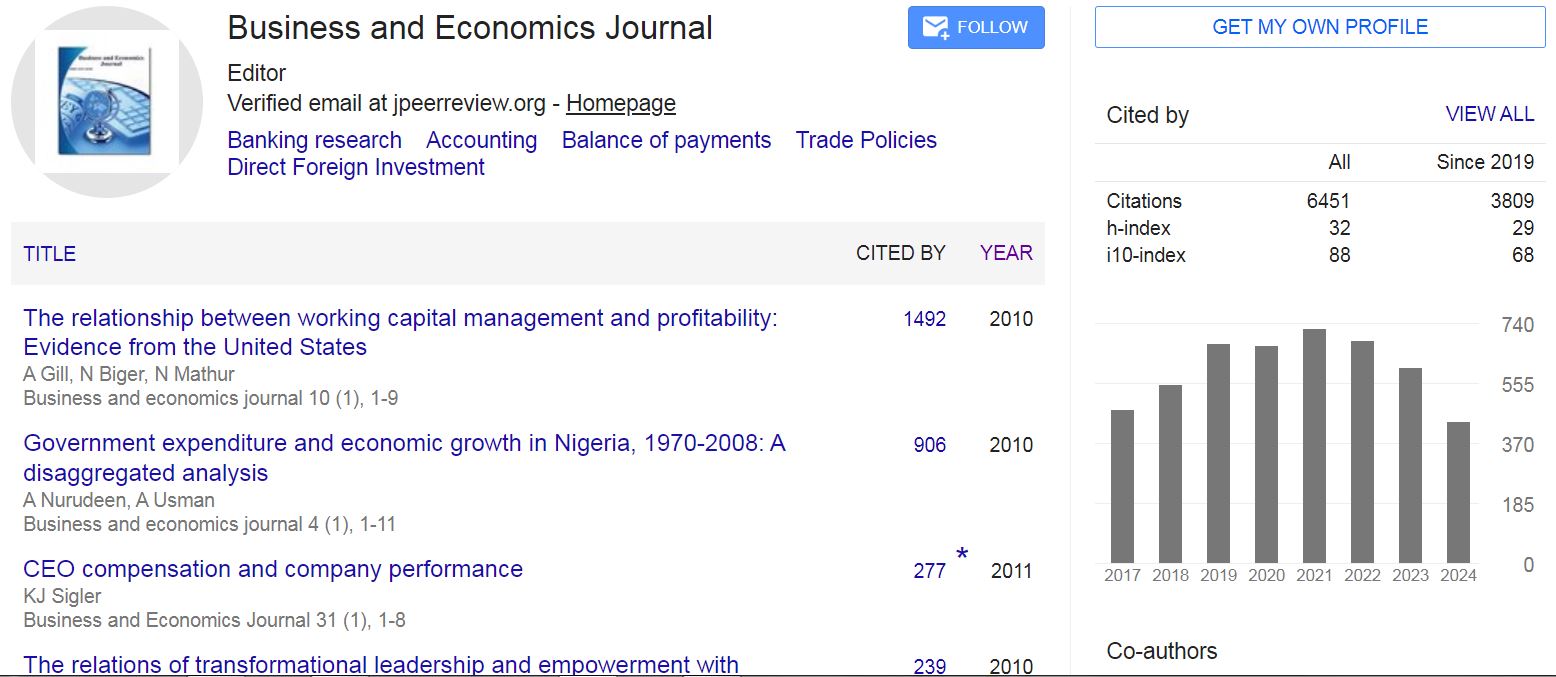
Business and Economics Journal received 6451 citations as per Google Scholar report