Brief Report - (2025) Volume 16, Issue 3
Received: 02-Jun-2025, Manuscript No. jbsbe-26-183297;
Editor assigned: 04-Jun-2025, Pre QC No. P-183297;
Reviewed: 18-Jun-2025, QC No. Q-183297;
Revised: 23-Jun-2025, Manuscript No. R-183297;
Published:
30-Jun-2025
, DOI: 10.37421/2165-6210.2025.16.503
Citation: Chen, Mei-Ling. ”Biosensors Revolutionize Early Cancer Detection, Enhancing Outcomes.” J Biosens Bioelectron 16 (2025):503.
Copyright: © 2025 Chen M. This is an open-access article distributed under the terms of the Creative Commons Attribution License, which permits unrestricted use, distribution and reproduction in any medium, provided the original author and source are credited.
Biosensors represent a revolutionary frontier in the ongoing battle against cancer, offering unparalleled potential for early detection and improved patient outcomes. These sophisticated devices are engineered to identify specific biomarkers that indicate the presence of cancer, often at concentrations far below what was previously detectable. This capability facilitates non-invasive or minimally invasive testing methodologies, which are crucial for patient comfort and adherence to screening protocols. Recent advancements in nanomaterials and microfluidics are significantly enhancing the sensitivity, specificity, and multiplexing capabilities of these biosensing platforms, paving the way for more effective cancer diagnostics and management strategies. Electrochemical biosensors, a prominent class of these diagnostic tools, are at the forefront of sensitive cancer biomarker detection. By employing diverse electrode modifications, often utilizing advanced nanomaterials and highly specific recognition elements, these systems achieve remarkable sensitivity. Their capacity for real-time, label-free measurements is a significant advantage, allowing for dynamic monitoring of disease progression and treatment response. The development of electrochemical biosensors for detecting circulating tumor cells (CTCs) and tumor-derived extracellular vesicles (TEVs) highlights their potential as early indicators of cancer, offering a glimpse into the primary tumor without the need for direct tissue biopsy. Nanoparticle-based biosensors are profoundly transforming cancer diagnostics by leveraging the unique properties of nanoparticles to amplify signals and increase the surface area available for biomarker capture. This enhanced capture efficiency, coupled with the inherent sensitivity of nanoparticle detection, allows for the identification of a broad spectrum of cancer markers, including proteins, nucleic acids, and even whole cells. The integration of these nanoparticle-based systems with microfluidic devices further refines their performance, enabling precise sample handling and analysis, thereby contributing to earlier and more accurate cancer diagnosis. Optical biosensors, encompassing technologies such as fluorescence and surface plasmon resonance (SPR), offer highly sensitive and specific methods for detecting cancer biomarkers. The continuous evolution in this field is driven by the pursuit of miniaturized, point-of-care devices. These next-generation optical biosensors employ novel fluorescent probes and plasmonic nanoparticles to achieve rapid and multiplexed analysis of cancer markers directly from biological fluids, bringing advanced diagnostic capabilities closer to the patient. Microfluidic devices are fundamental to the advancement of modern biosensors designed for early cancer detection and monitoring. Their ability to precisely manipulate minute volumes of biological samples and integrate multiple complex detection steps into a single 'lab-on-a-chip' system is transformative. These systems significantly enhance assay efficiency, drastically reduce reagent consumption, and facilitate the efficient capture and detailed analysis of critical biomarkers such as circulating tumor cells (CTCs) and exosomes, which are vital for understanding cancer biology. The detection of circulating tumor DNA (ctDNA) using highly sensitive biosensors is rapidly emerging as a cornerstone of non-invasive cancer diagnostics. This approach provides a powerful means for early cancer diagnosis and for monitoring the effectiveness of therapeutic interventions. Ongoing innovations in nanotechnology and molecular biology are yielding biosensors capable of detecting specific ctDNA mutations at ultra-low concentrations, offering the promise of highly personalized cancer management strategies based on individual patient genomic profiles. CRISPR-based biosensors represent a paradigm shift in cancer diagnostics, showcasing exceptional potential for the rapid and highly specific detection of cancer-related nucleic acids and proteins. By harnessing the inherent precision of CRISPR technology for molecular targeting, these biosensors can effectively identify biomarkers associated with early-stage cancers. This innovative approach opens up new avenues for developing highly accurate and sensitive diagnostic tools that can significantly impact early cancer detection rates. The synergy between artificial intelligence (AI) and biosensor technology is accelerating the development of sophisticated systems for early cancer detection. AI algorithms possess the remarkable capability to analyze intricate biosensor data, discern subtle patterns that may indicate early malignancy, and consequently enhance the overall accuracy and predictive power of diagnostic tests. This integration promises to unlock deeper insights from biosensor outputs. Point-of-care (POC) biosensors are indispensable for democratizing early cancer detection, bringing diagnostic capabilities directly to patients and healthcare providers in various settings. Innovations in portable device design, enabling multiplexed detection of multiple biomarkers simultaneously, and advancements in wireless data transmission are making POC biosensors increasingly practical and accessible for widespread clinical application in cancer screening and management, reducing the reliance on centralized laboratory facilities. Exosome-based biosensors are gaining significant momentum for early cancer detection, owing to the rich cargo of cancer-specific biomarkers contained within these extracellular vesicles. These biosensors are designed for the efficient capture and meticulous analysis of exosomes derived from biofluids, providing invaluable information regarding tumor origin, stage, and metastatic potential. This detailed molecular profiling aids significantly in achieving early diagnosis and establishing accurate prognoses.
Biosensors are emerging as a pivotal technology in the early detection of cancer, offering a promising route to identify specific biomarkers at low concentrations. This capability allows for non-invasive or minimally invasive testing, which can significantly improve patient outcomes by enabling timely interventions. The continuous progress in nanomaterials and microfluidics is instrumental in enhancing the sensitivity, specificity, and multiplexing capabilities of these biosensing devices. Electrochemical biosensors, characterized by their diverse electrode modifications using nanomaterials and specific recognition elements, are at the forefront of sensitive cancer biomarker detection. These systems are designed to facilitate real-time, label-free measurements. Ongoing research is focused on developing these biosensors for the detection of circulating tumor cells (CTCs) and tumor-derived extracellular vesicles (TEVs), which serve as critical early indicators of cancer. Nanoparticle-based biosensors are revolutionizing the field of cancer diagnostics by providing enhanced signal amplification and an increased surface area for effective biomarker capture. These platforms, frequently integrated with microfluidic devices, are capable of detecting a wide range of cancer markers, including proteins, nucleic acids, and cells, with exceptional sensitivity and specificity, thereby facilitating earlier and more accurate diagnoses. Optical biosensors, such as fluorescence-based systems and surface plasmon resonance (SPR) devices, offer highly sensitive and specific detection of cancer biomarkers. Current advancements are centered on the development of miniaturized, point-of-care devices that utilize novel fluorescent probes and plasmonic nanoparticles. These innovations are enabling rapid and multiplexed analysis of cancer markers directly from biological fluids. Microfluidic devices are an integral component in the development of advanced biosensors for early cancer detection. These devices enable precise manipulation of small sample volumes and facilitate the integration of multiple detection steps, embodying the 'lab-on-a-chip' concept. They enhance assay efficiency, minimize reagent consumption, and are crucial for the capture and analysis of circulating tumor cells (CTCs) and exosomes. The detection of circulating tumor DNA (ctDNA) using highly sensitive biosensors is rapidly emerging as a powerful non-invasive tool for early cancer diagnosis and for monitoring treatment response. Innovations in nanotechnology and molecular biology are leading to the development of biosensors capable of detecting specific ctDNA mutations at ultra-low levels, thus paving the way for personalized cancer management strategies. CRISPR-based biosensors are demonstrating exceptional potential for the rapid and highly specific detection of cancer-related nucleic acids and proteins. These systems leverage the precise targeting capabilities of CRISPR technology to identify biomarkers associated with early-stage cancers, offering a new paradigm for diagnostic tools that promise improved accuracy and speed. The integration of artificial intelligence (AI) with biosensor technology is significantly accelerating the development of sophisticated early cancer detection systems. AI algorithms are capable of analyzing complex biosensor data, identifying subtle patterns indicative of early malignancy, and thereby improving the accuracy and predictive power of diagnostic tests, leading to more informed clinical decisions. Point-of-care (POC) biosensors play a critical role in making early cancer detection more accessible to patients, enabling rapid, on-site diagnostics. Innovations in portable device design, multiplexed detection capabilities, and wireless data transmission are enhancing the viability of POC biosensors for widespread clinical application in cancer screening and ongoing management. Exosome-based biosensors are gaining increasing traction for early cancer detection due to the significant presence of cancer-specific biomarkers within exosomes. These biosensors are designed to efficiently capture and analyze exosomes from biofluids, providing crucial information about tumor origin, stage, and metastatic potential, which aids in early diagnosis and prognosis.
Biosensors are revolutionizing early cancer detection by identifying biomarkers at low concentrations through non-invasive or minimally invasive methods. Advances in nanomaterials and microfluidics are enhancing their sensitivity and specificity. Electrochemical, nanoparticle-based, and optical biosensors, along with microfluidic platforms, are key technologies in this field. The detection of circulating tumor DNA (ctDNA) and exosomes using advanced biosensors offers promising non-invasive diagnostic avenues. Emerging technologies like CRISPR-based biosensors and the integration of artificial intelligence with biosensing are further accelerating the development of accurate and rapid diagnostic tools. Point-of-care biosensors are crucial for bringing these advanced diagnostic capabilities closer to patients, ultimately improving cancer management and patient outcomes.
None
None
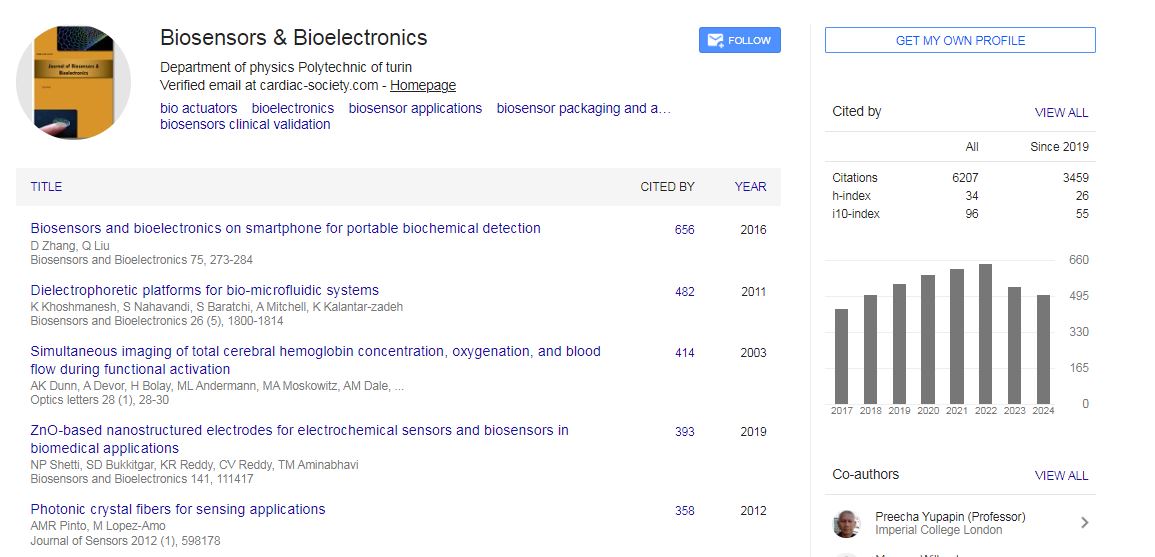
Biosensors & Bioelectronics received 6207 citations as per Google Scholar report