Opinion - (2025) Volume 16, Issue 5
Received: 01-Oct-2025, Manuscript No. jbsbe-26-183318;
Editor assigned: 03-Oct-2025, Pre QC No. P-183318;
Reviewed: 17-Oct-2025, QC No. Q-183318;
Revised: 22-Oct-2025, Manuscript No. R-183318;
Published:
29-Oct-2025
, DOI: 10.37421/2165-6210.2025.16.524
Citation: Ferrer, Isabel. ”Biosensors Revolutionize Cellular Metabolism: Real-Time Insights.” J Biosens Bioelectron 16 (2025):524.
Copyright: © 2025 Ferrer I. This is an open-access article distributed under the terms of the Creative Commons Attribution License, which permits unrestricted use, distribution and reproduction in any medium, provided the original author and source are credited.
The field of biosensor technology has witnessed remarkable advancements, particularly in the realm of real-time monitoring of cellular metabolism. These sophisticated devices offer unprecedented precision in tracking key metabolic parameters such as glucose, lactate, and oxygen levels. This capability provides invaluable insights into cellular function, disease states, and the complex responses of cells to various therapeutic interventions. The integration of microfluidic systems with advanced detection methodologies is paramount for developing miniaturized, high-throughput analytical platforms that are essential for diverse biological and biomedical applications [1].
Electrochemical biosensors represent a significant segment of this technological evolution, demonstrating great promise in the analysis of metabolites crucial for cellular energy production. Researchers have focused on the development of novel electrode materials and innovative immobilization strategies to enhance the sensitivity and selectivity of these sensors. Such advancements are vital for accurately detecting analytes like ATP and pyruvate, which play critical roles in understanding metabolic flux and identifying disruptions associated with diseases like cancer and neurodegenerative disorders [2].
Optical biosensors, especially those employing fluorescence-based detection, are increasingly utilized for monitoring intracellular metabolic dynamics. These systems often incorporate novel fluorescent probes designed to report on the concentrations of reactive oxygen species (ROS) and cellular redox states within living cells. These techniques offer a dynamic perspective on metabolic activity and stress responses, making them indispensable tools for research in areas such as aging and toxicology [3].
The synergy between microfluidics and biosensor technology has led to the development of powerful platforms for high-throughput screening of cellular metabolism. These integrated systems are capable of simultaneously measuring multiple metabolic markers in small-volume cell cultures, thereby accelerating processes like drug discovery and toxicity testing. The optimization of reagent consumption and the enhancement of detection limits afforded by microfluidic designs make these platforms highly suitable for personalized medicine initiatives [4].
In parallel, the development of wearable biosensors for continuous, non-invasive monitoring of metabolic biomarkers in biofluids is gaining momentum. These devices often feature flexible electrodes and integrated microelectronics, enabling the real-time tracking of analytes such as glucose and lactate in sweat. This technology holds substantial promise for the management of chronic diseases and the optimization of athletic performance through precise physiological monitoring [5].
Surface plasmon resonance (SPR) biosensors offer a unique capability for label-free detection of metabolic enzymes and their substrates. These sensors are adept at providing real-time kinetic data for metabolic reactions, thereby facilitating a deeper understanding of enzyme mechanisms and enabling efficient inhibitor screening. This functionality is of particular importance for the advancement of targeted metabolic therapies [6].
Cell-based biosensors, utilizing genetically engineered reporter cells, present another innovative approach to real-time metabolic profiling. These biosensors are designed to respond to specific metabolic cues by modulating luminescence or fluorescence, offering a comprehensive view of cellular metabolic health and responses to environmental stimuli. This method is proving valuable for personalized drug efficacy testing and environmental monitoring applications [7].
The growing complexity of cellular metabolism necessitates the development of multiplexed biosensors capable of simultaneously monitoring multiple metabolic pathways. The integration of diverse sensing modalities onto a single platform is crucial for capturing the intricate nature of cellular metabolic networks. Emerging trends in this area include the application of AI-driven data analysis and the utilization of nanomaterials to enhance sensor performance and overall capabilities [8].
Enzymatic biosensors have been instrumental in the precise quantification of key metabolites within metabolic pathways, such as those in the Krebs cycle, including citrate and succinate. The rational design of enzyme immobilization techniques on electrode surfaces is critical for achieving high stability and operational longevity, which are essential requirements for long-term metabolic studies in various experimental settings [9].
Furthermore, the integration of aptamers as biorecognition elements in biosensors is revolutionizing metabolic monitoring. Aptamer-based biosensors offer significant advantages in terms of stability and ease of modification when compared to traditional antibody-based systems. Their utility in detecting metabolites like glucose and lactate with high specificity and sensitivity is paving the way for advanced point-of-care diagnostics [10].
Biosensor technology has significantly advanced the capabilities for real-time monitoring of cellular metabolism, enabling precise tracking of critical parameters like glucose, lactate, and oxygen. This meticulous observation provides profound insights into cellular processes, disease progression, and drug efficacy. The integration of microfluidics with advanced detection methods is crucial for the development of compact, high-throughput analytical systems applicable to a wide array of biological and biomedical research [1].
Electrochemical biosensors are at the forefront of analyzing metabolites essential for cellular energy production. Ongoing research focuses on developing novel electrode materials and sophisticated immobilization techniques to boost sensitivity and selectivity. This is particularly important for the detection of analytes such as ATP and pyruvate, which are key indicators of metabolic flux and metabolic disruptions in diseases like cancer and neurodegenerative conditions [2].
Optical biosensors, particularly fluorescence-based systems, are increasingly employed for real-time intracellular metabolic monitoring. These systems utilize innovative fluorescent probes that can dynamically report on the concentrations of reactive oxygen species (ROS) and the cellular redox state. Such methods provide a dynamic understanding of metabolic activity and stress responses, vital for studies in aging and toxicology [3].
The fusion of microfluidic devices with biosensor technology has yielded powerful platforms for high-throughput cellular metabolism analysis. These integrated platforms can simultaneously measure numerous metabolic markers from minimal cell cultures, significantly accelerating drug discovery and toxicity assessments. The microfluidic architecture optimizes reagent use and enhances detection limits, making them ideal for personalized medicine applications [4].
Wearable biosensors are emerging as a critical technology for continuous, non-invasive monitoring of metabolic biomarkers in bodily fluids. Advancements in flexible electrodes and integrated microelectronics allow for real-time tracking of analytes like glucose and lactate in sweat. This technology promises significant improvements in managing chronic diseases and optimizing athletic performance through consistent physiological data [5].
Surface plasmon resonance (SPR) biosensors are being utilized for label-free detection of metabolic enzymes and their associated substrates. The real-time kinetic data provided by SPR is instrumental in understanding enzyme mechanisms and conducting inhibitor screening. This capability is highly relevant for the development of targeted metabolic therapies [6].
Cell-based biosensors, which employ genetically engineered reporter cells, offer a unique approach to dynamic metabolic profiling. These biosensors respond to specific metabolic signals by altering their luminescent or fluorescent output, providing a holistic view of cellular metabolic health and responses to environmental changes. This technology is valuable for personalized drug testing and environmental monitoring [7].
The drive towards comprehensive cellular metabolism monitoring has led to the development of multiplexed biosensors capable of simultaneous analysis of multiple metabolic pathways. Integrating various sensing modalities onto a single platform is key to capturing the intricate nature of cellular metabolism. Emerging trends include AI-driven data analysis and the use of nanomaterials to enhance performance [8].
Enzymatic biosensors are crucial for quantifying metabolites within pathways like the Krebs cycle, including citrate and succinate. The rational design of enzyme immobilization on electrode surfaces is critical for ensuring high stability and long operational lifetimes, essential for sustained metabolic studies in bioreactors and cell cultures [9].
Aptamer-based biosensors are gaining traction for metabolic monitoring due to their stability and ease of modification. These aptasensors demonstrate high specificity and sensitivity in detecting metabolites such as glucose and lactate, paving the way for advanced point-of-care diagnostic solutions [10].
Biosensors are revolutionizing cellular metabolism monitoring by offering real-time insights into critical metabolic parameters. Electrochemical, optical, and cell-based biosensors provide diverse methods for tracking metabolites, intracellular dynamics, and enzyme activity. Microfluidic integration enhances throughput and efficiency, while wearable biosensors enable continuous, non-invasive monitoring. Advances in SPR and aptamer technology offer label-free and highly specific detection. These developments are crucial for understanding diseases, accelerating drug discovery, and advancing personalized medicine.
None
None
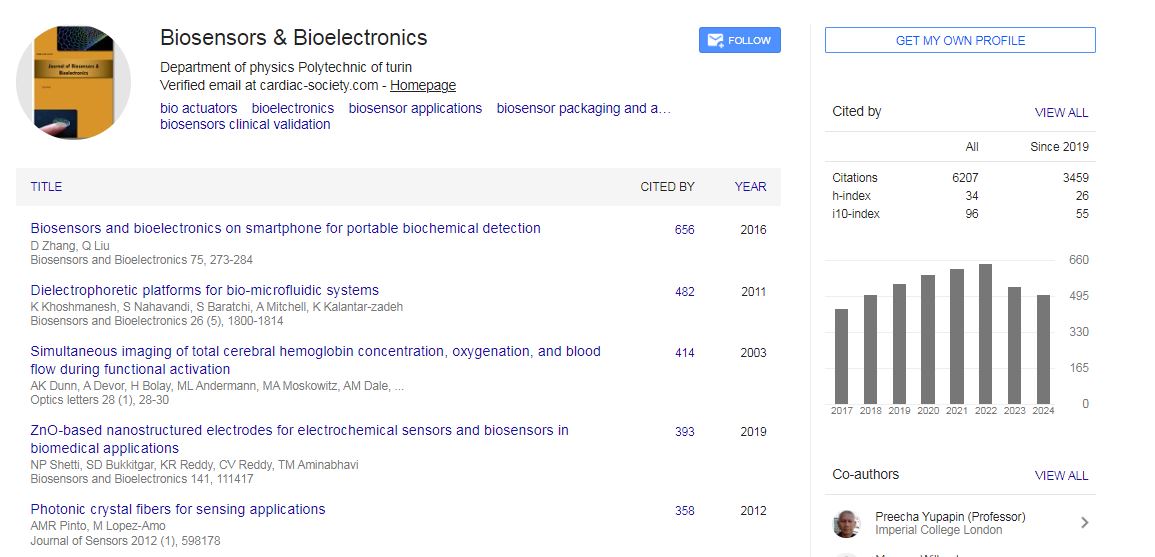
Biosensors & Bioelectronics received 6207 citations as per Google Scholar report