Perspective - (2025) Volume 9, Issue 6
Received: 01-Nov-2025, Manuscript No. fsb-26-189981;
Editor assigned: 03-Nov-2025, Pre QC No. P-189981;
Reviewed: 17-Nov-2025, QC No. Q-189981;
Revised: 24-Nov-2025, Manuscript No. R-189981;
Published:
29-Nov-2025
, DOI: 10.37421/2577-0543.2025.9.267
Citation: Johnson, Emily. ”Bioequivalence Studies: Ensuring Drug Efficacy, Safety, and Access.” J. Formul. Sci. Bioavailability 09 (2025):267.
Copyright: © 2025 Johnson E. This is an open-access article distributed under the terms of the Creative Commons Attribution License, which permits unrestricted use, distribution and reproduction in any medium, provided the original author and source are credited.
Bioavailability and bioequivalence studies are of paramount importance in the drug development process, ensuring that a drug product effectively delivers its active pharmaceutical ingredient (API) to the systemic circulation at a rate and extent comparable to a reference product. This directly influences therapeutic efficacy and safety, playing a crucial role in guiding regulatory decisions for both drug approval and post-marketing surveillance. Understanding these fundamental parameters is vital for both innovator and generic drug manufacturers, as it facilitates the development of high-quality medicines and ultimately protects public health by ensuring therapeutic interchangeability of drug products [1].
The design and subsequent interpretation of bioequivalence studies necessitate a meticulous consideration of various critical factors, including the potential impact of food on drug absorption, the inherent variability within different patient populations, and the judicious selection of appropriate analytical methods for drug quantification. Furthermore, advanced statistical approaches, such as those that incorporate Bayesian methodologies, are increasingly being explored and adopted to enhance the sensitivity and overall efficiency of these studies. This is particularly relevant for drugs that possess narrow therapeutic indices or exhibit complex pharmacokinetic profiles, where precise assessment is paramount. Ensuring robust study designs is fundamental to minimizing the risk of erroneous conclusions regarding the performance and comparability of drug products [2].
Another critical area of research within pharmaceutical development focuses on the significant influence that formulation excipients can exert on a drug's bioavailability. These inactive ingredients are not merely fillers; they can substantially alter key processes such as drug dissolution rates, absorption efficiency, and metabolic pathways. Consequently, modern formulation strategies are increasingly directed towards optimizing bioavailability. This is achieved through the implementation of sophisticated techniques like solid dispersions, the creation of nanocrystals, and the utilization of liposomes, especially for drugs that present challenges due to poor solubility. A deep understanding of these intricate formulation-effect relationships is therefore key to the successful development of effective, stable, and bioavailable drug products [3].
It is important to recognize that the scope of bioequivalence studies extends well beyond traditional oral dosage forms, encompassing a diverse range of administration routes including parenteral (injectable), topical, and inhaled products. Each of these distinct routes of administration presents its own unique set of challenges and necessitates the development of carefully tailored study designs. For instance, evaluating the bioavailability of inhaled drugs requires specific methodologies, such as measuring systemic absorption alongside local effects within the lungs, which in turn demands the application of specialized pharmacokinetic models and sophisticated analytical techniques. Ensuring bioequivalence across such a wide array of diverse delivery systems is absolutely vital for achieving favorable patient outcomes and maintaining therapeutic consistency [4].
The intricate relationship between pharmacokinetics (PK) and pharmacodynamics (PD) is intrinsically intertwined with the concepts of bioavailability and bioequivalence. Pharmacokinetics precisely describes what the body does to the drugâ??encompassing its absorption, distribution, metabolism, and excretionâ??which are the direct parameters measured in bioavailability studies. Pharmacodynamics, on the other hand, describes what the drug does to the body, referring to its observed effect. The integration of PK/PD modeling offers a more comprehensive understanding of a drug's overall performance, effectively linking drug exposure levels to the resulting physiological response. This integrated approach is invaluable in establishing clinically relevant endpoints for bioequivalence assessments [5].
Regulatory agencies across the globe, including prominent bodies like the U.S. Food and Drug Administration (FDA) and the European Medicines Agency (EMA), place significant reliance on comprehensive bioavailability and bioequivalence data when making decisions regarding drug approval. In recognition of the need for global consistency, harmonization efforts led by the International Council for Harmonisation of Technical Requirements for Pharmaceuticals for Human Use (ICH) are actively working to standardize guidelines for these crucial studies. This standardization promotes broader accessibility to safe and effective medicines worldwide. Strict adherence to these established guidelines is essential for ensuring consistent product quality and facilitating smooth international trade of pharmaceutical products [6].
The fundamental clinical relevance of bioequivalence is rooted in its capacity to reliably predict therapeutic equivalence between different drug products. While achieving statistical bioequivalence does not automatically guarantee absolute clinical equivalence in all scenarios, well-designed and robust bioequivalence studies, particularly those that incorporate in vitro-in vivo correlations (IVIVC), provide strong evidence. This evidence indicates that a generic drug product is likely to perform identically to its reference counterpart within patients. This assurance is absolutely fundamental for maintaining patient safety and enabling successful therapeutic substitution with generic alternatives [7].
Variability is an inherent aspect of drug bioavailability and bioequivalence, and it can originate from a multitude of sources. These include patient-specific factors such as genetic makeup and disease states, drug-related factors like formulation characteristics and dissolution profiles, and external environmental factors such as dietary intake and the use of concomitant medications. A thorough understanding and proactive mitigation of this inherent variability, achieved through meticulously planned study designs and appropriate statistical analyses, are crucial. This ensures consistent and predictable drug performance across diverse patient populations and varied clinical settings [8].
The continuous emergence of novel drug delivery systems, such as advanced long-acting injectable formulations and complex biological therapeutics, inherently necessitates the evolution and adaptation of bioequivalence assessment strategies. Traditional metrics and methodologies may prove insufficient for accurately evaluating these cutting-edge formulations. Consequently, the development of innovative bioanalytical methods and sophisticated study designs capable of precisely capturing the unique pharmacokinetic and pharmacodynamic profiles of these advanced products represents an ongoing challenge. This area of research is critically important for ensuring the efficacy and safety of next-generation medicines [9].
Ultimately, the rigorous development and approval process for generic drugs depend fundamentally on demonstrating bioequivalence. This demonstration serves as the cornerstone to ensure that patients receive the same therapeutic benefit from a generic medication as they would from the originator's reference listed drug. This entire process is indispensable for fostering healthy competition within the pharmaceutical market, significantly reducing overall healthcare costs, and expanding patient access to essential, affordable medications. The meticulous execution and thorough evaluation of bioequivalence studies are therefore indispensable pillars supporting both the pharmaceutical industry and the broader goals of public health [10].
Ensuring that drug products deliver their active pharmaceutical ingredient (API) to the systemic circulation at a rate and extent comparable to a reference product is the core principle of bioavailability and bioequivalence studies, which are critical in drug development. These studies directly impact therapeutic efficacy and safety, thereby guiding regulatory decisions for drug approval and subsequent post-marketing surveillance. For both innovator and generic drug manufacturers, a deep understanding of these parameters is essential for producing high-quality medicines and safeguarding public health through the assurance of therapeutic interchangeability [1].
A comprehensive approach to the design and interpretation of bioequivalence studies requires careful consideration of a multitude of factors. These include potential food effects on drug absorption, variability within different patient populations, and the selection of precise analytical methods. The field is also seeing an increasing exploration of advanced statistical techniques, such as Bayesian methods, aimed at improving the sensitivity and efficiency of these studies, particularly for drugs with narrow therapeutic indices or complex pharmacokinetic characteristics. Robust study designs are key to preventing erroneous conclusions about drug product performance [2].
The impact of formulation excipients on a drug's bioavailability is a significant area of pharmaceutical research. These inactive ingredients can profoundly influence drug dissolution, absorption, and metabolism. Current formulation strategies focus on enhancing bioavailability using techniques like solid dispersions, nanocrystals, and liposomes, especially for poorly soluble drugs. A thorough understanding of how excipients affect drug performance is crucial for developing effective and stable drug products [3].
Bioequivalence assessments are not limited to oral dosage forms but extend to parenteral, topical, and inhaled products, each presenting unique challenges. For inhaled drugs, for instance, bioavailability is evaluated by measuring systemic absorption and local lung effects, necessitating specialized pharmacokinetic models and analytical techniques. Ensuring bioequivalence across these diverse delivery systems is vital for patient outcomes [4].
Pharmacokinetics (PK) and pharmacodynamics (PD) play interconnected roles in bioavailability and bioequivalence. PK describes the body's handling of the drug (absorption, distribution, metabolism, excretion), directly measured in bioavailability studies, while PD describes the drug's effect on the body. Integrating PK/PD modeling provides a more holistic understanding of drug performance, linking exposure to response and aiding in the establishment of clinically meaningful endpoints for bioequivalence [5].
Global regulatory bodies like the FDA and EMA rely heavily on bioavailability and bioequivalence data for drug approval. Harmonization efforts by the ICH aim to standardize guidelines for these studies, promoting worldwide access to safe and effective medicines and ensuring consistent product quality for international trade [6].
The clinical significance of bioequivalence is its ability to predict therapeutic equivalence. While statistical bioequivalence doesn't always guarantee clinical equivalence, robust studies, especially those using in vitro-in vivo correlations (IVIVC), strongly suggest similar performance of generic and reference products in patients, which is fundamental for safety and substitution [7].
Variability in drug bioavailability and bioequivalence can stem from patient factors (genetics, disease), drug factors (formulation, dissolution), and environmental factors (food, medications). Understanding and managing this variability through appropriate study design and statistical analysis is crucial for ensuring consistent drug performance across diverse patient populations and clinical settings [8].
The evolution of new drug delivery systems, such as long-acting injectables and biologics, demands updated bioequivalence assessment strategies. Traditional metrics may be insufficient, making the development of novel bioanalytical methods and study designs to capture unique pharmacokinetic and pharmacodynamic profiles a critical ongoing research area [9].
The successful development and market entry of generic drugs hinge on demonstrating bioequivalence, ensuring equivalent therapeutic benefit to the reference product. This process is essential for fostering competition, reducing healthcare costs, and improving patient access to affordable medicines, underscoring the indispensable nature of bioequivalence studies for the pharmaceutical industry and public health [10].
Bioavailability and bioequivalence studies are critical for ensuring drug efficacy and safety, guiding regulatory approvals and post-marketing surveillance. These studies are vital for both innovator and generic drug manufacturers. Key considerations in bioequivalence include food effects, population variability, and analytical methods, with advanced statistical approaches gaining prominence. Formulation excipients significantly impact bioavailability, necessitating optimization strategies for poorly soluble drugs. Bioequivalence assessments extend to various dosage forms beyond oral, each requiring tailored study designs. The integration of pharmacokinetic and pharmacodynamic principles enhances the understanding of drug performance and the establishment of relevant endpoints. Global regulatory agencies rely on this data, with harmonization efforts promoting consistency. Bioequivalence predicts therapeutic equivalence, ensuring patient safety and enabling generic drug substitution. Managing variability from patient, drug, and environmental factors through robust study designs is crucial. The development of novel bioequivalence assessment strategies is ongoing for advanced drug delivery systems. Ultimately, demonstrating bioequivalence is fundamental for the development and accessibility of generic medicines, promoting competition and reducing healthcare costs.
None
None
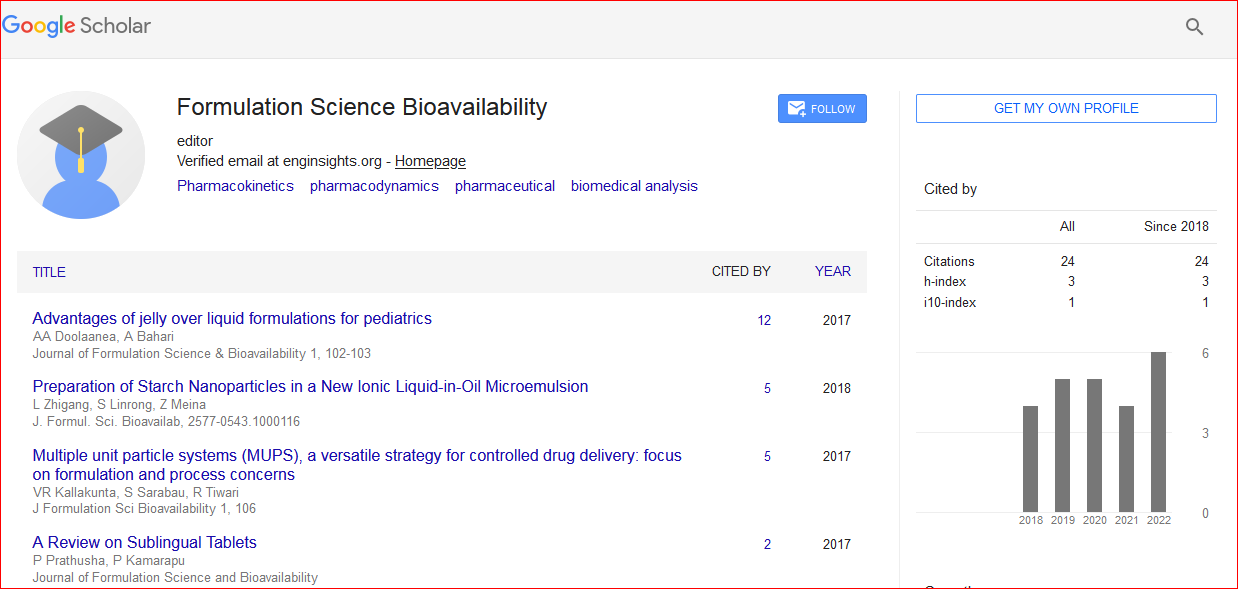
Journal of Formulation Science & Bioavailability received 23 citations as per Google Scholar report