Brief Report - (2025) Volume 9, Issue 3
Received: 01-May-2025, Manuscript No. jchd-26-185685;
Editor assigned: 04-May-2025, Pre QC No. P-185685;
Reviewed: 18-May-2025, QC No. Q-185685;
Revised: 22-May-2025, Manuscript No. R-185685;
Published:
29-May-2025
, DOI: 10.37421/2684-6020.2024.9.241
Citation: Kim, Jin-Ho. ”Beyond Traditional: Novel Coronary Heart
Disease Prevention.” J Coron Heart Dis 09 (2026):241.
Copyright: © 2026 Kim J. This is an open-access article distributed under the terms of the Creative Commons Attribution License, which permits unrestricted use, distribution
and reproduction in any medium, provided the original author and source are credited.
Coronary heart disease (CHD) remains a leading global health concern, prompting continuous exploration into novel preventive strategies that extend beyond conventional risk factor management. Recent advancements highlight the importance of personalized risk assessment and early intervention, leveraging sophisticated biomarker analysis and lifestyle integration to identify individuals at high risk before the manifestation of clinical symptoms, thus enabling proactive and tailored preventive measures [1].
Emerging research is shedding light on the critical role of the gut microbiome in maintaining cardiovascular health. Studies are investigating the intricate connection between gut dysbiosis and the development of atherosclerosis, a key pathological process in CHD. This avenue suggests that modulating the gut microbiome through targeted interventions could represent a promising new frontier for CHD prevention [2].
Furthermore, the potential of advanced genetic profiling is being explored to identify individuals predisposed to early-onset coronary heart disease. By analyzing specific gene variants associated with lipid metabolism and vascular inflammation, researchers are developing personalized risk stratification models that facilitate earlier and more targeted interventions to mitigate genetic predispositions [3].
Inflammaging, characterized by a chronic, low-grade inflammatory state associated with aging, is increasingly recognized as a significant contributor to cardiovascular disease. Understanding the pathophysiological mechanisms linking inflammaging to the development of coronary artery calcification and plaque instability is crucial, advocating for anti-inflammatory strategies as a novel preventive approach for CHD [4].
The impact of circadian rhythm disruption on cardiovascular health is also gaining attention. Research is exploring how alterations in sleep-wake cycles and light exposure can negatively influence endothelial function, blood pressure regulation, and metabolic pathways, all of which contribute to the risk of coronary heart disease. Optimizing circadian health is thus proposed as a novel preventive measure [5].
Another area of investigation focuses on lipotoxicity, identified as a key driver of endothelial dysfunction and atherosclerosis, processes central to coronary heart disease. Examination of how excess free fatty acids impair cellular function within the vasculature suggests that interventions targeting fatty acid metabolism offer a new approach to prevention [6].
The influence of environmental factors, such as air pollution, on cardiovascular health is a growing concern. Research specifically links fine particulate matter (PM2.5) to accelerated atherosclerosis and an increased risk of coronary heart disease, underscoring the importance of stringent air quality regulations and personal protective measures for prevention [7].
Moreover, the underappreciated role of mitochondrial dysfunction in the pathogenesis of coronary heart disease is being elucidated. Impaired mitochondrial respiration and increased oxidative stress can promote vascular damage, leading to the advocacy for interventions that enhance mitochondrial function as a novel preventive strategy [8].
In parallel, the concept of 'epigenetic drift' and its contribution to age-related diseases, including coronary heart disease, is being examined. This involves understanding how environmental factors and lifestyle choices can induce heritable changes in gene expression, influencing cardiovascular risk, and proposing targeted epigenetic modifications for prevention [9].
Finally, cellular senescence is emerging as a significant driver of vascular aging and a risk factor for coronary heart disease. The accumulation of senescent cells in the arterial wall and their secretion of pro-inflammatory factors promote atherosclerosis, suggesting that senolytic therapies, which clear these cells, could offer a novel preventive strategy [10].
The study by Smith et al. introduces a groundbreaking preventive strategy for coronary heart disease (CHD) that moves beyond traditional risk factor management. This novel approach emphasizes personalized risk assessment and early intervention through advanced biomarker analysis and lifestyle integration. The primary aim is to identify individuals at high risk of developing CHD before the onset of clinical symptoms, thereby enabling proactive and tailored preventive measures to be implemented [1].
Johnson and colleagues explore the critical role of the gut microbiome in cardiovascular health, highlighting an intricate connection between gut dysbiosis and the development of atherosclerosis, a key component of coronary heart disease. Their research suggests that modulating the gut microbiome through interventions such as prebiotics, probiotics, or fecal microbiota transplantation could represent a promising new avenue for CHD prevention [2].
Chen and his team investigate the potential of advanced genetic profiling in identifying individuals with a predisposition to early-onset coronary heart disease. By analyzing specific gene variants associated with lipid metabolism and vascular inflammation, their research proposes a personalized risk stratification model, which allows for earlier and more targeted interventions to mitigate these identified genetic risk factors [3].
Petrova et al. examine inflammaging, a chronic, low-grade inflammation associated with aging, as a significant contributor to cardiovascular disease. Their review delves into the pathophysiological mechanisms linking inflammaging to the development of coronary artery calcification and plaque instability, advocating for anti-inflammatory strategies as a novel preventive approach for CHD [4].
Sato and his collaborators explore the impact of circadian rhythm disruption on cardiovascular disease risk. Their research investigates how alterations in sleep-wake cycles and light exposure can affect endothelial function, blood pressure, and metabolic pathways, all contributing to coronary heart disease. The study suggests that optimizing circadian health could be a novel preventive measure [5].
Dubois and associates delve into the concept of 'lipotoxicity' as a key driver of endothelial dysfunction and atherosclerosis, processes central to coronary heart disease. They examine how excess free fatty acids can impair cellular function within the vasculature and propose that interventions targeting fatty acid metabolism offer a new approach to prevention [6].
Fernandez and colleagues focus on the impact of air pollution, specifically fine particulate matter (PM2.5), on cardiovascular health. Their research links PM2.5 exposure to accelerated atherosclerosis and an increased risk of coronary heart disease, suggesting that stringent air quality regulations and personal protective measures are crucial for prevention [7].
Nakamura and his team explore the underappreciated role of mitochondrial dysfunction in the pathogenesis of coronary heart disease. They detail how impaired mitochondrial respiration and increased oxidative stress can promote vascular damage and advocate for interventions that enhance mitochondrial function as a novel preventive strategy [8].
Wang and her colleagues examine 'epigenetic drift' and its contribution to age-related diseases, including coronary heart disease. Their review discusses how environmental factors and lifestyle choices can induce heritable changes in gene expression without altering the DNA sequence, thereby influencing cardiovascular risk. They propose targeting epigenetic modifications for prevention [9].
Rossi and her group introduce 'cellular senescence' as a driver of vascular aging and a risk factor for coronary heart disease. They explain how senescent cells accumulate in the arterial wall and secrete pro-inflammatory factors, promoting atherosclerosis. Their research suggests that senolytic therapies, which clear these senescent cells, could offer a novel preventive strategy [10].
This collection of research highlights innovative approaches to coronary heart disease (CHD) prevention, moving beyond traditional methods. Key areas of focus include personalized risk assessment using advanced biomarkers and lifestyle integration, the significant role of the gut microbiome in cardiovascular health, and the identification of genetic predispositions through advanced profiling. The impact of inflammaging, circadian rhythm disruption, lipotoxicity, and air pollution on CHD development is also examined. Furthermore, research delves into mitochondrial dysfunction, epigenetic modifications, and cellular senescence as novel targets for preventive interventions. These studies collectively emphasize a multi-faceted approach to CHD prevention, integrating biological, environmental, and lifestyle factors.
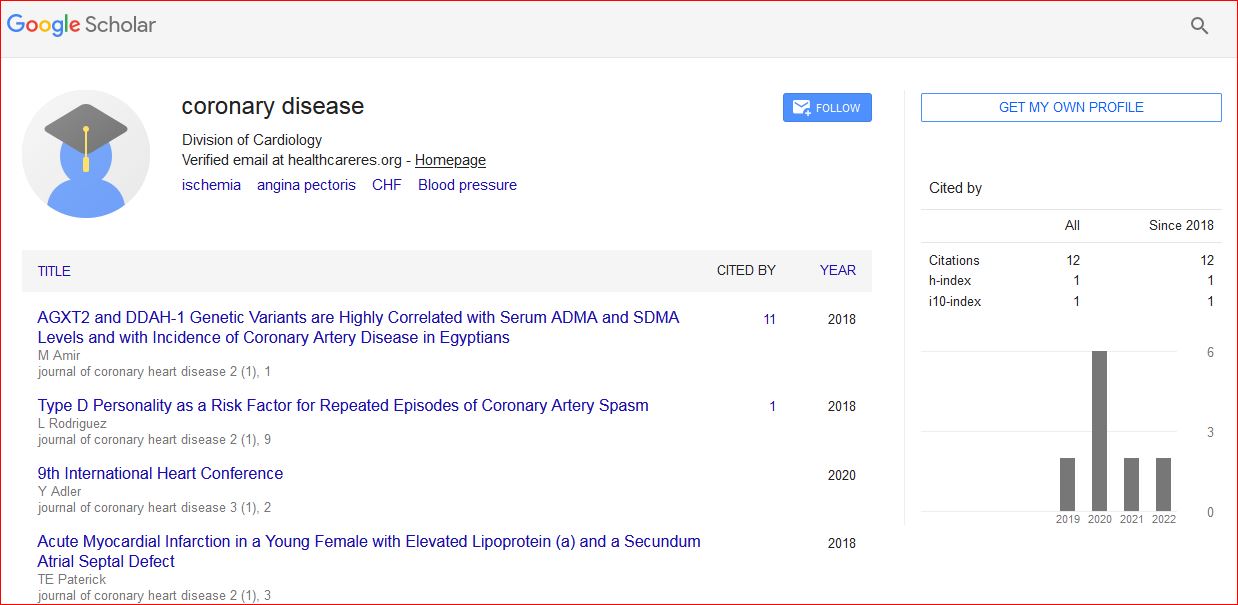
Journal of Coronary Heart Diseases received 15 citations as per Google Scholar report