Opinion - (2025) Volume 10, Issue 3
Received: 01-Jun-2025, Manuscript No. jidm-26-188064;
Editor assigned: 03-Jun-2025, Pre QC No. P-188064;
Reviewed: 17-Jun-2025, QC No. Q-188064;
Revised: 23-Jun-2025, Manuscript No. R-188064;
Published:
30-Jun-2025
, DOI: 10.37421/2576-1420.2025.10.402
Citation: Clark, Gregory. ”Antiviral Therapies: Innovation, Targeting,
and Control.” J Infect Dis Med 10 (2025):402.
Copyright: © 2025 Clark G. This is an open-access article distributed under the terms of the Creative Commons Attribution License, which permits unrestricted use, distribution
and reproduction in any medium, provided the original author and source are credited.
Recent advancements in antiviral therapies are revolutionizing the management of infectious diseases, heralding a new era in combating viral pathogens. Novel drug classes are being developed that target critical stages of the viral life cycle, including entry into host cells, replication within the host, and the assembly of new viral particles, all of which are showing significant promise in preclinical and clinical studies [1].
The development of broadly neutralizing antibodies (bNAbs) represents a significant leap forward in combating viral infections, particularly for challenging pathogens like HIV. These antibodies possess the remarkable ability to neutralize a wide spectrum of viral strains by targeting highly conserved regions of the virus, offering new hope for both disease prevention and treatment [2].
Repurposing existing antiviral drugs has proven to be an exceptionally effective strategy, especially in the context of emerging pandemics. This approach accelerates the drug development timeline considerably by leveraging compounds that have already undergone rigorous safety and preliminary efficacy testing, making them readily available for new indications [3].
The advent of small interfering RNA (siRNA) and other RNA interference (RNAi) therapeutics offers a highly precise method for targeting viral RNA, thereby inhibiting viral replication. This advanced technology allows for sequence-specific knockdown of viral genes, providing a potent and targeted antiviral effect, though challenges in delivery and potential off-target effects are still being addressed [4].
Host-directed antiviral therapies are emerging as a promising avenue, aiming to bolster the host's intrinsic immune response or interfere with host factors that are essential for viral replication, rather than directly targeting the virus itself. This strategic approach can effectively overcome issues of viral resistance, which is particularly relevant for viruses that exhibit high mutation rates [5].
The integration of artificial intelligence (AI) and machine learning (ML) is significantly accelerating the discovery and optimization of antiviral compounds. These powerful computational tools are capable of analyzing vast datasets to predict drug efficacy, identify novel therapeutic targets, and even design new molecular structures, thereby considerably shortening the drug development cycle [6].
CRISPR-based gene editing technology holds immense potential for treating chronic viral infections by directly targeting and excising viral genomes that have become integrated into the host DNA. While still in the early stages of development, this revolutionary technology offers the compelling possibility of achieving a permanent cure for infections such as HIV and HPV [7].
The development of effective treatments for emerging coronaviruses has been substantially informed by prior experiences with outbreaks like SARS and MERS. Current research is strategically focusing on novel inhibitors of viral proteases and polymerases, as well as host-targeted interventions designed to mitigate hyperinflammation and reduce lung damage [8].
Understanding the complex processes of viral evolution and the subsequent emergence of drug resistance is absolutely critical for ensuring the sustained effectiveness of antiviral therapies over time. Pharmacokinetic/pharmacodynamic (PK/PD) modeling and robust resistance surveillance are indispensable tools for optimizing current treatment regimens and for guiding the development of next-generation antivirals [9].
The development of effective vaccines in conjunction with antiviral therapies offers a powerful dual-pronged approach to the control of infectious diseases. While vaccines are primarily designed to provide prophylaxis, antiviral medications are crucial for the treatment of active infections, especially in cases of vaccine breakthrough or for diseases where effective vaccines are not yet available. The synergistic interplay between these distinct modalities is key to achieving the eradication and effective control of infectious diseases globally [10].
The landscape of infectious disease management is undergoing a profound transformation due to recent advancements in antiviral therapies, which are revolutionizing how we approach and treat viral infections. A key area of progress involves the development of novel drug classes specifically designed to target critical stages of the viral life cycle. These therapies are engineered to interfere with viral entry into host cells, inhibit viral replication processes, and disrupt the assembly of new viral particles, with many of these approaches demonstrating considerable promise in both laboratory settings and early-stage clinical trials [1].
A significant breakthrough in the fight against viral infections, particularly for difficult-to-treat pathogens like HIV, is the development of broadly neutralizing antibodies (bNAbs). These unique antibodies have the capacity to neutralize a wide array of viral strains by binding to conserved regions of the virus that are less prone to mutation. Their potential applications span both therapeutic interventions for existing infections and prophylactic strategies for disease prevention, offering a renewed sense of hope [2].
An effective strategy that has gained prominence, especially during emergent pandemics, is the repurposing of existing antiviral drugs. This method significantly expedites the drug development process by utilizing compounds that have already passed initial safety evaluations and demonstrated some level of efficacy. Identifying new therapeutic uses for established antivirals necessitates a thorough understanding of their underlying mechanisms of action and the specific host-pathogen pathways involved in disease progression [3].
The introduction of small interfering RNA (siRNA) and other RNA interference (RNAi) therapeutics provides a highly precise mechanism for targeting viral RNA, effectively halting viral replication. This technology enables sequence-specific silencing of viral genes, leading to a potent antiviral response. While challenges related to efficient delivery and the possibility of unintended off-target effects are still being actively researched, considerable progress is being made towards their clinical implementation [4].
Host-directed antiviral therapies represent a compelling approach that focuses on strengthening the host's own immune defenses or disrupting host cellular factors that are indispensable for viral replication, rather than directly attacking the virus. This strategy is particularly valuable for overcoming the development of viral resistance and is highly relevant for viruses that tend to mutate rapidly. A primary focus of current research is the identification and validation of suitable host targets for therapeutic intervention [5].
The integration of advanced computational tools, such as artificial intelligence (AI) and machine learning (ML), is dramatically accelerating the pace of antiviral compound discovery and optimization. These sophisticated tools can sift through immense volumes of data to predict the potential efficacy of drug candidates, identify novel molecular targets for therapeutic intervention, and even assist in the design of new molecular structures, thereby substantially reducing the time required for drug development [6].
CRISPR-based gene editing technology presents a revolutionary potential for treating chronic viral infections by enabling the direct targeting and removal of viral genomes that have become integrated within the host cell's DNA. Although this technology is still in its nascent stages of development, it holds the promise of offering a permanent cure for persistent viral infections such as HIV and human papillomavirus (HPV) [7].
The development of successful treatments against emerging coronaviruses has been greatly enhanced by lessons learned from previous outbreaks, including SARS and MERS. Current research efforts are concentrated on identifying and developing novel inhibitors that target viral proteases and polymerases, alongside exploring host-targeted interventions to manage the severe inflammatory responses and lung damage characteristic of these infections [8].
A fundamental aspect of maintaining the long-term effectiveness of antiviral therapies is a comprehensive understanding of viral evolution and the mechanisms by which drug resistance emerges. Pharmacokinetic/pharmacodynamic (PK/PD) modeling, coupled with continuous surveillance for resistance, are essential methodologies for refining current treatment regimens and for guiding the strategic development of next-generation antiviral agents that can overcome resistance challenges [9].
The coordinated development of vaccines alongside antiviral therapies provides a powerful two-pronged strategy for controlling infectious diseases. Vaccines serve as a primary preventive measure, while antiviral drugs are indispensable for managing active infections, particularly in scenarios involving vaccine breakthrough infections or for diseases where effective vaccines are not yet available. The synergistic relationship between these complementary approaches is vital for the ultimate goal of eradicating and effectively controlling infectious diseases on a global scale [10].
Antiviral therapies are rapidly advancing, targeting viral entry, replication, and assembly with novel drug classes. Broadly neutralizing antibodies offer new hope for challenging infections like HIV. Drug repurposing accelerates the development of treatments, while RNA interference provides precise gene targeting. Host-directed therapies aim to enhance the immune response and overcome resistance, especially for rapidly mutating viruses. Artificial intelligence and machine learning are speeding up drug discovery. CRISPR-based gene editing holds potential for curative treatments by excising viral DNA. Lessons from SARS and MERS inform coronavirus treatment strategies, focusing on viral and host targets. Understanding viral evolution and resistance through PK/PD modeling and surveillance is crucial for long-term therapeutic success. The synergy between vaccines and antivirals is essential for comprehensive infectious disease control.
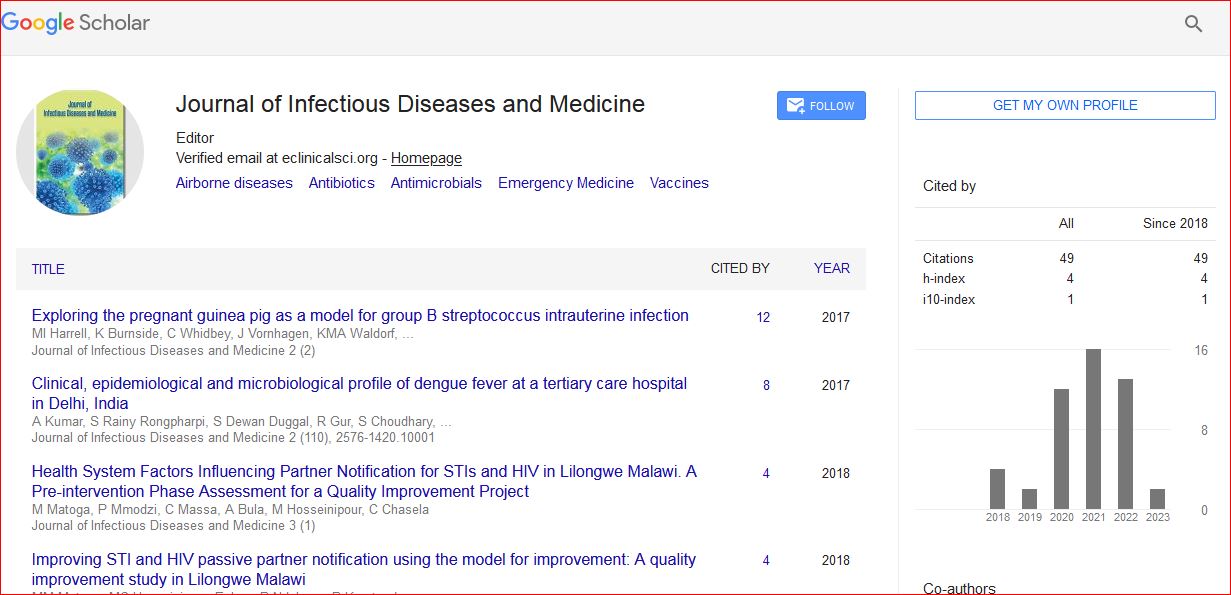
Journal of Infectious Diseases and Medicine received 1059 citations as per Google Scholar report